



Sugar-based Surfactants Market Size & Growth Forecast 2026–2035, By Segments (Raw Material, Application, Type), Regional Demand Trends (North America, Asia Pacific, Europe), Key Country Insights (U.S., Japan, South Korea, Germany, France, Italy), and Competitive Landscape
Market Size and Growth Outlook
Base Year Value (2025)
USD 6.77 Billion
CAGR (2026-2035)
5.8%
Forecast Year Value (2035)
USD 11.9 Billion

Historical Data Period
2022-2025

Largest Region
Europe

Forecast Period
2026-2035
Sugar-based Surfactants Market Intelligence Snapshot:
-
Regional Market Dynamics:
- Europe held a 34.87% market share in 2025, supported by mature manufacturing, well-developed specialty ingredient supply chains, and sustained demand for bio-based surfactant formulations.
- Asia Pacific is forecast to grow at a 6.55% CAGR as manufacturing expands and demand rises for plant-derived surfactants across household, personal care, and industrial formulations.
-
Segment Momentum:
- Homecare & Personal Care accounted for 49.61% of the market in 2025 due to high-volume demand from everyday cleaning and personal hygiene products requiring reliable surfactant performance.
- Pharmaceuticals is the fastest-growing application segment because formulation requirements increasingly prioritize specialized surfactants that deliver performance, compatibility, and controlled functional outcomes.
-
Market Expansion Drivers:
- Rising demand for renewable low-toxicity ingredients driven by personal hygiene awareness.
- Expanding personal and home care applications across detergents, skincare, and baby care products.
- Regulatory push for biodegradable surfactants accelerating green formulation shifts in chemical industry.
-
Leading Market Participants:
Top companies in the sugar-based surfactants market include BASF SE (Germany), Evonik Industries AG (Germany), Solvay S.A. (Belgium), Clariant AG (Switzerland), Croda International plc (United Kingdom), Stepan Company (United States), SEPPIC (France), Kao Corporation (Japan), Dow Inc. (United States).
Global Market Forecast Snapshot:
-
Market Outlook:
- 2025 Market Size: USD 6.77 Billion
- 2026 Market Size: USD 15.2 billion
- Projected Market Size: USD 11.9 Billion by 2035
- Growth Forecasts: 5.8% CAGR (2026-2035)
-
Regional and Segment Outlook:
- Leading Regional Market: Europe
- High-Growth Regional Hub: Asia Pacific
- Core Revenue Segment: Monomeric (Raw Material) | Homecare & Personal Care (Application) | Alkyl Polyglycoside (Type)
- Emerging Opportunity Segment: Polymeric (Raw Material) | Pharmaceuticals (Application) | Decyl Glucoside (Type)
Market Growth Drivers and Industry Trends
Rising demand for renewable low-toxicity ingredients driven by personal hygiene awarenessHeightened attention to ingredient safety in everyday cleansing and hygiene products is shifting formulation priorities toward milder, plant-derived inputs, strengthening demand for the sugar-based surfactants market. As consumers scrutinize labels for skin compatibility, low irritation potential, and renewable sourcing, brand owners in hand wash, facial cleanser, body wash, and intimate hygiene categories are reformulating away from harsher petrochemical surfactants. This purchasing behavior influences the sugar-based surfactants market in practice by increasing adoption of alkyl polyglucosides and related materials that align with both gentleness claims and naturally derived positioning, giving manufacturers a clearer route to premium product differentiation and broader retail acceptance.
Expanding personal and home care applications across detergents, skincare, and baby care products
Broader use across household cleaning and personal care categories is contributing to market size growth by widening the range of formulations that can absorb sugar-derived surfactants. In the sugar-based surfactants market, demand is not limited to niche natural cosmetics; it is being reinforced by their functional fit in laundry detergents, dishwashing liquids, baby shampoos, facial cleansers, and sensitive-skin products where mildness, foaming performance, and compatibility with other ingredients matter in day-to-day formulation decisions. As producers seek versatile surfactants that can serve multiple product lines while supporting gentler product positioning, procurement volumes rise and commercialization becomes less dependent on any single end-use segment.
Regulatory push for biodegradable surfactants accelerating green formulation shifts in chemical industry
Tighter environmental scrutiny on surfactant persistence and aquatic toxicity is prompting manufacturers to reassess legacy chemistries, aiding market expansion for biodegradable alternatives such as sugar-derived surfactants. The sugar-based surfactants market benefits when chemical producers and downstream formulators respond to compliance pressure by redesigning products around ingredients that are easier to position against evolving environmental standards and retailer sustainability requirements. This trend plays out through reformulation pipelines, supplier qualification programs, and portfolio rationalization, where biodegradable inputs gain preference because they reduce regulatory friction while helping companies align product development with broader green chemistry strategies.
| Growth Driver Assessment Framework | |||||
| Growth Driver | Impact On CAGR | Regulatory Influence | Geographic Relevance | Adoption Rate | Impact Timeline |
|---|---|---|---|---|---|
| Rising demand for renewable low-toxicity ingredients driven by personal hygiene awareness | 2.00% | Moderate | North America, Europe, Asia Pacific | High | Near Term |
| Expanding personal and home care applications across detergents, skincare, and baby care products | 1.80% | Moderate | Asia Pacific, North America, Europe | High | Near Term |
| Regulatory push for biodegradable surfactants accelerating green formulation shifts in chemical industry | 2.20% | High | Europe, North America | Medium | Mid Term |
Unlock insights tailored to your business with our bespoke market research solutions - Click to get your customized report now!
Regional Demand Dynamics
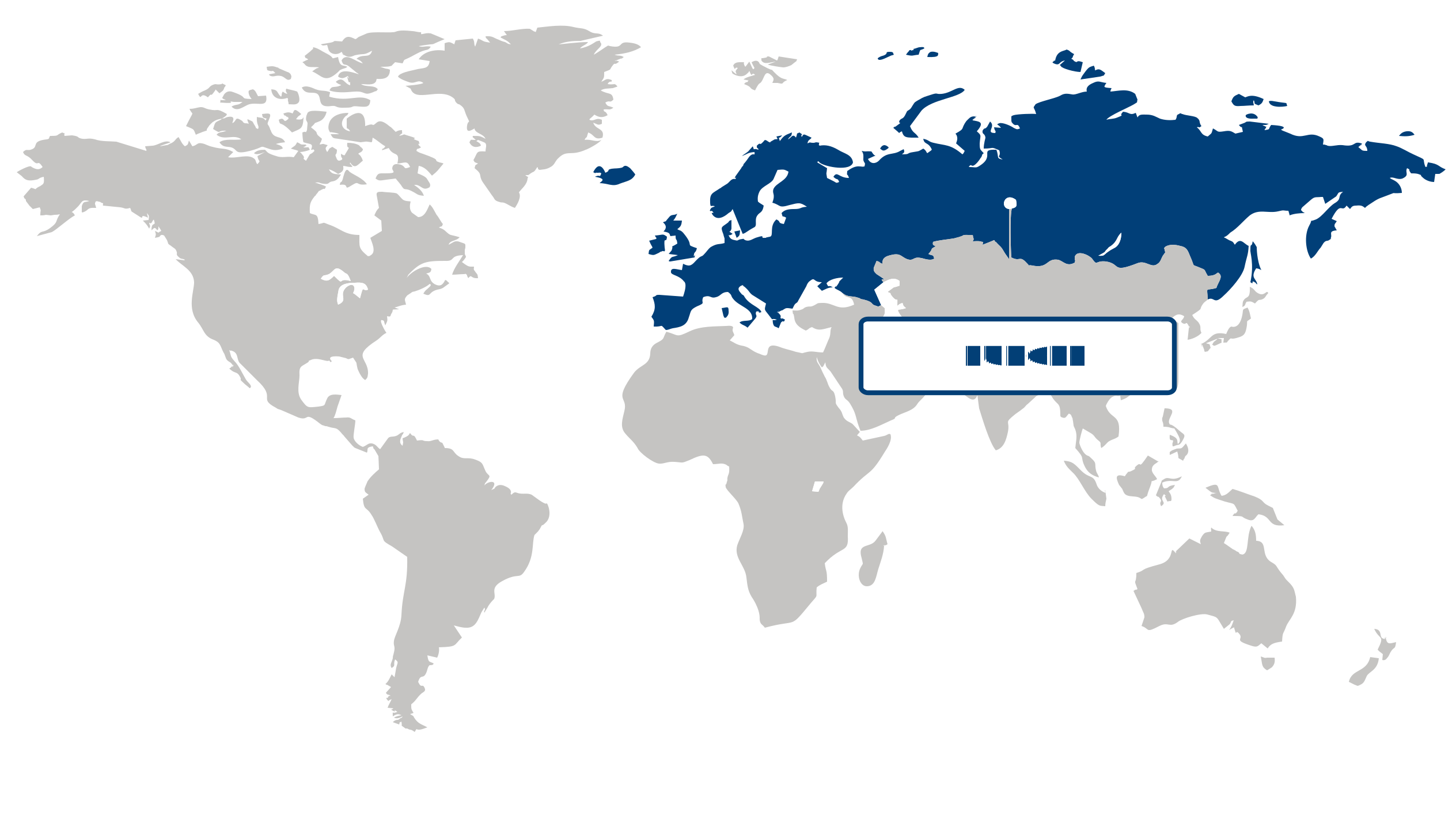
Largest Region
Europe
34.87% Market Share in 2025
Europe held a 34.87% share of the sugar-based surfactants market in 2025, backed by the region’s established base of personal care, home care, and industrial cleaning manufacturers that actively incorporate bio-based ingredients into commercial formulations. Demand is reinforced by mature product development capabilities, well-developed supply chains for specialty ingredients, and strong buyer preference for milder and more sustainable surfactant systems. In practice, this supports steady ordering from formulators seeking reliable performance, regulatory alignment, and consistent raw material quality across large-volume applications.
Asia Pacific is projected to expand at a 6.55% CAGR over the forecast period, with growth in the sugar-based surfactants market being propelled by rising manufacturing activity and increasing adoption of gentler, plant-derived ingredients across consumer and industrial applications. The region benefits from a broadening base of end-use production, where formulators are scaling output for household and personal care products while responding to shifting ingredient preferences. As local manufacturing deepens and product portfolios diversify, demand is accelerating through practical use in everyday formulations rather than remaining limited to niche sustainable product lines.
| Regional Market Attractiveness & Strategic Fit Matrix | |||||
| Parameter | North America | Asia Pacific | Europe | Latin America | MEA |
|---|---|---|---|---|---|
| Innovation Hub | Advanced | Developing | Advanced | Nascent | Nascent |
| Cost-Sensitive Region | Medium | High | Medium | High | High |
| Regulatory Environment | Supportive | Neutral | Restrictive | Neutral | Neutral |
| Demand Drivers | Moderate | Strong | Moderate | Weak | Weak |
| Development Stage | Developed | Developing | Developed | Emerging | Emerging |
| Adoption Rate | High | Medium | High | Low | Low |
| New Entrants / Startups | Moderate | Dense | Moderate | Sparse | Sparse |
| Macro Indicators | Strong | Stable | Stable | Weak | Weak |
Key Country Insights
The U.S. is increasing the use of sugar-based surfactants in household, personal care, and industrial cleaning formulations. Manufacturers prioritize renewable raw materials and biodegradable ingredients to meet evolving sustainability expectations from commercial customers.
Japan emphasizes high-performance sugar-based surfactants for premium personal care and specialty cleaning applications. Manufacturers in Japan continue improving formulation efficiency while maintaining stringent quality and safety standards.
South Korea is expanding the use of sugar-based surfactants in cosmetic and personal care formulations designed for mild skin compatibility. Domestic ingredient suppliers focus on innovative formulations that align with clean beauty product development.
Germany is strengthening the adoption of sugar-based surfactants within environmentally responsible chemical manufacturing. German producers continue investing in bio-based formulation technologies that support regulatory compliance and sustainable product development.
France promotes sugar-based surfactants that support environmentally responsible cosmetics and household care products. French manufacturers continue incorporating plant-derived ingredients to satisfy demand for certified sustainable formulations.
Italy is advancing sugar-based surfactant production through greater use of renewable feedstocks and environmentally conscious processing methods. Italian chemical manufacturers focus on supplying versatile ingredients for home care and personal care product manufacturers.
Segment Leadership and Growth Trends
Monomeric held a 43.46% share of the sugar-based surfactants market in 2025, making it the leading raw material segment. Its position is sustained by broad commercial usability across established formulations where producers prioritize processing familiarity, consistent performance, and easier integration into existing product systems. In the sugar-based surfactants market, monomeric materials remain widely adopted because they align well with current manufacturing practices and support reliable supply and formulation efficiency at scale.
Polymeric is the fastest-growing raw material segment in the sugar-based surfactants market as demand shifts toward more specialized formulation needs that require enhanced functional performance beyond conventional options. Its momentum is tied to growing interest in application environments where formulators are seeking greater flexibility in balancing mildness, stability, and product differentiation. Compared with monomeric alternatives, polymeric materials are gaining traction where innovation in end-use formulations is creating room for higher-value surfactant systems.
Application Segment Analysis: Homecare & Personal Care (Largest Segment) vs Pharmaceuticals (Fastest-Growing Segment)
Homecare & Personal Care accounted for a 49.61% share of the sugar-based surfactants market in 2025, establishing it as the largest application segment. This leadership is underpinned by steady, high-volume usage in everyday cleaning and personal hygiene products, where manufacturers require surfactants that fit routine formulation needs and broad consumer product turnover. The sugar-based surfactants market benefits from this application’s scale because it combines frequent end-use consumption with well-established product demand across household and personal care categories.
Pharmaceuticals is the fastest-growing application segment in the sugar-based surfactants market, influenced by rising formulation requirements where ingredient selection is more closely tied to performance, compatibility, and controlled application outcomes. Growth is strengthening here because pharmaceutical use cases often demand more specialized surfactant roles than mainstream consumer applications, creating stronger momentum for adoption as formulation standards become more exacting. Relative to more mature application areas, pharmaceuticals is advancing faster as product development activity increasingly favors ingredients that can meet stricter functional requirements.
| Report Segmentation | |||
| Segment | Sub-Segment | Largest Segment | Fastest Growing Segment |
|---|---|---|---|
| Raw Material | Monomeric, Polymeric, Dimeric | Monomeric | Polymeric |
| Application | Biotechnology, Homecare & Personal Care, Pharmaceuticals, Agriculture, Others | Homecare & Personal Care | Pharmaceuticals |
| Type | Alkyl Polyglycoside, Decyl Glucoside, Sucrose Cocoate, Others | Alkyl Polyglycoside | Decyl Glucoside |
 Read our Research Approach
Competitive Landscape and Market Positioning
Company Profile
Business Overview Financial Highlights Product Landscape SWOT Analysis Recent Developments Company Heat Map Analysis

1. BASF SE (Germany)
2. Evonik Industries AG (Germany)
3. Solvay S.A. (Belgium)
4. Clariant AG (Switzerland)
5. Croda International plc (United Kingdom)
6. Stepan Company (United States)
7. SEPPIC (France)
8. Kao Corporation (Japan)
9. Dow Inc. (United States)
In the sugar-based surfactants market, eco-friendly formulation development is driving strong innovation momentum. Bio-derived surfactant systems are improving biodegradability and performance balance. The sugar-based surfactants market is also witnessing expansion in personal care and industrial cleaning applications. Continuous research is enhancing functional efficiency and application versatility.
Frequently Asked Questions
What is the market valuation of sugar-based surfactants?
As of 2026 the market size of sugar-based surfactants is valued at USD 7.11 billion.
What is the projected value of the sugar-based surfactants industry by 2035?
Sugar-based Surfactants Market size is set to grow from USD 6.77 billion in 2025 to USD 11.9 billion by 2035 reflecting a CAGR greater than 5.8% through 2026-2035.
How is demand for renewable low-toxicity ingredients influencing surfactant formulation choices?
Growing scrutiny of ingredient safety is pushing formulators toward milder, plant-derived surfactants that support skin compatibility and cleaner labeling. This is accelerating adoption of sugar-based options that enable gentler and more premium-positioned personal and home care products.
What is driving increased adoption of biodegradable surfactants across regulatory environments?
Heightened environmental scrutiny is encouraging manufacturers to reformulate with biodegradable surfactants that reduce ecological impact. Regulatory pressure and sustainability expectations are reinforcing the shift toward compliant, greener chemistries across personal care and cleaning applications.
Why does Homecare & Personal Care lead the sugar-based surfactants market?
Homecare & Personal Care accounted for 49.61% of the market in 2025 due to high-volume demand from everyday cleaning and personal hygiene products requiring reliable surfactant performance.
Which application segment is growing the fastest in the sugar-based surfactants market?
Pharmaceuticals is the fastest-growing application segment because formulation requirements increasingly prioritize specialized surfactants that deliver performance, compatibility, and controlled functional outcomes.
Why is Europe the leading regional market for sugar-based surfactants?
Europe held a 34.87% market share in 2025, supported by mature manufacturing, well-developed specialty ingredient supply chains, and sustained demand for bio-based surfactant formulations.
What factors are accelerating sugar-based surfactant demand in Asia Pacific?
Asia Pacific is forecast to grow at a 6.55% CAGR as manufacturing expands and demand rises for plant-derived surfactants across household, personal care, and industrial formulations.
Which companies dominate the sugar-based surfactants landscape?
Top companies in the sugar-based surfactants market include BASF SE (Germany), Evonik Industries AG (Germany), Solvay S.A. (Belgium), Clariant AG (Switzerland), Croda International plc (United Kingdom), Stepan Company (United States), SEPPIC (France), Kao Corporation (Japan), Dow Inc. (United States).
Our Clients


Why Choose Us
Specialized Expertise: Our team comprises industry experts with a deep understanding of your market segment. We bring specialized knowledge and experience that ensures our research and consulting services are tailored to your unique needs.
Customized Solutions: We understand that every client is different. That's why we offer customized research and consulting solutions designed specifically to address your challenges and capitalize on opportunities within your industry.
Proven Results: With a track record of successful projects and satisfied clients, we have demonstrated our ability to deliver tangible results. Our case studies and testimonials speak to our effectiveness in helping clients achieve their goals.
Cutting-Edge Methodologies: We leverage the latest methodologies and technologies to gather insights and drive informed decision-making. Our innovative approach ensures that you stay ahead of the curve and gain a competitive edge in your market.
Client-Centric Approach: Your satisfaction is our top priority. We prioritize open communication, responsiveness, and transparency to ensure that we not only meet but exceed your expectations at every stage of the engagement.
Continuous Innovation: We are committed to continuous improvement and staying at the forefront of our industry. Through ongoing learning, professional development, and investment in new technologies, we ensure that our services are always evolving to meet your evolving needs.
Value for Money: Our competitive pricing and flexible engagement models ensure that you get maximum value for your investment. We are committed to delivering high-quality results that help you achieve a strong return on your investment.
Select Licence Type

