Sustainable Finance Market Size & Growth Forecast 2027–2036, By Segments (Asset Class, Investment Style, Investor Type, Offerings), Regional Demand Trends (North America, Asia Pacific, Europe), Key Country Insights (U.S., Japan, South Korea, Germany, France, Italy), and Competitive Landscape
Jump to Content
Market Size and Growth Outlook
Sustainable Finance Market size was over USD 1.13 trillion in 2026 and is likely to grow at a 22.14% CAGR between 2027 and 2036, reaching USD 8.35 trillion by 2036. The industry revenue for 2027 is estimated at USD 1.34 trillion.
Get more details on this report
Request Free Sample ReportSustainable Finance Market Intelligence Snapshot
Regional Market Dynamics
- Europe leads with 40.70% share due to mature ESG regulations, strong disclosure frameworks, and active institutional investment across green bonds, sustainability-linked loans, and impact finance products.
- Asia Pacific is growing at 24.42% CAGR, supported by rising green bond issuance, climate-focused lending, and large-scale financing needs for energy transition and low-carbon infrastructure development.
Segment Momentum
- Equities accounted for 50.8% of the market in 2026 as their liquidity, transparency, and broad issuer coverage enable investors to efficiently implement ESG screening, stewardship, and thematic investment strategies.
- Multi-asset strategies are expanding rapidly because investors seek diversified portfolios that balance sustainability objectives, risk, and return while providing greater flexibility than single asset class allocations.
Market Expansion Drivers
- Growing ESG awareness among investors accelerating sustainable capital allocation.
- Regulatory frameworks and disclosure mandates promoting standardized sustainability reporting.
- Advanced ESG data analytics improving investment decision-making and risk assessment.
Leading Market Participants
- Major companies in the sustainable finance market include BlackRock, Inc. (United States), JPMorgan Chase & Co. (United States), Goldman Sachs Group, Inc. (United States), Morgan Stanley (United States), UBS Group AG (Switzerland), Deutsche Bank AG (Germany), State Street Corporation (United States), The Bank of New York Mellon Corporation (United States), Amundi S.A. (France), Franklin Resources, Inc. (United States).
Global Market Forecast Snapshot
Market Outlook
- 2026 Market Size: USD 1.13 trillion
- 2027 Estimated Market Size: USD 1.34 trillion.
- Projected Market Size: USD 8.35 trillion by 2036
- Growth Forecast: 22.14% CAGR (2027-2036)
Regional and Segment Outlook
- Leading Regional Market: Europe
- High-Growth Regional Hub: Asia Pacific
- Core Revenue Segment: Equities (Asset Class) | Active (Investment Style) | Institutional Investors (Investor Type) | Equity Funds (Offerings)
- Emerging Opportunity Segment: Multi-asset (Asset Class) | Passive (Investment Style) | Retail Investors (Investor Type) | ETFs/Index Funds (Offerings)
Market Growth Drivers and Industry Trends
Growing ESG awareness among investors accelerating sustainable capital allocation
Growing attention to environmental, social, and governance considerations is supporting the sustainable finance market as investors increasingly incorporate sustainability factors into capital allocation and portfolio evaluation. ESG considerations can influence how investors assess companies, projects, and financial instruments based on their environmental impact, social practices, and governance performance. This shift is encouraging financial institutions and asset managers to develop investment products and strategies that align financial objectives with sustainability preferences, increasing demand for capital deployment approaches that incorporate ESG criteria.
Regulatory frameworks and disclosure mandates promoting standardized sustainability reporting
The development of regulatory frameworks and sustainability disclosure requirements is strengthening the sustainable finance market by increasing the need for consistent and transparent reporting of environmental and social performance. Standardized disclosures enable investors and financial institutions to assess sustainability-related information more systematically and compare organizations using clearer reporting criteria. As regulatory expectations become more integrated into financial activities, companies and financial market participants require stronger processes for collecting, verifying, and communicating sustainability information, supporting greater integration of ESG considerations into financing and investment decisions.
Advanced ESG data analytics improving investment decision-making and risk assessment
Advanced data analytics are expanding the sustainable finance market by enabling investors to process increasingly complex ESG information and incorporate sustainability-related risks into investment analysis. Analytical tools can support the evaluation of environmental exposure, governance characteristics, social performance, and potential risks across portfolios, allowing financial institutions to identify sustainability factors that may affect investment outcomes. Improved data processing and analytical capabilities also help address challenges associated with fragmented ESG information, supporting more structured comparisons and risk assessments during portfolio construction and asset evaluation.
| Growth Driver | Impact on CAGR | Regulatory Influence | Geographic Relevance | Adoption Rate | Impact Timeline |
|---|---|---|---|---|---|
| Growing ESG awareness among investors accelerating sustainable capital allocation | 2.60% | High | Europe, North America | High | Near Term |
| Regulatory frameworks and disclosure mandates promoting standardized sustainability reporting | 2.30% | High | Europe | High | Mid Term |
| Advanced ESG data analytics improving investment decision-making and risk assessment | 2.00% | Moderate | North America, Europe | High | Mid Term |
Explore Growth Opportunities
Request Free Sample ReportRegional Demand Dynamics
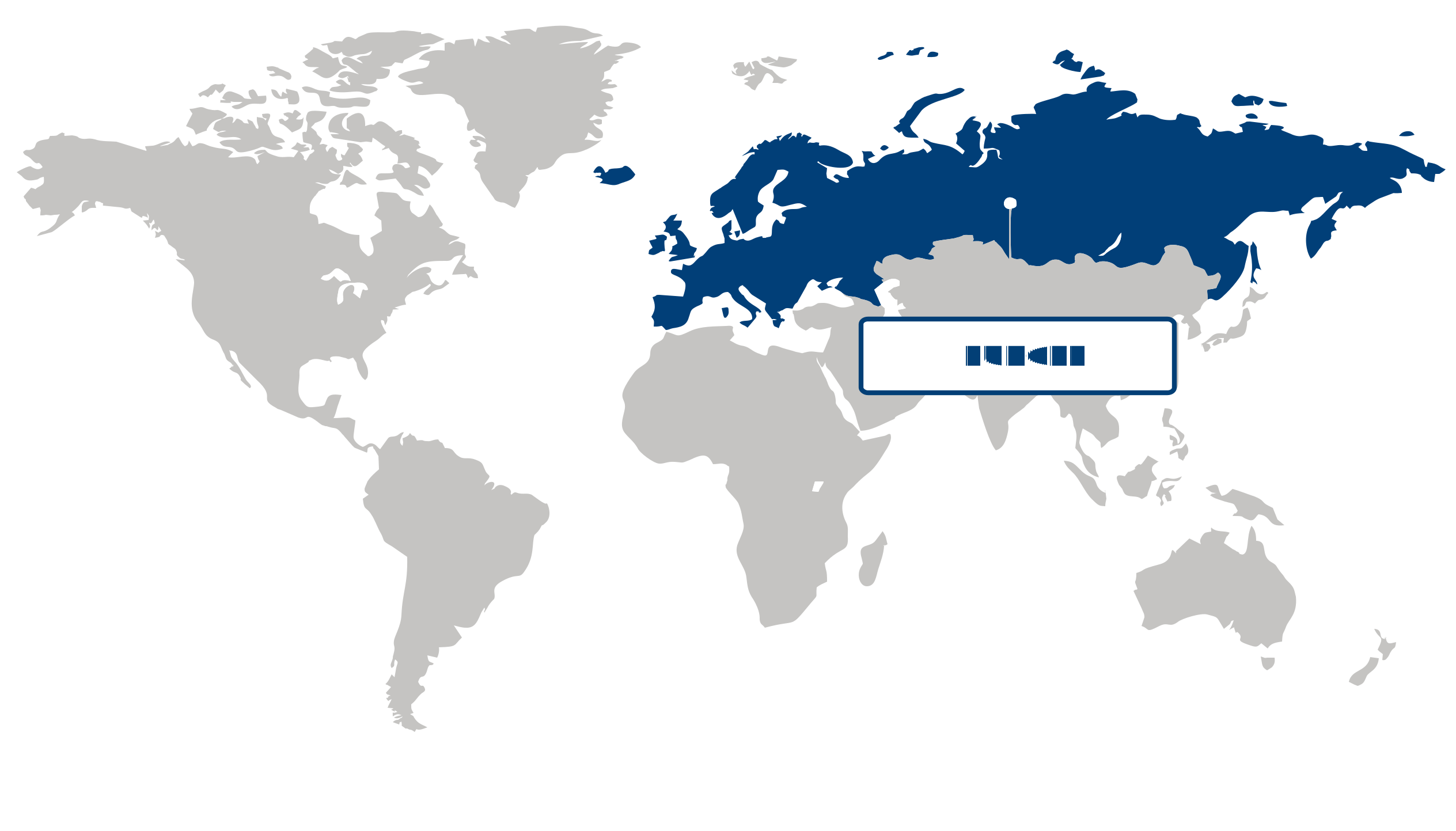
Europe (Largest Region)
Europe dominated the sustainable finance market in 2026 with a 40.70% share, reflecting the region's strong regulatory focus on environmental, social, and governance considerations and its established sustainable investment ecosystem. Financial institutions, asset managers, and institutional investors are increasingly integrating sustainability considerations into capital allocation and risk management decisions. A well-developed framework for sustainable financial products, growing demand for responsible investment opportunities, and increasing corporate emphasis on climate-related disclosures are reinforcing market adoption. Europe's broader transition toward a lower-carbon economy is also directing financing toward renewable energy, energy efficiency, sustainable infrastructure, and other environmentally focused activities, strengthening the region's position in sustainable finance.
Asia Pacific (Fastest-Growing Region)
Asia Pacific represents the fastest-growing regional market, supported by accelerating economic development, expanding capital markets, and increasing awareness of environmental and social risks. Governments and financial institutions across the region are progressively incorporating sustainability objectives into investment and financing frameworks, while businesses are seeking capital aligned with cleaner production, resource efficiency, and responsible growth. Rising demand for green bonds, sustainability-linked financing, and other responsible investment instruments is broadening the market's reach. At the same time, growing climate-related concerns and significant infrastructure financing requirements are encouraging financial markets to channel capital toward sustainable development priorities, creating substantial opportunities for further adoption.
| Parameter | North America | Asia Pacific | Europe | Latin America | MEA |
|---|---|---|---|---|---|
| Innovation HubiScaleNascentDeveloping Advanced | |||||
| Cost-Sensitive RegioniScaleLowMedium High | |||||
| Regulatory EnvironmentiScaleRestrictiveNeutral Supportive | |||||
| Demand DriversiScaleWeakModerate Strong | |||||
| Development StageiScaleEmergingDeveloping Developed | |||||
| Adoption RateiScaleLowMedium High | |||||
| New Entrants / StartupsiScaleSparseModerate Dense | |||||
| Macro IndicatorsiScaleWeakStable Strong |
Key Country Insights
Germany 🇩🇪
Industrial Transition FinancingGermany prioritizes sustainable finance solutions that support industrial decarbonization, renewable energy investment, and energy-efficient infrastructure. Banks and asset managers increasingly align financing frameworks with corporate transition objectives and evolving sustainability reporting requirements.
France 🇫🇷
Responsible Investment AlignmentFrance advances sustainable finance through responsible investment practices, climate-focused asset management, and sustainable corporate funding. Financial organizations in France continue integrating ESG considerations into portfolio construction and financing decisions across multiple industries.
Italy 🇮🇹
Sustainable Infrastructure FundingItaly emphasizes sustainable finance mechanisms that facilitate infrastructure modernization, renewable energy deployment, and environmentally responsible business investment. Italian financial institutions increasingly incorporate sustainability metrics into lending decisions and project financing frameworks.
Japan 🇯🇵
Transition Finance AdoptionJapan continues expanding transition finance initiatives that help carbon-intensive industries modernize while maintaining industrial competitiveness. Financial institutions in Japan increasingly develop sustainability-linked lending and investment products tailored to long-term corporate transformation strategies.
South Korea 🇰🇷
Green Investment MobilizationSouth Korea focuses on mobilizing sustainable capital for clean technologies, low-carbon manufacturing, and green infrastructure projects. Domestic financial institutions strengthen ESG investment capabilities while supporting companies seeking financing aligned with national sustainability priorities.
United States 🇺🇸
Institutional Capital IntegrationThe U.S. sustainable finance market emphasizes integrating environmental and social criteria into institutional investment strategies, green bond issuance, and corporate financing. Financial institutions continue refining climate risk assessment and sustainability disclosure practices to support evolving investor and regulatory expectations.
Sustainable Finance Market Share (%), by Asset Class, 2026
Go beyond the chart, access full insights & data tables
Request Free Sample ReportAsset Class Segment Analysis: Equities (Largest Segment) vs Multi-asset (Fastest-Growing Segment)
The equities segment held the largest share of the sustainable finance market in 2026, accounting for 50.8% share. Equity investments provide investors with direct exposure to businesses pursuing environmental and social objectives, making them an important vehicle for incorporating sustainability considerations into portfolio strategies. Growing attention to responsible investment principles and the integration of sustainability factors into investment decisions continues to support the segment’s strong position.
Multi-asset is the fastest-growing segment, supported by increasing investor interest in diversified strategies that combine multiple asset classes within sustainable portfolios. Such approaches can provide greater flexibility in allocating capital across sustainability-focused opportunities while helping investors balance risk, return, and broader environmental or social objectives. The expanding emphasis on portfolio diversification is supporting wider adoption of multi-asset sustainable investment strategies.
Investment Style Segment Analysis: Active (Largest Segment) vs Passive (Fastest-Growing Segment)
Active investment held the largest share of the sustainable finance market in 2026, reflecting the importance of manager-led portfolio construction in incorporating sustainability considerations. Active strategies allow investment managers to evaluate individual securities based on sustainability characteristics and adjust allocations in response to changing market and responsible-investment priorities. This flexibility supports the continued relevance of active approaches among investors seeking more targeted sustainable investment exposure.
Passive investment represents the fastest-growing segment as investors increasingly seek systematic approaches to sustainable portfolio construction. Passive strategies can provide structured exposure to sustainability-oriented investment themes while supporting transparent and rules-based allocation. Growing demand for efficient investment solutions and greater accessibility to sustainability-focused portfolios is contributing to the expansion of passive approaches.
| Segment | Sub-Segment | Largest Segment | Fastest Growing |
|---|---|---|---|
| Asset Class | Equities, Fixed-income, Multi-asset, Alternatives | Equities | Multi-asset |
| Investment Style | Active, Passive | Active | Passive |
| Investor Type | Institutional Investors, Retail Investors | Institutional Investors | Retail Investors |
| Offerings | Equity Funds, Bond Funds, ETFs/Index Funds, Alternatives/Hedged Funds | Equity Funds | ETFs/Index Funds |
Unlock insights tailored to your business with our bespoke market research solutions.
Click to get your customized report now.
Competitive Landscape and Market Positioning
Top players in the sustainable finance market:
1. BlackRock Inc. (United States)
2. JPMorgan Chase & Co. (United States)
3. Goldman Sachs Group Inc. (United States)
4. Morgan Stanley (United States)
5. UBS Group AG (Switzerland)
6. Deutsche Bank AG (Germany)
7. State Street Corporation (United States)
8. The Bank of New York Mellon Corporation (United States)
9. Amundi S.A. (France)
10. Franklin Resources Inc. (United States)
The sustainable finance market is advancing through integration of ESG-aligned investment strategies. Innovation is improving risk assessment and sustainable capital allocation. Collaborative financial initiatives are strengthening green investment ecosystems. Continuous development is supporting responsible financial growth.
| Company | Market Share | Company Revenue | Revenue CAGR (%) | Product Portfolio | Geographic Presence | Innovation / R&D Focus | Strategic Developments |
|---|---|---|---|---|---|---|---|
| BlackRock Inc. (United States) | |||||||
| JPMorgan Chase & Co. (United States) | |||||||
| Goldman Sachs Group Inc. (United States) | |||||||
| Morgan Stanley (United States) | |||||||
| UBS Group AG (Switzerland) | |||||||
| Deutsche Bank AG (Germany) | |||||||
| State Street Corporation (United States) | |||||||
| The Bank of New York Mellon Corporation (United States) | |||||||
| Amundi S.A. (France) | |||||||
| Franklin Resources Inc. (United States). |
Industry Development/News
| Company Name | Date | Key Development |
|---|---|---|
| International Organization for Standardization (ISO) | Jun-26 | The International Organization for Standardization launched ISO 32212, a new global standard governing net-zero transition planning for financial institutions. The uniform framework guides banks, insurers, and institutional investors in developing and embedding operational climate transition plans, driving market standardization. |
| Deutsche Bank | Nov-25 | Deutsche Bank introduced a transition finance framework targeting hard-to-abate sectors and established a new €900 billion sustainable finance objective for 2030. The strategic initiative expands financing mechanisms to accelerate net-zero transition activities within highly carbon-intensive industrial sectors. |
| Cathay United Bank | Sep-25 | Cathay United Bank expanded its regional footprint by developing new green finance products and executing strategic partnerships aimed at low-carbon transition initiatives in Asia. The expansion strengthens the bank's competitive positioning and accelerates the development of the regional sustainable finance ecosystem. |
| Standard Chartered | Oct-24 | Standard Chartered launched sustainable finance variants of its Borrowing Base Trade Loans to support the commodity sector. The secured revolving credit facility initial roll-out spans the U.S., UK, UAE, Singapore, South Africa, and Hong Kong to provide critical structural funding for businesses. |
| Citi | Aug-24 | Citi partnered with the International Finance Corporation to launch a US$2 billion sustainable supply chain finance program for emerging markets, commencing with a US$500 million facility in Mexico. The joint initiative aims to mobilize capital for sustainable supply chains and expand access to targeted financing solutions across developing economies. |
| Societe Generale | Jan-24 | Societe Generale signed a collaboration framework agreement with the International Finance Corporation to advance sustainable finance in developing nations. The partnership focuses on co-financing projects and risk-sharing agreements designed to mobilize private sector capital toward the climate transition and UN Sustainable Development Goals. |
| Barclays | Jan-24 | Barclays restructured its Capital Markets division by consolidating its Sustainable Capital Markets and ESG Advisory teams into a newly formed Sustainable Banking Group. This organizational alignment enhances the bank's capability to deliver integrated, sustainability-related advisory and corporate financing solutions globally. |
Customize Your Report
Explore examples of how this report can be tailored to different research needs, including custom segments, additional topics or chapters, and related reports. Click a section of the wheel or its numbered marker to explore the available options.
Sustainable Finance Market — Custom Segments
| Segment | Sub-Segment |
|---|---|
| Sustainability Objective | Climate & Decarbonization, Natural Capital & Biodiversity, Social & Inclusive Development, Broad ESG & Sustainability |
| Regulatory Classification | Regulated Sustainable Investment Products, Sustainability-Labeled Products, Voluntary ESG Products |
| Distribution Channel | Banks & Wealth Managers, Asset Management Platforms, Institutional Direct Sales, Digital Investment Platforms |
Sustainable Finance Market — Custom TOC
| Custom Chapter | Chapter Details |
|---|---|
| Climate Finance Opportunity Mapping |
|
| Transition Finance Adoption Strategies |
|
| ESG Data & Ratings Vendor Landscape Assessment |
|
Need a different cut of the data?
Request Custom ResearchFrequently Asked Questions
What is the current revenue of the sustainable finance market?
What is the forecasted size of the sustainable finance industry?
How is ESG integration influencing capital allocation decisions in the sustainable finance market?
Why are standardized sustainability disclosures strengthening sustainable finance adoption?
Why do equities dominate the sustainable finance market?
Why is the multi-asset segment growing the fastest in the sustainable finance market?
Why does Europe lead the sustainable finance market?
What is driving growth in Asia Pacific?
Which companies are driving growth in the sustainable finance landscape?
Our Clients
"The report provided us with a clear direction, and the level of detail was beyond what we expected. I would definitely recommend their services to others."
Haier Appliances
"The collaboration with Fundamental Business Insights has added significant value to our decision-making process, and we look forward to continuing this partnership for our future market research requirements."
Luxottica Group S.p.A.
"The team at FBI delivered an exceptional research report. The insights on industry innovations were particularly impressive and added a lot of value to the overall report."
Nike
Our Research Team & Methodology
Every Fundamental Business Insights report is built by a dedicated vertical research team, validated through a structured primary-and-secondary methodology, and reviewed for accuracy before it reaches you.
This report was prepared by the Consumer Goods & Services Research Team at Fundamental Business Insights, a dedicated research group specializing in global consumer markets, retail industries, and service-oriented businesses. The team closely tracks evolving consumer preferences, purchasing behavior, product innovation, brand strategies, retail and e-commerce developments, pricing trends, distribution channels, sustainability initiatives, demographic shifts, and changing lifestyle patterns to deliver timely and reliable market intelligence. The research is developed using a structured methodology that combines primary discussions with manufacturers, brand owners, retailers, distributors, service providers, industry experts, and other key stakeholders, along with company annual reports, government consumer statistics, regulatory publications, industry associations, retail market data, trade publications, and other authoritative secondary sources. Market estimates are validated through multiple research techniques, including top-down and bottom-up analysis, before undergoing an internal quality review to ensure accuracy, consistency, and methodological integrity prior to publication.
Delivery
Published
Available
Support
- Market Size & Forecast
- Market Segmentation
- Regional Analysis
- Growth Drivers & Challenges
- Market Dynamics
- Competitive Landscape
- Company Profiles
- Competitive Benchmarking
- Mergers & Acquisitions
- Market Share Analysis or Key Company Strategies
- Value Chain Analysis
- Porter's Five Forces
- PESTLE Analysis
- Pricing Trends
- Supply-Demand Analysis
- Technology Landscape
- Regulatory Landscape
- Investment & Funding Landscape
- Emerging Opportunities
- Future Market Outlook