



Sustainable Packaging Market Size & Growth Forecast 2027–2036, By Segments (Type, Packaging Format, Process, Material, Application), Regional Demand Trends (North America, Asia Pacific, Europe), Key Country Insights (U.S., Japan, South Korea, Germany, France, Italy), and Competitive Landscape
Market Size and Growth Outlook
Sustainable Packaging Market size was valued at USD 326.7 billion in 2026 and is anticipated to grow at a 7.22% CAGR from 2027 to 2036, exceeding USD 656.01 billion by 2036. The industry revenue for 2027 is estimated at USD 346.56 billion.
Base Year Value (2026)
USD 326.7 billion
CAGR (2027-2036)
7.22%
Forecast Year Value (2036)
USD 656.01 billion

Historical Data Period
2022-2026

Largest Region
Europe

Forecast Period
2027-2036
Sustainable Packaging Market Intelligence Snapshot:
-
Regional Market Dynamics:
- Europe leads with 38.16% share, driven by strict packaging waste regulations, mature recycling infrastructure, and strong adoption of recyclable and reusable materials across FMCG and retail packaging operations.
- Asia Pacific grows at 8.7% CAGR due to rapid expansion of packaged goods, e-commerce growth, rising production capacity for recyclable formats, and shifting consumer sustainability expectations.
-
Segment Momentum:
- Rigid packaging held a 63% share in 2026 because it delivers dependable structural protection, product integrity, and shelf presentation, making it the preferred choice for durability-focused packaging applications.
- Secondary packaging is growing fastest as businesses redesign logistics and shipping solutions to reduce waste, improve transport efficiency, and optimize product handling throughout supply chains.
-
Market Expansion Drivers:
- Rising consumer preference for environmentally responsible packaging accelerating sustainable material adoption globally.
- Stringent regulations on single-use plastics driving investment in recyclable and compostable packaging solutions.
- Expanding partnerships across recycling and packaging supply chains improving circular packaging ecosystem development.
-
Leading Market Participants:
Leading players in the sustainable packaging market include Amcor plc (Berry Global Inc.) (Australia), Sealed Air Corporation (United States), Sonoco Products Company (United States), Smurfit Westrock plc (Ireland), Tetra Pak International S.A. (Switzerland), Mondi plc (United Kingdom), DS Smith plc (United Kingdom), Huhtamaki Oyj (Finland), Novolex Holdings LLC (United States).
Global Market Forecast Snapshot:
-
Market Outlook:
- 2026 Market Size: USD 326.7 billion
- 2027 Estimated Market Size: USD 346.56 billion.
- Projected Market Size: USD 656.01 billion by 2036
- Growth Forecasts: 7.22% CAGR (2027-2036)
-
Regional and Segment Outlook:
- Leading Regional Market: Europe
- High-Growth Regional Hub: Asia Pacific
- Core Revenue Segment: Rigid (Type) | Primary Packaging (Packaging Format) | Recyclable (Process) | Plastics (Material) | Food & Beverages (Application)
- Emerging Opportunity Segment: Flexible (Type) | Secondary Packaging (Packaging Format) | Biodegradable (Process) | Paper & Paperboard (Material) | Healthcare (Application)
Market Growth Drivers and Industry Trends
Rising consumer preference for environmentally responsible packaging accelerating sustainable material adoption globally
Changing consumer attitudes toward environmental impact are driving the sustainable packaging market as buyers increasingly consider recyclability, material sourcing, and waste generation when selecting products. Manufacturers and retailers are responding by incorporating paper-based, recyclable, biodegradable, and other lower-impact packaging formats into product portfolios. This shift is also influencing packaging design, with businesses seeking solutions that balance product protection, shelf appeal, functionality, and environmental performance while responding to growing expectations for responsible consumption.
Stringent regulations on single-use plastics driving investment in recyclable and compostable packaging solutions
Stringent restrictions on single-use plastics are accelerating the sustainable packaging market by encouraging manufacturers to replace difficult-to-recycle formats with recyclable and compostable alternatives. Regulatory pressure is prompting packaging producers and brand owners to reassess material selection, product design, and end-of-life management across supply chains. Investments in alternative materials and improved recycling compatibility are increasing as businesses seek to maintain packaging functionality while meeting evolving environmental requirements and reducing reliance on conventional plastic formats.
Expanding partnerships across recycling and packaging supply chains improving circular packaging ecosystem development
Greater collaboration among packaging manufacturers, recyclers, material suppliers, retailers, and other supply chain participants will strengthen the sustainable packaging market by improving the coordination required for circular material flows. Partnerships can facilitate better collection systems, material recovery, recycled-content integration, and packaging designs that are more compatible with existing recycling infrastructure. Such cooperation also helps companies address supply and processing challenges associated with sustainable materials while creating more connected pathways between packaging production and end-of-life recovery.
| Growth Driver Assessment Framework | |||||
| Growth Driver | Impact On CAGR | Regulatory Influence | Geographic Relevance | Adoption Rate | Impact Timeline |
|---|---|---|---|---|---|
| Rising consumer preference for environmentally responsible packaging accelerating sustainable material adoption globally | 1.90% | Moderate | Europe, North America | High | Near Term |
| Stringent regulations on single-use plastics driving investment in recyclable and compostable packaging solutions | 1.70% | High | Europe, Asia Pacific | High | Mid Term |
| Expanding partnerships across recycling and packaging supply chains improving circular packaging ecosystem development | 1.30% | Moderate | Europe, North America | Emerging | Long Term |
Unlock insights tailored to your business with our bespoke market research solutions - Click to get your customized report now!
Regional Demand Dynamics
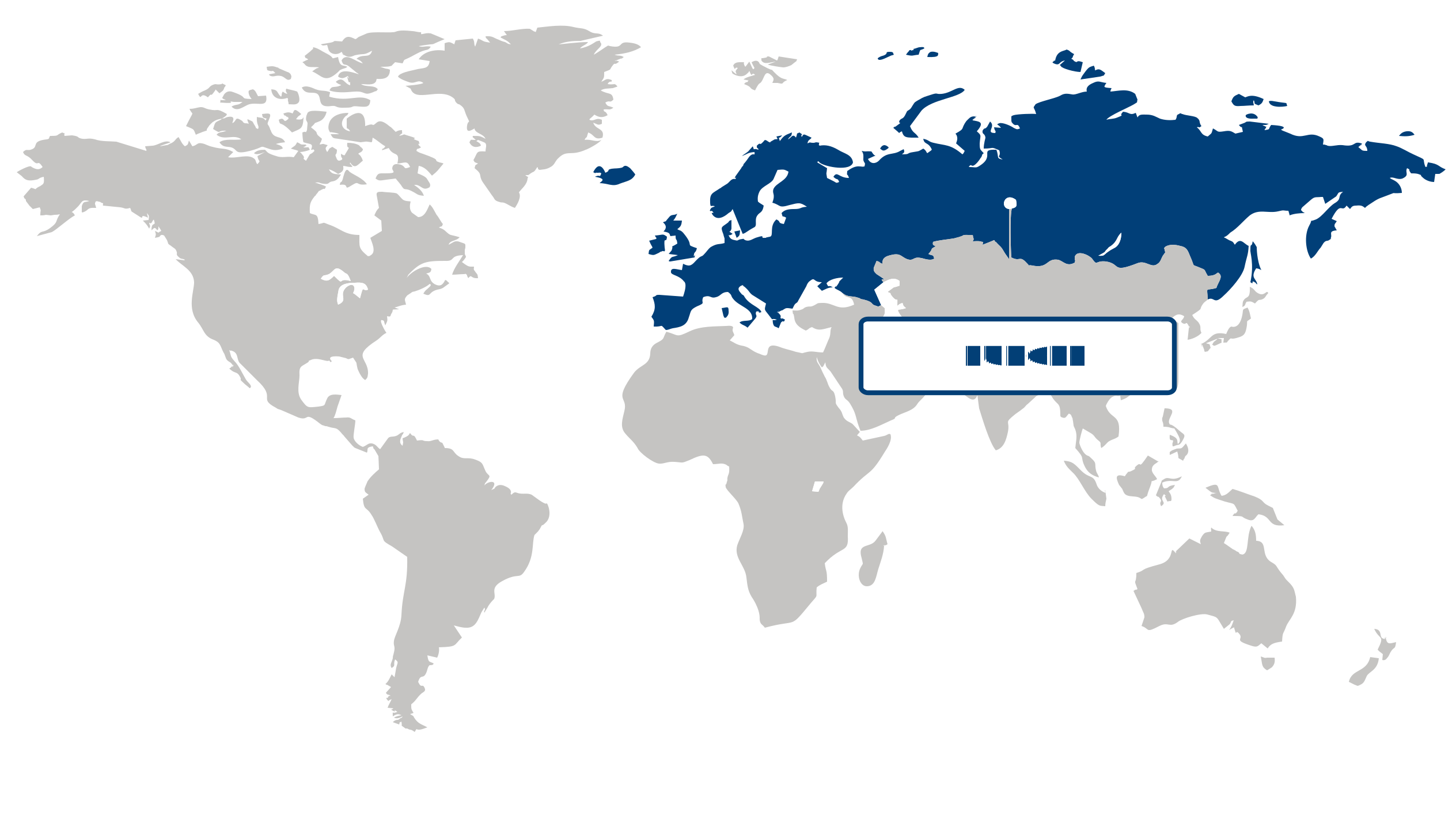
Largest Region
Europe
38.16% Market Share in 2026
Europe (Largest Region) vs Asia Pacific (Fastest-Growing Region)
Europe dominated the sustainable packaging market with a 38.16% share in 2026, underpinned by strong environmental priorities, established recycling infrastructure, and widespread adoption of packaging practices designed to reduce material waste and environmental impact. Regulatory initiatives focused on packaging waste, recyclability, and resource efficiency are encouraging manufacturers and retailers to transition toward recyclable, reusable, and bio-based packaging formats. Growing consumer preference for environmentally responsible products is reinforcing this shift, while established manufacturing capabilities and circular-economy initiatives provide a supportive foundation for sustainable packaging adoption across multiple end-use industries.
Asia Pacific is experiencing the fastest growth as manufacturers respond to rising consumption, expanding retail and e-commerce activity, and increasing environmental awareness. Rapid industrialization and urbanization are generating substantial packaging requirements, while governments and businesses are placing greater emphasis on waste reduction and more sustainable material use. The expansion of modern retail and food delivery ecosystems is also encouraging packaging innovation, creating opportunities for solutions that combine functional performance with improved environmental characteristics. Increasing investment in recycling, material recovery, and sustainable production practices is further strengthening the region's growth trajectory.
Key Country Insights
The U.S. market emphasizes sustainable packaging solutions that improve material efficiency while meeting evolving consumer and corporate sustainability objectives. Companies increasingly invest in recyclable, reusable, and fiber-based packaging supported by product redesign initiatives.
Japan focuses on lightweight, recyclable, and material-efficient packaging solutions that balance sustainability with product protection. Businesses increasingly refine packaging formats to reduce waste while maintaining high manufacturing and quality standards.
South Korea is combining sustainable materials with advanced packaging technologies to improve product value and environmental performance. Manufacturers increasingly develop recyclable and innovative packaging formats suited to consumer goods and industrial applications.
Germany prioritizes sustainable packaging materials that align with circular economy objectives and resource optimization. Manufacturers continue adopting recyclable designs and advanced material technologies to improve environmental performance across packaging applications.
France encourages packaging solutions designed around recyclability, material reduction, and environmental compliance. Companies increasingly integrate eco-design principles into packaging development to address sustainability expectations across multiple industries.
Italy is advancing the transition toward renewable and recyclable packaging materials across food, consumer goods, and industrial sectors. Businesses continue refining packaging designs that balance functionality, sustainability objectives, and manufacturing practicality.
Segment Leadership and Growth Trends
Type Segment Analysis: Rigid (Largest Segment) vs Flexible (Fastest-Growing Segment)
The rigid segment dominated the sustainable packaging market, accounting for 63% share in 2026, supported by its strong role in applications where structural integrity, product protection, and reliable handling are essential. Rigid sustainable packaging provides durability and protection during storage, transportation, and retail display while enabling manufacturers to incorporate recyclable, recycled, or renewable materials into established packaging formats. Growing pressure to reduce packaging waste and improve material efficiency is encouraging businesses to adopt more sustainable rigid solutions without compromising functional performance. Its broad applicability across consumer goods, food, beverages, and other packaged products continues to sustain the segment's leading position.
Flexible packaging is expected to register the fastest growth as manufacturers increasingly prioritize lightweight formats that can reduce material consumption while maintaining product protection. Flexible solutions offer versatility in design, storage, transportation, and dispensing, making them attractive for brands seeking to balance sustainability with convenience. Advances in recyclable and bio-based flexible materials are also helping address environmental concerns associated with conventional packaging. Rising consumer awareness of packaging waste, combined with efforts to improve resource efficiency and develop lower-impact packaging formats, is creating favorable conditions for wider adoption of sustainable flexible packaging.
Packaging Format Segment Analysis: Primary Packaging (Largest Segment) vs Secondary Packaging (Fastest-Growing Segment)
Primary packaging represented the largest packaging format segment in the sustainable packaging market, holding 72.96% share in 2026. Its dominant position reflects its direct role in protecting products, maintaining quality, and providing essential information to consumers throughout the purchasing and consumption cycle. As sustainability becomes increasingly important in packaging decisions, manufacturers are focusing on replacing conventional materials with recyclable, reusable, compostable, and renewable alternatives while preserving product integrity. The direct connection between primary packaging and product protection makes material innovation particularly important, encouraging continued investment in sustainable formats that meet both functional and environmental requirements.
Secondary packaging is projected to be the fastest-growing format as businesses increasingly address sustainability across the broader distribution and logistics chain. Used to group, protect, and transport primary packages, secondary packaging provides opportunities to reduce excess material, improve recyclability, and optimize handling efficiency. Retailers and manufacturers are placing greater emphasis on reducing packaging waste beyond the product container itself, encouraging the adoption of more resource-efficient materials and designs. Growing attention to sustainable supply chains and packaging optimization is consequently supporting faster development of secondary packaging solutions.
| Report Segmentation | |||
| Segment | Sub-Segment | Largest Segment | Fastest Growing Segment |
|---|---|---|---|
| Type | Rigid, Flexible | Rigid | Flexible |
| Packaging Format | Primary Packaging, Secondary Packaging, Tertiary Packaging | Primary Packaging | Secondary Packaging |
| Process | Recyclable, Reusable, Biodegradable | Recyclable | Biodegradable |
| Material | Plastics, Paper & Paperboard, Glass, Metal | Plastics | Paper & Paperboard |
| Application | Food & Beverages, Personal Care & Cosmetics, Healthcare, Others | Food & Beverages | Healthcare |
 Read our Research Approach
Competitive Landscape and Market Positioning
Key companies in the sustainable packaging market:
1. Amcor plc (Berry Global Inc.) (Australia)
2. Sealed Air Corporation (United States)
3. Sonoco Products Company (United States)
4. Smurfit Westrock plc (Ireland)
5. Tetra Pak International S.A. (Switzerland)
6. Mondi plc (United Kingdom)
7. DS Smith plc (United Kingdom)
8. Huhtamaki Oyj (Finland)
9. Novolex Holdings LLC (United States)
The sustainable packaging market is evolving rapidly with increasing emphasis on eco-friendly materials and reduced environmental impact. New product innovations are focused on biodegradable and recyclable solutions. Collaborative initiatives are strengthening material innovation capabilities, while growing consumer demand for sustainable alternatives is reshaping packaging development priorities.
Industry Development/News
| Company Name | Date | Key Development |
|---|---|---|
| International Paper | Jun-26 | Approved a US$225 million investment to construct a 468,000-square-foot sustainable packaging facility in Brandon, Mississippi. Scheduled for Q4 2027, the site will significantly enhance the company’s manufacturing capacity and operational efficiency, supporting its long-term strategic growth objectives in the sustainable packaging sector. |
| ProAmpac | Mar-26 | Finalized the US$1.51 billion acquisition of TC Transcontinental Packaging. The move significantly bolsters ProAmpac’s global sustainable packaging footprint, material science expertise, and market share across critical end-use segments, including the food, dairy, protein, and medical packaging industries. |
| Tetra Pak | Mar-26 | Invested €60 million into proprietary paper-based barrier technology. This capital allocation reinforces the company’s focus on advancing renewable packaging materials and accelerating the commercialization of next-generation, sustainable food packaging solutions. |
| Shellworks | Mar-26 | Secured US$15 million in Series A funding led by Alter Equity. The investment is dedicated to scaling production and commercializing its biomaterial-based alternative to conventional plastics, facilitating broader adoption in sustainable packaging applications. |
| ORBIS | Feb-26 | Acquired Robinson Industries to broaden its manufacturing portfolio. The acquisition strengthens the company’s ability to deliver innovative, sustainable packaging solutions throughout global supply chains, enhancing both its production capacity and geographic market reach. |
| Ecopax | Oct-25 | Announced a 104,238-square-foot expansion of its Bethlehem, Pennsylvania, facility. The project is designed to scale production capacity for sustainable food packaging to address the rising market demand for environmentally responsible packaging materials. |
| Xampla | Sep-25 | Secured US$14 million in funding to advance the commercialization of plant-based alternatives to single-use plastics. The capital will strengthen the company’s ability to scale sustainable material production and accelerate the transition toward fiber-based packaging solutions. |
| Sappi North America | Jul-25 | Completed the US$500 million Project Elevate expansion at the Somerset Mill in Maine. The facility has commenced commercial production of fiber-based sustainable packaging products, increasing the company's output to meet escalating customer demand for renewable materials. |
| TOPPAN Holdings | Apr-25 | Finalized the acquisition of Sonoco’s TFP business. The transaction accelerates the global expansion of TOPPAN’s sustainable packaging operations and strengthens its competitive presence within the Americas through an enhanced product portfolio. |
| TOPPAN | Mar-24 | Established end-to-end manufacturing capabilities for sustainable mono-material packaging in India by producing BOPP-based GL-SP barrier film. This development strengthens the company's regional manufacturing footprint and supports the localized production of high-performance, sustainable packaging solutions. |
Why Choose Us
Specialized Expertise: Our team comprises industry experts with a deep understanding of your market segment. We bring specialized knowledge and experience that ensures our research and consulting services are tailored to your unique needs.
Customized Solutions: We understand that every client is different. That's why we offer customized research and consulting solutions designed specifically to address your challenges and capitalize on opportunities within your industry.
Proven Results: With a track record of successful projects and satisfied clients, we have demonstrated our ability to deliver tangible results. Our case studies and testimonials speak to our effectiveness in helping clients achieve their goals.
Cutting-Edge Methodologies: We leverage the latest methodologies and technologies to gather insights and drive informed decision-making. Our innovative approach ensures that you stay ahead of the curve and gain a competitive edge in your market.
Client-Centric Approach: Your satisfaction is our top priority. We prioritize open communication, responsiveness, and transparency to ensure that we not only meet but exceed your expectations at every stage of the engagement.
Continuous Innovation: We are committed to continuous improvement and staying at the forefront of our industry. Through ongoing learning, professional development, and investment in new technologies, we ensure that our services are always evolving to meet your evolving needs.
Value for Money: Our competitive pricing and flexible engagement models ensure that you get maximum value for your investment. We are committed to delivering high-quality results that help you achieve a strong return on your investment.
Select Licence Type

