



Sustainable Polymers Market Size & Forecasts 2026-2035, By Segments (Type, Applications), Growth Opportunities, Innovation Landscape, Regulatory Shifts, Strategic Regional Insights (U.S., Japan, China, South Korea, UK, Germany, France), and Competitive Dynamics (NatureWorks, BASF, Covestro, DSM, Braskem)
Market Size and Growth Outlook
Base Year Value (2025)
USD 12.08 Billion
CAGR (2026-2035)
23.1%
Forecast Year Value (2035)
USD 96.53 Billion

Historical Data Period
2022-2025

Largest Region
Europe

Forecast Period
2026-2035
Key Takeaways
- Europe region captured more than 38% revenue share in 2025, supported by stringent government regulations and high consumer demand for eco-friendly alternatives.
- Asia Pacific region will observe more than 27.72% CAGR from 2026 to 2035, accelerated by rapid industrialization and increasing investments in biopolymer production facilities.
- The synthetic bio-based polymers segment captured majority of the market share in 2025, driven by increasing environmental consciousness and regulatory pressure favoring renewable-resource based plastics.
- In sustainable polymers market, the packaging segment accounted for the largest revenue share in 2025, due to rising consumer demand for sustainable packaging and corporate commitments to reduce plastic waste.
- Top companies in the sustainable polymers market comprise NatureWorks (USA), BASF (Germany), Covestro (Germany), DSM (Netherlands), Braskem (Brazil), DuPont (USA), Mitsubishi Chemical (Japan), LG Chem (South Korea), SABIC (Saudi Arabia), Arkema (France).
Market Growth Drivers and Industry Trends
Growing focus on sustainable polymers in packaging and automotive — Major brand and OEM commitments are reshaping demand dynamics: Nestlé and Unilever public sustainability targets and the European Commission’s Packaging and Packaging Waste Directive are driving packaging design toward recyclable and bio-based solutions, while Toyota Motor Corporation and BMW Group have publicly piloted biomass-derived and recycled-plastic components in vehicle interiors. This convergence of regulation, brand commitments, and end-user expectations accelerates adoption in the sustainable polymers market and rewards firms that can certify recyclability and supply chain traceability. Established chemical producers can scale integrated offerings; specialty recyclers and material innovators can form OEM partnerships. Expect steady procurement shifts as regulatory and corporate requirements harden.Investment in bio-based and recyclable polymer technologies — Strategic capital flows and public funding are de-risking scale-up: NatureWorks’ commercial Ingeo developments and Braskem’s bio-PE investments, together with European Commission Horizon 2020 funding for bio-based projects, illustrate coordinated public–private support that advances feedstock-to-polymer pathways. These investments lower technology and supply risks in the sustainable polymers market, creating opportunities for incumbents to retrofit plants and for entrants to commercialize niche chemistries or licensing models. Partnerships between feedstock suppliers, converters, and brand owners will be pivotal. Continued targeted funding and disclosed capacity expansions point to incremental technology maturation rather than abrupt disruption.
Innovation in high-performance eco-polymers — New formulations are unlocking premium applications: BASF’s ecovio biodegradable plastics and DuPont’s Sorona bio-based polymers demonstrate that performance-grade, eco-oriented materials can meet demanding use cases in packaging, textiles, and automotive. Covestro and other producers’ R&D pipelines focused on recycled- and bio-based resins signal a shift from commodity substitution to performance differentiation. These advances expand addressable applications in the sustainable polymers market, offering high-margin opportunities for specialty players and strategic co-development for large polymer producers. Observable product launches and pilot programs indicate a gradual broadening of high-performance use cases driven by material innovation and OEM acceptance.
Industry Restraints:
Feedstock Supply Constraints and Quality Variability
Limited availability of consistent, high‑quality bio‑ and recycled feedstocks directly restricts scale-up of sustainable polymers by increasing processing downtime, variability in material performance, and sourcing costs. The Ellen MacArthur Foundation has documented that much post‑consumer plastic waste is contaminated or degraded and unsuitable for closed‑loop mechanical recycling, while Veolia reports local collection and sorting bottlenecks that constrain feedstock throughput. Commercial players such as Braskem and ExxonMobil cite feedstock sourcing and consistency as barriers when scaling bio‑based or chemically recycled routes. Strategically, incumbents with integrated supply chains gain advantage through long‑term offtake and feedstock procurement, whereas smaller entrants face capital intensity and contract risk. Expect continued emphasis on feedstock‑of‑ftake deals, investment in pre‑processing and certification, and persistent short‑to‑medium‑term supply tightness.
Regulatory Fragmentation and Certification Complexity
Divergent regulatory regimes and evolving sustainability claims frameworks create compliance costs, market fragmentation, and time‑to‑market delays that impede commercial adoption. The European Commission’s Packaging and Packaging Waste rules, the U.S. Environmental Protection Agency’s differing recycled content guidance, and policy shifts signaled by China’s National Development and Reform Commission produce inconsistent requirements across key markets. Certification schemes such as ISCC add verification pathways but increase administrative burden cited by companies like Unilever when harmonizing product portfolios. For incumbents, regulatory complexity drives larger compliance teams and slows product launches; for challengers, it raises market entry thresholds. In the near to medium term, expect incremental harmonization efforts but continued certification proliferation that favors players able to absorb regulatory cost and manage multi‑jurisdictional compliance.
| Growth Driver Assessment Framework | |||||
| Growth Driver | Impact On CAGR | Regulatory Influence | Geographic Relevance | Adoption Rate | Impact Timeline |
|---|---|---|---|---|---|
| Growing focus on sustainable polymers in packaging and automotive | 8.00% | Short term (≤ 2 yrs) | Europe, North America; Spillover: Asia Pacific | Medium | Fast |
| Investment in bio-based and recyclable polymer technologies | 7.00% | Medium term (2–5 yrs) | Asia Pacific, Europe | Medium | Moderate |
| Innovation in high-performance eco-polymers | 8.10% | Long term (5+ yrs) | North America, Europe | High | Slow |
Unlock insights tailored to your business with our bespoke market research solutions - Click to get your customized report now!
Regional Demand Dynamics
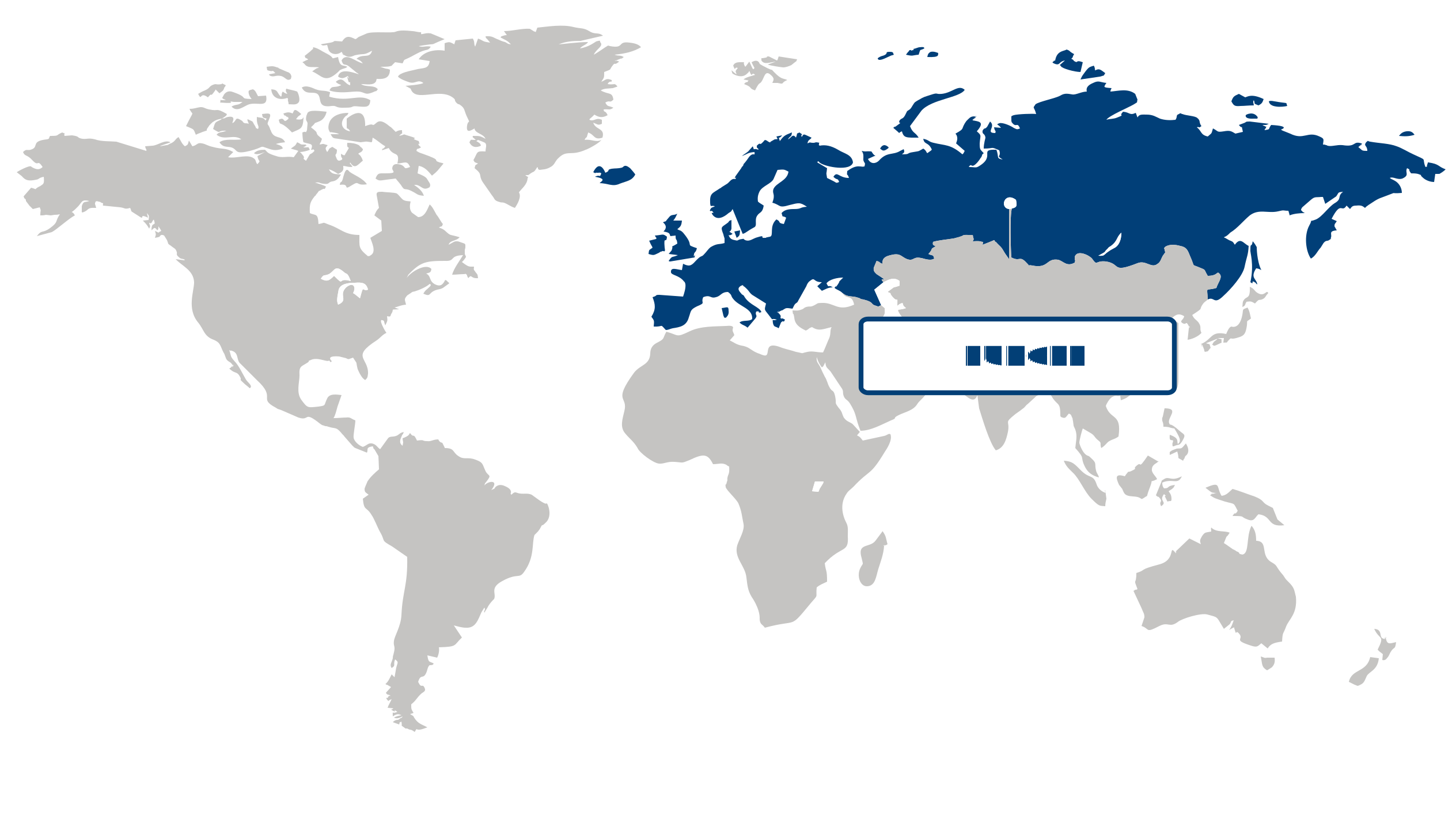
Largest Region
Europe
38% Market Share in 2025
Europe captured approximately 38% of the sustainable polymers market in 2025 and stands as the region with the largest share. Tightened EU-wide mandates—notably the European Commission’s Circular Economy Action Plan and the Single-Use Plastics Directive—combined with strong consumer demand for eco-friendly products have driven rapid adoption of recycled- and bio-based polymers across value chains. Industry leaders such as BASF and Covestro have announced circular-feedstock and chemical-recycling initiatives that illustrate private-sector response to policy signals, while the European Chemicals Agency (ECHA) is streamlining substance assessments that affect formulation choices. These regulatory and demand dynamics, supported by investment in recycling infrastructure and digital traceability pilots, position Europe to scale circular feedstocks and commercial partnerships, creating durable opportunities for investors and strategic entrants in sustainable polymers.
Germany serves as the industrial backbone of the sustainable polymers market, leveraging large-scale manufacturing, advanced recycling capacity, and strict national rules. Germany’s Verpackungsgesetz (Packaging Act) and active engagement from the Federal Environment Agency (Umweltbundesamt) impose recycled-content targets and reporting that accelerate demand for certified recycled polymers; simultaneously, chemical producers such as BASF have publicly scaled ChemCycling and feedstock-recycling projects to meet industrial demand. Strong engineering talent, supplier clusters, and OEM commitments in automotive and packaging create a pragmatic ecosystem for commercialization, making Germany a testbed whose scale and standards amplify regional deployment.
France functions as a regulatory and consumer trend leader in the sustainable polymers market, where policy and retailer initiatives shape purchasing and formulation decisions. France’s anti-waste Loi AGEC and programs run by ADEME have pushed recycled-content mandates and circular-economy funding, while major retailers and brands—Carrefour and L’Oréal—have announced specific targets for recycled or bio-based plastics in packaging and products, signaling procurement shifts. These policy-driven demand signals and visible brand commitments make France a high-visibility market for pilots and premium positioning, feeding regional momentum by proving commercial models that can be replicated across Europe.
Asia Pacific Market Analysis:
Asia Pacific emerged as the fastest-growing region in the sustainable polymers market, registering a robust CAGR of 27.72% driven by rapid industrialization and growing investments in biopolymer production facilities. Accelerated plant builds and upgrade programs across China and Japan, supported by policy signals from China’s National Development and Reform Commission (NDRC) and the Ministry of Industry and Information Technology (MIIT) and Japan’s Ministry of Economy, Trade and Industry (METI), are expanding local manufacturing capacity and lowering delivered costs for bioplastics. Corporates such as Kingfa Sci & Tech, Mitsubishi Chemical, and Kaneka have publicly emphasized scale-up and product launches, while financiers including the Asian Development Bank are increasingly underwriting green industrial projects. Given abundant feedstock access, dense manufacturing clusters, and rising consumer preference for circular solutions, the region is positioned to convert capacity investments into commercial-scale, lower-cost sustainable polymer supply and downstream adoption over the near term.
Japan functions as a technology and premium-application hub in the sustainable polymers market, where advanced material science and high-value end‑use demand converge. Japanese policy instruments — notably METI’s industry guidance and government-supported demonstration projects — have encouraged firms to shift R&D into bio-based and degradable polymers; Kaneka and Mitsubishi Chemical have public communications outlining product development and collaborative pilots. Strong OEM and packaging demand for high-performance, certified biopolymers, coupled with sophisticated recycling and quality-control systems, means Japan often commercializes higher-margin formulations first, which then inform standards and specifications used elsewhere in Asia Pacific. Strategically, Japan’s innovation-led pipelines and certification experience create exportable know‑how and product specifications that will help scale regional commercialization and premium-segment adoption.
China acts as the capacity and scale engine in the sustainable polymers market, where rapid industrialization, regional industrial policy and localized investment create large-volume production of biopolymers. National plans such as the 14th Five-Year Plan and directives from the NDRC and MIIT promote new-materials manufacturing and circular economy pilots; domestic producers like Kingfa Sci & Tech and other resin manufacturers have announced expansion of biodegradable polyester lines in response. Cost-driven fast-moving consumer goods demand, municipal procurement pilots, and integrated petrochemical-to-biopolymer value chains enable China to push down unit costs and serve mass-market applications across Asia Pacific. For investors and strategists, China’s scale efficiencies and policy-backed capacity make it essential for volume plays, while its downstream networks accelerate regional adoption and commoditization of sustainable polymer grades.
North America Market Trends:
North America experienced lucrative growth in the sustainable polymers market, maintaining a notable position due to an ecosystem of large-scale converters, advanced materials R&D, and evolving policy signals that favor lower-carbon and circular materials. Regional momentum is visible in regulatory and programmatic moves such as the U.S. Environmental Protection Agency’s National Recycling Strategy and Canada’s Zero Plastic Waste agenda (Environment and Climate Change Canada), while industry coalitions like the U.S. Plastics Pact and technology investments by producers including NatureWorks and Eastman illustrate commercial commitment. Logistics hubs in the U.S. and Canada and deep manufacturing clusters enable rapid scale-up, and corporate procurement shifts toward recycled and bio-based resins are accelerating demand. These converging factors position North America to capture premium end-markets and attract follow‑on investment into scalable sustainable polymer supply chains.
The U.S. serves as the primary engine of the sustainable polymers market in North America, offering depth of demand, investment capital, and deployment pathways. Federal funding streams and programs—such as competitive grants from the U.S. Department of Energy’s Bioenergy Technologies Office—and regulatory pressure exemplified by the U.S. Securities and Exchange Commission’s climate disclosure activity are mobilizing corporate buyers and financiers. Private-sector initiatives by firms like Eastman on molecular recycling and NatureWorks on commercial PLA supply highlight pathway diversity from recycling to bio‑based feedstocks, while participation in the U.S. Plastics Pact signals buyer aggregation. Strategically, U.S. scale and capital efficiency make it the testing ground for technologies that can be exported across the region, creating a domino effect of commercial adoption and supply‑chain integration across North America.
No card data available for this language/report.
Segment Leadership and Growth Trends
Synthetic bio-based polymers dominated the sustainable polymers market as the largest share in 2025. This leadership stems from rising environmental consciousness and regulatory pressure favoring renewable-resource-based plastics, reflected in policy activity such as the European Commission’s Circular Economy Action Plan and advocacy by the United Nations Environment Programme, while commercial scale examples from NatureWorks and Braskem demonstrate industrial viability. Demand patterns for lower-carbon feedstocks and improved biorefinery supply chains have attracted incumbents to integrate bio-based grades and opened room for innovative specialty formulators, and workforce and digital supply-chain improvements have reduced time-to-market. Established chemical producers can leverage feedstock sourcing and capital intensity to scale, while smaller entrants can capture niche compostable or performance formulations. Regulatory momentum and corporate sustainability commitments suggest continued relevance through the near to medium term.
Analysis by Applications
Packaging represented the largest share of the sustainable polymers market in 2025. The segment leads because rising consumer preference for recyclable and low-impact packaging, together with corporate initiatives such as Coca-Cola’s World Without Waste and Nestlé’s packaging commitments, and frameworks advanced by the Ellen MacArthur Foundation and the European Commission’s Packaging and Packaging Waste Directive, are concentrating demand for sustainable polymers in packaging applications. Shifts in procurement, investments in recycled-content supply chains, and advances in barrier performance and digital traceability are reshaping supplier competition and enabling pilot commercialization by both majors and start-ups. Large producers can secure feedstock and retrofit lines for recycled or bio-based grades, while challengers can win design wins with compostable films or chemical-recycling partnerships. Continued regulatory tightening and brand-level targets point to sustained importance over the near to medium term.
| Report Segmentation | |||
| Segment | Sub-Segment | Largest Segment | Fastest Growing Segment |
|---|---|---|---|
| Type | Natural Polymers, Synthetic Bio-Based Polymers | ||
| Applications | Automotive, Packaging, Drug Delivery, Agriculture, Construction | ||
 Read our Research Approach
Competitive Landscape and Market Positioning
Key players in the sustainable polymers market include NatureWorks (USA), BASF (Germany), Covestro (Germany), DSM (Netherlands), Braskem (Brazil), DuPont (USA), Mitsubishi Chemical (Japan), LG Chem (South Korea), SABIC (Saudi Arabia), and Arkema (France). These firms occupy differentiated positions: NatureWorks is recognized for commercial PLA supply chains and application pull, Braskem for sugarcane-derived polyethylene leadership in Brazil, and BASF, Covestro and DSM for broad portfolios that bridge commodity scale and specialty bio-enabled chemistries. DuPont, Mitsubishi Chemical, LG Chem and SABIC leverage large petrochemical platforms to pivot toward circular feedstocks, while Arkema and other specialty players focus on high-value formulations and close industry partnerships to speed commercialization and qualification across end markets.The competitive environment is characterized by accelerated capability-building and targeted portfolio expansion among incumbents and specialists. Several companies are linking upstream feedstock expertise with downstream converters, bringing niche technologies into larger portfolios and introducing new bio-based and recycling-compatible grades to shorten adoption cycles. Cross-sector arrangements with packaging, automotive and consumer brands are helping firms validate performance and secure off-take, while investments in pilot operations, process optimization and materials design are sharpening differentiation between scale players and innovators, shaping a market where technical validation and supply flexibility determine positioning.
Strategic / Actionable Recommendations for Regional Players
North America: Regional actors should deepen cooperative ties with feedstock producers and downstream formulators to accelerate qualification into packaging and durable-goods supply chains. Emphasize scale-ready chemistries and advanced recycling trials, pair pilot assets with procurement commitments from major converters, and pursue certification and traceability efforts to meet customer and regulatory expectations.
Asia Pacific: Firms can consolidate cost and supply advantages by integrating local biomass streams with engineering capabilities and partnering with large OEMs to co-develop fit-for-market grades. Prioritize process intensification and digital process control to lower unit costs, and work with regional standards bodies to align specifications that enable faster adoption across high-volume applications.
Europe: Market players should leverage strong regulatory and brand demand for circularity by focusing on specialty, high-value bio-based polymers and collaboratives with waste-management and reuse platforms. Invest in chemical-recycling demonstrations, robust chain-of-custody systems, and selective alliances with premium brands to capture margin and accelerate acceptance in sustainability-conscious value chains.
Why Choose Us
Specialized Expertise: Our team comprises industry experts with a deep understanding of your market segment. We bring specialized knowledge and experience that ensures our research and consulting services are tailored to your unique needs.
Customized Solutions: We understand that every client is different. That's why we offer customized research and consulting solutions designed specifically to address your challenges and capitalize on opportunities within your industry.
Proven Results: With a track record of successful projects and satisfied clients, we have demonstrated our ability to deliver tangible results. Our case studies and testimonials speak to our effectiveness in helping clients achieve their goals.
Cutting-Edge Methodologies: We leverage the latest methodologies and technologies to gather insights and drive informed decision-making. Our innovative approach ensures that you stay ahead of the curve and gain a competitive edge in your market.
Client-Centric Approach: Your satisfaction is our top priority. We prioritize open communication, responsiveness, and transparency to ensure that we not only meet but exceed your expectations at every stage of the engagement.
Continuous Innovation: We are committed to continuous improvement and staying at the forefront of our industry. Through ongoing learning, professional development, and investment in new technologies, we ensure that our services are always evolving to meet your evolving needs.
Value for Money: Our competitive pricing and flexible engagement models ensure that you get maximum value for your investment. We are committed to delivering high-quality results that help you achieve a strong return on your investment.
Select Licence Type

