Tartaric Acid Market Size & Growth Forecast 2027–2036, By Segments (Source, Application), Regional Demand Trends (North America, Asia Pacific, Europe), Key Country Insights (U.S., Japan, South Korea, Germany, France, Italy), and Competitive Landscape
Market Size and Growth Outlook
Tartaric Acid Market size was over USD 453.3 million in 2026 and is likely to grow at a 5.7% CAGR between 2027 and 2036, attaining USD 789.11 million by 2036. The industry revenue for 2027 is calculated at USD 475.06 million.
Get more details on this report
Request Free Sample ReportTartaric Acid Market Intelligence Snapshot
Regional Market Dynamics
- Europe held a 37.10% market share in 2026, supported by its established wine industry, mature food and beverage processing sector, dependable grape-derived raw material supply, and well-developed manufacturing networks.
- Asia Pacific is projected to grow at a 6.89% CAGR, driven by expanding processed food and beverage production, increasing industrial adoption, and rising manufacturing capacity across developing economies.
Segment Momentum
- Maleic Anhydride led with 57.75% share due to stable synthetic production, consistent raw material availability, and scalable output supporting high-volume industrial tartaric acid manufacturing.
- Grapes & Sun-dried Raisins is the fastest-growing source segment as demand increases for naturally derived ingredients aligned with clean-label preferences in food and beverage formulations.
Market Expansion Drivers
- Rising global wine production and consumption driving tartaric acid demand expansion.
- Expanding food and beverage processing industry increasing acidulant usage in formulations.
- Growth in pharmaceutical and cosmetic applications enhancing multifunctional acid demand.
Leading Market Participants
- Prominent companies in the tartaric acid market include Distillerie Mazzari S.p.A. (Italy), Thirumalai Chemicals Limited (India), Alvinesa Natural Ingredients, S.A. (Spain), Industria Chimica Valenzana S.p.A. (Italy), Tártaros Gonzalo Castelló, S.L. (Spain), Comercial Química Sarasa, S.L. (Spain), Caviro Extra S.p.A. (Italy), American Tartaric Products Inc. (United States), Merck KGaA (Germany), Tarac Technologies Pty Ltd. (Australia).
Global Market Forecast Snapshot
Market Outlook
- 2026 Market Size: USD 453.3 million
- 2027 Estimated Market Size: USD 475.06 million.
- Projected Market Size: USD 789.11 million by 2036
- Growth Forecast: 5.7% CAGR (2027-2036)
Regional and Segment Outlook
- Leading Regional Market: Europe
- High-Growth Regional Hub: Asia Pacific
- Core Revenue Segment: Maleic Anhydride (Source) | Beverages (Application)
- Emerging Opportunity Segment: Grapes & Sun-dried Raisins (Source) | Food (Application)
Market Growth Drivers and Industry Trends
Rising global wine production and consumption driving tartaric acid demand expansion
Rising wine production and consumption across established and emerging markets will drive the tartaric acid market growth because tartaric acid is naturally associated with grape processing and plays an important role in wine stabilization, acidity regulation, and overall product quality. As wineries increase production to address consumer demand for different wine varieties and regional preferences, the requirement for tartaric acid in winemaking processes also expands. Its role in maintaining appropriate acidity and supporting consistent sensory characteristics makes it an important input for producers seeking reliable fermentation and finishing processes. Growth in wine-related processing activity therefore creates sustained demand from wineries and associated beverage manufacturers.
Expanding food and beverage processing industry increasing acidulant usage in formulations
The tartaric acid market is supported by the expanding food and beverage processing industry, where acidulants are used to regulate acidity, enhance flavor profiles, stabilize formulations, and support product preservation. Tartaric acid is suitable for applications across processed foods, confectionery, beverages, and other formulated products where controlled acidity is required. As manufacturers broaden their portfolios and develop products with specific taste and stability characteristics, the need for functional ingredients that can provide consistent acidification increases. Its compatibility with various formulations allows processors to incorporate tartaric acid into products where acidity control and sensory performance are important formulation considerations.
Growth in pharmaceutical and cosmetic applications enhancing multifunctional acid demand
Beyond food and beverage uses, expanding pharmaceutical and cosmetic applications are creating additional avenues for the tartaric acid market by increasing demand for ingredients with functional and formulation-supporting properties. In pharmaceutical products, tartaric acid can be utilized as an acidity regulator and formulation component, while cosmetic applications can benefit from its role in products requiring controlled acidity and specific formulation characteristics. The broader adoption of multifunctional ingredients enables manufacturers to address technical requirements across different product categories, while continued development of pharmaceutical and personal care formulations creates opportunities for tartaric acid suppliers serving specialized applications.
| Growth Driver | Impact on CAGR | Regulatory Influence | Geographic Relevance | Adoption Rate | Impact Timeline |
|---|---|---|---|---|---|
| Rising global wine production and consumption driving tartaric acid demand expansion | 2.10% | Moderate | Europe, North America | High | Near Term |
| Expanding food and beverage processing industry increasing acidulant usage in formulations | 1.90% | Low | Asia Pacific, Europe | High | Mid Term |
| Growth in pharmaceutical and cosmetic applications enhancing multifunctional acid demand | 1.60% | Moderate | North America, Europe | Medium | Mid Term |
Explore Growth Opportunities
Request Free Sample ReportRegional Demand Dynamics
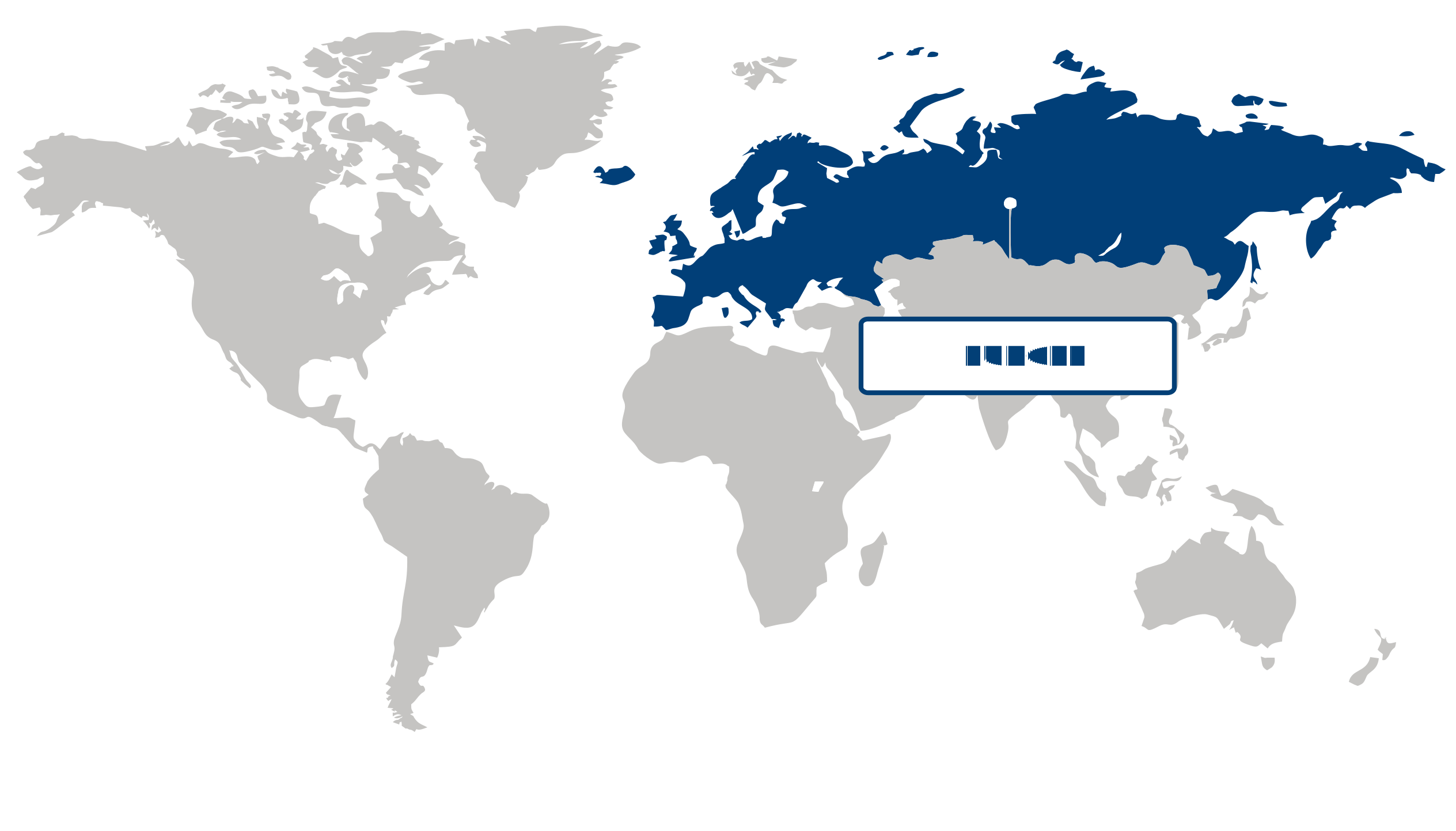
Europe (Largest Region)
Europe led the tartaric acid market, accounting for a 37.10% share in 2026, supported by the region’s established food and beverage processing industry, strong demand for wine and processed food products, and the broad use of tartaric acid as an acidity regulator and stabilizing agent. Well-developed pharmaceutical and chemical manufacturing capabilities also contribute to regional consumption, while stringent food-quality and safety standards encourage manufacturers to use reliable, standardized ingredients. The region’s mature industrial infrastructure, established agricultural supply chains, and emphasis on product quality further reinforce its position, particularly across applications involving food preservation, beverages, pharmaceuticals, and industrial formulations.
Asia Pacific (Fastest-Growing Region)
Asia Pacific is positioned as the fastest-growing regional market, driven by expanding food and beverage manufacturing, rising processed-food consumption, and increasing adoption of functional ingredients across emerging economies. Growing urbanization and changing dietary preferences are supporting demand for packaged foods, beverages, confectionery, and bakery products where tartaric acid can serve acidity, flavor, and formulation requirements. Expanding pharmaceutical and chemical processing industries are also creating additional opportunities, while improving manufacturing infrastructure and investment in regional production capacity are strengthening supply capabilities. Increasing consumer demand and the continued development of domestic processing industries are expected to support the region’s rapid market expansion.
| Parameter | North America | Asia Pacific | Europe | Latin America | MEA |
|---|---|---|---|---|---|
| Innovation Hub i Scale Nascent Developing Advanced | |||||
| Cost-Sensitive Region i Scale Low Medium High | |||||
| Regulatory Environment i Scale Restrictive Neutral Supportive | |||||
| Demand Drivers i Scale Weak Moderate Strong | |||||
| Development Stage i Scale Emerging Developing Developed | |||||
| Adoption Rate i Scale Low Medium High | |||||
| New Entrants / Startups i Scale Sparse Moderate Dense | |||||
| Macro Indicators i Scale Weak Stable Strong |
Key Country Insights
Germany 🇩🇪
Formulation Quality FocusGermany incorporates tartaric acid into food processing, specialty chemicals, and pharmaceutical applications requiring precise formulation performance. Manufacturers prioritize production efficiency, quality assurance, and sustainable sourcing practices throughout the value chain.
France 🇫🇷
Wine Industry AlignmentFrance maintains strong demand for tartaric acid through wine production alongside food and pharmaceutical applications. Producers prioritize quality control, traceable sourcing, and formulation performance that supports premium product standards.
Italy 🇮🇹
Viticulture Supply ChainItaly relies on tartaric acid for wine production while supporting broader demand from food processing and specialty manufacturing. Companies are strengthening processing efficiency, raw material utilization, and quality consistency across commercial applications.
Japan 🇯🇵
Precision Ingredient ApplicationsJapan applies tartaric acid in premium food products, pharmaceuticals, and specialty manufacturing where formulation stability is critical. Producers focus on consistent quality, process optimization, and reliable supply for high-value applications.
South Korea 🇰🇷
Process Efficiency IntegrationSouth Korea is expanding the use of tartaric acid in processed foods, nutraceuticals, and industrial manufacturing. Companies emphasize ingredient consistency, production efficiency, and compatibility with advanced processing technologies.
United States 🇺🇸
Specialty Ingredient DemandU.S. manufacturers utilize tartaric acid across food, beverages, pharmaceuticals, and industrial formulations where product consistency is essential. Companies emphasize high-purity ingredients, dependable sourcing, and compliance with evolving quality requirements.
Segment Leadership and Growth Trends
Tartaric Acid Market Share (%), by Source, 2026
Go beyond the chart, access full insights & data tables
Request Free Sample ReportSource Segment Analysis: Maleic Anhydride (Largest Segment) vs Grapes & Sun-dried Raisins (Fastest-Growing Segment)
Maleic anhydride accounted for the largest share of the tartaric acid market at 57.75% in 2026, supported by its role as an important industrial feedstock for producing synthetic tartaric acid. The synthetic route provides manufacturers with a consistent and controllable source of tartaric acid for applications requiring dependable material quality and supply. Its established industrial use across food, pharmaceutical, chemical, and other formulations supports broad demand, while the need for reliable raw-material sourcing reinforces the importance of maleic anhydride as a production pathway.
Grapes & sun-dried raisins are gaining momentum as a natural source of tartaric acid, supported by increasing interest in naturally derived ingredients and renewable raw materials. Tartaric acid obtained from grape-related sources is valued for its suitability in food and beverage applications and its association with naturally occurring ingredients. Growing consumer preference for clean-label formulations, greater interest in plant-derived inputs, and increasing utilization of agricultural by-products are creating additional opportunities for grape and raisin-based sourcing.
Application Segment Analysis: Beverages (Largest Segment) vs Food (Fastest-Growing Segment)
Beverages led the tartaric acid market with a 42.4% share in 2026, driven by the ingredient's ability to provide acidity, flavor balance, and ph control in beverage formulations. Tartaric acid is particularly useful in products where a distinctive tart profile and stable acidity are important to the finished product. Rising demand for diverse beverage formulations and increasing consumer interest in refreshing, flavored, and premium drink options continue to support tartaric acid consumption in this application.
Food applications are advancing at the fastest pace as manufacturers increasingly use tartaric acid as an acidulant, stabilizing ingredient, and formulation aid. Its functional properties support applications across confectionery, baked products, processed foods, and other categories where controlled acidity and product consistency are required. Growing demand for processed and convenience foods, alongside continued innovation in food formulations, is broadening the opportunities for tartaric acid in food applications.
| Segment | Sub-Segment | Largest Segment | Fastest Growing |
|---|---|---|---|
| Source | Grapes & Sun-dried Raisins, Maleic Anhydride, Others | Maleic Anhydride | Grapes & Sun-dried Raisins |
| Application | Food, Beverages, Pharmaceuticals, Cosmetics & Personal Care, Animal Feed, Construction, Metal Cleaning, Others | Beverages | Food |
Unlock insights tailored to your business with our bespoke market research solutions.
Click to get your customized report now.
Competitive Landscape and Market Positioning
Prominent players in the tartaric acid market:
1. Distillerie Mazzari S.p.A. (Italy)
2. Thirumalai Chemicals Limited (India)
3. Alvinesa Natural Ingredients S.A. (Spain)
4. Industria Chimica Valenzana S.p.A. (Italy)
5. Tártaros Gonzalo Castelló S.L. (Spain)
6. Comercial QuÃmica Sarasa S.L. (Spain)
7. Caviro Extra S.p.A. (Italy)
8. American Tartaric Products Inc. (United States)
9. Merck KGaA (Germany)
10. Tarac Technologies Pty Ltd. (Australia)
The tartaric acid market is witnessing steady transformation driven by expanding application requirements across multiple end-use sectors. Emphasis on refining production methods and improving output quality is pushing greater investment into research-driven enhancements. Collaborative development efforts are helping accelerate innovation cycles, while customized formulations are gaining traction to meet specialized industrial needs.
| Company | Market Share | Company Revenue | Revenue CAGR (%) | Product Portfolio | Geographic Presence | Innovation / R&D Focus | Strategic Developments |
|---|---|---|---|---|---|---|---|
| Distillerie Mazzari S.p.A. (Italy) | |||||||
| Thirumalai Chemicals Limited (India) | |||||||
| Alvinesa Natural Ingredients S.A. (Spain) | |||||||
| Industria Chimica Valenzana S.p.A. (Italy) | |||||||
| Tártaros Gonzalo Castelló S.L. (Spain) | |||||||
| Comercial Química Sarasa S.L. (Spain) | |||||||
| Caviro Extra S.p.A. (Italy) | |||||||
| American Tartaric Products Inc. (United States) | |||||||
| Merck KGaA (Germany) | |||||||
| Tarac Technologies Pty Ltd. (Australia). |
Industry Development/News
| Company Name | Date | Key Development |
|---|---|---|
| Disaronno Group | Jun-26 | Disaronno Group completed the acquisition of spirits and wine brands including Amaro Averna and Zedda Piras, following the agreement signed in May 2026. The transaction strengthens its diversified beverage and wine portfolio and expands its international footprint across approximately 160 countries, indirectly reinforcing exposure to wine-linked ingredient ecosystems relevant to tartaric acid applications in beverage formulation and processing. |
| Adani Wilmar | Jul-24 | Adani Wilmar acquired a 67% stake in Omkar Chemicals to strengthen its position in the specialty chemicals segment. The transaction enhances chemical manufacturing and supply capabilities, supporting diversification beyond its core edible oils business into industrial and specialty chemical value chains relevant to ingredient and acid-based applications. |
Customize Your Report
Explore examples of how this report can be tailored to different research needs, including custom segments, additional topics or chapters, and related reports. Click a section of the wheel or its numbered marker to explore the available options.
Tartaric Acid Market — Custom Segments
| Segment | Sub-Segment |
|---|---|
| Purity Grade | Food Grade, Pharmaceutical Grade, Industrial Grade, Technical Grade |
| Physical Form | Powder, Crystalline, Granular, Liquid Solution |
| Distribution Channel | Direct Sales, Chemical Distributors, Specialty Chemical Suppliers, Online & E-Commerce Channels |
Tartaric Acid Market — Custom TOC
| Custom Chapter | Chapter Details |
|---|---|
| Food & Beverage Application Expansion Strategy |
|
| Sustainable Raw Material Sourcing Strategy |
|
| Industrial Application Diversification Strategy |
|
Need a different cut of the data?
Request Custom ResearchWhat is the current size of the tartaric acid market?
How is the tartaric acid industry size expected to evolve during the forecast period?
Which demand trends are expanding commercial opportunities in the tartaric acid market?
How is application diversification influencing purchasing behavior in the tartaric acid market?
Why does maleic anhydride dominate tartaric acid production?
Why are grapes and sun-dried raisins the fastest-growing source of tartaric acid?
Why does Europe lead the tartaric acid market?
Why is Asia Pacific the fastest-growing region in the tartaric acid market?
Who are the leading players in the tartaric acid landscape?
Our Clients
"The report helped us understand emerging consumer trends in our product category. It clarified where to focus innovation for the next product launch."
LyondellBasell
"The regional forecast section was incredibly useful. We were able to identify two new potential partners in Europe thanks to the vendor mapping you included."
SABIC
"We appreciated how actionable the recommendations were. It guided us to improve supply chain resilience."
Olin Corporation
Our Research Team & Methodology
Every Fundamental Business Insights report is built by a dedicated vertical research team, validated through a structured primary-and-secondary methodology, and reviewed for accuracy before it reaches you.
Research Team Overview
Prepared by the Chemicals & Materials Research Team
Delivery
Published
Demand
Available
Support
Trust & Compliance
Research Intelligence
| Source | Reference |
|---|---|
| American Chemistry Council (ACC) | www.americanchemistry.com |
| European Chemical Industry Council (Cefic) | cefic.org |
| International Council of Chemical Associations (ICCA) | icca-chem.org |
| European Chemicals Agency (ECHA) | echa.europa.eu |
| U.S. Environmental Protection Agency (EPA) | www.epa.gov |
| ASTM International | www.astm.org |
| International Organization for Standardization (ISO) | www.iso.org |
| National Institute of Standards and Technology (NIST) | www.nist.gov |
| Plastics Industry Association (PLASTICS) | www.plasticsindustry.org |
| European Biplastics | www.european-bioplastics.org |
| The Adhesive and Sealant Council (ASC) | www.ascouncil.org |
| National Association of Corrosion Engineers (AMPP) | www.ampp.org |
| Society of Plastics Engineers (SPE) | www.4spe.org |
| International Fertilizer Association (IFA) | www.fertilizer.org |
| CropLife International | croplife.org |
| Packaging Europe | packagingeurope.com |
| Flexible Packaging Association (FPA) | www.flexpack.org |
| Battery Council International (BCI) | batterycouncil.org |
| International Copper Association (ICA) | internationalcopper.org |
| World Steel Association | worldsteel.org |
Research Workflow & Quality Assurance
Data Collection
Verified information gathered through primary and secondary research.
Data Triangulation
Cross-validation using multiple independent data sources.
Forecast Modelling
Market estimates developed using historical trends and analytical models.
Analyst Validation
Findings reviewed by domain experts for accuracy and consistency.
Editorial & Quality Review
Final editorial, quality, and compliance checks before publication.
Final Publication
Released after successful completion of the internal review process.
Report Coverage
📊 Market Assessment
- Market Size & Forecast
- Market Segmentation
- Regional Analysis
- Growth Drivers & Challenges
- Market Dynamics
🏢 Competitive Intelligence
- Competitive Landscape
- Company Profiles
- Competitive Benchmarking
- Mergers & Acquisitions
- Market Share Analysis or Key Company Strategies
🔍 Strategic Analysis
- Value Chain Analysis
- Porter's Five Forces
- PESTLE Analysis
- Pricing Trends
- Supply-Demand Analysis
🚀 Future Outlook
- Technology Landscape
- Regulatory Landscape
- Investment & Funding Landscape
- Emerging Opportunities
- Future Market Outlook
Have a question about this report or need a custom scope?
Request Customization