Transcritical CO2 Systems Market Size & Growth Forecast 2027–2036, By Segments (Function, Application), Regional Demand Trends (North America, Asia Pacific, Europe), Key Country Insights (U.S., Japan, South Korea, Germany, France, Italy), and Competitive Landscape
Market Size and Growth Outlook
Transcritical CO2 Systems Market size was worth USD 48 billion in 2026 and is expected to grow at a 15.49% CAGR between 2027 and 2036, attaining USD 202.62 billion by 2036. The industry revenue for 2027 is estimated at USD 54.26 billion.
Get more details on this report
Request Free Sample ReportTranscritical CO2 Systems Market Intelligence Snapshot
Regional Market Dynamics
- Europe held a 73.92% market share in 2026, driven by early adoption of natural refrigerants, widespread commercial refrigeration deployment, and regulatory support for low-GWP refrigerant technologies.
- Asia Pacific is projected to grow at an 18.14% CAGR as supermarkets, food retail networks, and cold storage facilities increasingly adopt lower-emission refrigeration technologies.
Segment Momentum
- Refrigeration held an 85.69% share in 2026 because reliable cooling remains the primary operational requirement across commercial and industrial facilities, making it the most established application of transcritical CO2 systems.
- Food Processing and Storage Facilities are the fastest-growing application as operators increasingly adopt transcritical CO2 systems for continuous cooling, product preservation, and efficient thermal management.
Market Expansion Drivers
- Stringent environmental regulations accelerating replacement of HFC-based refrigeration systems with CO2 alternatives.
- Rising demand for energy-efficient refrigeration increasing adoption of transcritical CO2 technologies.
- IoT-enabled smart monitoring and predictive maintenance improving operational efficiency of CO2 systems.
Leading Market Participants
- Prominent companies in the transcritical CO2 systems market include Danfoss A/S (Denmark), Carrier Global Corporation (United States), Emerson Electric Co. (United States), BITZER SE (Germany), Mayekawa MFG. Co., Ltd. (Japan), Hillphoenix, Inc. (United States), Advansor A/S (Denmark), SCM Frigo S.p.A. (Italy).
Global Market Forecast Snapshot
Market Outlook
- 2026 Market Size: USD 48 billion
- 2027 Estimated Market Size: USD 54.26 billion.
- Projected Market Size: USD 202.62 billion by 2036
- Growth Forecast: 15.49% CAGR (2027-2036)
Regional and Segment Outlook
- Leading Regional Market: Europe
- High-Growth Regional Hub: Asia Pacific
- Core Revenue Segment: Refrigeration (Function) | Retail (Application)
- Emerging Opportunity Segment: Heating (Function) | Food Processing and Storage Facilities (Application)
Market Growth Drivers and Industry Trends
Stringent environmental regulations accelerating replacement of HFC-based refrigeration systems with CO2 alternatives
Stronger environmental requirements concerning refrigerants are supporting the transcritical CO2 systems market by encouraging refrigeration operators to transition away from high-impact HFC-based technologies. Carbon dioxide offers a refrigerant option with a very low global warming potential, making it relevant for businesses seeking to align refrigeration infrastructure with evolving environmental standards. Regulatory pressure can also influence equipment replacement decisions during system upgrades, particularly in commercial and industrial refrigeration applications where long-term refrigerant compliance is an important consideration.
Rising demand for energy-efficient refrigeration increasing adoption of transcritical CO2 technologies
Energy performance has become an increasingly important consideration for refrigeration operators, and the transcritical CO2 systems market is gaining from demand for systems capable of supporting efficient operation under appropriate conditions. Advances in system design, heat recovery, controls, and component performance can help operators manage energy consumption while maintaining required refrigeration performance. This combination of environmental and operational considerations makes CO2-based systems increasingly attractive for facilities seeking to modernize refrigeration equipment and improve overall system efficiency.
IoT-enabled smart monitoring and predictive maintenance improving operational efficiency of CO2 systems
Integration of connected sensors, remote monitoring, and predictive maintenance capabilities is creating additional value for the transcritical CO2 systems market by improving visibility into equipment performance. IoT-enabled systems can continuously track operating conditions and identify irregularities that may indicate developing equipment issues, allowing maintenance activities to be planned before failures disrupt refrigeration operations. Real-time data can also help operators optimize system settings, monitor performance trends, and manage equipment more effectively across refrigeration facilities.
| Growth Driver | Impact on CAGR | Regulatory Influence | Geographic Relevance | Adoption Rate | Impact Timeline |
|---|---|---|---|---|---|
| Stringent environmental regulations accelerating replacement of HFC-based refrigeration systems with CO2 alternatives | 2.00% | High | Europe, North America | High | Near Term |
| Rising demand for energy-efficient refrigeration increasing adoption of transcritical CO2 technologies | 1.90% | High | Europe, Asia Pacific | High | Mid Term |
| IoT-enabled smart monitoring and predictive maintenance improving operational efficiency of CO2 systems | 1.50% | Moderate | North America, Europe | Emerging | Mid Term |
Unlock insights tailored to your business with our bespoke market research solutions.
Click to get your customized report now.
Regional Demand Dynamics
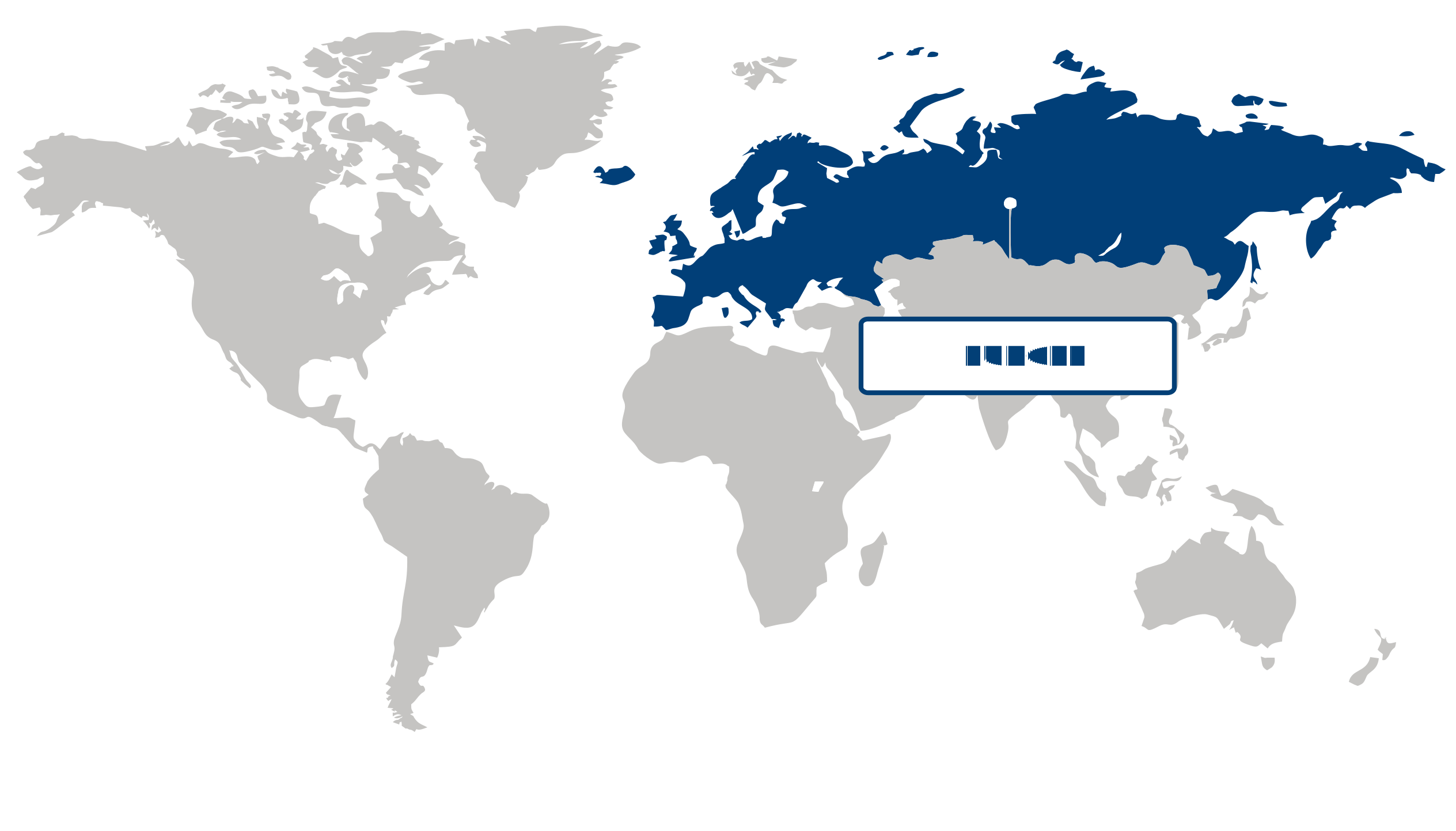
Europe (Largest Region)
In the transcritical CO2 systems market, Europe accounted for the largest share of 73.92% in 2026, reflecting strong adoption of natural refrigerants and sustained efforts to reduce the environmental impact of commercial and industrial refrigeration. Regulatory emphasis on lowering the use of high-global-warming-potential refrigerants has encouraged retailers, food distributors, and industrial operators to adopt CO2-based systems. Europe's established cold-chain infrastructure and growing investment in energy-efficient refrigeration further support deployment, particularly where businesses seek solutions that combine regulatory compliance with long-term operating efficiency.
Asia Pacific (Fastest-Growing Region)
Asia Pacific represents the fastest-growing regional market as expanding retail infrastructure, food processing, cold storage, and temperature-controlled logistics increase demand for modern refrigeration technologies. Rising urbanization and the development of organized food distribution networks are creating new applications for advanced refrigeration systems. Growing environmental awareness and efforts to improve energy efficiency are also encouraging businesses to consider natural refrigerant technologies, strengthening the adoption potential of transcritical CO2 systems across the region.
| Parameter | North America | Asia Pacific | Europe | Latin America | MEA |
|---|---|---|---|---|---|
| Innovation Hub i Scale Nascent Developing Advanced | |||||
| Cost-Sensitive Region i Scale Low Medium High | |||||
| Regulatory Environment i Scale Restrictive Neutral Supportive | |||||
| Demand Drivers i Scale Weak Moderate Strong | |||||
| Development Stage i Scale Emerging Developing Developed | |||||
| Adoption Rate i Scale Low Medium High | |||||
| New Entrants / Startups i Scale Sparse Moderate Dense | |||||
| Macro Indicators i Scale Weak Stable Strong |
Key Country Insights
Germany 🇩🇪
Energy-Efficient Cooling SolutionsGermany prioritizes transcritical CO2 systems across commercial refrigeration and industrial facilities seeking environmentally responsible cooling technologies. German system integrators emphasize energy optimization, natural refrigerants, and long-term operating efficiency in new installations and retrofits.
France 🇫🇷
Natural Refrigerant AdoptionFrance encourages the deployment of transcritical CO2 systems in commercial refrigeration projects where environmental performance is a primary consideration. Businesses in France increasingly replace conventional refrigerants with CO2-based solutions that support regulatory compliance and operational efficiency.
Italy 🇮🇹
Retail Cooling UpgradesItaly is strengthening the use of transcritical CO2 systems in supermarkets and food distribution facilities undergoing refrigeration modernization. Italian businesses prioritize dependable system performance and energy savings while transitioning toward natural refrigerant technologies.
Japan 🇯🇵
Compact Refrigeration InnovationJapan advances transcritical CO2 systems through compact, high-efficiency refrigeration designs suited for retail and convenience store applications. Companies in Japan focus on improving system reliability and operational performance in space-constrained commercial environments.
South Korea 🇰🇷
Commercial Refrigeration ModernizationSouth Korea is adopting transcritical CO2 systems across food retail and logistics facilities seeking efficient refrigeration infrastructure. Equipment suppliers in South Korea emphasize advanced controls and energy performance to support modern commercial refrigeration requirements.
United States 🇺🇸
Sustainable Refrigeration TransitionThe U.S. transcritical CO2 systems market is expanding through supermarket, cold storage, and industrial refrigeration upgrades that prioritize lower-emission technologies. Businesses in the U.S. increasingly invest in energy-efficient CO2 refrigeration systems to support evolving environmental and operational requirements.
Segment Leadership and Growth Trends
Transcritical CO2 Systems Market Share (%), by Function, 2026
Go beyond the chart, access full insights & data tables
Request Free Sample ReportFunction Segment Analysis: Refrigeration (Largest Segment) vs Heating (Fastest-Growing Segment)
Holding an 85.69% share in 2026, the refrigeration segment was the leading function within the transcritical CO2 systems market, supported by the widespread use of carbon dioxide as a natural refrigerant in commercial and industrial cooling applications. Transcritical CO2 systems provide an alternative to conventional refrigerants while supporting efficient temperature management across demanding refrigeration environments. Increasing attention to refrigerant environmental impact, energy performance, and compliance with evolving sustainability requirements continues to favor CO2-based refrigeration solutions.
Heating applications are gaining momentum as transcritical CO2 technology is increasingly considered for heat recovery and high-temperature heat pump applications. The ability of these systems to utilize recovered heat can improve overall energy utilization in commercial and industrial facilities. Growing efforts to decarbonize heating operations and integrate refrigeration and heating functions more efficiently are creating additional opportunities for this application.
Application Segment Analysis: Retail (Largest Segment) vs Food Processing and Storage Facilities (Fastest-Growing Segment)
The retail application accounted for a 74.3% share of the transcritical CO2 systems market in 2026, reflecting strong adoption in supermarkets and other food retail environments where refrigeration is essential for preserving perishable products. Retail operators require dependable cooling across display cases, storage areas, and centralized refrigeration systems, making transcritical CO2 technology well suited to integrated refrigeration needs. Increasing emphasis on energy efficiency and environmentally preferable refrigerants further supports deployment in modern retail facilities.
Food processing and storage facilities are experiencing increasing interest in transcritical CO2 systems because of their substantial and continuous refrigeration requirements. Cold storage, processing, and preservation operations depend on reliable temperature control, while energy optimization has become increasingly important for facility economics and sustainability. The suitability of CO2 systems for large-scale refrigeration and opportunities to recover and reuse heat can encourage wider adoption across food-sector facilities.
| Segment | Sub-Segment | Largest Segment | Fastest Growing |
|---|---|---|---|
| Function | Refrigeration, Heating, Air Conditioning | Refrigeration | Heating |
| Application | Retail, Heat Pumps, Food Processing and Storage Facilities, Ice Skating Rinks, Automobiles, Others | Retail | Food Processing and Storage Facilities |
Competitive Landscape and Market Positioning
Prominent players in the transcritical CO2 systems market:
1. Danfoss A/S (Denmark)
2. Carrier Global Corporation (United States)
3. Emerson Electric Co. (United States)
4. BITZER SE (Germany)
5. Mayekawa MFG. Co. Ltd. (Japan)
6. Hillphoenix Inc. (United States)
7. Advansor A/S (Denmark)
8. SCM Frigo S.p.A. (Italy)
The transcritical CO2 systems market is being shaped by stricter environmental regulations and growing demand for energy-efficient refrigeration technologies. Industry participants are investing in advanced system designs that improve cooling performance while reducing carbon emissions. Expanding adoption across commercial and industrial applications is also encouraging innovation aimed at enhancing reliability and operational flexibility.
| Company | Market Share | Company Revenue | Revenue CAGR (%) | Product Portfolio | Geographic Presence | Innovation / R&D Focus | Strategic Developments |
|---|---|---|---|---|---|---|---|
| Danfoss A/S (Denmark) | |||||||
| Carrier Global Corporation (United States) | |||||||
| Emerson Electric Co. (United States) | |||||||
| BITZER SE (Germany) | |||||||
| Mayekawa MFG. Co. Ltd. (Japan) | |||||||
| Hillphoenix Inc. (United States) | |||||||
| Advansor A/S (Denmark) | |||||||
| SCM Frigo S.p.A. (Italy). |
Industry Development/News
| Company Name | Date | Key Development |
|---|---|---|
| Danfoss | Feb-26 | Danfoss introduced a large-scale CO₂ ejector engineered to optimize thermodynamic performance in industrial refrigeration systems. By enhancing energy efficiency and reducing consumption, the technology supports the operational scalability of transcritical CO₂ systems, facilitating broader adoption within large-scale industrial cooling infrastructure and improving the competitive viability of natural refrigerant alternatives. |
| Copeland | Dec-25 | Copeland launched a transcritical CO₂ scroll compressor, broadening its existing portfolio of semi-hermetic and subcritical components. This integration supports the development of more efficient and scalable CO₂ booster system architectures, directly addressing the growing demand for improved performance in commercial and industrial refrigeration applications through standardized, integrated hardware solutions. |
| SCM Ref NZ | Sep-25 | SCM Ref NZ localized manufacturing of a standardized range of 6 to 42kW CO₂ condensing units at its Auckland facility. With over 80 systems deployed across New Zealand, this investment in regional production capacity demonstrates the increasing commercialization and modular deployment of transcritical CO₂ technology for commercial cooling applications in the region. |
| Evapco LMP | Sep-24 | Evapco LMP confirmed the installation of over 430 transcritical CO₂ systems throughout North America and Costa Rica. This deployment scale highlights significant market penetration for industrial CO₂ refrigeration solutions, signaling a robust trend toward the adoption of sustainable cooling architectures across diverse geographic and industrial segments in the region. |
| Emerson | Mar-23 | Emerson launched the Copeland 4MTLS28ME semi-hermetic reciprocating compressor, providing a 303 kBTU/hour capacity for transcritical CO₂ booster systems. As a high-displacement solution, it offers improved design flexibility and system efficiency by reducing the required number of compressors in rack configurations, thereby enhancing the operational scalability of medium-temperature refrigeration systems. |
Customize Your Report
Explore examples of how this report can be tailored to different research needs, including custom segments, additional topics or chapters, and related reports. Click a section of the wheel or its numbered marker to explore the available options.
Transcritical CO2 Systems Market — Custom Segments
| Segment | Sub-Segment |
|---|---|
| System Configuration | Booster Systems, Parallel Compression Systems, Cascade Systems, Dedicated Transcritical Systems |
| Installation Type | New Installations, Retrofit Installations, Replacement Installations |
| Component | Compressors, Gas Coolers, Evaporators, Valves and Controls, Receivers and Other Components |
Transcritical CO2 Systems Market — Custom TOC
| Custom Chapter | Custom Details |
|---|---|
| Refrigeration Decarbonization Adoption Roadmap |
|
| Natural Refrigerant Transition Readiness Assessment |
|
| Total Cost of Ownership and ROI Assessment |
|
Need a different cut of the data?
Request Custom ResearchWhat is the current revenue of the transcritical CO2 systems market?
What is the projected value of the transcritical CO2 systems industry by 2036?
How are environmental regulations influencing procurement strategies in the transcritical CO2 systems market?
How are energy efficiency and digital monitoring shaping adoption in the transcritical CO2 systems market?
Why does refrigeration dominate the transcritical CO2 systems market?
Which application segment is growing the fastest in the transcritical CO2 systems market?
Why does Europe dominate the transcritical CO2 systems market?
What is driving growth in the transcritical CO2 systems market in Asia Pacific?
Which companies are driving growth in the transcritical CO2 systems landscape?
Our Clients
"The information presented in the report was genuinely insightful. The data was clear and easy to understand, which made it much easier to interpret the findings."
Amara Raja Group
"The responsiveness and professionalism exhibited by the team were exemplary. They were readily available to address queries, provide clarifications, and offer additional insights."
ONGC
"The reports offered a comprehensive analysis of various segments within the market. The detailed insights into market trends, and regulatory landscapes were excellent."
TotalEnergies
Our Research Team & Methodology
Every Fundamental Business Insights report is built by a dedicated vertical research team, validated through a structured primary-and-secondary methodology, and reviewed for accuracy before it reaches you.
Research Team Overview
Prepared by the Energy & Power Research Team
Delivery
Published
Demand
Available
Support
Trust & Compliance
Research Domains
10 coverage areasResearch Intelligence
| Source | Reference |
|---|---|
| International Energy Agency (IEA) | www.iea.org |
| U.S. Energy Information Administration (EIA) | www.eia.gov |
| International Renewable Energy Agency (IRENA) | www.irena.org |
| International Electrotechnical Commission (IEC) | www.iec.ch |
| International Organization for Standardization (ISO) | www.iso.org |
| IEEE | www.ieee.org |
| CIGRE (International Council on Large Electric Systems) | www.cigre.org |
| World Energy Council (WEC) | www.worldenergy.org |
| U.S. Department of Energy (DOE) | www.energy.gov |
| International Atomic Energy Agency (IAEA) | www.iaea.org |
| American Petroleum Institute (API) | www.api.org |
| Society of Petroleum Engineers (SPE) | www.spe.org |
| Hydrogen Council | hydrogencouncil.com |
| Battery Council International (BCI) | batterycouncil.org |
| Global Wind Energy Council (GWEC) | gwec.net |
| SolarPower Europe | www.solarpowereurope.org |
| World Bioenergy Association (WBA) | worldbioenergy.org |
| International Hydropower Association (IHA) | www.hydropower.org |
| Edison Electric Institute (EEI) | www.eei.org |
| National Renewable Energy Laboratory (NREL) | www.nrel.gov |
Research Workflow & Quality Assurance
Data Collection
Verified information gathered through primary and secondary research.
Data Triangulation
Cross-validation using multiple independent data sources.
Forecast Modelling
Market estimates developed using historical trends and analytical models.
Analyst Validation
Findings reviewed by domain experts for accuracy and consistency.
Editorial & Quality Review
Final editorial, quality, and compliance checks before publication.
Final Publication
Released after successful completion of the internal review process.
Report Coverage
📊 Market Assessment
- Market Size & Forecast
- Market Segmentation
- Regional Analysis
- Growth Drivers & Challenges
- Market Dynamics
🏢 Competitive Intelligence
- Competitive Landscape
- Company Profiles
- Competitive Benchmarking
- Mergers & Acquisitions
- Market Share Analysis or Key Company Strategies
🔍 Strategic Analysis
- Value Chain Analysis
- Porter's Five Forces
- PESTLE Analysis
- Pricing Trends
- Supply-Demand Analysis
🚀 Future Outlook
- Technology Landscape
- Regulatory Landscape
- Investment & Funding Landscape
- Emerging Opportunities
- Future Market Outlook
Have a question about this report or need a custom scope?
Request Customization