Vehicle-to-Grid (V2G) Technology Market Size & Growth Forecast 2027–2036, By Segments (Charging, Vehicle, Component, Application), Regional Demand Trends (North America, Asia Pacific, Europe), Key Country Insights (U.S., Japan, South Korea, Germany, France, Italy), and Competitive Landscape
Jump to content
Market Size and Growth Outlook
V2G Technology Market size was assessed at USD 5.6 Billion in 2026 and is poised to grow at 38.76% CAGR between 2027 and 2036, attaining USD 148.19 Billion by 2036. The industry revenue for 2027 is calculated at USD 7.52 Billion.
Get more details on this report
Request Free Sample ReportVehicle-to-Grid (V2G) Technology Market Intelligence Snapshot
Regional Market Dynamics
- Europe led in 2026, supported by electric vehicle adoption, grid modernization, renewable integration, smart charging investment, and growing interest in flexible electricity management.
- Asia Pacific is the fastest-growing region as electric mobility, smart-grid investment, charging infrastructure, urbanization, and renewable energy expansion accelerate bidirectional charging adoption.
Segment Momentum
- Bidirectional charging accounted for 62.4% of the market in 2026 by enabling two-way energy flow between electric vehicles and the grid, improving energy management, grid flexibility, and renewable energy integration.
- Software solutions are growing fastest as intelligent energy management platforms help coordinate charging, optimize energy flows, monitor grid conditions, and support real-time communication between vehicles and utilities.
Market Expansion Drivers
- Supportive government incentives accelerating large-scale V2G infrastructure deployment
- Rapid electric vehicle adoption enabling bidirectional energy flow integration in power grids
- Grid modernization and renewable integration driving demand for distributed energy storage systems
Leading Market Participants
- Leading players in the V2G technology market include ABB Ltd. (Switzerland), Nuvve Holding Corp. (USA), Wallbox N.V. (Spain), Nissan Motor Corporation (Japan), Honda Motor Co., Ltd. (Japan), Toyota Motor Corporation (Japan), Mitsubishi Motors Corporation (Japan), Renault Group (France), Hitachi Ltd. (Japan), Fermata Energy LLC (USA)
Global Market Forecast Snapshot
Market Outlook
- 2026 Market Size: USD 5.6 Billion
- 2027 Estimated Market Size: USD 7.52 Billion
- Projected Market Size: USD 148.19 Billion by 2036
- Growth Forecast: 38.76% CAGR (2027-2036)
Regional and Segment Outlook
- Leading Regional Market: Europe
- High-Growth Regional Hub: Asia Pacific
- Core Revenue Segment: Bidirectional Charging (Charging) | BEVs (Vehicle) | Electric Vehicle Supply Equipment (EVSE) (Component) | Domestic (Application)
- Emerging Opportunity Segment: Bidirectional Charging (Charging) | BEVs (Vehicle) | Software Solutions (Component) | Commercial (Application)
Market Growth Drivers and Industry Trends
Supportive government incentives accelerating large-scale V2G infrastructure deployment
Government policies encouraging clean energy adoption and grid flexibility are creating favorable conditions for bidirectional charging infrastructure development. The V2G technology market growth is driven by incentive programs that support charging network expansion, pilot projects, infrastructure investments, and regulatory frameworks enabling vehicles to participate in electricity markets. Public-sector initiatives also reduce financial barriers for utilities, charging operators, and fleet owners, encouraging broader collaboration across the energy and transportation sectors while facilitating standardized implementation practices.
Rapid electric vehicle adoption enabling bidirectional energy flow integration in power grids
The accelerating transition toward electric mobility is expanding the number of connected batteries capable of interacting with electricity networks beyond conventional charging functions. Rising electric vehicle adoption will boost the V2G technology market demand by creating a larger installed base of mobile energy storage assets that can return electricity to the grid during periods of high demand. Bidirectional charging capabilities allow utilities to better balance supply fluctuations while enabling vehicle owners to participate in energy management programs through coordinated charging and discharging operations.
Grid modernization and renewable integration driving demand for distributed energy storage systems
Power systems are increasingly incorporating renewable energy sources whose generation profiles vary according to weather and time of day, creating greater demand for flexible balancing resources. As utilities modernize transmission and distribution infrastructure, the V2G technology market plays an important role by supporting distributed energy storage through connected electric vehicles that complement conventional grid assets. Integration with advanced grid management platforms enables more responsive energy distribution, enhances load balancing capabilities, and improves utilization of renewable electricity across decentralized power networks.
| Growth Driver | Impact on CAGR | Regulatory Influence | Geographic Relevance | Adoption Rate | Impact Timeline |
|---|---|---|---|---|---|
| Supportive government incentives accelerating large-scale V2G infrastructure deployment | 3.5% | High | Europe, Asia Pacific | High | Near Term |
| Rapid electric vehicle adoption enabling bidirectional energy flow integration in power grids | 3.8% | High | Global | High | Mid Term |
| Grid modernization and renewable integration driving demand for distributed energy storage systems | 3.6% | High | North America, Europe | Medium | Mid Term |
Unlock insights tailored to your business with our bespoke market research solutions.
Click to get your customized report now.
Regional Demand Dynamics
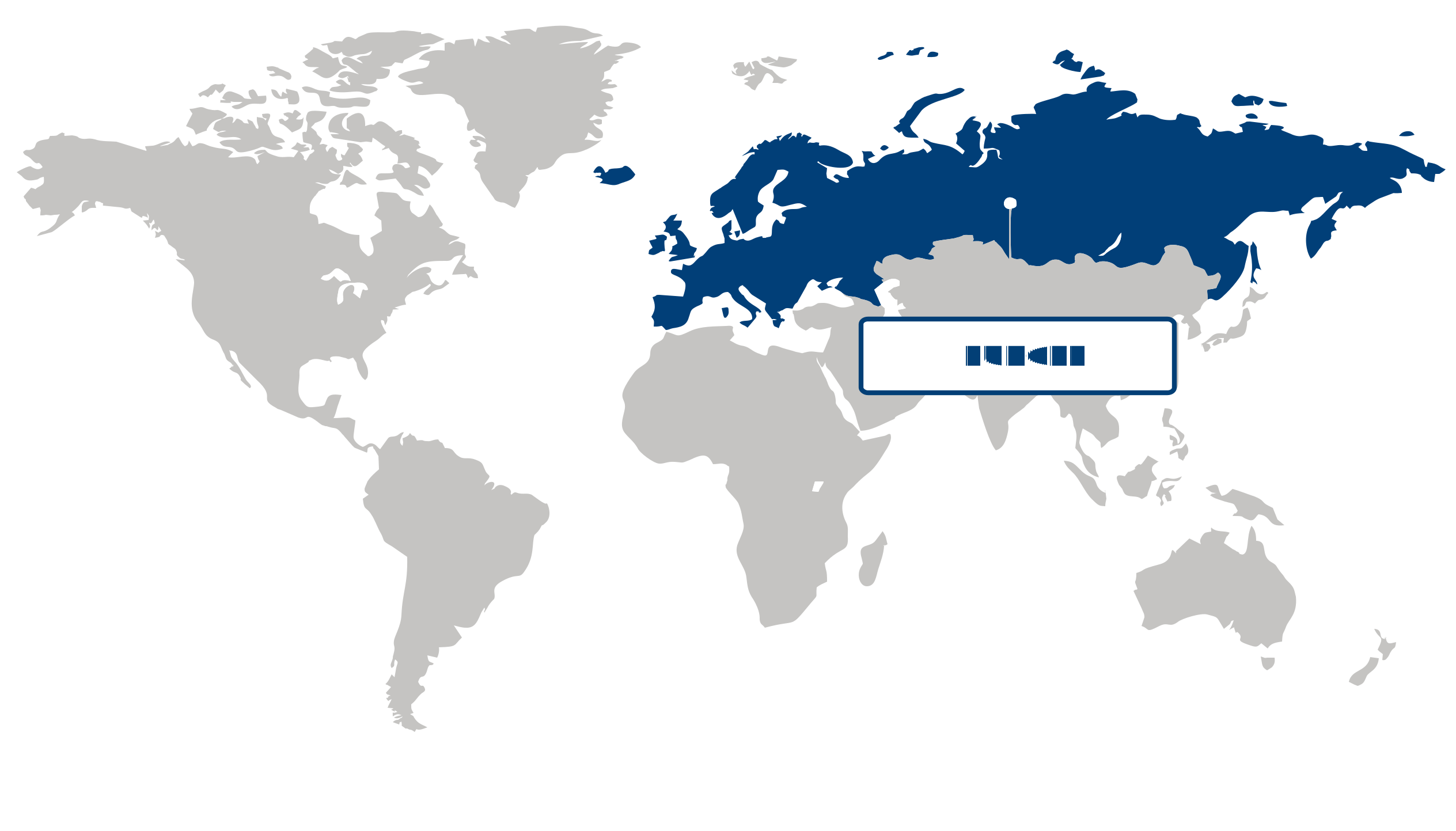
Europe (Largest Region)
Europe held the largest position in the vehicle-to-grid (V2G) technology market in 2026, supported by strong electric vehicle adoption, grid modernization efforts, and growing emphasis on integrating distributed energy resources. The region’s focus on renewable energy integration and flexible electricity management is creating a favorable environment for V2G technologies, which can enable electric vehicles to interact dynamically with the power grid. Increasing investments in smart charging infrastructure and efforts to improve grid resilience are also supporting interest in bidirectional energy flows. The combination of electrified transportation and evolving energy systems is strengthening the role of V2G within the regional clean-energy ecosystem.
Asia Pacific (Fastest-Growing Region)
Asia Pacific is expected to experience the fastest growth in the vehicle-to-grid (V2G) technology market as electric mobility expands alongside investments in smart grids and charging infrastructure. Growing deployment of electric vehicles is creating a larger potential base of mobile energy storage assets, while utilities and energy stakeholders are increasingly exploring technologies that can improve grid flexibility. Urbanization, renewable energy expansion, and efforts to modernize electricity networks are further encouraging interest in bidirectional charging solutions. As transportation and power systems become more interconnected, V2G technology is gaining relevance as a tool for supporting efficient energy management and broader electrification.
| Parameter | North America | Asia Pacific | Europe | Latin America | MEA |
|---|---|---|---|---|---|
| Innovation HubiScaleNascentDeveloping Advanced | |||||
| Cost-Sensitive RegioniScaleLowMedium High | |||||
| Regulatory EnvironmentiScaleRestrictiveNeutral Supportive | |||||
| Demand DriversiScaleWeakModerate Strong | |||||
| Development StageiScaleEmergingDeveloping Developed | |||||
| Adoption RateiScaleLowMedium High | |||||
| New Entrants / StartupsiScaleSparseModerate Dense | |||||
| Macro IndicatorsiScaleWeakStable Strong |
Key Country Insights
United States 🇺🇸
Utility Integration FocusThe U.S. is advancing vehicle-to-grid deployment through utility collaborations, smart charging platforms, and grid modernization initiatives. Commercial priorities emphasize interoperability, fleet electrification, and scalable energy management solutions that improve the value of bidirectional charging.
Germany 🇩🇪
Grid Stability AlignmentGermany is emphasizing V2G solutions that complement renewable energy integration and strengthen electricity grid flexibility. Industry participants are prioritizing standardized charging infrastructure and coordinated partnerships between automakers, utilities, and technology providers.
Japan 🇯🇵
Bidirectional Charging EcosystemJapan continues to expand V2G adoption by integrating electric vehicles into broader energy resilience strategies. The country is supporting commercial deployment through advanced charging technologies, distributed energy systems, and collaboration across automotive and power sectors.
South Korea 🇰🇷
Smart Mobility IntegrationSouth Korea is aligning V2G development with connected mobility and intelligent energy infrastructure projects. Market activity is centered on digital energy platforms, EV charging optimization, and coordinated deployment across urban transportation networks.
France 🇫🇷
Renewable Energy CoordinationFrance is incorporating vehicle-to-grid capabilities into its transition toward cleaner electricity systems and flexible energy consumption. Commercial efforts prioritize coordinated charging infrastructure, energy storage applications, and utility partnerships that improve grid responsiveness.
Italy 🇮🇹
Distributed Energy ApplicationsItaly is expanding interest in V2G technologies that support decentralized energy management and electric mobility adoption. The market is focusing on integrating charging infrastructure with renewable generation and localized grid optimization initiatives.
Vehicle-to-Grid (V2G) Technology Market Share (%), by Charging, 2026
Go beyond the chart, access full insights & data tables
Request Free Sample ReportCharging Segment Analysis: Bidirectional Charging (Largest & Fastest-Growing Segment)
The V2G technology market was led by the bidirectional charging segment, which accounted for 62.4% of the market share in 2026 while also emerging as the fastest-growing charging category. The segment's strong position is supported by its ability to enable two-way energy flow between electric vehicles and the power grid, allowing vehicles to function as distributed energy resources. This capability improves grid flexibility, supports renewable energy integration, and enhances energy management during periods of fluctuating electricity demand. Increasing focus on grid resilience, energy optimization, and intelligent charging infrastructure continues to accelerate the adoption of bidirectional charging solutions, reinforcing its leadership and long-term growth potential.
Vehicle Segment Analysis: BEVs (Largest & Fastest-Growing Segment)
The V2G technology market was dominated by the battery electric vehicle (BEV) segment, which held 68.16% of the market share in 2026 and also represented the fastest-growing vehicle category. BEVs are particularly well suited for vehicle-to-grid applications because of their fully electric architecture and larger battery capacities, enabling efficient energy exchange with the grid. Expanding adoption of battery electric vehicles, supportive charging infrastructure development, and growing interest in smart energy ecosystems are strengthening demand for V2G-compatible BEVs. As utilities and vehicle owners increasingly recognize the value of flexible energy storage and grid support, the segment is expected to maintain its leading position.
Component Segment Analysis: Electric Vehicle Supply Equipment (EVSE) (Largest Segment) vs Software Solutions (Fastest-Growing Segment)
Electric vehicle supply equipment (EVSE) represented the largest component segment in 2026, reflecting its fundamental role in enabling safe, reliable, and efficient vehicle-to-grid charging operations. EVSE infrastructure serves as the physical interface between electric vehicles and the electricity network, supporting energy transfer, communication, and charging management. Continued investments in public and private charging infrastructure, together with increasing deployment of V2G-enabled charging stations, have reinforced the segment's dominant position.
In the V2G technology market, the software solutions segment is anticipated to witness the fastest growth as advanced energy management platforms become increasingly important for coordinating charging schedules, monitoring grid conditions, optimizing energy flows, and supporting real-time communication between vehicles and utilities. Growing adoption of intelligent grid technologies and digital energy management systems is driving demand for sophisticated software capable of maximizing the operational benefits of V2G networks.
| Segment | Sub-Segment | Largest Segment | Fastest Growing |
|---|---|---|---|
| Charging | Unidirectional Charging, Bidirectional Charging | Bidirectional Charging | Bidirectional Charging |
| Vehicle | BEVs, PHEVs, FCVs | BEVs | BEVs |
| Component | Smart Meters, Electric Vehicle Supply Equipment (EVSE), Home Energy Management, Software Solutions | Electric Vehicle Supply Equipment (EVSE) | Software Solutions |
| Application | Domestic, Commercial | Domestic | Commercial |
Competitive Landscape and Market Positioning
Prominent players in the vehicle-to-grid (V2G) technology market:
- ABB Ltd. (Switzerland)
- Nuvve Holding Corp. (USA)
- Wallbox N.V. (Spain)
- Nissan Motor Corporation (Japan)
- Honda Motor Co., Ltd. (Japan)
- Toyota Motor Corporation (Japan)
- Mitsubishi Motors Corporation (Japan)
- Renault Group (France)
- Hitachi Ltd. (Japan)
- Fermata Energy LLC (USA)
The market is evolving around the ability to coordinate energy, mobility, and digital infrastructure within a single operating framework, encouraging participants to strengthen expertise in bidirectional charging, intelligent energy management, and grid communication. Rather than competing solely on charging hardware, suppliers are developing software-centric platforms that optimize energy flows, accommodate diverse vehicle platforms, and respond to changing grid conditions in real time. As deployment environments become more complex, interoperability, cybersecurity, and integration with utility and fleet management systems are emerging as critical differentiators for vendors seeking long-term adoption.
| Company | Market Share | Company Revenue | Revenue CAGR (%) | Product Portfolio | Geographic Presence | Innovation / R&D Focus | Strategic Developments |
|---|---|---|---|---|---|---|---|
| ABB Ltd. (Switzerland) | |||||||
| Nuvve Holding Corp. (USA) | |||||||
| Wallbox N.V. (Spain) | |||||||
| Nissan Motor Corporation (Japan) | |||||||
| Honda Motor Co. Ltd. (Japan) | |||||||
| Toyota Motor Corporation (Japan) | |||||||
| Mitsubishi Motors Corporation (Japan) | |||||||
| Renault Group (France) | |||||||
| Hitachi Ltd. (Japan) | |||||||
| Fermata Energy LLC (USA) |
Industry Development / News
| Company Name | Date | Key Development |
|---|---|---|
| General Motors | Jun-26 | General Motors announced plans to manufacture sodium-ion batteries for grid-scale energy storage and expand bidirectional charging capabilities across its electric vehicle portfolio. This initiative strengthens the company’s competitive position in the vehicle-to-grid market by integrating stationary storage and vehicle-based grid services into its core energy ecosystem. |
| Octopus Energy | Jun-26 | Octopus Energy partnered with CATL to deploy a battery-swapping network for electric trucks across Europe. The initiative aims to reduce charging downtime to minutes while supporting broader electrification and enabling future grid integration for commercial EV fleets, representing a significant infrastructure development for high-capacity V2G applications. |
| E.ON | May-26 | E.ON announced plans to acquire OVO Energy to bolster its smart home energy services, including EV charging and future vehicle-to-grid capabilities. This acquisition is designed to expand E.ON’s integrated energy management offerings, consolidating its market position in residential smart energy distribution and grid-interactive technologies. |
| Volkswagen | Apr-26 | Volkswagen, via its energy brand Elli, announced the commercial rollout of a V2G offering in Germany by late 2026. The service will enable EV owners to participate in bidirectional charging to lower ownership costs while generating value through grid-balancing services, signaling a shift toward mass-market commercialization of bidirectional technology. |
| CSIRO | Feb-26 | CSIRO completed a AU$3 million expansion of its Renewable Energy Integration Facility in Australia. This upgrade enhances testing capabilities for vehicle-to-grid technologies and advanced EV-grid integration, providing critical infrastructure to support the validation and commercial standardization of bidirectional charging solutions in the region. |
| BMW | Sep-25 | BMW introduced bidirectional V2G charging for its Neue Klasse electric vehicles, allowing customers to export electricity back to the grid. By integrating vehicle-to-grid capabilities directly into its next-generation platform, BMW is enabling users to reduce charging costs through active participation in energy management and utility-led grid programs. |
| Amber | Jul-25 | Amber secured AU$45 million in funding to accelerate the development of its V2G technology platform and support expansion into UK and European markets. This capital infusion strengthens the company’s international growth strategy and underscores the rising investment activity directed toward independent V2G platform providers. |
| BYD | Jun-25 | BYD partnered with Octopus Energy to launch the UK's first V2G bundle, combining a bidirectional-capable EV, home charger, and smart energy tariff. This commercial package facilitates consumer participation in grid services, demonstrating a integrated approach to scaling V2G adoption through unified hardware and software offerings. |
| ABB | Feb-24 | ABB launched its Terra V2G high-power bidirectional chargers in North America, targeting fleet operators and utilities. The new line includes cloud-integrated load management and cybersecurity-compliant firmware for large-scale municipal and commercial deployment, positioning ABB at the forefront of industrial-grade infrastructure development for the grid-interactive EV sector. |
| Hitachi Energy | Feb-24 | Hitachi Energy launched its "GridSync" grid-edge software suite to enable dynamic control of EV fleets as virtual power plants. Deployed with utility partners in Europe for pilot testing, the system integrates smart metering and load balancing to orchestrate fleet-wide bidirectional energy feedback, marking a significant step in smart energy management. |
Customize Your Report
Explore examples of how this report can be tailored to different research needs, including custom segments, additional topics or chapters, and related reports. Click a section of the wheel or its numbered marker to explore the available options.
Vehicle-to-Grid (V2G) Technology Market — Custom Segments
| Segment | Sub-Segment |
|---|---|
| Energy Service | Peak Load Management, Demand Response, Frequency Regulation, Renewable Energy Integration, Backup Power |
| Revenue Model | Energy Arbitrage, Grid Services, Capacity Services, Subscription-Based Services, Aggregated Flexibility Services |
| Grid Integration | Distribution Grid, Transmission Grid, Microgrids, Renewable Energy Systems |
Vehicle-to-Grid (V2G) Technology Market — Custom TOC
| Custom Chapter | Chapter Details |
|---|---|
| V2G Revenue Model Assessment |
|
| Fleet Electrification & V2G Deployment Roadmap |
|
| Grid Services Opportunity Mapping |
|
Need a different cut of the data?
Request Custom ResearchFrequently Asked Questions
How much is the vehicle-to-grid (V2G) technology market worth?
What is the anticipated CAGR of the vehicle-to-grid technology industry?
What is driving investment in Vehicle-to-Grid infrastructure?
How does growing electric vehicle adoption support the V2G technology market?
Why does bidirectional charging lead the V2G technology market?
Why are software solutions the fastest-growing component in the V2G technology market?
Why does Europe lead the vehicle-to-grid technology market?
How is Asia Pacific driving future V2G technology growth?
What are the key competitors in the vehicle-to-grid technology landscape?
Our Clients
"The team surpassed our expectations with the report depth. The actionable insights provided proved crucial in navigating market challenges."
Tata Motors
"We found the report to be very informative. The expertise and attention to market nuances significantly influenced our business direction."
DENSO Corporation
"The consumer survey findings were quite good. We now have a clearer picture of the customer churning and retention strategy."
HL Mando
Our Research Team & Methodology
Every Fundamental Business Insights report is built by a dedicated vertical research team, validated through a structured primary-and-secondary methodology, and reviewed for accuracy before it reaches you.
Delivery
Published
Available
Support
- Market Size & Forecast
- Market Segmentation
- Regional Analysis
- Growth Drivers & Challenges
- Market Dynamics
- Competitive Landscape
- Company Profiles
- Competitive Benchmarking
- Mergers & Acquisitions
- Market Share Analysis or Key Company Strategies
- Value Chain Analysis
- Porter's Five Forces
- PESTLE Analysis
- Pricing Trends
- Supply-Demand Analysis
- Technology Landscape
- Regulatory Landscape
- Investment & Funding Landscape
- Emerging Opportunities
- Future Market Outlook