



Virtual Pipeline Market Size & Growth Forecast 2027–2036, By Segments (End Use, Mode of Transportation, Fuel), Regional Demand Trends (North America, Asia Pacific, Europe), Key Country Insights (U.S., Japan, South Korea, Germany, France, Italy), and Competitive Landscape
Market Size and Growth Outlook
Virtual Pipeline Market size was worth USD 2.66 Billion in 2026 and is expected to grow at 6.15% CAGR between 2027 and 2036, reaching USD 4.83 Billion by 2036. The industry revenue for 2027 is assessed at USD 2.8 Billion.
Base Year Value (2026)
USD 2.66 Billion
CAGR (2027-2036)
6.15%
Forecast Year Value (2036)
USD 4.83 Billion

Historical Data Period
2022-2026

Largest Region
Europe

Forecast Period
2027-2036
Virtual Pipeline Market Intelligence Snapshot:
-
Regional Market Dynamics:
- Europe led in 2025 as energy security, gas supply diversification, and demand from locations without viable conventional pipelines support flexible gas delivery.
- Asia Pacific is the fastest-growing region, fueled by industrialization, rising energy demand, cleaner-fuel investment, and expanding gas access in underserved areas.
-
Segment Momentum:
- CNG was the largest fuel segment in 2025 because it is widely used as a cleaner alternative fuel and provides a practical solution for supplying natural gas to areas without pipeline infrastructure.
- LNG is expected to record the fastest growth due to its higher energy density, efficient long-distance transportation capabilities, and increasing demand for flexible and reliable cleaner fuel distribution.
-
Market Expansion Drivers:
- Expanding remote industrial gas supply needs driving virtual pipeline adoption
- Rising LNG distribution flexibility requirements boosting mobile gas transport solutions
- Infrastructure constraints in remote regions increasing off-grid energy logistics demand
-
Leading Market Participants:
Prominent players in the virtual pipeline market include Kinder Morgan, Inc. (United States), Stabilis Solutions, Inc. (United States), Hexagon Agility (United States), Air Products and Chemicals, Inc. (United States), Aggreko plc (United Kingdom), Snam S.p.A. (Italy), Petroliam Nasional Berhad (PETRONAS) (Malaysia), NG Advantage LLC (United States), Galileo Technologies S.A. (Argentina), Xpress Natural Gas LLC (United States)
Global Market Forecast Snapshot:
-
Market Outlook:
- 2026 Market Size: USD 2.66 Billion
- 2027 Estimated Market Size: USD 2.8 Billion
- Projected Market Size: USD 4.83 Billion by 2036
- Growth Forecasts: 6.15% CAGR (2027-2036)
-
Regional and Segment Outlook:
- Leading Regional Market: Europe
- High-Growth Regional Hub: Asia Pacific
- Core Revenue Segment: Industrial (End Use) | Truck (Mode of Transportation) | CNG (Fuel)
- Emerging Opportunity Segment: Industrial (End Use) | Truck (Mode of Transportation) | LNG (Fuel)
Market Growth Drivers and Industry Trends
Expanding remote industrial gas supply needs driving virtual pipeline adoption
Industrial operations located far from conventional pipeline infrastructure are increasingly seeking dependable alternatives for the transportation of natural gas and industrial gases, creating favorable conditions for the virtual pipeline market. Mining sites, manufacturing facilities, power generation plants, and other remote operations require uninterrupted fuel supply to maintain productivity, making mobile gas delivery systems an attractive solution. Virtual pipeline networks enable compressed or liquefied gas to be transported by specialized trailers, reducing dependence on costly fixed infrastructure while improving supply flexibility. This approach also allows industrial users to expand operations in underserved locations without waiting for permanent pipeline construction or extensive utility network development.
Rising LNG distribution flexibility requirements boosting mobile gas transport solutions
The growing need for flexible liquefied natural gas distribution across diverse end-user locations will propel the virtual pipeline market growth as energy suppliers prioritize efficient transportation models that can adapt to changing consumption patterns. Mobile LNG transport solutions allow distributors to serve industrial facilities, commercial users, and regional energy networks through scalable delivery schedules without requiring continuous pipeline connectivity. This flexibility supports seasonal demand variations, temporary energy requirements, and emerging industrial projects while enabling suppliers to optimize logistics and improve asset utilization. The ability to rapidly redirect gas deliveries according to operational needs strengthens the role of virtual pipeline systems within modern energy distribution strategies.
Infrastructure constraints in remote regions increasing off-grid energy logistics demand
Limited pipeline infrastructure across isolated and geographically challenging regions is strengthening demand for alternative energy transportation systems, driving wider adoption across the virtual pipeline market. Many remote communities and industrial developments face significant barriers to conventional pipeline construction due to terrain, investment requirements, and extended project timelines. Virtual pipeline solutions provide an effective means of delivering reliable gas supplies through road-based transportation, supporting off-grid energy applications where permanent infrastructure is economically impractical. These systems also improve energy accessibility for developing industrial clusters and decentralized facilities by enabling consistent fuel availability without extensive network expansion.
| Growth Driver Assessment Framework | |||||
| Growth Driver | Impact On CAGR | Regulatory Influence | Geographic Relevance | Adoption Rate | Impact Timeline |
|---|---|---|---|---|---|
| Expanding remote industrial gas supply needs driving virtual pipeline adoption | 1.9% | High | Asia Pacific, North America | High | Near Term |
| Rising LNG distribution flexibility requirements boosting mobile gas transport solutions | 1.8% | High | Europe, Asia Pacific | High | Mid Term |
| Infrastructure constraints in remote regions increasing off-grid energy logistics demand | 1.7% | High | Latin America, Africa | Emerging | Mid Term |
Unlock insights tailored to your business with our bespoke market research solutions - Click to get your customized report now!
Regional Demand Dynamics
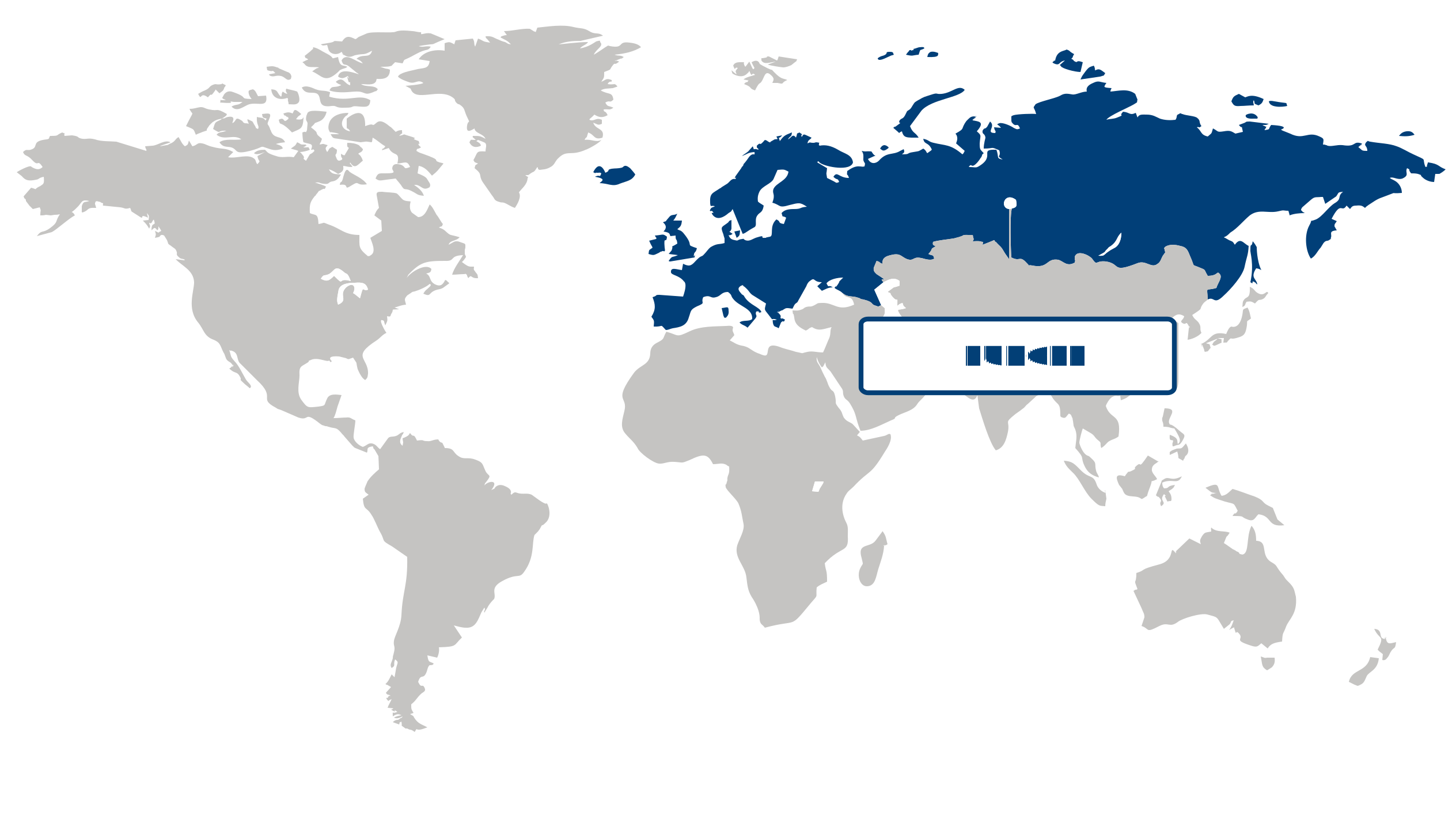
Largest Region
Europe
Largest Market Share in 2026
Europe (Largest Region) vs Asia Pacific (Fastest-Growing Region)
Europe held the largest position in the virtual pipeline market in 2026, supported by the region's focus on energy security, diversification of gas supply, and the need to serve locations where conventional pipeline infrastructure is unavailable or economically difficult to extend. Virtual pipeline systems provide flexibility in transporting compressed or liquefied gas to remote industrial facilities, commercial users, and communities, making them valuable for decentralized energy distribution. Growing efforts to strengthen energy resilience and improve access to cleaner-burning fuels are also supporting demand, while industrial and infrastructure applications continue to create opportunities for mobile and flexible gas delivery solutions.
Asia Pacific is emerging as the fastest-growing region in the virtual pipeline market as industrialization, urbanization, and expanding energy demand increase the need for flexible gas distribution solutions. Remote industrial areas and locations with limited pipeline connectivity can benefit from virtual pipeline systems that provide access to natural gas without requiring extensive fixed infrastructure. Growing investment in cleaner energy sources, efforts to reduce reliance on more polluting fuels, and expanding industrial and commercial activity are further encouraging adoption. The ability to rapidly extend gas access to underserved locations is particularly relevant across developing economies with evolving energy infrastructure.
No card data available for this language/report.
Segment Leadership and Growth Trends
End Use Segment Analysis: Industrial (Largest & Fastest-Growing Segment)
Industrial segment dominated the virtual pipeline market in 2026 and also represented the fastest-growing segment, driven by the increasing requirement for flexible and reliable energy transportation solutions across industrial facilities. Virtual pipeline systems enable the delivery of natural gas and other energy sources to locations where traditional pipeline infrastructure may not be practical or economically viable. The growing focus on cleaner energy utilization, operational efficiency, and dependable fuel supply for industrial operations is supporting the adoption of virtual pipeline solutions.
Mode of Transportation Segment Analysis: Truck (Largest & Fastest-Growing Segment)
Truck segment led the virtual pipeline market in 2026 and also emerged as the fastest-growing segment due to its flexibility, accessibility, and ability to support energy distribution across diverse locations. Truck-based transportation provides an efficient solution for delivering compressed or liquefied fuels to areas with limited pipeline connectivity. The adaptability of trucking networks, ease of deployment, and suitability for short- and medium-distance fuel transportation are contributing to the segment’s strong market position.
Fuel Segment Analysis: CNG (Largest Segment) vs LNG (Fastest-Growing Segment)
CNG segment accounted for the largest share of the virtual pipeline market in 2026, supported by its established use as a cleaner alternative fuel and its suitability for distributed energy supply applications. CNG-based virtual pipelines provide a practical solution for transporting natural gas to areas lacking direct pipeline access while supporting industrial and commercial energy requirements. The availability of supporting infrastructure and operational familiarity continue to strengthen demand for CNG applications.
LNG segment is experiencing faster growth as increasing demand for higher energy-density fuel transportation solutions encourages adoption across various applications. LNG enables efficient transportation over longer distances and supports energy supply flexibility for regions requiring alternative gas delivery methods. The growing emphasis on cleaner fuels and expanding requirements for reliable energy distribution are contributing to increased interest in LNG-based virtual pipeline systems.
| Report Segmentation | |||
| Segment | Sub-Segment | Largest Segment | Fastest Growing Segment |
|---|---|---|---|
| End Use | Commercial, Industrial, Transportation | Industrial | Industrial |
| Mode of Transportation | Truck, Rail, Ship, Barge | Truck | Truck |
| Fuel | CNG, LNG, Others | CNG | LNG |
 Read our Research Approach
Competitive Landscape and Market Positioning
Prominent players in the virtual pipeline market:
- Kinder Morgan, Inc. (United States)
- Stabilis Solutions, Inc. (United States)
- Hexagon Agility (United States)
- Air Products and Chemicals, Inc. (United States)
- Aggreko plc (United Kingdom)
- Snam S.p.A. (Italy)
- Petroliam Nasional Berhad (PETRONAS) (Malaysia)
- NG Advantage LLC (United States)
- Galileo Technologies S.A. (Argentina)
- Xpress Natural Gas LLC (United States)
Market participants are broadening competition by expanding beyond conventional gas transportation services toward integrated delivery models capable of serving diverse industrial, commercial, and remote energy applications. Greater emphasis is being placed on logistics optimization, storage flexibility, and reliable supply coordination, reflecting customer demand for dependable energy access in locations lacking permanent pipeline infrastructure. Differentiation is also emerging through advancements in transport equipment, digital fleet monitoring, and operational efficiency, enabling suppliers to improve service responsiveness while adapting to changing regulatory expectations and evolving fuel preferences across regional markets.
Industry Development/News
| Company Name | Date | Key Development |
|---|---|---|
| U.S. Trade and Development Agency (USTDA) | Jul-26 | The USTDA funded a comprehensive feasibility study for a small-scale LNG facility in Nigeria. The project evaluates decentralized gas delivery infrastructure designed to supply remote industrial end-users and communities through a flexible virtual pipeline LNG distribution network. |
| Portland Gas Limited | May-26 | Portland Gas Limited, in partnership with Nigeria’s Midstream and Downstream Gas Infrastructure Fund, successfully commissioned a 96,000 Standard Cubic Metres capacity compressed natural gas daughter station, scaling up regional cleaner gas virtual distribution infrastructure. |
| PT Likuid Nusantara Gas | Feb-26 | PT Likuid Nusantara Gas inaugurated Indonesia's inaugural modular micro LNG facility utilizing Galileo Technologies' proprietary Cryobox technology. The deployment establishes localized, highly scalable modular LNG infrastructure optimized for flexible gas supply applications in underserved regions. |
| Sarawak Energy | Dec-25 | Sarawak Energy announced that its proprietary Virtual Pipeline System, designed to transport LNG from Bintulu to Kuching, is scheduled to commence commercial operations in Q1 2026, establishing a major new regional gas supply network. |
| Endurance Group | Nov-25 | Endurance Group entered a strategic partnership with Nigeria’s Midstream and Downstream Gas Infrastructure Fund to construct 500 compressed natural gas refueling stations nationwide by 2028, driving significant structural expansion of the country's downstream CNG distribution footprint. |
| NNPC Gas Marketing Limited | Apr-25 | NNPC Gas Marketing Limited acquired a 15% equity stake in Starzs Gas Limited’s compressed natural gas facility in Delta State. The transaction strengthens the company's financial and operational participation in decentralized CNG processing and downstream distribution networks. |
| Naturgy | Sep-24 | Naturgy partnered with biomethane developer CycleØ to launch Spain’s first virtual gas pipeline system. The operational model enables the distribution of renewable gas to off-grid industrial locations lacking direct connection to traditional pipeline infrastructure. |
| Gas Malaysia Green Ventures | Apr-24 | Gas Malaysia Green Ventures finalized a collaboration agreement with FGV Palm Industries to acquire purified biogas for conversion into biomethane, securing commercial feedstock supplies to support alternative renewable gas virtual pipeline networks. |
| Kinder Morgan | Aug-22 | Kinder Morgan acquired North American Natural Resources, Inc. and North American BiofueLLC for USD 135 million, investing an additional USD 175 million to convert power plants in Michigan and Kentucky into renewable natural gas facilities, substantially advancing its sustainable distribution infrastructure and supply capabilities. |
| Petronas | Sep-20 | Petronas commercialized its customer-centric Virtual Pipeline System solution via its Peninsular Malaysia Regasification Terminal. Managed through PETRONAS Dagangan Berhad, the system utilizes specialized cryogenic trucks to deliver liquefied natural gas directly to off-grid industrial consumers. |
Why Choose Us
Specialized Expertise: Our team comprises industry experts with a deep understanding of your market segment. We bring specialized knowledge and experience that ensures our research and consulting services are tailored to your unique needs.
Customized Solutions: We understand that every client is different. That's why we offer customized research and consulting solutions designed specifically to address your challenges and capitalize on opportunities within your industry.
Proven Results: With a track record of successful projects and satisfied clients, we have demonstrated our ability to deliver tangible results. Our case studies and testimonials speak to our effectiveness in helping clients achieve their goals.
Cutting-Edge Methodologies: We leverage the latest methodologies and technologies to gather insights and drive informed decision-making. Our innovative approach ensures that you stay ahead of the curve and gain a competitive edge in your market.
Client-Centric Approach: Your satisfaction is our top priority. We prioritize open communication, responsiveness, and transparency to ensure that we not only meet but exceed your expectations at every stage of the engagement.
Continuous Innovation: We are committed to continuous improvement and staying at the forefront of our industry. Through ongoing learning, professional development, and investment in new technologies, we ensure that our services are always evolving to meet your evolving needs.
Value for Money: Our competitive pricing and flexible engagement models ensure that you get maximum value for your investment. We are committed to delivering high-quality results that help you achieve a strong return on your investment.
Select Licence Type

