Waste Heat Recovery System Market Size & Growth Forecast 2027–2036, By Segments (Application, Phase System, End-use), Regional Demand Trends (North America, Asia Pacific, Europe), Key Country Insights (U.S., Japan, South Korea, Germany, France, Italy), and Competitive Landscape
Market Size and Growth Outlook
Waste Heat Recovery System Market size was more than USD 68.4 billion in 2026 and is set to grow at a 8.84% CAGR between 2027 and 2036, attaining USD 159.57 billion by 2036. The industry revenue for 2027 is calculated at USD 73.49 billion.
Get more details on this report
Request Free Sample ReportWaste Heat Recovery System Market Intelligence Snapshot
Regional Market Dynamics
- Europe accounts for a 32.29% share due to energy-intensive industries and strong regulatory pressure to improve efficiency across cement, metal, chemical, and power generation sectors.
- Asia Pacific is growing at an 11.3% CAGR, driven by expanding industrial capacity, rising energy demand, and increased adoption of heat recovery systems to improve operational efficiency.
Segment Momentum
- Power & Steam Generation leads the market because it converts recovered thermal energy into usable power or steam, directly supporting energy cost savings and operational efficiency in industrial facilities.
- Liquid-gas Phase Systems are expanding fastest as industries focus on recovering heat from exhaust and flue gases, unlocking additional efficiency opportunities from high-temperature waste heat streams.
Market Expansion Drivers
- Industrial decarbonization mandates driving large-scale deployment of waste heat recovery systems.
- Rising energy cost pressures increasing adoption of efficiency-focused heat recovery solutions.
- Integration of digital monitoring systems improving WHR efficiency and predictive maintenance.
Leading Market Participants
- Prominent companies in the waste heat recovery system market include Siemens Energy AG (Germany), Mitsubishi Heavy Industries, Ltd. (Japan), General Electric Company (United States), ABB Ltd. (Switzerland), Turboden S.p.A. (Italy), Bosch Industriekessel GmbH (Germany), Exergy International S.r.l. (Italy), Forbes Marshall Pvt. Ltd. (India), IHI Corporation (Japan), Ormat Technologies, Inc. (United States).
Global Market Forecast Snapshot
Market Outlook
- 2026 Market Size: USD 68.4 billion
- 2027 Estimated Market Size: USD 73.49 billion.
- Projected Market Size: USD 159.57 billion by 2036
- Growth Forecast: 8.84% CAGR (2027-2036)
Regional and Segment Outlook
- Leading Regional Market: Europe
- High-Growth Regional Hub: Asia Pacific
- Core Revenue Segment: Power & Steam Generation (Application) | Liquid-liquid Phase System (Phase System) | Petroleum Refinery (End-use)
- Emerging Opportunity Segment: Pre Heating (Application) | Liquid-gas Phase System (Phase System) | Petroleum Refinery (End-use)
Market Growth Drivers and Industry Trends
Industrial decarbonization mandates driving large-scale deployment of waste heat recovery systems
Industrial decarbonization mandates are expected to drive the waste heat recovery system market as energy-intensive industries seek technologies that reduce fuel consumption and improve the utilization of existing energy resources. Waste heat recovery systems capture thermal energy that would otherwise be released into the environment and redirect it for useful heating, power generation, or process applications. Their ability to improve energy utilization while supporting emissions-reduction objectives makes these systems increasingly relevant to industrial facilities pursuing lower-carbon operating models.
Rising energy cost pressures increasing adoption of efficiency-focused heat recovery solutions
Rising energy cost pressures will strengthen demand in the waste heat recovery system market as industrial operators focus on extracting greater value from every unit of energy consumed. Recovering heat from exhaust gases and other industrial processes can reduce the amount of additional energy required to maintain production operations, supporting more efficient facility performance. This economic incentive is particularly relevant for energy-intensive processes where recurring thermal losses represent an opportunity to improve operating efficiency and manage energy expenditure.
Integration of digital monitoring systems improving WHR efficiency and predictive maintenance
Integration of digital monitoring technologies will propel the waste heat recovery system market by enabling operators to track system performance, identify efficiency deviations, and improve maintenance planning. Sensors, connected monitoring platforms, and data-driven analysis can provide greater visibility into temperature conditions, heat transfer performance, and equipment operating behavior. Such capabilities support predictive maintenance by helping operators identify potential performance issues before they result in significant operational disruption, while continuous monitoring can assist in maintaining effective heat recovery across changing industrial conditions.
| Growth Driver | Impact on CAGR | Regulatory Influence | Geographic Relevance | Adoption Rate | Impact Timeline |
|---|---|---|---|---|---|
| Industrial decarbonization mandates driving large-scale deployment of waste heat recovery systems | 2.30% | High | Europe, North America | High | Near Term |
| Rising energy cost pressures increasing adoption of efficiency-focused heat recovery solutions | 2.00% | Moderate | Asia Pacific, Europe | High | Near Term |
| Integration of digital monitoring systems improving WHR efficiency and predictive maintenance | 1.40% | Moderate | North America, Asia Pacific | Emerging | Mid Term |
Unlock insights tailored to your business with our bespoke market research solutions.
Click to get your customized report now.
Regional Demand Dynamics
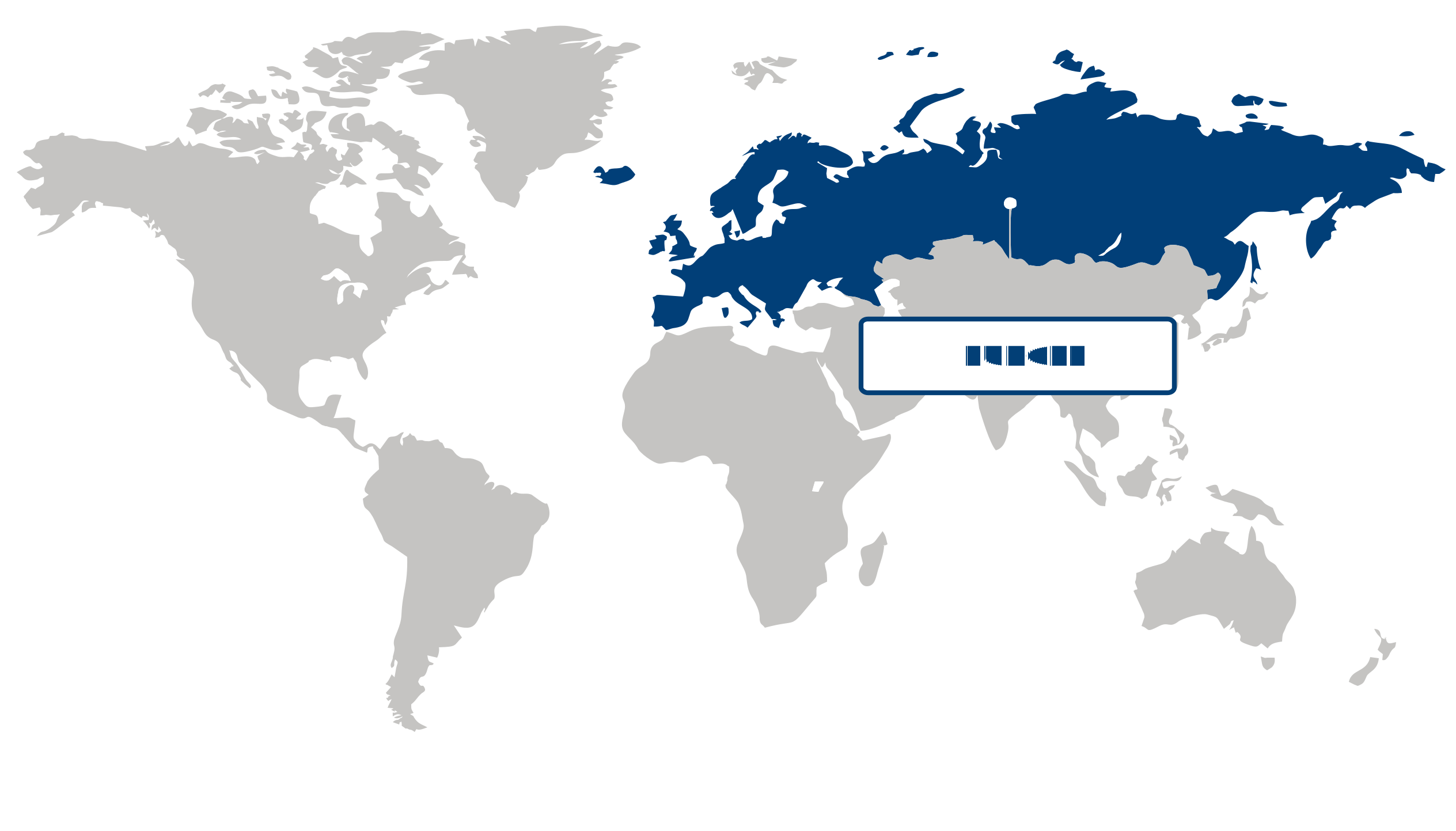
Europe (Largest Region)
In the waste heat recovery system market, Europe held the largest share of 32.29% in 2026, supported by stringent energy-efficiency priorities and the region’s focus on reducing industrial energy consumption and emissions. Energy-intensive sectors are increasingly evaluating methods to capture and reuse heat generated during industrial processes, helping improve operational efficiency while supporting decarbonization objectives. The presence of mature industrial infrastructure and continued investment in energy optimization technologies is reinforcing demand for waste heat recovery solutions across manufacturing and processing facilities.
Asia Pacific (Fastest-Growing Region)
Asia Pacific represents the fastest-growing region, driven by expanding industrialization, rising energy requirements, and increasing pressure on industries to improve energy efficiency. Growth in manufacturing and process-intensive activities is creating a wider base of facilities where recovered heat can be reused for power generation, heating, or other operational needs. Greater attention to industrial emissions, energy conservation, and modernization of production infrastructure is encouraging investment in heat recovery technologies, strengthening the region’s growth prospects.
| Parameter | North America | Asia Pacific | Europe | Latin America | MEA |
|---|---|---|---|---|---|
| Innovation Hub i Scale Nascent Developing Advanced | |||||
| Cost-Sensitive Region i Scale Low Medium High | |||||
| Regulatory Environment i Scale Restrictive Neutral Supportive | |||||
| Demand Drivers i Scale Weak Moderate Strong | |||||
| Development Stage i Scale Emerging Developing Developed | |||||
| Adoption Rate i Scale Low Medium High | |||||
| New Entrants / Startups i Scale Sparse Moderate Dense | |||||
| Macro Indicators i Scale Weak Stable Strong |
Key Country Insights
Germany 🇩🇪
Efficient Industrial RetrofitGermany prioritizes waste heat recovery system deployment through modernization of manufacturing facilities and energy-intensive industries. Companies are integrating recovery technologies into existing operations to improve resource utilization while supporting industrial decarbonization initiatives.
France 🇫🇷
Industrial Decarbonization SupportFrance is strengthening waste heat recovery system adoption as manufacturers seek practical approaches to improving energy performance. Industrial investments emphasize integrating heat recovery into production processes while supporting long-term sustainability objectives.
Italy 🇮🇹
Factory Efficiency UpgradesItaly continues adopting waste heat recovery systems across manufacturing sectors where energy optimization remains a commercial priority. Companies are modernizing production facilities with technologies that improve thermal efficiency and reduce overall energy consumption.
Japan 🇯🇵
Process Efficiency EnhancementJapan advances waste heat recovery system adoption by emphasizing efficient thermal management in manufacturing and industrial processing. Businesses are incorporating compact, reliable recovery technologies that complement high-performance production environments and energy conservation goals.
South Korea 🇰🇷
Manufacturing Energy RecoverySouth Korea is expanding waste heat recovery system implementation across heavy industry and advanced manufacturing facilities. Industrial operators are focusing on improving operational efficiency by converting excess thermal energy into productive industrial use.
United States 🇺🇸
Industrial Energy OptimizationThe U.S. waste heat recovery system market is driven by industrial facilities seeking improved energy efficiency and reduced operating costs. Investment continues in technologies that recover process heat across manufacturing, power generation, and oil and gas operations.
Segment Leadership and Growth Trends
Waste Heat Recovery System Market Share (%), by Application, 2026
Go beyond the chart, access full insights & data tables
Request Free Sample ReportApplication Segment Analysis: Power & Steam Generation (Largest Segment) vs Pre Heating (Fastest-Growing Segment)
The power & steam generation segment represented the largest share in 2026, underlining the importance of waste heat recovery in converting otherwise unused thermal energy into useful power and process steam. Industrial facilities with significant heat-generating operations can improve overall energy utilization by recovering thermal energy from exhaust and process streams. The growing focus on energy efficiency, operating-cost optimization, and industrial decarbonization is encouraging organizations to integrate heat recovery systems into energy-intensive operations, supporting the segment's established position.
Pre heating is gaining traction as industries increasingly seek straightforward ways to improve thermal efficiency before energy enters subsequent production stages. Recovering waste heat to preheat combustion air, feedwater, raw materials, or process streams can reduce the amount of additional energy required during operations. This approach is particularly relevant to facilities pursuing greater fuel efficiency and lower emissions, while improvements in heat exchanger technologies are helping expand the practical deployment of pre-heating applications.
Phase System Segment Analysis: Liquid-liquid Phase System (Largest Segment) vs Liquid-gas Phase System (Fastest-Growing Segment)
Within the waste heat recovery system market, the liquid-liquid phase system segment held the largest share in 2026, supported by its applicability in industrial processes where thermal energy is transferred between liquid streams. These systems can efficiently recover and reuse heat from process fluids, helping facilities improve energy utilization while maintaining temperature requirements across interconnected operations. Their relevance across chemical processing, manufacturing, and other heat-intensive environments contributes to continued demand for reliable liquid-phase heat transfer solutions.
The liquid-gas phase system segment is expanding as industries increasingly target heat recovery from exhaust gases and other gaseous streams that would otherwise release useful thermal energy into the environment. Advances in heat transfer equipment and greater emphasis on industrial energy conservation are making recovery from gas streams more practical across a range of applications. The push to reduce fuel consumption and improve emissions performance is further encouraging facilities to capture and reuse heat generated during combustion and high-temperature processes.
| Segment | Sub-Segment | Largest Segment | Fastest Growing |
|---|---|---|---|
| Application | Pre Heating, Power & Steam Generation, Others | Power & Steam Generation | Pre Heating |
| Phase System | Liquid-liquid Phase System, Liquid-gas Phase System, Thermal Regeneration | Liquid-liquid Phase System | Liquid-gas Phase System |
| End-use | Petroleum Refinery, Power, Cement, Chemical, Metal Production & Casting, Pulp & Paper, Other | Petroleum Refinery | Petroleum Refinery |
Competitive Landscape and Market Positioning
Prominent players in the waste heat recovery system market:
1. Siemens Energy AG (Germany)
2. Mitsubishi Heavy Industries Ltd. (Japan)
3. General Electric Company (United States)
4. ABB Ltd. (Switzerland)
5. Turboden S.p.A. (Italy)
6. Bosch Industriekessel GmbH (Germany)
7. Exergy International S.r.l. (Italy)
8. Forbes Marshall Pvt. Ltd. (India)
9. IHI Corporation (Japan)
10. Ormat Technologies Inc. (United States)
The waste heat recovery system market is expanding through advancements in energy efficiency technologies designed to optimize industrial heat utilization and reduce operational costs. Companies are engaging in collaborative projects to improve system integration capabilities across manufacturing, power generation, and process industries. Ongoing investments in research and development are also supporting the introduction of more compact and high-performance recovery systems within the waste heat recovery system market.
| Company | Market Share | Company Revenue | Revenue CAGR (%) | Product Portfolio | Geographic Presence | Innovation / R&D Focus | Strategic Developments |
|---|---|---|---|---|---|---|---|
| Siemens Energy AG (Germany) | |||||||
| Mitsubishi Heavy Industries Ltd. (Japan) | |||||||
| General Electric Company (United States) | |||||||
| ABB Ltd. (Switzerland) | |||||||
| Turboden S.p.A. (Italy) | |||||||
| Bosch Industriekessel GmbH (Germany) | |||||||
| Exergy International S.r.l. (Italy) | |||||||
| Forbes Marshall Pvt. Ltd. (India) | |||||||
| IHI Corporation (Japan) | |||||||
| Ormat Technologies Inc. (United States). |
Industry Development/News
| Company Name | Date | Key Development |
|---|---|---|
| JSW Cement | Jun-26 | JSW Cement commissioned its new Nagaur plant in Rajasthan, expanding grinding capacity to 24.1 million tonnes per annum. The facility design integrates high-efficiency manufacturing standards, providing a strategic foundation for the implementation of advanced waste heat recovery systems to optimize thermal energy usage in large-scale cement production. |
| Canaan Inc. | Jan-26 | Canaan Inc. partnered with Bitforest Investment Ltd. to deploy a waste heat recovery pilot in Manitoba. The project repurposes thermal energy generated by high-density bitcoin mining hardware to sustain greenhouse operations, validating a scalable model for cross-industry energy synergy and resource efficiency in decentralized computing infrastructure. |
| Shree Cement Ltd. | Jan-26 | Shree Cement commissioned the RAS Unit-11 at its Jaitaran facility in Rajasthan, augmenting North Indian production capacity. The expansion is strategically aligned with the company’s focus on energy efficiency, facilitating the incorporation of waste heat recovery technology to reduce specific power consumption across its integrated cement manufacturing portfolio. |
| Reefers Technologies | Oct-25 | Reefers Technologies developed and introduced a specialized retrofit waste heat recovery system for refrigerated transport vehicles. The technology is engineered to utilize thermal output from transport refrigeration units, effectively eliminating the need for secondary power sources and extending the application of energy-recovery systems into mobile cold-chain logistics. |
| Infomaniak | Aug-25 | Infomaniak completed a large-scale waste heat recovery project at its Geneva data center, capturing 1.7 MW of thermal energy for residential heating. This installation underscores the growing strategic role of data centers in circular energy economies and the deployment of advanced recovery systems within urban district heating infrastructure. |
| Trane | Aug-25 | Trane supplied high-capacity heat pumps (3.2 MW total) to facilitate the integration of data center waste heat into a municipal district heating network in Geneva. This deployment demonstrates the commercial viability of utilizing modular heat pump technology to upgrade industrial waste streams for urban energy utility networks. |
| ContiOcean Environment Tech Co., Ltd. | Jan-25 | ContiOcean delivered its inaugural maritime waste heat recovery system, expanding its energy-efficiency portfolio to the shipping sector. The system is designed to capture exhaust gas energy to reduce vessel fuel consumption and greenhouse gas emissions, representing a significant technical milestone in applying industrial-grade recovery solutions to complex marine propulsion environments. |
| UltraTech Cement Ltd. | Aug-24 | UltraTech Cement secured $500 million in financing to accelerate its carbon-neutral concrete initiatives. These funds are earmarked for capital investments in comprehensive energy-efficiency and decarbonization technologies, including large-scale waste heat recovery systems, which are essential for reducing the carbon intensity of the company's extensive cement manufacturing operations. |
| Clean Energy Technologies | Jan-24 | Clean Energy Technologies formalized a strategic collaboration with Stanley Black & Decker to advance sustainable industrial energy solutions. The partnership focuses on the commercialization of waste heat utilization technologies, aimed at enhancing the energy efficiency of heavy industrial processes and reducing operational carbon footprints through innovative heat capture systems. |
| Harvest Power Systems | Aug-23 | Harvest Power Systems introduced a compact waste heat recovery solution tailored for high-energy commercial environments, initially deployed at three restaurant locations in the Greater Toronto Area. The system provides a scalable approach for small-to-medium enterprises to capture thermal waste, lower operating costs, and reduce facility-level emissions. |
Customize Your Report
Explore examples of how this report can be tailored to different research needs, including custom segments, additional topics or chapters, and related reports. Click a section of the wheel or its numbered marker to explore the available options.
Waste Heat Recovery System Market — Custom Segments
| Segment | Sub-Segment |
|---|---|
| Technology | Heat Exchangers & Heat Boilers, Organic Rankine Cycle Systems, Steam Rankine Cycle Systems, Kalina Cycle Systems, Thermoelectric Recovery Systems |
| Deployment Mode | New Installations, Retrofit Installations, Expansion & Replacement Projects |
| Ownership Model | Captive Ownership, Third-Party Energy Service Models, Leasing & Performance-Based Models |
Waste Heat Recovery System Market — Custom TOC
| Custom Chapter | Custom Details |
|---|---|
| Industrial Facility Opportunity Mapping |
|
| Project Economics and Investment Feasibility Benchmarking |
|
| Installed Base Replacement and Retrofit Opportunity Analysis |
|
Need a different cut of the data?
Request Custom ResearchHow much revenue does the waste heat recovery system market generate?
How much is the waste heat recovery system industry expected to grow by 2036?
Why are industrial decarbonization initiatives accelerating deployment of waste heat recovery systems?
How is digital monitoring changing operational priorities in the waste heat recovery system market?
Why is Power & Steam Generation the leading application in the waste heat recovery system market?
What is driving growth in the Liquid-gas Phase System segment?
Why does Europe hold the largest share in waste heat recovery systems?
What is driving Asia Pacific’s fastest growth in this market?
What are the prominent companies operating in the waste heat recovery system landscape?
Our Clients
"The information presented in the report was genuinely insightful. The data was clear and easy to understand, which made it much easier to interpret the findings."
Amara Raja Group
"The responsiveness and professionalism exhibited by the team were exemplary. They were readily available to address queries, provide clarifications, and offer additional insights."
ONGC
"The reports offered a comprehensive analysis of various segments within the market. The detailed insights into market trends, and regulatory landscapes were excellent."
TotalEnergies
Our Research Team & Methodology
Every Fundamental Business Insights report is built by a dedicated vertical research team, validated through a structured primary-and-secondary methodology, and reviewed for accuracy before it reaches you.
Research Team Overview
Prepared by the Energy & Power Research Team
Delivery
Published
Demand
Available
Support
Trust & Compliance
Research Domains
10 coverage areasResearch Intelligence
| Source | Reference |
|---|---|
| International Energy Agency (IEA) | www.iea.org |
| U.S. Energy Information Administration (EIA) | www.eia.gov |
| International Renewable Energy Agency (IRENA) | www.irena.org |
| International Electrotechnical Commission (IEC) | www.iec.ch |
| International Organization for Standardization (ISO) | www.iso.org |
| IEEE | www.ieee.org |
| CIGRE (International Council on Large Electric Systems) | www.cigre.org |
| World Energy Council (WEC) | www.worldenergy.org |
| U.S. Department of Energy (DOE) | www.energy.gov |
| International Atomic Energy Agency (IAEA) | www.iaea.org |
| American Petroleum Institute (API) | www.api.org |
| Society of Petroleum Engineers (SPE) | www.spe.org |
| Hydrogen Council | hydrogencouncil.com |
| Battery Council International (BCI) | batterycouncil.org |
| Global Wind Energy Council (GWEC) | gwec.net |
| SolarPower Europe | www.solarpowereurope.org |
| World Bioenergy Association (WBA) | worldbioenergy.org |
| International Hydropower Association (IHA) | www.hydropower.org |
| Edison Electric Institute (EEI) | www.eei.org |
| National Renewable Energy Laboratory (NREL) | www.nrel.gov |
Research Workflow & Quality Assurance
Data Collection
Verified information gathered through primary and secondary research.
Data Triangulation
Cross-validation using multiple independent data sources.
Forecast Modelling
Market estimates developed using historical trends and analytical models.
Analyst Validation
Findings reviewed by domain experts for accuracy and consistency.
Editorial & Quality Review
Final editorial, quality, and compliance checks before publication.
Final Publication
Released after successful completion of the internal review process.
Report Coverage
📊 Market Assessment
- Market Size & Forecast
- Market Segmentation
- Regional Analysis
- Growth Drivers & Challenges
- Market Dynamics
🏢 Competitive Intelligence
- Competitive Landscape
- Company Profiles
- Competitive Benchmarking
- Mergers & Acquisitions
- Market Share Analysis or Key Company Strategies
🔍 Strategic Analysis
- Value Chain Analysis
- Porter's Five Forces
- PESTLE Analysis
- Pricing Trends
- Supply-Demand Analysis
🚀 Future Outlook
- Technology Landscape
- Regulatory Landscape
- Investment & Funding Landscape
- Emerging Opportunities
- Future Market Outlook
Have a question about this report or need a custom scope?
Request Customization