



Waterborne Coatings Market Size & Growth Forecast 2027–2036, By Segments (Resin, Application), Regional Demand Trends (North America, Asia Pacific, Europe), Key Country Insights (U.S., Japan, South Korea, Germany, France, Italy), and Competitive Landscape
Market Size and Growth Outlook
Waterborne Coatings Market size was valued at USD 80.4 billion in 2026 and is anticipated to grow at a 5.04% CAGR from 2027 to 2036, crossing USD 131.46 billion by 2036. The industry revenue for 2027 is estimated at USD 83.81 billion.
Base Year Value (2026)
USD 80.4 billion
CAGR (2027-2036)
5.04%
Forecast Year Value (2036)
USD 131.46 billion

Historical Data Period
2022-2026

Largest Region
Europe

Forecast Period
2027-2036
Waterborne Coatings Market Intelligence Snapshot:
-
Regional Market Dynamics:
- Europe holds 40.39% share due to a mature coatings industry, strong demand from construction and automotive sectors, and established regulatory push toward low-VOC water-based formulations.
- Asia Pacific is growing at 6.44% CAGR driven by expanding industrial output, construction activity, and increasing adoption of environmentally compliant water-based coating technologies.
-
Segment Momentum:
- Acrylic accounted for 79.23% of the resin segment in 2026 because it offers broad application compatibility, reliable performance, and cost-effective processing across high-volume coating formulations.
- Industrial applications are expanding fastest as manufacturers increasingly adopt waterborne coatings to meet operational and environmental requirements while maintaining the protective performance needed for factory-applied coatings.
-
Market Expansion Drivers:
- Stringent VOC emission regulations accelerating transition toward eco-friendly waterborne coating technologies.
- Rapid construction and urbanization activities increasing demand for low-emission architectural coatings.
- Rising automotive design innovation driving adoption of advanced waterborne coating formulations.
-
Leading Market Participants:
Prominent players in the waterborne coatings market include Akzo Nobel N.V. (Netherlands), BASF SE (Germany), Axalta Coating Systems Ltd. (United States), Berger Paints India Limited (India), Kansai Paint Co., Ltd. (Japan), Nippon Paint Holdings Co., Ltd. (Japan), PPG Industries, Inc. (Tikkurila Oyj) (United States), RPM International Inc. (United States), The Sherwin-Williams Company (United States).
Global Market Forecast Snapshot:
-
Market Outlook:
- 2026 Market Size: USD 80.4 billion
- 2027 Estimated Market Size: USD 83.81 billion.
- Projected Market Size: USD 131.46 billion by 2036
- Growth Forecasts: 5.04% CAGR (2027-2036)
-
Regional and Segment Outlook:
- Leading Regional Market: Europe
- High-Growth Regional Hub: Asia Pacific
- Core Revenue Segment: Acrylic (Resin) | Architectural (Application)
- Emerging Opportunity Segment: Polyurethane (Resin) | Industrial (Application)
Market Growth Drivers and Industry Trends
Stringent VOC emission regulations accelerating transition toward eco-friendly waterborne coating technologies
Stricter controls on volatile organic compound emissions are encouraging manufacturers and end users to adopt lower-emission coating systems, strengthening the waterborne coatings market as industries seek alternatives to solvent-intensive formulations. Waterborne technologies use water as a primary carrier and can help reduce VOC emissions during application while maintaining the functional properties required for many coating applications. Regulatory compliance requirements across industrial, architectural, and commercial environments are therefore influencing formulation choices and encouraging coating producers to improve performance characteristics such as durability, adhesion, drying, and surface finish.
Rapid construction and urbanization activities increasing demand for low-emission architectural coatings
Urban expansion and ongoing construction of residential, commercial, and public infrastructure are increasing demand for architectural coatings, supporting the waterborne coatings market through greater use of low-emission products. Builders and property developers are increasingly considering indoor air quality, environmental performance, and occupant safety when selecting coating materials for walls, ceilings, facades, and other surfaces. Waterborne formulations can provide practical application characteristics while supporting lower-emission building practices, making them suitable for a broad range of interior and exterior architectural applications.
Rising automotive design innovation driving adoption of advanced waterborne coating formulations
Automotive manufacturers are increasingly pursuing distinctive finishes, improved surface quality, and more environmentally responsible production processes, creating opportunities for the waterborne coatings market. Advanced waterborne formulations can be engineered to provide color consistency, adhesion, corrosion protection, and visual appeal across vehicle bodies and components while helping manufacturers manage solvent emissions during coating operations. The increasing variety of vehicle designs, finishes, and surface treatments is also encouraging coating developers to refine formulations for demanding automotive application and curing requirements.
| Growth Driver Assessment Framework | |||||
| Growth Driver | Impact On CAGR | Regulatory Influence | Geographic Relevance | Adoption Rate | Impact Timeline |
|---|---|---|---|---|---|
| Stringent VOC emission regulations accelerating transition toward eco-friendly waterborne coating technologies | 2.00% | High | Europe, North America, Asia Pacific | High | Near Term |
| Rapid construction and urbanization activities increasing demand for low-emission architectural coatings | 1.70% | Moderate | Asia Pacific, Middle East | High | Mid Term |
| Rising automotive design innovation driving adoption of advanced waterborne coating formulations | 1.30% | Moderate | North America, Europe, Asia Pacific | Emerging | Long Term |
Unlock insights tailored to your business with our bespoke market research solutions - Click to get your customized report now!
Regional Demand Dynamics
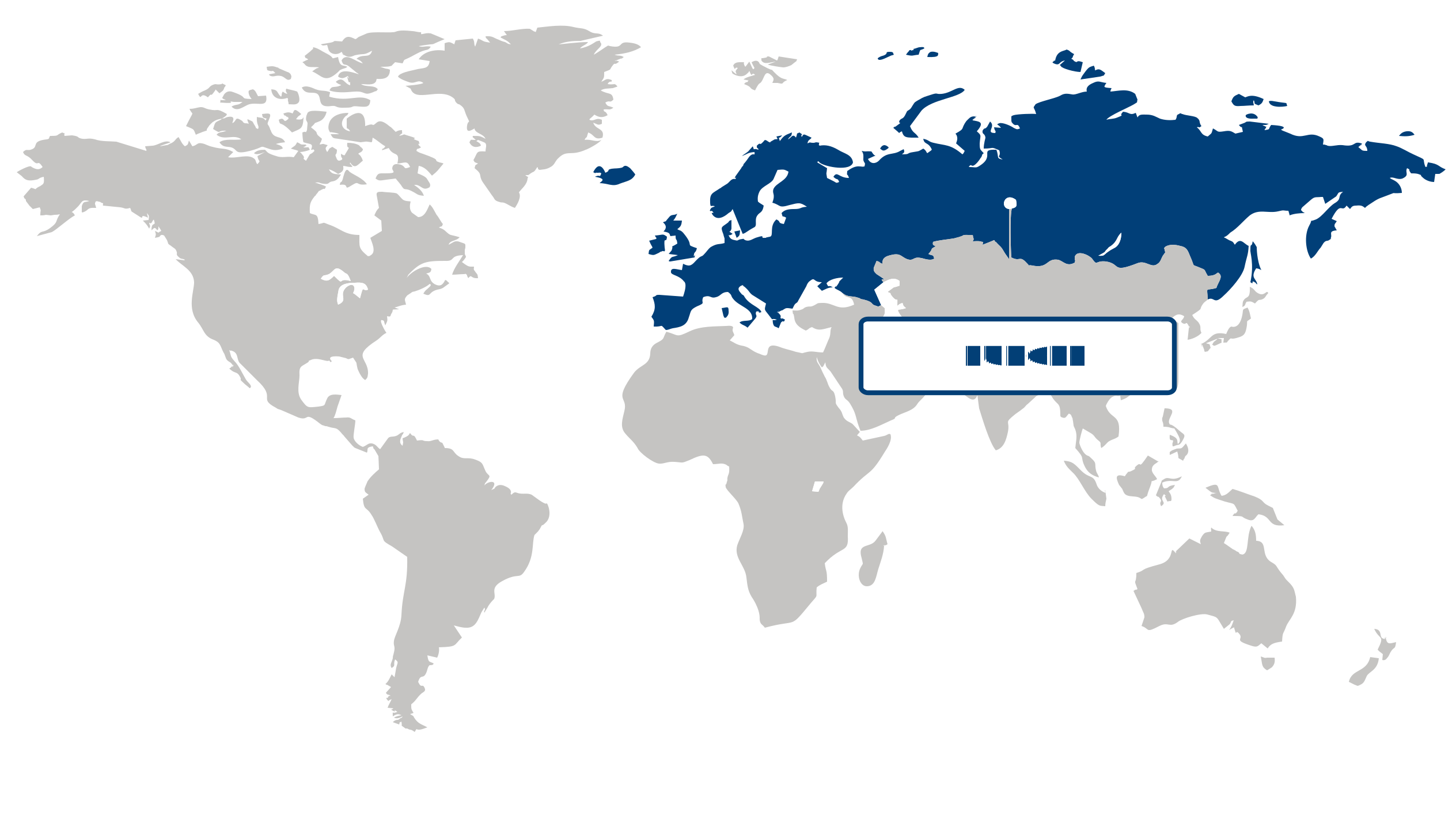
Largest Region
Europe
40.39% Market Share in 2026
Europe (Largest Region) vs Asia Pacific (Fastest-Growing Region)
In the waterborne coatings market, Europe held the largest share of 40.39% in 2026, reflecting the region's strong environmental focus and continued shift toward coatings with lower volatile organic compound emissions. Demand is supported by stringent environmental regulations, sustainability objectives, and widespread adoption of water-based formulations across construction, automotive, industrial, and architectural applications. Established manufacturing capabilities and ongoing investment in environmentally preferable coating technologies further reinforce Europe's position, while the push toward resource efficiency encourages continued formulation innovation.
Asia Pacific is the fastest-growing region, supported by expanding construction and infrastructure activity, industrialization, and increasing demand for coatings across automotive, manufacturing, and building applications. The transition toward lower-emission coating technologies is gaining momentum as environmental requirements become more prominent and manufacturers seek alternatives to conventional solvent-based products. Rising urban development, expanding industrial production, and growing investment in sustainable materials are creating favorable conditions for broader adoption of waterborne coatings across the region.
Key Country Insights
The U.S. continues to expand the use of waterborne coatings across construction, automotive, and industrial manufacturing as environmental compliance becomes more important. Manufacturers increasingly refine low-VOC formulations that balance durability, application efficiency, and performance requirements.
Japan focuses on waterborne coatings that deliver consistent quality for electronics, automotive, and consumer goods manufacturing. Producers in Japan prioritize formulation stability, efficient application processes, and premium surface finishes to support demanding production standards.
South Korea integrates waterborne coatings into high-value manufacturing sectors where product quality and environmental performance are equally important. Companies in South Korea increasingly adopt coating technologies that improve operational efficiency while supporting sustainable production practices.
Germany emphasizes waterborne coatings that align with stringent environmental standards while maintaining high-performance finishes for manufacturing applications. Coating suppliers in Germany increasingly develop advanced formulations for automotive, machinery, and industrial production environments.
France promotes waterborne coatings for residential, commercial, and renovation projects with an emphasis on environmental performance. Manufacturers in France continue introducing products that combine decorative quality, regulatory compliance, and long-term surface protection.
Italy expands the use of waterborne coatings in furniture, architectural finishes, and industrial applications where appearance and sustainability influence purchasing decisions. Italian manufacturers increasingly invest in formulations that deliver aesthetic quality alongside improved environmental performance.
Segment Leadership and Growth Trends
Resin Segment Analysis: Acrylic (Largest Segment) vs Polyurethane (Fastest-Growing Segment)
The acrylic segment dominated the waterborne coatings market with a 79.23% share in 2026, supported by its broad applicability, favorable weather resistance, and ability to deliver durable and visually appealing finishes. Acrylic-based waterborne coatings are widely used across architectural and other surface protection applications, where low-emission formulations and reliable coating performance are increasingly important. Growing regulatory and environmental emphasis on reducing solvent use, combined with continued demand for high-quality protective coatings, reinforced the segment's dominant position in 2026.
The polyurethane segment is the fastest-growing resin segment, driven by increasing demand for waterborne coatings that offer strong mechanical performance, durability, abrasion resistance, and surface protection. These properties make waterborne polyurethane formulations increasingly suitable for demanding applications requiring enhanced coating performance. Ongoing advances in resin technology are also improving their versatility and expanding adoption across applications where manufacturers seek to combine high performance with lower environmental impact.
Application Segment Analysis: Architectural (Largest Segment) vs Industrial (Fastest-Growing Segment)
The architectural segment held the largest share of the waterborne coatings market at 82.75% in 2026, owing to extensive demand from residential and commercial construction, renovation, and maintenance activities. Waterborne coatings are increasingly preferred for architectural surfaces because they support lower emissions, ease of application, and effective aesthetic and protective performance. Growing construction activity, rising renovation requirements, and stronger environmental regulations governing conventional coatings continued to support the segment's leading position in 2026.
The industrial segment is the fastest-growing application segment, supported by increasing adoption of environmentally compatible coating solutions across manufacturing, equipment, machinery, and other industrial products. Producers are seeking alternatives that can reduce solvent emissions while maintaining the durability, adhesion, and protective characteristics required in demanding operating environments. Continued innovation in waterborne coating formulations is expanding their suitability for industrial applications and accelerating their adoption.
| Report Segmentation | |||
| Segment | Sub-Segment | Largest Segment | Fastest Growing Segment |
|---|---|---|---|
| Resin | Acrylic, Polyurethane, Epoxy, Others | Acrylic | Polyurethane |
| Application | Architectural, Automotive, Industrial, Others | Architectural | Industrial |
 Read our Research Approach
Competitive Landscape and Market Positioning
Leading companies in the waterborne coatings market:
1. Akzo Nobel N.V. (Netherlands)
2. BASF SE (Germany)
3. Axalta Coating Systems Ltd. (United States)
4. Berger Paints India Limited (India)
5. Kansai Paint Co. Ltd. (Japan)
6. Nippon Paint Holdings Co. Ltd. (Japan)
7. PPG Industries Inc. (Tikkurila Oyj) (United States)
8. RPM International Inc. (United States)
9. The Sherwin-Williams Company (United States)
The waterborne coatings market is evolving through increasing emphasis on environmentally responsible coating solutions and performance optimization. Growing shift toward low-emission and eco-friendly formulations is influencing product development priorities. Continuous innovation in coating chemistry is enhancing durability and application efficiency, while advancement in application technologies is supporting broader industrial adoption across diverse end-use sectors.
Industry Development/News
| Company Name | Date | Key Development |
|---|---|---|
| PPG | Jun-24 | PPG initiated a USD 300 million investment program to advance its manufacturing capabilities across North America, highlighting the construction of a new paint and coatings manufacturing plant in Tennessee. The facility expansion targets substantial increases in production capacity and the optimization of regional supply chain infrastructure to meet long-term volume demand. |
| Amcor | Apr-25 | Amcor finalized construction of a medical and healthcare packaging coating facility in Malaysia, establishing localized production in Southeast Asia. The plant integrates specialized industrial air-knife and waterborne coating technologies, extending the company's regional operational footprint and supporting strict performance mandates for sterile healthcare applications. |
| Reactive Surfaces | Mar-26 | Reactive Surfaces commercialized a modular bio-based antimicrobial additive tailored for waterborne coating configurations. Engineered for commercial distribution within healthcare environments and public infrastructure, the formulation addresses rising regulatory and commercial demand for sustainable bio-functional technologies within architectural and industrial coating systems. |
| AkzoNobel | Feb-25 | AkzoNobel deployed its RUBBOL WF 3350 waterborne wood coating system out of its manufacturing site in Sweden, introducing a formulation composed of 20% bio-based raw materials. The technology commercialization aims to scale operational sustainability profiles for commercial woodwork segments without diminishing industrial finish durability standards. |
| Covestro | Feb-24 | Covestro launched a portfolio of waterborne, ultraviolet-curable coating solutions engineered specifically for demanding industrial applications. The technology roll-out targets commercial scale adoption in regional cabinetry, structural building components, and wood furniture manufacturing sectors by altering VOC profiles while preserving operational processing efficiencies. |
Why Choose Us
Specialized Expertise: Our team comprises industry experts with a deep understanding of your market segment. We bring specialized knowledge and experience that ensures our research and consulting services are tailored to your unique needs.
Customized Solutions: We understand that every client is different. That's why we offer customized research and consulting solutions designed specifically to address your challenges and capitalize on opportunities within your industry.
Proven Results: With a track record of successful projects and satisfied clients, we have demonstrated our ability to deliver tangible results. Our case studies and testimonials speak to our effectiveness in helping clients achieve their goals.
Cutting-Edge Methodologies: We leverage the latest methodologies and technologies to gather insights and drive informed decision-making. Our innovative approach ensures that you stay ahead of the curve and gain a competitive edge in your market.
Client-Centric Approach: Your satisfaction is our top priority. We prioritize open communication, responsiveness, and transparency to ensure that we not only meet but exceed your expectations at every stage of the engagement.
Continuous Innovation: We are committed to continuous improvement and staying at the forefront of our industry. Through ongoing learning, professional development, and investment in new technologies, we ensure that our services are always evolving to meet your evolving needs.
Value for Money: Our competitive pricing and flexible engagement models ensure that you get maximum value for your investment. We are committed to delivering high-quality results that help you achieve a strong return on your investment.
Select Licence Type

