Web-To-Print Software Market Size & Growth Forecast 2027–2036, By Segments (Type, Application), Regional Demand Trends (North America, Asia Pacific, Europe), Key Country Insights (U.S., Japan, South Korea, Germany, France, Italy), and Competitive Landscape
Market Size and Growth Outlook
Web-To-Print Software Market size was more than USD 1.39 billion in 2026 and is set to grow at a 7.41% CAGR between 2027 and 2036, reaching USD 2.84 billion by 2036. The industry revenue for 2027 is calculated at USD 1.48 billion.
Get more details on this report
Request Free Sample ReportWeb-To-Print Software Market Intelligence Snapshot
Regional Market Dynamics
- Europe accounted for 35.93% of the market in 2026, supported by a mature commercial printing industry, widespread digital workflow adoption, and strong use of automated online print management systems.
- Asia Pacific is forecast to grow at an 8.81% CAGR as print businesses digitize operations, demand for personalized printing rises, and e-commerce supports scalable online ordering and fulfillment workflows.
Segment Momentum
- Fully Customizable/Design-it-yourself held a 59.85% share in 2026 because it enables users to personalize layouts, graphics, and text, supporting diverse commercial and consumer printing requirements.
- Home Décor is the fastest-growing application as consumers increasingly seek personalized interior products, with web-to-print software simplifying customization, visualization, and online ordering of décor items.
Market Expansion Drivers
- Rising demand for personalized printing and customizable marketing materials driving W2P adoption.
- Expansion of print e-commerce platforms enabling global automated order fulfillment systems.
- SME digital storefront adoption accelerating cloud-based on-demand printing transformation.
Leading Market Participants
- Major companies in the web-to-print software market include Design’N’Buy (India), Xerox Corporation (United States), CHILI publish NV (Belgium), DATATECH SMARTSOFT, INC. (India), PRINTBOX APPLICATION (Poland), Brush Your Ideas (India), OnPrintShop (United States), Agfa-Gevaert Group (Belgium), Rocketprint Software, LLC (United States), B2CPrint Ltd (United Kingdom).
Global Market Forecast Snapshot
Market Outlook
- 2026 Market Size: USD 1.39 billion
- 2027 Estimated Market Size: USD 1.48 billion.
- Projected Market Size: USD 2.84 billion by 2036
- Growth Forecast: 7.41% CAGR (2027-2036)
Regional and Segment Outlook
- Leading Regional Market: Europe
- High-Growth Regional Hub: Asia Pacific
- Core Revenue Segment: Fully Customizable/Design-it-yourself (Type) | Apparels (Application)
- Emerging Opportunity Segment: Template-based (Type) | Home Décor (Application)
Market Growth Drivers and Industry Trends
Rising demand for personalized printing and customizable marketing materials driving W2P adoption
Growing preference for tailored customer communications and differentiated promotional materials is increasing the need for flexible digital printing workflows. The web-to-print software market will benefit as businesses seek platforms that allow customers to personalize layouts, content, formats, and branding elements before submitting orders, reducing manual coordination while supporting more responsive marketing campaigns.
Expansion of print e-commerce platforms enabling global automated order fulfillment systems
The growing integration of printing services with e-commerce channels is reshaping how customers place and manage print orders across geographically dispersed markets. Expansion of the web-to-print software market is supported by automated ordering, production routing, payment processing, and fulfillment workflows that enable print providers to handle digital transactions more efficiently while serving customers beyond traditional local sales networks.
SME digital storefront adoption accelerating cloud-based on-demand printing transformation
Increasing use of digital storefronts among small and medium-sized enterprises is encouraging businesses to move printing operations toward accessible, cloud-enabled platforms. For these organizations, the web-to-print software market supports on-demand production by connecting online storefronts with ordering and print workflows, helping SMEs manage customized products without relying heavily on complex in-house systems.
| Growth Driver | Impact on CAGR | Regulatory Influence | Geographic Relevance | Adoption Rate | Impact Timeline |
|---|---|---|---|---|---|
| Increasing demand for customized print solutions | 2.00% | Short term (≤ 2 yrs) | North America, Europe (spillover: Asia Pacific) | Low | Fast |
| Integration with digital and web-to-print workflows | 1.50% | Medium term (2–5 yrs) | Europe, Asia Pacific (spillover: North America) | Medium | Moderate |
| Expansion of cloud-based print management platforms | 1.00% | Long term (5+ yrs) | North America, Europe (spillover: Asia Pacific) | Medium | Slow |
| Rising demand for personalized printing and customizable marketing materials driving W2P adoption | 2.10% | Low | Europe, North America | High | Near Term |
| Expansion of print e-commerce platforms enabling global automated order fulfillment systems | 1.90% | Low | Asia Pacific, Europe | High | Near Term |
| SME digital storefront adoption accelerating cloud-based on-demand printing transformation | 1.50% | Low | Asia Pacific, Latin America | Medium | Mid Term |
Unlock insights tailored to your business with our bespoke market research solutions.
Click to get your customized report now.
Regional Demand Dynamics
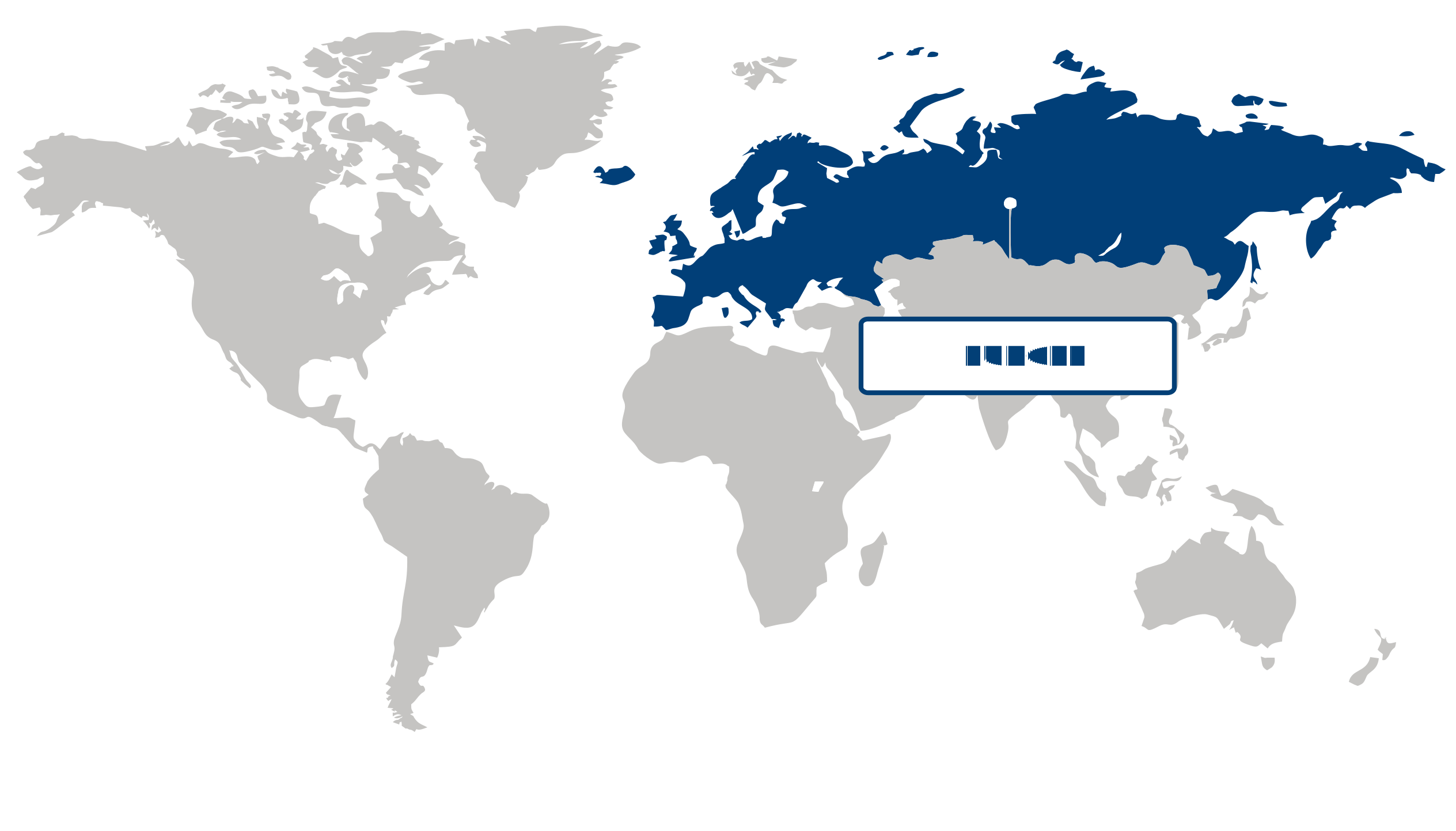
Europe (Largest Region)
The web-to-print software market was led by Europe, which held the largest regional share in 2026. The region benefits from a mature commercial printing ecosystem, widespread digital adoption, and increasing demand for automated ordering and customization workflows. Businesses across retail, marketing, publishing, and corporate communications are increasingly using web-to-print platforms to streamline print procurement, manage personalized content, and improve production efficiency. Established digital infrastructure and growing emphasis on operational automation further strengthen the region’s position.
Asia Pacific (Fastest-Growing Region)
Asia Pacific is emerging as the fastest-growing regional market, supported by rapid digital transformation across businesses and expanding e-commerce activity. Rising demand for personalized printed materials, online ordering capabilities, and efficient print management is encouraging organizations to adopt web-to-print solutions. Growing internet penetration, expanding small and medium-sized business ecosystems, and increasing investments in digital commerce infrastructure are also creating favorable conditions for broader software adoption across the region.
| Parameter | North America | Asia Pacific | Europe | Latin America | MEA |
|---|---|---|---|---|---|
| Innovation Hub i Scale Nascent Developing Advanced | |||||
| Cost-Sensitive Region i Scale Low Medium High | |||||
| Regulatory Environment i Scale Restrictive Neutral Supportive | |||||
| Demand Drivers i Scale Weak Moderate Strong | |||||
| Development Stage i Scale Emerging Developing Developed | |||||
| Adoption Rate i Scale Low Medium High | |||||
| New Entrants / Startups i Scale Sparse Moderate Dense | |||||
| Macro Indicators i Scale Weak Stable Strong |
Key Country Insights
Germany 🇩🇪
Industrial Print AutomationGermany emphasizes web-to-print software that complements advanced commercial printing operations and manufacturing efficiency. German print providers are investing in automated order management and production workflows to support customized print services.
France 🇫🇷
Brand Asset ManagementFrance is utilizing web-to-print software to maintain consistent branded print materials across retail and corporate networks. French organizations increasingly value centralized template management and automated approval workflows for marketing collateral production.
Italy 🇮🇹
Creative Print PersonalizationItaly is adopting web-to-print software to support customized packaging, promotional materials, and premium print applications. Italian print businesses emphasize flexible design capabilities and efficient digital ordering to serve diverse commercial clients.
Japan 🇯🇵
Custom Print EfficiencyJapan is expanding web-to-print software adoption to manage personalized print orders with consistent production quality. Japanese printing companies increasingly deploy digital platforms that simplify customer ordering while improving production scheduling.
South Korea 🇰🇷
E-commerce Print IntegrationSouth Korea is aligning web-to-print software with digital commerce platforms that support customized printing services. South Korean providers focus on seamless online ordering, rapid fulfillment, and scalable print management for business customers.
United States 🇺🇸
Enterprise Workflow DigitizationThe U.S. continues adopting web-to-print software to automate print procurement and manage customized marketing materials across distributed organizations. Businesses in the U.S. increasingly integrate cloud-based platforms with existing enterprise systems to improve operational efficiency.
Segment Leadership and Growth Trends
Web-To-Print Software Market Share (%), by Type, 2026
Go beyond the chart, access full insights & data tables
Request Free Sample ReportType Segment Analysis: Fully Customizable/Design-it-yourself (Largest Segment) vs Template-based (Fastest-Growing Segment)
Fully Customizable/Design-it-yourself solutions led the web-to-print software market, representing a 59.85% share in 2026, driven by demand for greater creative control and personalized print outputs. These platforms allow users to modify designs according to specific branding, product, and customer requirements without relying extensively on external design support. The growing importance of personalization and the need for businesses to maintain consistent visual identities are supporting continued adoption of highly flexible web-to-print tools.
Template-based solutions are expected to achieve the fastest growth as businesses and individual users increasingly prioritize simplified design processes and faster content creation. Preconfigured templates reduce the effort required to produce professional-looking materials while enabling users with limited design expertise to customize print products efficiently. Rising demand for convenient self-service printing workflows and shorter production cycles is strengthening the appeal of template-driven web-to-print platforms.
Application Segment Analysis: Apparels (Largest Segment) vs Home Décor (Fastest-Growing Segment)
Apparels accounted for the largest share of the web-to-print software market at 43.46% in 2026, reflecting strong demand for customized clothing, branded merchandise, and personalized apparel designs. Web-to-print platforms enable customers and businesses to create and modify apparel designs digitally before placing orders, supporting more flexible personalization and on-demand production models. Growing consumer interest in individualized products and the expansion of digitally enabled printing workflows continue to support the segment's leading position.
Home décor is anticipated to register the fastest growth as consumers increasingly seek personalized products that complement individual interior preferences. Web-to-print solutions can facilitate customization across items such as wall décor, furnishings, decorative textiles, and other printable home products, allowing users to select designs suited to their spaces. The broader movement toward personalized interiors and digitally enabled purchasing experiences is expanding the application potential of web-to-print technologies within home décor.
| Segment | Sub-Segment | Largest Segment | Fastest Growing |
|---|---|---|---|
| Type | Fully Customizable/Design-it-yourself, Template-based | Fully Customizable/Design-it-yourself | Template-based |
| Application | Apparels, Marketing Materials, Business Cards, Packaging, Stationery, Home Décor, Others | Apparels | Home Décor |
Competitive Landscape and Market Positioning
Top players in the web-to-print software market:
1. Design’N’Buy (India)
2. Xerox Corporation (United States)
3. CHILI publish NV (Belgium)
4. DATATECH SMARTSOFT INC. (India)
5. PRINTBOX APPLICATION (Poland)
6. Brush Your Ideas (India)
7. OnPrintShop (United States)
8. Agfa-Gevaert Group (Belgium)
9. Rocketprint Software LLC (United States)
10. B2CPrint Ltd (United Kingdom)
Digital customization demand is reshaping production workflows in the web-to-print software market. In the web-to-print software market, automation-enabled design tools and cloud-based printing platforms are improving scalability and user experience.
| Company | Market Share | Company Revenue | Revenue CAGR (%) | Product Portfolio | Geographic Presence | Innovation / R&D Focus | Strategic Developments |
|---|---|---|---|---|---|---|---|
| Design’N’Buy (India) | |||||||
| Xerox Corporation (United States) | |||||||
| CHILI publish NV (Belgium) | |||||||
| DATATECH SMARTSOFT INC. (India) | |||||||
| PRINTBOX APPLICATION (Poland) | |||||||
| Brush Your Ideas (India) | |||||||
| OnPrintShop (United States) | |||||||
| Agfa-Gevaert Group (Belgium) | |||||||
| Rocketprint Software LLC (United States) | |||||||
| B2CPrint Ltd (United Kingdom). |
Industry Development/News
| Company Name | Date | Key Development |
|---|
Customize Your Report
Explore examples of how this report can be tailored to different research needs, including custom segments, additional topics or chapters, and related reports. Click a section of the wheel or its numbered marker to explore the available options.
Web-To-Print Software Market — Custom Segments
| Segment | Sub-Segment |
|---|---|
| Deployment Model | Cloud-Based, On-Premises, Hybrid |
| Enterprise Size | Small & Medium-Sized Enterprises, Large Enterprises |
| Business Model | Subscription-Based, License-Based, Transaction-Based |
Web-To-Print Software Market — Custom TOC
| Custom Chapter | Custom Details |
|---|---|
| Digital Printing Workflow Transformation |
|
| Omnichannel Personalization Opportunity Mapping |
|
| Print Commerce Business Model Analysis |
|
Need a different cut of the data?
Request Custom ResearchWhat is the current revenue of the web-to-print software market?
How is the web-to-print software industry size expected to evolve during the forecast period?
How is the rise of personalized print demand influencing the adoption of web-to-print platforms among print providers?
Why is SME adoption accelerating the shift toward cloud-based web-to-print storefronts?
Why is Fully Customizable/Design-it-yourself the leading type in the web-to-print software market?
Why is Home Décor the fastest-growing application in the web-to-print software market?
Why is Europe the leading region in the web-to-print software market?
What factors are accelerating web-to-print software adoption in Asia Pacific?
Which companies are driving growth in the web-to-print software landscape?
Our Clients
"The team demonstrated a great understanding of our business needs, and the reports were tailored to address our specific concerns and objectives."
Infosys
"The report was up-to-date with the latest industry trends and technological advancements. The detailed competitive landscape analysis was quite helpful."
Zebra Technologies
"The data presented in the report was accurate and well-researched. I also found the market dynamics section particularly useful."
Arlo Technologies
Our Research Team & Methodology
Every Fundamental Business Insights report is built by a dedicated vertical research team, validated through a structured primary-and-secondary methodology, and reviewed for accuracy before it reaches you.
Research Team Overview
Prepared by the Smart Technologies Research Team
Delivery
Published
Demand
Available
Support
Trust & Compliance
Research Domains
10 coverage areasResearch Intelligence
| Source | Reference |
|---|---|
| National Institute of Standards and Technology (NIST) | www.nist.gov |
| International Organization for Standardization (ISO) | www.iso.org |
| Institute of Electrical and Electronics Engineers (IEEE) | www.ieee.org |
| Internet Engineering Task Force (IETF) | www.ietf.org |
| World Wide Web Consortium (W3C) | www.w3.org |
| Cloud Security Alliance (CSA) | cloudsecurityalliance.org |
| Open Source Initiative (OSI) | opensource.org |
| Linux Foundation | www.linuxfoundation.org |
| FinOps Foundation | www.finops.org |
| PCI Security Standards Council | www.pcisecuritystandards.org |
| SWIFT | www.swift.com |
| Financial Stability Board (FSB) | www.fsb.org |
| GSMA | www.gsma.com |
| International Telecommunication Union (ITU) | www.itu.int |
| OWASP Foundation | owasp.org |
| MITRE | www.mitre.org |
| World Economic Forum (WEF) | www.weforum.org |
| OECD Digital Economy | www.oecd.org/digital |
| World Bank Data | data.worldbank.org |
| U.S. Census Bureau | www.census.gov |
Research Workflow & Quality Assurance
Data Collection
Verified information gathered through primary and secondary research.
Data Triangulation
Cross-validation using multiple independent data sources.
Forecast Modelling
Market estimates developed using historical trends and analytical models.
Analyst Validation
Findings reviewed by domain experts for accuracy and consistency.
Editorial & Quality Review
Final editorial, quality, and compliance checks before publication.
Final Publication
Released after successful completion of the internal review process.
Report Coverage
📊 Market Assessment
- Market Size & Forecast
- Market Segmentation
- Regional Analysis
- Growth Drivers & Challenges
- Market Dynamics
🏢 Competitive Intelligence
- Competitive Landscape
- Company Profiles
- Competitive Benchmarking
- Mergers & Acquisitions
- Market Share Analysis or Key Company Strategies
🔍 Strategic Analysis
- Value Chain Analysis
- Porter's Five Forces
- PESTLE Analysis
- Pricing Trends
- Supply-Demand Analysis
🚀 Future Outlook
- Technology Landscape
- Regulatory Landscape
- Investment & Funding Landscape
- Emerging Opportunities
- Future Market Outlook
Have a question about this report or need a custom scope?
Request Customization