



WEEE (Waste Electrical and Electronic Equipment) Recycling Market Size & Forecasts 2026-2035, By Segments (Type, Application), Growth Opportunities, Innovation Landscape, Regulatory Shifts, Strategic Regional Insights (U.S., Japan, China, South Korea, UK, Germany, France), and Competitive Dynamics (Umicore, Sims Lifecycle Services, Stena Recycling, TES, Electronic Recyclers International)
Market Size and Growth Outlook
Waste Electrical and Electronic Equipment Recycling Market size is estimated to increase from USD 345.25 million in 2025 to USD 773.44 million by 2035, supported by a CAGR exceeding 8.4% during 2026-2035. In 2026, revenues are forecast to reach USD 370.74 million.
Base Year Value (2025)
USD 345.25 Million
CAGR (2026-2035)
8.4%
Forecast Year Value (2035)
USD 773.44 Million

Historical Data Period
2022-2025

Largest Region
Asia Pacific

Forecast Period
2026-2035
Key Takeaways
- Asia Pacific region secured over 44.6% revenue share in 2025, supported by high volumes of consumer electronics scrap and presence of key recyclers.
- North America region will observe over 10.08% CAGR during the forecast period, accelerated by stringent regulatory frameworks and increasing environmental awareness.
- In 2025, the electrical equipment segment accounted for majority share of the WEEE recycling market, supported by rising disposal of household and industrial electrical equipment.
- The metal smelting segment dominated the market in 2025, accelerated by recovery of precious and critical metals from e-waste.
- Key companies dominating the waste electrical and electronic equipment recycling market are Umicore (Belgium), Sims Lifecycle Services (Australia), Stena Recycling (Sweden), TES (Singapore), Electronic Recyclers International (USA), Dowa Holdings (Japan), ALBA Group (Germany), RUSAL (Russia), Environmental Recycling Group (India), Aurubis (Germany).
Market Growth Drivers and Industry Trends
Increasing e-waste generation and recycling mandates
Rising volumes of end-of-life electronics and tightening policy frameworks are reshaping the WEEE (waste electrical and electronic equipment) recycling market by creating persistent feedstock growth and compliance-driven demand for traceable processing. The United Nations University Global E-waste Monitor documents rising streams worldwide, while the European Commission’s revisions to the WEEE Directive and Basel Convention decisions show regulators prioritizing collection and responsible export controls. Established recyclers can monetize scale, compliance services and OEM contracts; new entrants can capture niche collection, digital takeback and reverse-logistics opportunities. As regulators harmonize targets and enforcement, market share will accrue to operators that combine compliant logistics, transparent reporting and scalable collection networks.
Technological advancements in recycling processes
Improved mechanical separation, sensor-based sorting and hydrometallurgical recovery are increasing yield and lowering costs across the WEEE (waste electrical and electronic equipment) recycling market. Companies and research bodies such as Tomra Systems (sensor sorting), Umicore (advanced battery and precious-metal recovery) and the Fraunhofer Institute (process R&D) provide practical proof points of higher-value material recovery. Incumbents can retrofit plants to capture margin-rich streams; startups can commercialize modular, mobile or battery-specific solutions and license IP. Given the visible pipeline of demonstrated technologies and corporate pilots, competitive advantage will shift toward operators who integrate higher-recovery processes with secure material offtake.
Expansion of formal recycling infrastructure in emerging regions
Growth of regulated facilities, public–private projects and OEM takeback programs is broadening supply and formalizing downstream channels in the WEEE (waste electrical and electronic equipment) recycling market. The United Nations University and Global Environment Facility document capacity-building projects, while the World Bank and country regulators such as India’s Ministry of Environment, Forest and Climate Change (MoEFCC) highlight policy and funding support; corporations like Dell Technologies and HP have expanded regional takeback initiatives. This expansion creates opportunities for established global processors to secure long-term feedstock contracts and for local entrants to win municipal and OEM partnerships. As formal capacity scales, observable shifts toward compliant, contract-based sourcing will strengthen supply predictability and material quality.
Industry Restraints:
Regulatory Fragmentation and Compliance Costs — Fragmented national rules, extended producer responsibility (EPR) obligations, and transboundary controls raise compliance complexity and costs that slow formal recycling capacity expansion. The European Commission’s WEEE Directive (Directive 2012/19/EU), the Basel Convention on hazardous waste controls, and the United States Environmental Protection Agency’s e-waste guidance impose disparate collection, reporting, and shipment requirements that increase administrative burden and capital needs for processors. For incumbents this favors larger recyclers with compliance teams; for new entrants it creates high barriers to market entry and discourages cross-border consolidation. Expect ongoing regulatory tightening and slower harmonization to drive consolidation of compliant operators, continued outsourcing of compliance to specialist firms, and selective geographic investment in the near to medium term.
Insufficient Collection Infrastructure and Informal Recycling — Low capture rates and a dominant informal sector constrain feedstock quality and material recovery economics, undermining formal recycling investments. The United Nations University (Global E-waste Monitor 2023) documents large volumes diverted to informal processing, and the International Labour Organization has highlighted attendant health and safety risks that also create reputational exposure for supply chain buyers. Manufacturer take-back efforts (for example Apple’s recycling programs) improve flows but struggle to replace informal channels. Strategically, formal recyclers must invest in reverse logistics partnerships and community-level collection to secure consistent inputs, while new entrants face uphill costs to scale collection. Unless policymakers and brand owners significantly expand funded collection schemes, informal flows and collection gaps will continue to cap recovery improvements in the near to medium term.
| Growth Driver Assessment Framework | |||||
| Growth Driver | Impact On CAGR | Regulatory Influence | Geographic Relevance | Adoption Rate | Impact Timeline |
|---|---|---|---|---|---|
| Increasing e-waste generation and recycling mandates | 3.00% | Short term (≤ 2 yrs) | Europe, North America | High | Fast |
| Technological advancements in recycling processes | 2.50% | Medium term (2–5 yrs) | Asia Pacific, Europe | Medium | Moderate |
| Expansion of formal recycling infrastructure in emerging regions | 2.50% | Long term (5+ yrs) | Asia Pacific, MEA | Medium | Moderate |
Unlock insights tailored to your business with our bespoke market research solutions - Click to get your customized report now!
Regional Demand Dynamics
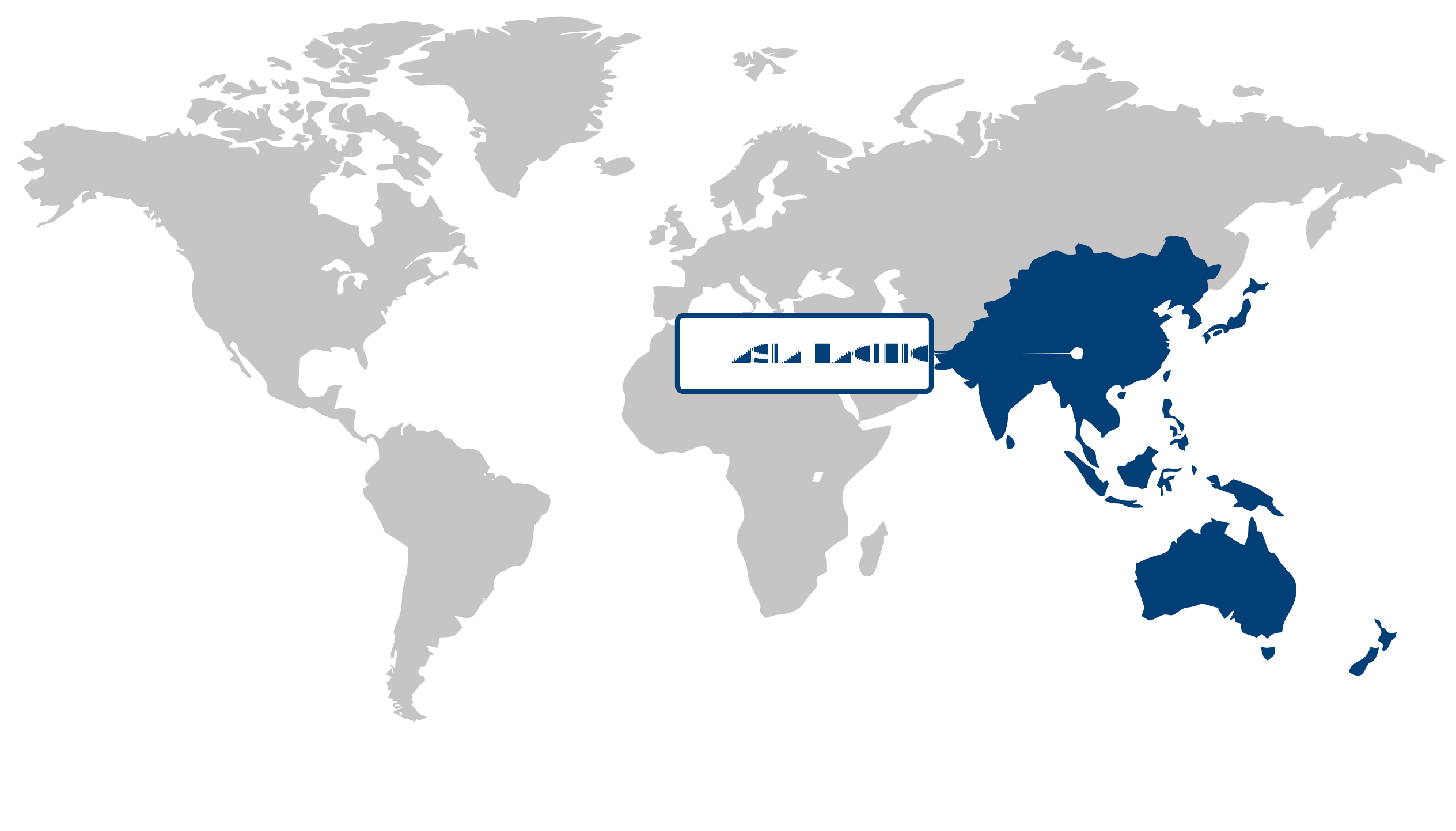
Largest Region
Asia Pacific
44.6% Market Share in 2025
Asia Pacific Market Statistics:
Asia Pacific captured over 44.6% of the WEEE (waste electrical and electronic equipment) recycling market in 2025, the largest regional share driven by the combination of vast consumer-electronics scrap streams and an established recycling ecosystem. High generation rates documented by the United Nations University (Global E-waste Monitor) and national policy activity—from the Ministry of Ecology and Environment of the People’s Republic of China to Japan’s Ministry of the Environment and METI—have accelerated collection and formal processing. Large regional players such as TES and Sims Limited operate reverse-logistics and processing hubs that aggregate feedstock at scale, while manufacturers including Panasonic and Huawei are expanding take-back and refurbishment programs. Together, these dynamics make Asia Pacific a priority for investors targeting scalable material recovery, upstream logistics optimization, and technology-led sorting and smelting upgrades.
Japan is positioned as a pivotal hub in Asia Pacific for the WEEE (waste electrical and electronic equipment) recycling market, supported by long-standing producer-responsibility laws and mature industrial processes. Japan’s Home Appliance Recycling Law and active oversight from the Ministry of the Environment have created predictable flows of high-quality scrap and incentivized advanced dismantling and component recovery; companies such as Panasonic and Ricoh publish circularity initiatives and facility investments that illustrate commercial pathways for closed-loop supply chains. For strategists, Japan offers a testing ground for high-efficiency processing technologies, premium secondary-material outputs, and partnership models that can be exported across the region.
China anchors the Asia Pacific WEEE (waste electrical and electronic equipment) recycling market, propelled by enormous consumer-electronics volumes and accelerating formalization under national policy. The Ministry of Ecology and Environment’s recent enforcement and pilot programs, together with data from the United Nations University (Global E-waste Monitor), signal a shift from informal collection toward licensed processing and larger-scale facility investment. Domestic OEMs and platforms, exemplified by Huawei’s recycling initiatives, are integrating reverse logistics at scale, while logistics and smelter capacity expansion present clear opportunities for capital deployment and technology transfer to capture value from heterogeneous urban mining streams.
North America Market Analysis:
North America emerged as the fastest-growing region in the WEEE (waste electrical and electronic equipment) recycling market, registering a CAGR of 10.08% driven by stringent regulatory frameworks and rising environmental awareness. Strong policy signals—ranging from U.S. Environmental Protection Agency electronics recycling guidance to state-level programs such as the California Department of Resources Recycling and Recovery’s e-waste initiatives and provincial Extended Producer Responsibility frameworks administered through organizations like the Electronic Products Recycling Association—have raised compliance standards and created consistent feedstock flows. Certification regimes (R2 via Sustainable Electronics Recycling International and e-Stewards via Basel Action Network) and stewardship programs (Call2Recycle, corporate takeback programs) are accelerating investment in advanced sorting, refurbishment and material recovery. These dynamics position North America for continued private‑sector investment and scalable collection infrastructure expansion.
The U.S. anchors regional momentum in the WEEE (waste electrical and electronic equipment) recycling market by converting regulatory pressure and consumer expectations into market-scale programs. Federal guidance from the U.S. Environmental Protection Agency, coupled with aggressive state laws—exemplified by California’s long-established e-waste framework administered by CalRecycle—has encouraged manufacturers and retailers to deploy national takeback schemes and certified processing partners. Market actors are responding with certified facilities (R2/e-Stewards) and national collectors such as Call2Recycle and corporate programs from major OEMs, improving upstream logistics and downstream material recovery rates. For investors and strategists, the U.S. landscape offers concentrated opportunities in compliant collection networks, certified processing capacity, and technologies that increase yield from complex e-waste streams, reinforcing North America’s regional growth thesis.
Europe Market Trends:
Held a substantial share, Europe’s WEEE (waste electrical and electronic equipment) recycling market remains a pivotal global hub due to dense urban consumption, stringent regulatory frameworks and mature collection networks. The European Commission’s Circular Economy Action Plan and the WEEE Directive have raised recovery expectations, while the WEEE Forum and the European Environment Agency document improving collection and treatment sophistication across member states. Commercial players such as Veolia and Umicore are investing in advanced separation and urban‑mining capabilities, and national agencies including ADEME and Umweltbundesamt report collaborative producer‑responsibility schemes. These factors—paired with digital sorting technologies, growing e‑mobility battery flows and sector consolidation—create clear opportunities for scale‑up, vertical integration and technology differentiation across Europe.
Germany, a regional leader, anchors the WEEE (waste electrical and electronic equipment) recycling market with high collection rates, deep industrial processing capacity and close links to manufacturing. The German Federal Environment Agency (Umweltbundesamt) and the Federal Ministry for the Environment enforce ElektroG provisions that strengthen take‑back and treatment standards; operators such as ALBA Group, Remondis and Stena Recycling Germany demonstrate advanced mechanical and metallurgical recovery for complex streams. Strong logistics, skilled labor and OEM partnerships support pilot projects for critical‑metal recovery from batteries and electronics. Strategically, Germany’s scale and technical depth make it an ideal testbed for innovations that can be scaled regionally.
France, an influential market player, advances the WEEE (waste electrical and electronic equipment) recycling market by emphasizing reuse, eco‑organisms and public‑private coordination. ADEME and the French Ministry for the Ecological Transition have backed repair and refurbishment initiatives, and the eco‑organization ECOLOGIC alongside operators such as Veolia, SUEZ and Paprec manage nationwide collection and sorting networks. Policy incentives and corporate commitments have spurred investments in digital traceability and extended producer responsibility compliance, while urban centers concentrate feedstock for battery and precious‑metal recovery. France’s policy leverage and operational footprint position it as a strategic partner for pan‑European consolidation and technology roll‑outs.
No card data available for this language/report.
Segment Leadership and Growth Trends
Analysis by Type
The Electrical Equipment segment accounted for the largest market share in Europe with around 60% in 2025, driven by the growing volume of discarded household appliances, industrial machinery, and electrical infrastructure equipment across the region. Increasing regulatory pressure under the European Union’s circular economy and e-waste management policies has encouraged the systematic collection, refurbishment, and recycling of electrical equipment to recover valuable metals and reduce landfill waste. The segment is also benefiting from rising consumer awareness regarding responsible disposal practices and the expansion of advanced recycling facilities capable of efficiently processing complex electrical components. In addition, the rapid replacement cycle of electrical products and ongoing investments in sustainable resource recovery technologies continue to strengthen the dominance of this segment in the European WEEE recycling industry.
Analysis by Application
Metal smelting held largest share in 2025 of the WEEE (waste electrical and electronic equipment) recycling market, driven by the economic incentive to recover precious and critical metals from e‑waste. This advantage stems from concentrated value recovery—precious metals refinement and alloy recovery—which fuels investment by specialist refiners; Umicore and other metallurgical recyclers publicly highlight refined metal outputs from e‑waste as core activities. Policy drivers such as the European Commission’s Critical Raw Materials initiatives and corporate sustainability commitments raise demand for recycled feedstock, while technological improvements in hydrometallurgy and furnace efficiency improve yields. For incumbents, high‑throughput smelters can scale margins; for entrants, innovative hydrometallurgical and sensor‑based sorting solutions offer partnership opportunities. Given ongoing demand for critical materials in electrification and renewable sectors and tightening raw‑material policies, metal‑centric segments will remain strategically important in the near to medium term.
| Report Segmentation | |||
| Segment | Sub-Segment | Largest Segment | Fastest Growing Segment |
|---|---|---|---|
| Type | Electrical Equipment, Electronic Equipment | ||
| Application | Energy Power, Metal Smelting, Chemical Extraction, Environmental Protection | ||
 Read our Research Approach
Competitive Landscape and Market Positioning
Key players in the WEEE (waste electrical and electronic equipment) recycling market include Umicore (Belgium), Sims Lifecycle Services (Australia), Stena Recycling (Sweden), TES (Singapore), Electronic Recyclers International (USA), Dowa Holdings (Japan), ALBA Group (Germany), RUSAL (Russia), Environmental Recycling Group (India), and Aurubis (Germany). These firms occupy distinct but complementary positions: Umicore and Aurubis are recognized for advanced metallurgy and refining pathways that capture high-value fractions; Sims, ERI and TES emphasize large-scale reverse-logistics, compliance and IT asset disposition across multiple markets; Stena and ALBA integrate municipal and industrial streams with downstream smelting options; Dowa and RUSAL bring primary smelting and material-loop expertise; Environmental Recycling Group anchors regional collection and informal-sector integration in India. Their prominence is rooted in vertical integration, material-specialist capabilities, and established collection networks.
The competitive landscape is defined by an emphasis on extending value down the recovery chain and securing feedstock through expanded service networks and operational integrations. Several players are broadening geographic footprints and deepening material-specific capabilities while embedding digital traceability and certified outlet services to meet regulatory and OEM requirements. Parallel investments in sorting automation, hydrometallurgical process improvement and modular processing capacity are reshaping cost and recovery profiles, and closer ties with refiners and smelters are shortening pathways from collection to high-purity output. These moves sharpen differentiation between material-focused refiners and logistics-led service providers and accelerate innovation in processing efficiency and compliance offerings.
Strategic / Actionable Recommendations for Regional Players
North America: Prioritize agreements with large electronics generators and OEMs to secure consistent, high-quality feedstock and to pilot advanced sorting and non-thermal recovery pilots. Combine certified data-wiping and chain-of-custody capabilities with selective downstream refining partnerships to capture higher-value copper and precious-metal streams while addressing evolving regulatory expectations.
Asia Pacific: Strengthen regional collection density by formalizing links with informal collectors and local dismantlers, enabling scalable input volumes. Invest in modular, lower-capex hydromet and automated sorting solutions tailored for mixed streams, and build cross-border service arrangements to channel high-grade fractions to specialist refiners.
Europe: Leverage tight regulatory frameworks to offer comprehensive take-back and compliance packages bundled with digital traceability, positioning as premium service providers to OEMs. Deepen alliances with metallurgical refiners to internalize value recovery for critical metals and pilot circular-supply programs that convert recovered concentrates into reuse-ready feed for local industry.
Why Choose Us
Specialized Expertise: Our team comprises industry experts with a deep understanding of your market segment. We bring specialized knowledge and experience that ensures our research and consulting services are tailored to your unique needs.
Customized Solutions: We understand that every client is different. That's why we offer customized research and consulting solutions designed specifically to address your challenges and capitalize on opportunities within your industry.
Proven Results: With a track record of successful projects and satisfied clients, we have demonstrated our ability to deliver tangible results. Our case studies and testimonials speak to our effectiveness in helping clients achieve their goals.
Cutting-Edge Methodologies: We leverage the latest methodologies and technologies to gather insights and drive informed decision-making. Our innovative approach ensures that you stay ahead of the curve and gain a competitive edge in your market.
Client-Centric Approach: Your satisfaction is our top priority. We prioritize open communication, responsiveness, and transparency to ensure that we not only meet but exceed your expectations at every stage of the engagement.
Continuous Innovation: We are committed to continuous improvement and staying at the forefront of our industry. Through ongoing learning, professional development, and investment in new technologies, we ensure that our services are always evolving to meet your evolving needs.
Value for Money: Our competitive pricing and flexible engagement models ensure that you get maximum value for your investment. We are committed to delivering high-quality results that help you achieve a strong return on your investment.
Select Licence Type

