Women's Jerseys, Sweatshirts & Pullovers Market Size & Growth Forecast 2027–2036, By Segments (Distribution Channel, Fiber), Regional Demand Trends (North America, Asia Pacific, Europe), Key Country Insights (U.S., Japan, South Korea, Germany, France, Italy), and Competitive Landscape
Market Size and Growth Outlook
Women's Jerseys, Sweatshirts & Pullovers Market size was worth USD 242.3 billion in 2026 and is poised to grow at a 8.08% CAGR between 2027 and 2036, crossing USD 527 billion by 2036. The industry revenue for 2027 is assessed at USD 258.78 billion.
Get more details on this report
Request Free Sample ReportWomen's Jerseys, Sweatshirts & Pullovers Market Intelligence Snapshot
Regional Market Dynamics
- Europe held a 36.04% share in 2026, supported by mature retail networks, established brands, strong e-commerce presence, and steady consumer demand for casual apparel.
- Asia Pacific is projected to grow at a 5.7% CAGR, driven by rising apparel consumption, expanding digital retail platforms, and increasing demand for comfortable everyday clothing.
Segment Momentum
- Offline channels held a 75.84% share in 2026 because shoppers prefer evaluating fit, fabric feel, comfort, and sizing before purchasing apparel in physical stores.
- Cotton is the fastest-growing fiber segment as consumers increasingly favor soft, breathable fabrics that provide greater comfort for everyday casual wear.
Market Expansion Drivers
- Hybrid work culture driving casual athleisure wardrobe normalization among women.
- Social media influencer marketing accelerating online jersey and sweatshirt purchases.
- Rising demand for sustainable recycled fabrics enhancing product differentiation.
Leading Market Participants
- Top companies in the women's jerseys, sweatshirts & pullovers market include Christian Dior SE (France), Chanel Limited (United Kingdom), Gucci S.p.A. (Italy), Prada S.p.A. (Italy), Giorgio Armani S.p.A. (Italy), Burberry Group plc (United Kingdom), Dolce & Gabbana S.r.l. (Italy), Gianni Versace S.r.l. (Italy), LVMH Moët Hennessy Louis Vuitton SE (France), Kering S.A. (France).
Global Market Forecast Snapshot
Market Outlook
- 2026 Market Size: USD 242.3 billion
- 2027 Estimated Market Size: USD 258.78 billion.
- Projected Market Size: USD 527 billion by 2036
- Growth Forecast: 8.08% CAGR (2027-2036)
Regional and Segment Outlook
- Leading Regional Market: Europe
- High-Growth Regional Hub: Asia Pacific
- Core Revenue Segment: Offline (Distribution Channel) | Polyester (Fiber)
- Emerging Opportunity Segment: Online (Distribution Channel) | Cotton (Fiber)
Market Growth Drivers and Industry Trends
Hybrid work culture driving casual athleisure wardrobe normalization among women
The continued adoption of hybrid working arrangements is changing women's apparel preferences by increasing demand for clothing that balances comfort, versatility, and presentable styling, which will drive the women's jerseys, sweatshirts & pullovers market growth. Women increasingly require garments that can transition between home-based work, casual outings, commuting, and leisure activities without requiring frequent wardrobe changes. Jerseys, sweatshirts, and pullovers fit this need through relaxed silhouettes, adaptable styling, and compatibility with both casual and athleisure-oriented outfits. The normalization of less formal workplace dressing is also reducing reliance on traditional officewear for certain work environments, encouraging consumers to incorporate comfortable knit and jersey-based pieces more regularly into their everyday wardrobes.
Social media influencer marketing accelerating online jersey and sweatshirt purchases
The growing influence of social media creators on fashion discovery and purchasing decisions is strengthening online demand for casual women's apparel, supporting the women's jerseys, sweatshirts & pullovers market. Influencers frequently demonstrate how jerseys, sweatshirts, and pullovers can be styled across different occasions, making these products easier for consumers to evaluate visually and incorporate into their own wardrobes. Social platforms also enable apparel trends to spread rapidly through short-form videos, outfit recommendations, and user-generated styling content, increasing product visibility among digitally engaged shoppers. As online fashion retailers increasingly integrate social discovery with direct purchasing journeys, influencer-led exposure can reduce the gap between product awareness and purchase consideration for casual apparel categories.
Rising demand for sustainable recycled fabrics enhancing product differentiation
Growing consumer attention to environmental considerations in apparel is encouraging manufacturers to incorporate recycled fibers and other lower-impact materials into women's casual clothing, creating new avenues for differentiation within the women's jerseys, sweatshirts & pullovers market. Products made with recycled fabrics can appeal to shoppers seeking more responsible alternatives while allowing brands to distinguish collections through material composition and sustainability-focused product positioning. Recycled polyester and other recovered textile inputs can be incorporated into selected jersey and sweatshirt constructions while retaining functional characteristics such as durability and comfort when appropriately processed. As sustainability becomes a more visible consideration during apparel selection, manufacturers are increasingly emphasizing material traceability, recycled content, and responsible sourcing in product development.
| Growth Driver | Impact on CAGR | Regulatory Influence | Geographic Relevance | Adoption Rate | Impact Timeline |
|---|---|---|---|---|---|
| Hybrid work culture driving casual athleisure wardrobe normalization among women | 2.00% | Low | North America, Europe | High | Near Term |
| Social media influencer marketing accelerating online jersey and sweatshirt purchases | 1.50% | Low | Asia Pacific, Europe | High | Near Term |
| Rising demand for sustainable recycled fabrics enhancing product differentiation | 1.00% | Low | Europe, Asia Pacific | Medium | Mid Term |
Unlock insights tailored to your business with our bespoke market research solutions.
Click to get your customized report now.
Regional Demand Dynamics
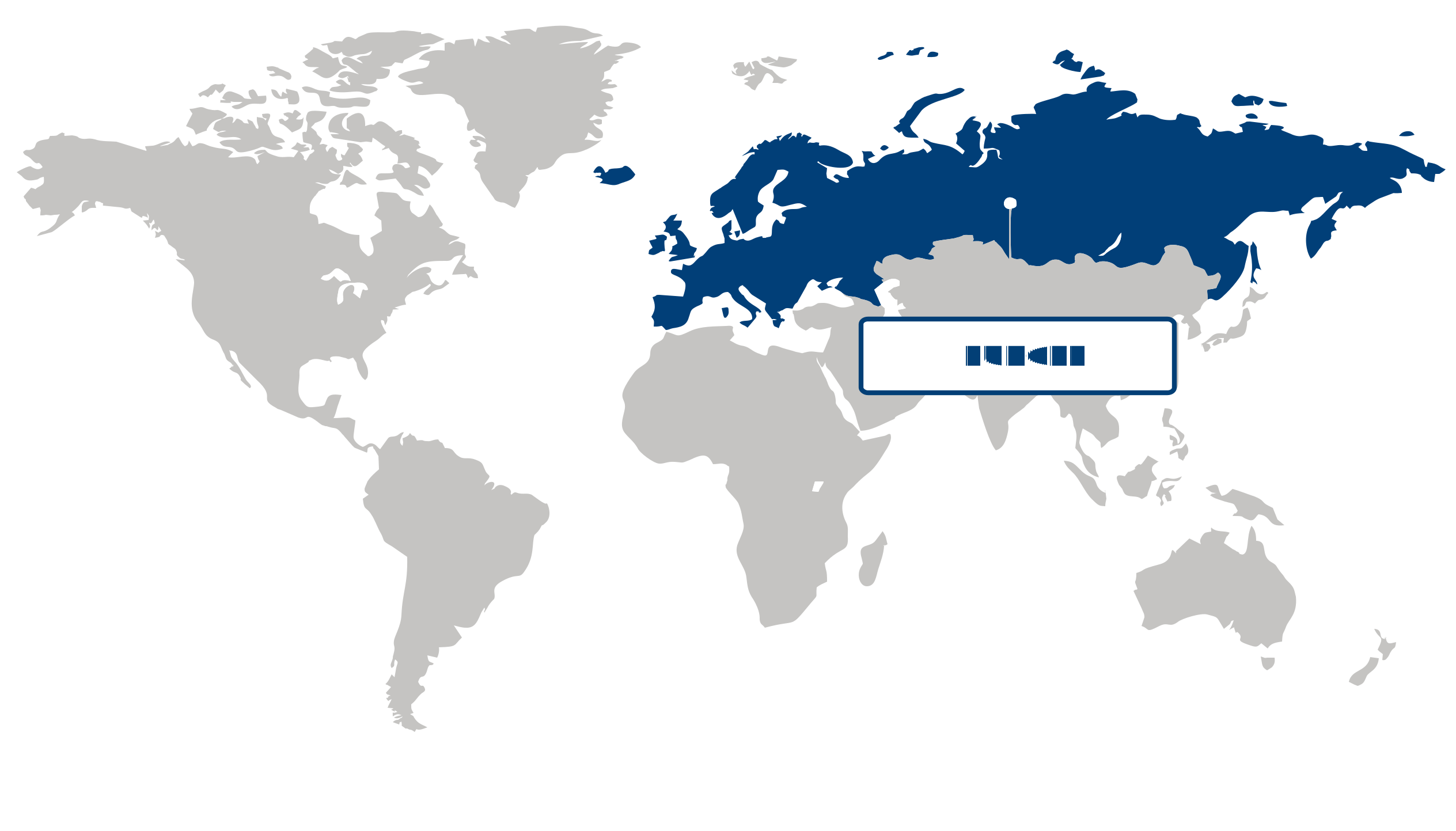
Europe (Largest Region)
Europe maintained the leading position in the women's jerseys, sweatshirts & pullovers market, holding a 36.04% share in 2026, supported by strong consumer demand for casual and versatile apparel alongside the region's established fashion and retail ecosystem. Consumers increasingly value clothing that combines comfort, functionality, and contemporary styling, supporting demand for jerseys, sweatshirts, and pullovers across everyday and leisurewear categories. The region's developed omnichannel retail infrastructure and strong penetration of e-commerce also provide consumers with broad access to diverse apparel collections. In addition, growing interest in durable materials, responsible sourcing, and adaptable wardrobe choices is influencing product development and purchasing decisions, creating opportunities for brands and retailers to differentiate offerings through design, quality, and sustainability attributes.
Asia Pacific (Fastest-Growing Region)
Asia Pacific is the fastest-growing region for the women's jerseys, sweatshirts & pullovers market, driven by expanding urban populations, rising fashion consciousness, and increasing adoption of casual and athleisure-oriented clothing. Changing lifestyles are encouraging consumers to favor comfortable apparel suitable for multiple settings, while the growing influence of digital retail and social commerce is accelerating product discovery and purchasing. Expanding middle-income consumer groups are also supporting greater discretionary spending on fashion and lifestyle products. Meanwhile, the region's strong textile and apparel manufacturing base provides access to extensive production capabilities and supports rapid product diversification, enabling retailers to respond efficiently to evolving preferences for colors, fabrics, silhouettes, and seasonal styles.
| Parameter | North America | Asia Pacific | Europe | Latin America | MEA |
|---|---|---|---|---|---|
| Innovation Hub i Scale Nascent Developing Advanced | |||||
| Cost-Sensitive Region i Scale Low Medium High | |||||
| Regulatory Environment i Scale Restrictive Neutral Supportive | |||||
| Demand Drivers i Scale Weak Moderate Strong | |||||
| Development Stage i Scale Emerging Developing Developed | |||||
| Adoption Rate i Scale Low Medium High | |||||
| New Entrants / Startups i Scale Sparse Moderate Dense | |||||
| Macro Indicators i Scale Weak Stable Strong |
Key Country Insights
Germany 🇩🇪
Performance Wear FocusGermany emphasizes women's jerseys, sweatshirts & pullovers that combine functional fabrics with durable construction for active and casual lifestyles. Consumer interest supports premium-quality products featuring responsible sourcing and long-lasting performance.
France 🇫🇷
Fashion Heritage AppealFrance positions women's jerseys, sweatshirts & pullovers around premium styling, quality textiles, and contemporary fashion influences. Consumers increasingly favor products that combine timeless aesthetics with environmentally responsible production practices.
Italy 🇮🇹
Craftsmanship-Led FashionItaly's women's jerseys, sweatshirts & pullovers market emphasizes premium fabrics, refined tailoring, and design quality. Manufacturers continue to integrate traditional craftsmanship with modern fashion trends to meet evolving consumer expectations.
Japan 🇯🇵
Premium Casual StylingJapan values women's jerseys, sweatshirts & pullovers with refined design, high-quality fabrics, and minimalist aesthetics. Local demand encourages brands to balance fashion trends with comfort, craftsmanship, and versatile wardrobe applications.
South Korea 🇰🇷
Trend-Led CollectionsSouth Korea's women's jerseys, sweatshirts & pullovers market responds quickly to changing fashion preferences driven by digital retail and contemporary styling. Brands frequently introduce updated collections that blend comfort with distinctive visual appeal.
United States 🇺🇸
Lifestyle Apparel InnovationThe U.S. women's jerseys, sweatshirts & pullovers market is shaped by demand for versatile apparel that blends comfort, athletic influence, and everyday wear. Brands are expanding seasonal collections while emphasizing sustainable materials and direct-to-consumer engagement.
Segment Leadership and Growth Trends
Women's Jerseys, Sweatshirts & Pullovers Market Share (%), by Distribution Channel, 2026
Go beyond the chart, access full insights & data tables
Request Free Sample ReportDistribution Channel Segment Analysis: Offline (Largest Segment) vs Online (Fastest-Growing Segment)
The offline segment dominated the women's jerseys, sweatshirts & pullovers market, accounting for a 75.84% share in 2026. Physical retail remains important because apparel purchases often involve evaluating fabric feel, fit, sizing, color, and garment quality before purchase. Department stores, specialty apparel outlets, and other brick-and-mortar channels also provide immediate product availability and personalized assistance, supporting consumer confidence and maintaining strong offline demand.
Online is the fastest-growing distribution channel as consumers increasingly value convenience, broader product selection, and flexible shopping experiences. E-commerce platforms allow shoppers to compare styles, prices, materials, and customer reviews without visiting physical stores, while improved delivery and return services are reducing barriers associated with apparel purchases. Growing smartphone usage and the increasing integration of digital merchandising, personalized recommendations, and social commerce are further encouraging online apparel shopping.
Fiber Segment Analysis: Polyester (Largest Segment) vs Cotton (Fastest-Growing Segment)
Polyester held the largest share of the women's jerseys, sweatshirts & pullovers market at 47.7% in 2026, supported by its durability, shape retention, wrinkle resistance, and suitability for active and casual apparel. The fiber's ability to support lightweight, stretch-oriented, and easy-care garment designs makes it well suited to modern jerseys, sweatshirts, and pullovers. Manufacturers also benefit from polyester's versatility across different garment constructions, helping sustain its broad presence in women's apparel.
Cotton is expanding at a faster pace as consumers increasingly favor natural fibers that offer softness, breathability, and comfortable everyday wear. Growing interest in comfort-oriented clothing and more natural material choices is strengthening demand for cotton-based jerseys, sweatshirts, and pullovers. The fiber also aligns well with casual and leisurewear trends, while increasing attention to responsible sourcing and material transparency can further support its appeal among environmentally conscious shoppers.
| Segment | Sub-Segment | Largest Segment | Fastest Growing |
|---|---|---|---|
| Distribution Channel | Offline, Online | Offline | Online |
| Fiber | Cotton, Polyester, Cellulosic, Others | Polyester | Cotton |
Competitive Landscape and Market Positioning
Leading companies in the women's jerseys, sweatshirts & pullovers market:
1. Christian Dior SE (France)
2. Chanel Limited (United Kingdom)
3. Gucci S.p.A. (Italy)
4. Prada S.p.A. (Italy)
5. Giorgio Armani S.p.A. (Italy)
6. Burberry Group plc (United Kingdom)
7. Dolce & Gabbana S.r.l. (Italy)
8. Gianni Versace S.r.l. (Italy)
9. LVMH Moët Hennessy Louis Vuitton SE (France)
10. Kering S.A. (France)
The women's jerseys, sweatshirts & pullovers market is being shaped by shifting fashion preferences and growing demand for versatile apparel. New design approaches are emphasizing comfort, seasonal adaptability, and sustainable material usage. Product innovation is frequent, while differentiation is increasingly driven by fabric technology and aesthetic variety.
| Company | Market Share | Company Revenue | Revenue CAGR (%) | Product Portfolio | Geographic Presence | Innovation / R&D Focus | Strategic Developments |
|---|---|---|---|---|---|---|---|
| Christian Dior SE (France) | |||||||
| Chanel Limited (United Kingdom) | |||||||
| Gucci S.p.A. (Italy) | |||||||
| Prada S.p.A. (Italy) | |||||||
| Giorgio Armani S.p.A. (Italy) | |||||||
| Burberry Group plc (United Kingdom) | |||||||
| Dolce & Gabbana S.r.l. (Italy) | |||||||
| Gianni Versace S.r.l. (Italy) | |||||||
| LVMH Moët Hennessy Louis Vuitton SE (France) | |||||||
| Kering S.A. (France). |
Industry Development/News
| Company Name | Date | Key Development |
|---|---|---|
| PUMA SE | Mar-24 | PUMA SE expanded its retail footprint in India through the opening of 75 new stores in 2023, strengthening its distribution network in a high-growth apparel market. This expansion supports improved market penetration for hoodies and sweatshirts categories by enhancing brand accessibility, increasing direct-to-consumer reach, and reinforcing its competitive positioning in emerging sportswear demand centers. |
| Reima | Aug-23 | Reima introduced kids’ hoodies manufactured using Infinna™ fibers derived from textile waste, reflecting a sustainability-driven material innovation in apparel. The development enhances the company’s positioning in eco-friendly clothing segments by integrating circular economy inputs into product design, supporting growing demand for environmentally responsible sweatshirts and pullovers across children’s wear markets. |
| Adidas AG | Aug-22 | Adidas AG launched hoodies made from regenerative fibers, expanding its sustainable apparel portfolio within the sweatshirts and hoodies segment. The initiative reflects continued material innovation focused on reducing environmental impact while addressing rising consumer demand for eco-conscious sportswear, reinforcing Adidas’ competitive positioning in performance and lifestyle apparel categories. |
| Damensch Apparel Pvt. Ltd. | Oct-21 | Damensch Apparel Pvt. Ltd. expanded its product portfolio by introducing additional menswear categories, including joggers, sweat shorts, sweatshirts, and hoodies. This diversification strengthens its presence in casualwear segments, supporting broader category expansion strategy and enabling improved market coverage across athleisure and comfort-oriented apparel offerings. |
Customize Your Report
Explore examples of how this report can be tailored to different research needs, including custom segments, additional topics or chapters, and related reports. Click a section of the wheel or its numbered marker to explore the available options.
Women's Jerseys, Sweatshirts & Pullovers Market — Custom Segments
| Segment | Sub-Segment |
|---|---|
| Product Style | Jerseys, Sweatshirts, Pullovers |
| Price Positioning | Mass Market, Mid-Range, Premium, Luxury |
| Usage Occasion | Casualwear, Activewear, Loungewear, Outdoor & Travel |
Women's Jerseys, Sweatshirts & Pullovers Market — Custom TOC
| Custom Chapter | Custom Details |
|---|---|
| Women's Athleisure Evolution Analysis |
|
| Sustainable Apparel Material Transition Study |
|
| E-Commerce Growth Opportunity Mapping |
|
Need a different cut of the data?
Request Custom ResearchHow much revenue does the women's jerseys, sweatshirts & pullovers market generate?
What is the projected value of the women's jerseys, sweatshirts & pullovers industry by 2036?
How is hybrid work culture influencing purchasing behavior in the women's jerseys, sweatshirts & pullovers market?
Why are sustainable materials becoming strategically important in the women's jerseys, sweatshirts & pullovers market?
Why does offline distribution lead the women's jerseys, sweatshirts & pullovers market?
Which fiber segment is growing the fastest in the women's jerseys, sweatshirts & pullovers market?
What factors make Europe the largest market for women's jerseys, sweatshirts & pullovers?
Why is Asia Pacific the fastest-growing region for women's jerseys, sweatshirts & pullovers?
What are the prominent companies operating in the women's jerseys sweatshirts & pullovers landscape?
Our Clients
"The report provided us with a clear direction, and the level of detail was beyond what we expected. I would definitely recommend their services to others."
Haier Appliances
"The collaboration with Fundamental Business Insights has added significant value to our decision-making process, and we look forward to continuing this partnership for our future market research requirements."
Luxottica Group S.p.A.
"The team at FBI delivered an exceptional research report. The insights on industry innovations were particularly impressive and added a lot of value to the overall report."
Nike
Our Research Team & Methodology
Every Fundamental Business Insights report is built by a dedicated vertical research team, validated through a structured primary-and-secondary methodology, and reviewed for accuracy before it reaches you.
Research Team Overview
Prepared by the Consumer Goods & Services Research Team
Delivery
Published
Demand
Available
Support
Trust & Compliance
Research Domains
10 coverage areasResearch Intelligence
| Source | Reference |
|---|---|
| International Organization for Standardization (ISO) | www.iso.org |
| ASTM International | www.astm.org |
| U.S. Consumer Product Safety Commission (CPSC) | www.cpsc.gov |
| European Commission – Consumer Safety | ec.europa.eu/safety-gate |
| Consumer Technology Association (CTA) | www.cta.tech |
| National Retail Federation (NRF) | nrf.com |
| World Retail Congress | www.worldretailcongress.com |
| World Travel & Tourism Council (WTTC) | wttc.org |
| UN Tourism | www.unwto.org |
| Personal Care Products Council (PCPC) | www.personalcarecouncil.org |
| Cosmetics Europe | cosmeticseurope.eu |
| International Housewares Association (IHA) | www.housewares.org |
| American Apparel & Footwear Association (AAFA) | www.aafaglobal.org |
| World Federation of the Sporting Goods Industry (WFSGI) | wfsgi.org |
| Juvenile Products Manufacturers Association (JPMA) | www.jpma.org |
| Pet Industry Joint Advisory Council (PIJAC) | pijac.org |
| International Council of Toy Industries (ICTI) | www.toy-icti.org |
| International Association of Amusement Parks and Attractions (IAAPA) | iaapa.org |
| Organisation for Economic Co-operation and Development (OECD) | www.oecd.org |
| World Bank Data | data.worldbank.org |
Research Workflow & Quality Assurance
Data Collection
Verified information gathered through primary and secondary research.
Data Triangulation
Cross-validation using multiple independent data sources.
Forecast Modelling
Market estimates developed using historical trends and analytical models.
Analyst Validation
Findings reviewed by domain experts for accuracy and consistency.
Editorial & Quality Review
Final editorial, quality, and compliance checks before publication.
Final Publication
Released after successful completion of the internal review process.
Report Coverage
📊 Market Assessment
- Market Size & Forecast
- Market Segmentation
- Regional Analysis
- Growth Drivers & Challenges
- Market Dynamics
🏢 Competitive Intelligence
- Competitive Landscape
- Company Profiles
- Competitive Benchmarking
- Mergers & Acquisitions
- Market Share Analysis or Key Company Strategies
🔍 Strategic Analysis
- Value Chain Analysis
- Porter's Five Forces
- PESTLE Analysis
- Pricing Trends
- Supply-Demand Analysis
🚀 Future Outlook
- Technology Landscape
- Regulatory Landscape
- Investment & Funding Landscape
- Emerging Opportunities
- Future Market Outlook
Have a question about this report or need a custom scope?
Request Customization