



Wood Adhesives Market Size & Growth Forecast 2027–2036, By Segments (Application, Substrate, Product), Regional Demand Trends (North America, Asia Pacific, Europe), Key Country Insights (U.S., Japan, South Korea, Germany, France, Italy), and Competitive Landscape
Market Size and Growth Outlook
Wood Adhesives Market size was more than USD 8.79 billion in 2026 and is set to grow at a 8.17% CAGR between 2027 and 2036, attaining USD 19.28 billion by 2036. The industry revenue for 2027 is calculated at USD 9.39 billion.
Base Year Value (2026)
USD 8.79 billion
CAGR (2027-2036)
8.17%
Forecast Year Value (2036)
USD 19.28 billion

Historical Data Period
2022-2026

Largest Region
Asia Pacific

Forecast Period
2027-2036
Wood Adhesives Market Intelligence Snapshot:
-
Regional Market Dynamics:
- Asia Pacific leads the market and is projected to grow at a 9.83% CAGR, supported by its extensive furniture and engineered wood manufacturing base alongside strong construction and interior demand.
- Expanding production capacity, rising engineered wood output, and increasing downstream demand across domestic and export supply chains are driving higher adhesive consumption throughout the region.
-
Segment Momentum:
- Furniture held a 49.4% share in 2026 due to high adhesive consumption across assembly, panel bonding, and structural joinery, supported by consistent production volumes in both mass manufacturing and custom fabrication.
- Medium-density Fiberboard (MDF) is the fastest-growing substrate segment as expanding panel-based manufacturing increases demand for reliable adhesives that ensure panel integrity and finishing quality.
-
Market Expansion Drivers:
- Growing engineered wood panel production increasing adhesive consumption across furniture manufacturing applications.
- Rising demand for sustainable and bio-based adhesives supporting eco-friendly construction initiatives.
- Expanding renovation and commercial infrastructure projects driving premium wood furniture manufacturing demand.
-
Leading Market Participants:
Prominent companies in the wood adhesives market include Henkel AG & Co. KGaA (Germany), H.B. Fuller Company (United States), 3M Company (United States), Sika AG (Switzerland), Bostik S.A. (France), Dow Inc. (United States), Arkema S.A. (France), Pidilite Industries Limited (India), Akzo Nobel N.V. (Netherlands), Ashland Inc. (United States).
Global Market Forecast Snapshot:
-
Market Outlook:
- 2026 Market Size: USD 8.79 billion
- 2027 Estimated Market Size: USD 9.39 billion.
- Projected Market Size: USD 19.28 billion by 2036
- Growth Forecasts: 8.17% CAGR (2027-2036)
-
Regional and Segment Outlook:
- Leading Regional Market: Asia Pacific
- High-Growth Regional Hub: Asia Pacific
- Core Revenue Segment: Furniture (Application) | Plywood (Substrate) | Urea-formaldehyde (UF) (Product)
- Emerging Opportunity Segment: Flooring (Application) | Medium-density Fiberboard (MDF) (Substrate) | Soy-based (Product)
Market Growth Drivers and Industry Trends
Growing engineered wood panel production increasing adhesive consumption across furniture manufacturing applications
The growing production of engineered wood panels will drive the wood adhesives market growth as manufacturers increasingly rely on adhesives to bond materials such as particleboard, medium-density fiberboard, and other composite wood products. Rising use of these panels in furniture manufacturing is creating sustained requirements for adhesives that provide strong bonding, dimensional stability, durability, and resistance to changing environmental conditions. As furniture producers expand the use of engineered wood for cabinets, tables, shelving, and other interior products, adhesive consumption increases across panel lamination, edge bonding, and component assembly processes, supporting broader adoption of specialized formulations suited to high-volume manufacturing environments.
Rising demand for sustainable and bio-based adhesives supporting eco-friendly construction initiatives
Growing emphasis on environmentally responsible building practices is strengthening demand for bio-based and lower-impact bonding solutions, supporting wood adhesives market growth through the transition toward more sustainable construction materials. Manufacturers and construction stakeholders are increasingly seeking adhesive formulations that reduce reliance on conventional petroleum-derived inputs while maintaining the bonding performance required for engineered wood products. Bio-based alternatives derived from renewable feedstocks can support sustainability objectives in furniture, flooring, cabinetry, and structural wood applications, while evolving environmental preferences encourage manufacturers to improve formulations, reduce emissions, and develop products compatible with green building practices.
Expanding renovation and commercial infrastructure projects driving premium wood furniture manufacturing demand
Expansion in renovation activity and commercial infrastructure development is increasing demand for higher-quality wood furniture and interior products, which will propel the wood adhesives market growth across manufacturing and assembly applications. Renovation of residential properties, offices, hospitality facilities, retail spaces, and other commercial environments requires durable cabinetry, fixtures, decorative panels, flooring components, and customized furniture. Premium furniture production often depends on adhesives capable of delivering clean finishes, reliable structural bonding, and long-term performance, encouraging manufacturers to adopt specialized products for different wood substrates and demanding production processes.
| Growth Driver Assessment Framework | |||||
| Growth Driver | Impact On CAGR | Regulatory Influence | Geographic Relevance | Adoption Rate | Impact Timeline |
|---|---|---|---|---|---|
| Growing engineered wood panel production increasing adhesive consumption across furniture manufacturing applications | 2.00% | Moderate | Asia Pacific, Europe, North America | High | Near Term |
| Rising demand for sustainable and bio-based adhesives supporting eco-friendly construction initiatives | 1.80% | High | Europe, North America | Medium | Mid Term |
| Expanding renovation and commercial infrastructure projects driving premium wood furniture manufacturing demand | 1.50% | Moderate | Asia Pacific, Latin America | Emerging | Long Term |
Unlock insights tailored to your business with our bespoke market research solutions - Click to get your customized report now!
Regional Demand Dynamics
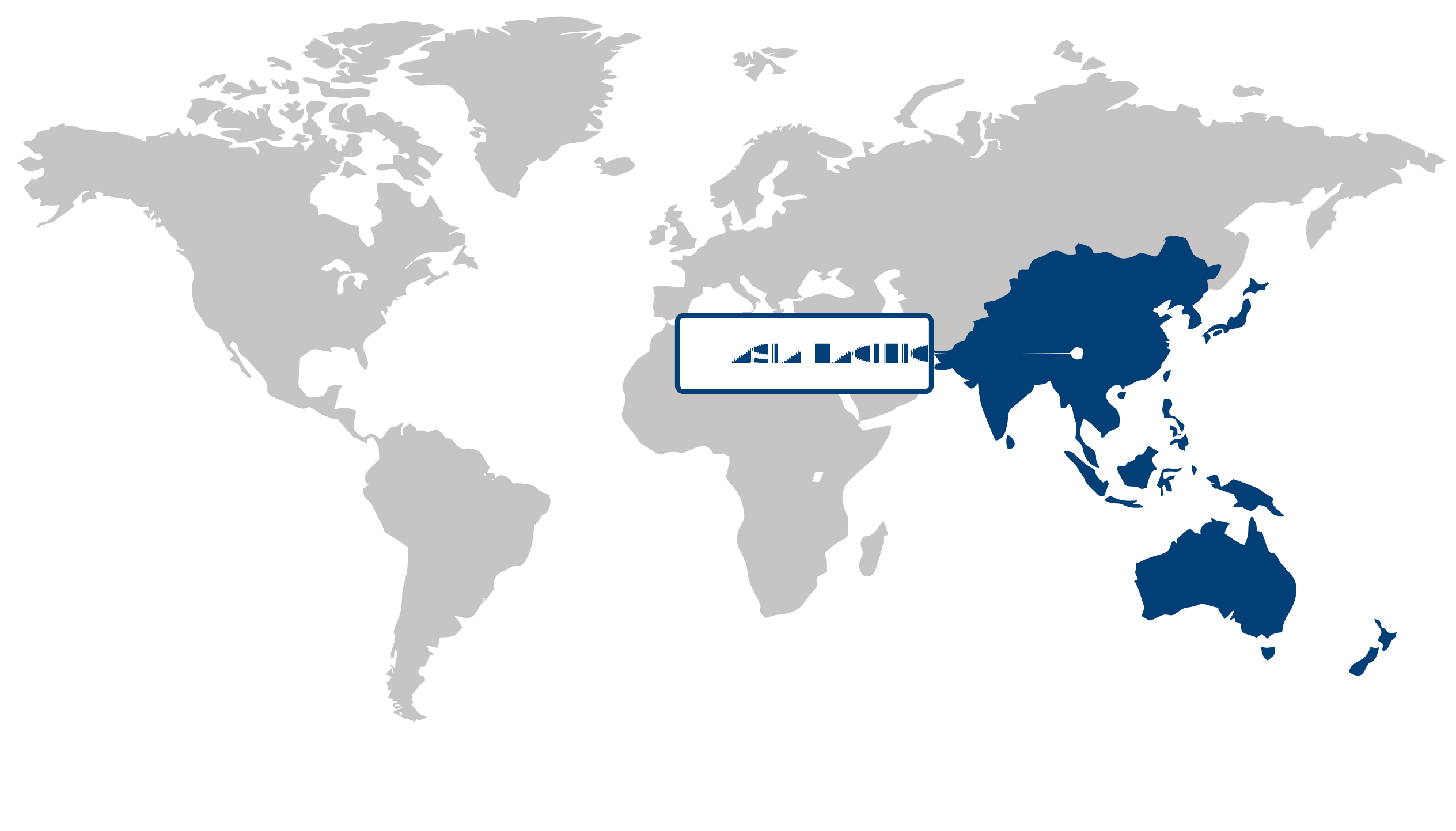
Largest Region
Asia Pacific
Largest Market Share in 2026
Asia Pacific (Largest & Fastest-Growing Region)
The Asia Pacific wood adhesives market held the largest share in 2026 and is also the fastest-growing regional market, supported by expanding construction activity, furniture manufacturing, and wood-processing industries across the region. Rising urbanization and infrastructure development are increasing demand for engineered wood products, flooring, cabinetry, and other applications that require reliable bonding solutions. The region's strong manufacturing base, availability of raw materials, and growing adoption of efficient production technologies further support consumption of wood adhesives. Increasing preference for low-emission and environmentally responsible adhesive formulations is also encouraging product development aligned with evolving construction and consumer requirements.
Key Country Insights
The U.S. wood adhesives market benefits from sustained demand across furniture, construction, and engineered wood product manufacturing. Producers are focusing on adhesive technologies that improve bonding performance, durability, and production efficiency.
Japan emphasizes wood adhesives that deliver consistent performance, precision application, and durability across specialized manufacturing environments. Demand remains concentrated on solutions that support product quality and efficient production processes.
South Korea utilizes wood adhesives extensively in furniture and interior product manufacturing. Market participants are investing in formulations that enhance bonding reliability, production speed, and compatibility with modern engineered wood materials.
Germany prioritizes wood adhesives that align with sustainability objectives and evolving environmental standards. Manufacturers increasingly develop low-emission formulations suitable for furniture production, wood panels, and advanced construction applications.
France is encouraging adoption of wood adhesives that support sustainable wood processing and environmentally responsible manufacturing practices. Demand increasingly favors products that balance performance requirements with lower environmental impact profiles.
Italy's wood adhesives market is closely linked to furniture and interior product manufacturing that requires strong and aesthetically reliable bonding solutions. Producers and users prioritize adhesive performance that supports craftsmanship, durability, and production flexibility.
Segment Leadership and Growth Trends
Application Segment Analysis: Furniture (Largest Segment) vs Flooring (Fastest-Growing Segment)
Furniture represented the largest application segment of the wood adhesives market, accounting for 49.4% share in 2026, driven by the extensive use of adhesives across furniture assembly, panel bonding, edge joining, and other manufacturing processes. Adhesive-based joining supports clean finishes, structural integrity, and efficient production while reducing reliance on conventional mechanical fastening methods. The flooring application, meanwhile, is experiencing the fastest growth as expanding demand for durable and visually consistent wood-based flooring increases the need for reliable bonding solutions. Adhesives that provide strong adhesion, dimensional stability, and resistance to everyday stresses are becoming increasingly important as flooring manufacturers pursue efficient installation and longer-lasting finished products.
Substrate Segment Analysis: Plywood (Largest Segment) vs Medium-density Fiberboard (MDF) (Fastest-Growing Segment)
In the wood adhesives market, the plywood segment held the largest share at 28.84% in 2026, reflecting the widespread use of plywood across construction, furniture, cabinetry, and other wood-based applications requiring durable bonded layers. Adhesives play a critical role in maintaining the structural cohesion of plywood while supporting manufacturing efficiency and consistent product performance. Medium-density fiberboard (MDF) is the fastest-growing substrate segment, supported by its broad application in furniture, interior components, cabinetry, and decorative wood products. The uniform structure and smooth surface of MDF make effective adhesive bonding particularly important, while continued preference for engineered wood materials is reinforcing demand for specialized adhesive formulations.
| Report Segmentation | |||
| Segment | Sub-Segment | Largest Segment | Fastest Growing Segment |
|---|---|---|---|
| Application | Flooring, Furniture, Doors & Windows, Housing Components, Others | Furniture | Flooring |
| Substrate | Solid Wood, Oriented Strand Board (OSB), Plywood, Particle Board (PB), Medium-density Fiberboard (MDF), High-density Fiberboard (HDF), Others | Plywood | Medium-density Fiberboard (MDF) |
| Product | Urea-formaldehyde (UF), Melamine Urea-formaldehyde (MUF), Phenol-formaldehyde (PF), Isocyanates, Polyurethane, Polyvinyl Acetate (PVA), Soy-based, Others | Urea-formaldehyde (UF) | Soy-based |
 Read our Research Approach
Competitive Landscape and Market Positioning
Prominent players in the wood adhesives market:
1. Henkel AG & Co. KGaA (Germany)
2. H.B. Fuller Company (United States)
3. 3M Company (United States)
4. Sika AG (Switzerland)
5. Bostik S.A. (France)
6. Dow Inc. (United States)
7. Arkema S.A. (France)
8. Pidilite Industries Limited (India)
9. Akzo Nobel N.V. (Netherlands)
10. Ashland Inc. (United States)
Innovation-led development is strongly influencing the wood adhesives market as manufacturers prioritize high-performance and application-specific formulations. The wood adhesives market is witnessing increased emphasis on environmentally safer and durable bonding solutions aligned with evolving construction and furniture needs. Focused R&D investments are accelerating formulation improvements, while collaborative efforts across supply chains are supporting faster commercialization of advanced adhesives. Product diversification remains a key strategy as firms aim to address specialized industrial requirements and improve efficiency standards.
Industry Development/News
| Company Name | Date | Key Development |
|---|---|---|
| Joint Venture (company names not specified) | Apr-26 | A newly formed joint venture integrated fire-retardant chemistry with industrial-scale manufacturing capabilities to produce sustainable Class A fire-rated wood products for construction applications. The initiative strengthens advanced wood bonding and engineered wood material development by combining specialty chemical innovation with scalable production infrastructure for commercial and residential building segments. |
| altM | Feb-26 | altM launched a pilot-scale integrated biorefinery in Bengaluru, transitioning from laboratory research to industrial validation. The facility is designed to produce bio-derived materials compatible with existing industrial manufacturing systems, supporting development of sustainable alternatives to petrochemical-based inputs used across adhesive and broader industrial material applications. |
| Sika AG | Jan-23 | Sika AG introduced MB EZ Rapid, a single-component fast-drying moisture barrier and adhesive substrate consolidator for residential and commercial flooring applications. The solution enhances adhesion performance on plywood substrates and reflects incremental innovation in wood-related adhesive systems used in construction and interior installation environments. |
| Henkel AG & Co. KGaA | May-23 | Henkel’s Engineered Wood division showcased its advanced adhesive portfolio for mass timber applications at LIGNA 2023, emphasizing sustainability and improved fire performance characteristics. The initiative reflects continued development of engineered wood bonding solutions aligned with evolving construction requirements for large-scale timber and structural wood applications. |
| Henkel AG & Co. KGaA | May-21 | Henkel invested in a new innovation center in Shanghai to strengthen its research and development capabilities in the Asia-Pacific region. The expansion enhances its formulation and product development capacity for adhesive technologies, supporting long-term competitiveness in regional wood adhesives and industrial bonding markets. |
| Henkel AG & Co. KGaA | Feb-20 | Henkel upgraded its innovation center in Sydney to expand R&D capabilities and strengthen regional innovation infrastructure. The enhancement supports development of advanced adhesive formulations and reinforces the company’s presence in the Asia-Pacific wood adhesives and industrial materials innovation ecosystem. |
Why Choose Us
Specialized Expertise: Our team comprises industry experts with a deep understanding of your market segment. We bring specialized knowledge and experience that ensures our research and consulting services are tailored to your unique needs.
Customized Solutions: We understand that every client is different. That's why we offer customized research and consulting solutions designed specifically to address your challenges and capitalize on opportunities within your industry.
Proven Results: With a track record of successful projects and satisfied clients, we have demonstrated our ability to deliver tangible results. Our case studies and testimonials speak to our effectiveness in helping clients achieve their goals.
Cutting-Edge Methodologies: We leverage the latest methodologies and technologies to gather insights and drive informed decision-making. Our innovative approach ensures that you stay ahead of the curve and gain a competitive edge in your market.
Client-Centric Approach: Your satisfaction is our top priority. We prioritize open communication, responsiveness, and transparency to ensure that we not only meet but exceed your expectations at every stage of the engagement.
Continuous Innovation: We are committed to continuous improvement and staying at the forefront of our industry. Through ongoing learning, professional development, and investment in new technologies, we ensure that our services are always evolving to meet your evolving needs.
Value for Money: Our competitive pricing and flexible engagement models ensure that you get maximum value for your investment. We are committed to delivering high-quality results that help you achieve a strong return on your investment.
Select Licence Type

