



Wood Pellets Market Size & Growth Forecast 2027–2036, By Segments (Application, End-use), Regional Demand Trends (North America, Asia Pacific, Europe), Key Country Insights (U.S., Japan, South Korea, Germany, France, Italy), and Competitive Landscape
Market Size and Growth Outlook
Wood Pellets Market size was over USD 10.3 billion in 2026 and is likely to grow at a 7.41% CAGR between 2027 and 2036, exceeding USD 21.05 billion by 2036. The industry revenue for 2027 is estimated at USD 10.94 billion.
Base Year Value (2026)
USD 10.3 billion
CAGR (2027-2036)
7.41%
Forecast Year Value (2036)
USD 21.05 billion

Historical Data Period
2022-2026

Largest Region
Europe

Forecast Period
2027-2036
Wood Pellets Market Intelligence Snapshot:
-
Regional Market Dynamics:
- Europe leads through established biomass heating and power generation infrastructure, mature supply chains, and widespread pellet consumption across residential, commercial, and utility applications.
- Asia Pacific is forecast to grow at a 7.12% CAGR as energy users expand fuel-switching initiatives, industrial pellet consumption, and infrastructure for pellet sourcing, handling, and combustion.
-
Segment Momentum:
- Heating accounted for 61.22% of the market in 2026 due to its widespread use across residential, commercial, and district heating systems, where recurring thermal demand supports consistent wood pellet consumption.
- Power Generation is expanding fastest as utilities increase biomass fuel use for electricity production, creating stronger demand for large-scale wood pellet supply to support lower-emission energy generation.
-
Market Expansion Drivers:
- Government climate targets accelerating coal-to-biomass transition in utility power generation.
- Expanding biomass heating infrastructure increasing industrial and residential wood pellet consumption.
- Rising investments in advanced pelletization technologies improving fuel efficiency and export scalability.
-
Leading Market Participants:
Key companies in the wood pellets market include Drax Group plc (United Kingdom), Enviva Inc. (United States), Pinnacle Renewable Energy Inc. (Canada), Georgia Biomass, LLC (United States), The Westervelt Company (United States), Energex Corporation (United States), Groupe Savoie Inc. (Canada), Wood Pellet Energy (UK) Ltd. (United Kingdom), SINGPELLET Pte. Ltd. (Singapore).
Global Market Forecast Snapshot:
-
Market Outlook:
- 2026 Market Size: USD 10.3 billion
- 2027 Estimated Market Size: USD 10.94 billion.
- Projected Market Size: USD 21.05 billion by 2036
- Growth Forecasts: 7.41% CAGR (2027-2036)
-
Regional and Segment Outlook:
- Leading Regional Market: Europe
- High-Growth Regional Hub: Asia Pacific
- Core Revenue Segment: Heating (Application) | Industrial (End-use)
- Emerging Opportunity Segment: Power Generation (Application) | Industrial (End-use)
Market Growth Drivers and Industry Trends
Government climate targets accelerating coal-to-biomass transition in utility power generation
Government efforts to reduce carbon emissions from conventional fossil-fuel power generation are encouraging utilities to evaluate lower-carbon alternatives, supporting demand across the wood pellets market. Wood pellets can be used as a biomass fuel in suitable power-generation systems and can provide utilities with an alternative to direct reliance on coal, particularly where biomass co-firing or dedicated biomass generation is technically and economically feasible. Climate policies, renewable energy targets, emissions reduction commitments, and incentives for cleaner energy production can influence utility fuel-selection decisions and encourage investment in biomass supply arrangements. The growing focus on decarbonizing existing power infrastructure is therefore strengthening the role of pelletized biomass in energy-transition strategies.
Expanding biomass heating infrastructure increasing industrial and residential wood pellet consumption
Investment in biomass heating systems is widening the applications for wood pellets across residential, commercial, and industrial settings. The wood pellets market is supported by the installation and modernization of pellet boilers, heating systems, and related fuel-handling infrastructure that allow users to adopt biomass for space heating and thermal energy requirements. Pellet heating can provide a convenient fuel format because standardized pellet dimensions support automated feeding and storage in compatible systems. As more heating infrastructure becomes capable of using biomass fuels, households and industrial facilities can incorporate wood pellets into their energy mix, while improvements in distribution networks and storage capabilities make regular pellet procurement more practical for end users.
Rising investments in advanced pelletization technologies improving fuel efficiency and export scalability
Technological investment throughout the pellet production process is improving the consistency, handling characteristics, and energy performance of manufactured biomass fuels. Within the wood pellets market, advanced pelletization equipment can improve the processing of raw materials into uniform products with characteristics suited to automated handling, transportation, and combustion systems. Modern production technologies can also support better control over moisture content, density, durability, and feedstock processing, helping producers maintain product quality across larger production volumes. Improvements in manufacturing efficiency and pellet quality are particularly relevant to international trade because standardized, durable products are easier to store, transport, and manage across longer supply chains.
| Growth Driver Assessment Framework | |||||
| Growth Driver | Impact On CAGR | Regulatory Influence | Geographic Relevance | Adoption Rate | Impact Timeline |
|---|---|---|---|---|---|
| Government climate targets accelerating coal-to-biomass transition in utility power generation | 2.00% | High | Europe, North America | High | Near Term |
| Expanding biomass heating infrastructure increasing industrial and residential wood pellet consumption | 1.80% | High | Europe, Asia Pacific | High | Mid Term |
| Rising investments in advanced pelletization technologies improving fuel efficiency and export scalability | 1.40% | Moderate | North America, Europe | Medium | Long Term |
Unlock insights tailored to your business with our bespoke market research solutions - Click to get your customized report now!
Regional Demand Dynamics
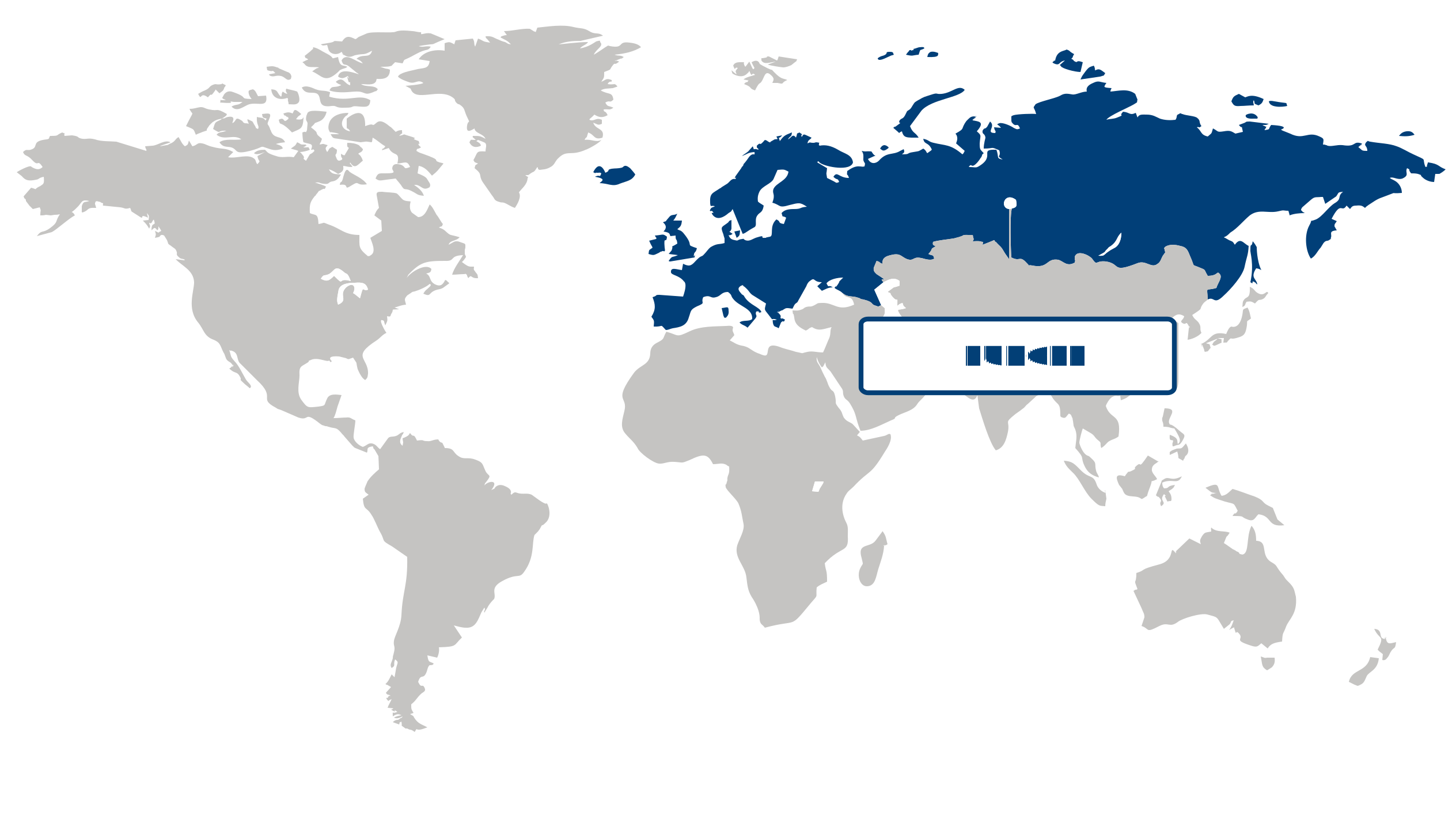
Largest Region
Europe
Largest Market Share in 2026
Europe (Largest Region) vs Asia Pacific (Fastest-Growing Region)
Holding the largest share of the wood pellets market in 2026, Europe benefits from strong renewable energy adoption, established biomass heating infrastructure, and sustained efforts to reduce dependence on conventional fossil fuels. Supportive environmental policies and decarbonization initiatives continue to encourage the use of wood pellets across residential heating and industrial energy applications. The region's mature pellet supply chain, developed distribution networks, and established consumer familiarity further reinforce demand, while the broader transition toward lower-carbon energy sources supports continued market development.
Asia Pacific is the fastest-growing region for the wood pellets market, supported by rising energy demand, expanding industrial activity, and increasing interest in renewable and lower-emission fuel alternatives. Growing efforts to diversify energy sources are creating opportunities for biomass-based heating and power generation, particularly as governments and industries pursue cleaner energy strategies. Improvements in pellet production, storage, transportation, and distribution infrastructure are also helping strengthen regional adoption and improve the accessibility of wood-based fuels.
Key Country Insights
The U.S. wood pellets market benefits from abundant forestry resources and export-oriented production alongside domestic industrial biomass use. U.S. suppliers continue investing in sustainable sourcing and pellet quality to meet utility and industrial customer requirements.
Japan continues incorporating wood pellets into thermal power generation to diversify energy sources and support lower-emission electricity production. Japanese utilities prioritize dependable long-term pellet supply and strict sustainability certification for imported biomass.
South Korea maintains demand for imported wood pellets to support biomass-based electricity generation. Buyers in South Korea are strengthening procurement strategies that emphasize certified feedstock, reliable logistics, and long-term supplier partnerships.
Germany emphasizes wood pellets for residential heating and industrial energy applications as part of its renewable energy strategy. Demand in Germany increasingly favors certified pellets and efficient heating systems aligned with environmental compliance requirements.
France supports wood pellet adoption through demand for efficient residential heating and modern biomass boilers. French distributors are expanding premium pellet availability while focusing on fuel consistency and environmentally responsible sourcing practices.
Italy remains an important consumer of wood pellets for household heating, supported by widespread pellet stove installations. Italian buyers increasingly seek high-quality certified pellets that deliver consistent combustion performance and reduced maintenance requirements.
Segment Leadership and Growth Trends
Application Segment Analysis: Heating (Largest Segment) vs Power Generation (Fastest-Growing Segment)
Heating accounted for the largest share of the wood pellets market in 2026, with a 61.22% share. The segment benefits from the established use of wood pellets as a renewable solid fuel for residential and commercial heating applications. Pellet-based heating systems offer automated fuel feeding, consistent combustion, and compatibility with modern heating equipment, making them an attractive alternative to conventional solid fuels in suitable markets. Growing interest in renewable energy, efforts to reduce dependence on fossil-based heating fuels, and demand for efficient biomass heating solutions continue to support consumption in this application.
Power generation is emerging as the fastest-growing application, supported by increasing interest in biomass-based electricity production and renewable energy integration. Wood pellets can provide a standardized and transportable biomass fuel for power facilities seeking to incorporate renewable feedstocks into their energy mix. The broader transition toward lower-carbon energy systems and efforts to diversify electricity generation sources are creating additional opportunities for pellet consumption in power generation. Improvements in biomass handling and combustion technologies are further supporting the adoption of wood pellets for utility-scale and industrial energy applications.
End-use Segment Analysis: Industrial (Largest & Fastest-Growing Segment)
Industrial applications dominated the wood pellets market in 2026, accounting for a 48.55% share, and the industrial segment is also the fastest-growing end-use category. Its combined leadership reflects the suitability of wood pellets as a consistent biomass fuel for industrial heating, steam generation, and energy-intensive operations. Their standardized characteristics support automated handling and predictable combustion, while the ability to replace or complement conventional fossil fuels can help industrial users pursue energy diversification and emissions-reduction objectives. Increasing adoption of renewable energy sources across industrial operations, alongside efforts to improve fuel efficiency and strengthen sustainability performance, is reinforcing demand. The segment's strong growth trajectory is further supported by expanding industrial interest in biomass-based energy solutions and the integration of renewable fuels into broader energy-management strategies.
| Report Segmentation | |||
| Segment | Sub-Segment | Largest Segment | Fastest Growing Segment |
|---|---|---|---|
| Application | Heating, Power Generation, CHP | Heating | Power Generation |
| End-use | Residential, Commercial, Industrial | Industrial | Industrial |
 Read our Research Approach
Competitive Landscape and Market Positioning
Key companies in the wood pellets market:
1. Drax Group plc (United Kingdom)
2. Enviva Inc. (United States)
3. Pinnacle Renewable Energy Inc. (Canada)
4. Georgia Biomass LLC (United States)
5. The Westervelt Company (United States)
6. Energex Corporation (United States)
7. Groupe Savoie Inc. (Canada)
8. Wood Pellet Energy (UK) Ltd. (United Kingdom)
9. SINGPELLET Pte. Ltd. (Singapore)
Increasing transition toward renewable heating solutions is driving steady demand for biomass-based fuel alternatives. The wood pellets market is expanding through improved production efficiency and supply chain optimization. Enhanced pelletization technologies are improving energy density and combustion performance. Growing focus on carbon-neutral energy sources is also strengthening adoption across residential and industrial heating systems.
Industry Development/News
| Company Name | Date | Key Development |
|---|---|---|
| Drax Group | Jan-25 | Drax Group signed a multi-year agreement to supply over 1 million tonnes of sustainable wood pellets annually to Pathway Energy. This partnership supports a proposed $2 billion SAF facility in Port Arthur, Texas, aimed at producing carbon-negative jet fuel, reflecting the strategic pivot of pellet producers toward the high-growth sustainable aviation fuel market. |
| Enviva Biomass | Feb-25 | Enviva Biomass closed its Amory, Mississippi, manufacturing facility as part of a significant operational restructuring. This reduction in the company's production footprint underscores ongoing efforts to optimize its manufacturing network and realign capacity with current market demand and supply chain constraints. |
| Carbona | Mar-25 | Carbona advanced plans for New Zealand’s first large-scale biomass torrefaction facility. Designed to produce 180,000 tonnes of torrefied biomass annually, the project represents a strategic investment in regional processing capacity, aiming to provide high-energy-density renewable fuel alternatives for low-emissions energy initiatives. |
| Bioena | Jun-25 | Bioena inaugurated a new wood pellet production plant in Colombia. Certified under SBP and FSC standards, the facility enhances the company's export capabilities to European markets and increases its strategic participation in the international biomass energy supply chain. |
| Drax | Nov-25 | Drax announced the closure of its Williams Lake wood pellet plant in British Columbia. The decision, driven by insufficient fiber availability and a lack of commercial viability, reflects the operational challenges currently facing regional pellet production facilities dependent on stable, sustainable biomass feedstock. |
| PowerWood Canada Corp. | Dec-25 | PowerWood Canada Corp. finalized an agreement with Mackenzie County to develop two advanced "black pellet" production facilities in Alberta. Utilizing steam-explosion technology, the plants will convert wildfire-damaged timber into low-carbon biofuel for export to Japanese power plants, marking a significant entry of next-generation biomass technology into the Canadian market. |
| Highland Pellets LLC | Apr-26 | Highland Pellets announced plans to integrate a biomass power plant and carbon capture technology at its Arkansas facility. This operational upgrade is designed to improve energy efficiency and decrease the carbon intensity of its manufacturing process, aligning production operations with evolving environmental standards and industrial sustainability targets. |
Why Choose Us
Specialized Expertise: Our team comprises industry experts with a deep understanding of your market segment. We bring specialized knowledge and experience that ensures our research and consulting services are tailored to your unique needs.
Customized Solutions: We understand that every client is different. That's why we offer customized research and consulting solutions designed specifically to address your challenges and capitalize on opportunities within your industry.
Proven Results: With a track record of successful projects and satisfied clients, we have demonstrated our ability to deliver tangible results. Our case studies and testimonials speak to our effectiveness in helping clients achieve their goals.
Cutting-Edge Methodologies: We leverage the latest methodologies and technologies to gather insights and drive informed decision-making. Our innovative approach ensures that you stay ahead of the curve and gain a competitive edge in your market.
Client-Centric Approach: Your satisfaction is our top priority. We prioritize open communication, responsiveness, and transparency to ensure that we not only meet but exceed your expectations at every stage of the engagement.
Continuous Innovation: We are committed to continuous improvement and staying at the forefront of our industry. Through ongoing learning, professional development, and investment in new technologies, we ensure that our services are always evolving to meet your evolving needs.
Value for Money: Our competitive pricing and flexible engagement models ensure that you get maximum value for your investment. We are committed to delivering high-quality results that help you achieve a strong return on your investment.
Select Licence Type

