



Workforce Management Market Size & Growth Forecast 2027–2036, By Segments (Deployment, Company Size, Solution, Application), Regional Demand Trends (North America, Asia Pacific, Europe), Key Country Insights (U.S., Japan, South Korea, Germany, France, Italy), and Competitive Landscape
Market Size and Growth Outlook
Workforce Management Market size was valued at USD 12.4 billion in 2026 and is projected to grow at a 11.12% CAGR from 2027 to 2036, attaining USD 35.59 billion by 2036. The industry revenue for 2027 is estimated at USD 13.56 billion.
Base Year Value (2026)
USD 12.4 billion
CAGR (2027-2036)
11.12%
Forecast Year Value (2036)
USD 35.59 billion

Historical Data Period
2022-2026

Largest Region
Europe

Forecast Period
2027-2036
Workforce Management Market Intelligence Snapshot:
-
Regional Market Dynamics:
- Europe held largest share, supported by enterprise adoption, compliance requirements, complex labor regulations, and mature digital infrastructure enabling advanced workforce management.
- Asia Pacific is set to expand at 13.1% CAGR, driven by workforce digitalization, cloud-based tools adoption, and growing need for automated scheduling and real-time employee data.
-
Segment Momentum:
- On-premise solutions held a 53.24% share in 2026 as organizations value greater control over workforce data, enterprise system integration, customization, and internal governance requirements.
- SMEs are the fastest-growing segment as more businesses adopt workforce management tools to streamline scheduling, improve time tracking, reduce manual administration, and support business expansion efficiently.
-
Market Expansion Drivers:
- Rising cloud-based workforce optimization adoption improving enterprise productivity and labor efficiency.
- Increasing remote and hybrid work models accelerating demand for mobile workforce management platforms.
- Growing emphasis on workforce analytics enhancing employee engagement and customer retention strategies.
-
Leading Market Participants:
Major players in the workforce management market include UKG Inc. (United States), SAP SE (Germany), Oracle Corporation (United States), Workday, Inc. (United States), Infor, Inc. (United States), NICE Ltd. (Israel), Workforce Software LLC (United States), ADP, Inc. (United States), Ceridian HCM Holding Inc. (Canada), ATOSS Software AG (Germany).
Global Market Forecast Snapshot:
-
Market Outlook:
- 2026 Market Size: USD 12.4 billion
- 2027 Estimated Market Size: USD 13.56 billion.
- Projected Market Size: USD 35.59 billion by 2036 by 2036
- Growth Forecasts: 11.12% CAGR (2027-2036) CAGR (2027-2036)
-
Regional and Segment Outlook:
- Leading Regional Market: Europe
- High-Growth Regional Hub: Asia Pacific
- Core Revenue Segment: On-premise (Deployment) | Large Enterprises (Company Size) | Time & Attendance Management (Solution) | BFSI (Application)
- Emerging Opportunity Segment: Cloud (Deployment) | Small and Medium Enterprises (SMEs) (Company Size) | Embedded Analytics (Solution) | Healthcare (Application)
Market Growth Drivers and Industry Trends
Rising cloud-based workforce optimization adoption improving enterprise productivity and labor efficiency
The workforce management market is gaining traction as enterprises increasingly adopt cloud-based platforms to coordinate staffing, scheduling, attendance, payroll-related workflows, and labor allocation through centralized systems. Cloud deployment enables organizations to access workforce information across locations while reducing reliance on fragmented administrative processes and on-premises infrastructure. Automated scheduling, time tracking, and resource allocation also help managers align staffing levels with operational requirements, improve workforce utilization, and identify inefficiencies across departments, particularly in organizations managing geographically dispersed employees.
Increasing remote and hybrid work models accelerating demand for mobile workforce management platforms
Expansion of remote and hybrid working arrangements will propel the workforce management market growth as organizations require flexible tools to coordinate employees operating across offices, homes, and other locations. Mobile-enabled platforms allow workers and managers to access schedules, submit time information, communicate availability, and manage work-related tasks without being tied to a centralized workplace. Workforce managers can also maintain greater visibility into distributed teams and adjust staffing according to changing operational needs, making mobile accessibility increasingly important for organizations with flexible employment structures.
Growing emphasis on workforce analytics enhancing employee engagement and customer retention strategies
Greater reliance on workforce analytics is supporting the workforce management market as organizations seek deeper insight into employee availability, productivity, scheduling patterns, absenteeism, and service performance. Analytical capabilities can help managers identify staffing gaps, workload imbalances, and operational trends that influence employee experience and customer interactions. By using workforce data to refine scheduling and resource allocation, enterprises can reduce avoidable workload pressures, improve employee engagement, and maintain more consistent service levels in customer-facing operations.
| Growth Driver Assessment Framework | |||||
| Growth Driver | Impact On CAGR | Regulatory Influence | Geographic Relevance | Adoption Rate | Impact Timeline |
|---|---|---|---|---|---|
| Rising cloud-based workforce optimization adoption improving enterprise productivity and labor efficiency | 2.20% | Moderate | North America, Europe, Asia Pacific | High | Near Term |
| Increasing remote and hybrid work models accelerating demand for mobile workforce management platforms | 1.90% | Moderate | Europe, North America | High | Near Term |
| Growing emphasis on workforce analytics enhancing employee engagement and customer retention strategies | 1.50% | Moderate | North America, Europe | Medium | Mid Term |
Unlock insights tailored to your business with our bespoke market research solutions - Click to get your customized report now!
Regional Demand Dynamics
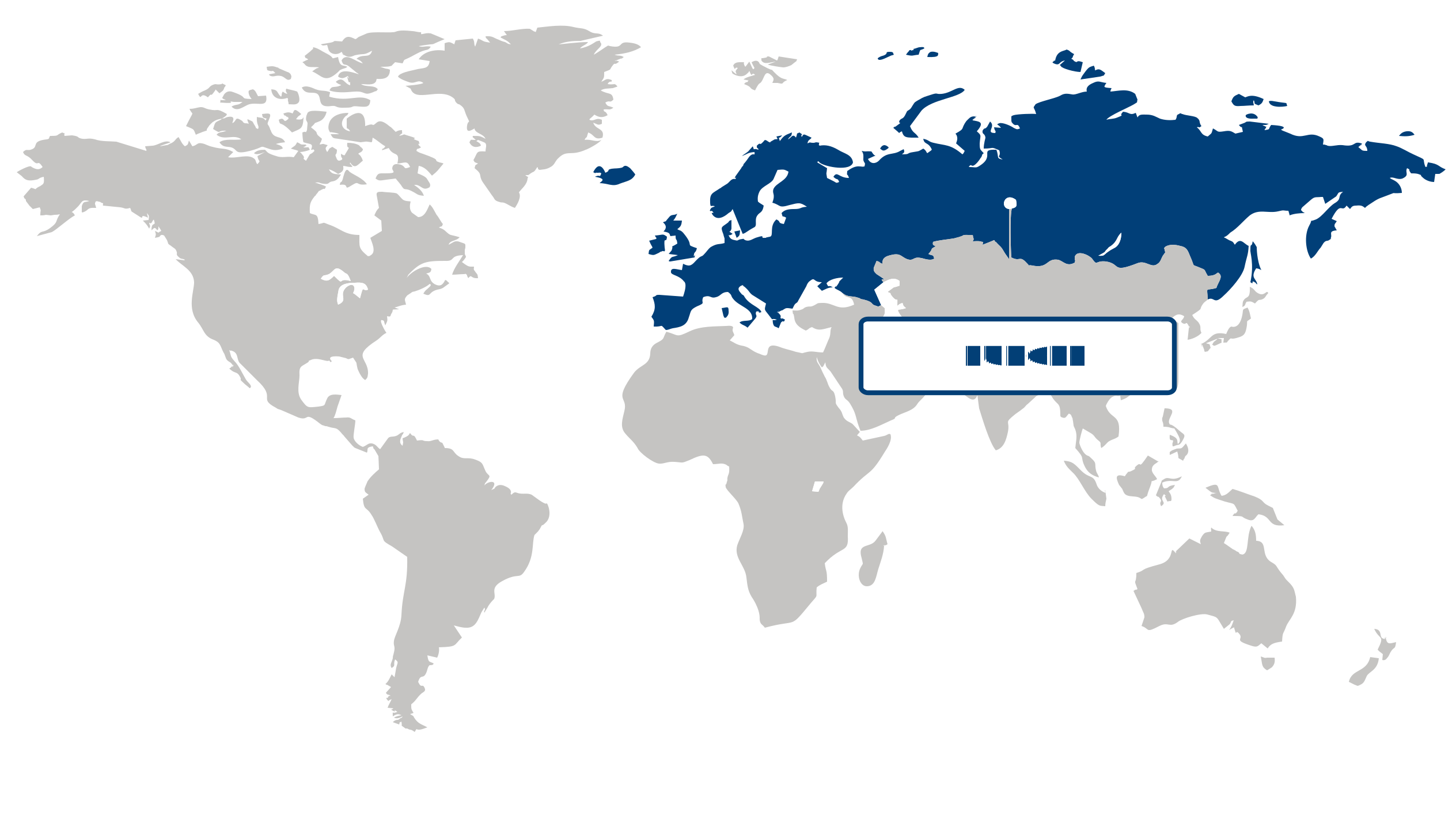
Largest Region
Europe
Largest Market Share in 2026
Europe (Largest Region) vs Asia Pacific (Fastest-Growing Region)
The workforce management market was led by Europe in 2026, supported by the region’s mature enterprise technology environment and growing emphasis on optimizing workforce productivity, scheduling, attendance, and labor-related processes. Organizations are increasingly integrating digital workforce platforms to streamline administrative functions, improve operational visibility, and support more flexible workforce models. Strong attention to labor regulations, employee management, and compliance is also encouraging businesses to adopt centralized workforce management solutions, reinforcing Europe’s established market position.
Asia Pacific is emerging as the fastest-growing region, driven by expanding business activity, increasing workforce complexity, and rapid digital transformation across enterprises. Organizations are progressively moving away from fragmented workforce administration toward integrated platforms capable of supporting scheduling, attendance, performance monitoring, and workforce planning. Rising technology adoption among businesses, combined with the expansion of digitally enabled operations and greater demand for efficient labor utilization, is creating favorable conditions for continued workforce management market development across the region.
Key Country Insights
U.S. organizations continue investing in workforce management platforms that unify scheduling, labor analytics, compliance, and employee engagement across distributed operations. Demand in the U.S. is shaped by hybrid work models, AI-enabled workforce planning, and integration with enterprise HR ecosystems.
Japan is adopting workforce management technologies to address labor shortages and improve productivity through intelligent scheduling and attendance management. Organizations across Japan are integrating digital workforce tools with existing business systems to optimize resource allocation.
South Korea is strengthening workforce management adoption by combining cloud-based scheduling, mobile workforce applications, and analytics-driven labor optimization. Enterprises in South Korea focus on improving workforce flexibility across manufacturing, retail, and service industries.
Germany emphasizes workforce management solutions that support complex labor regulations, collective agreements, and manufacturing workforce scheduling. German enterprises increasingly prioritize automation and workforce visibility to improve operational efficiency while maintaining regulatory compliance.
France is expanding workforce management deployments that simplify time tracking, leave administration, and labor compliance while supporting employee experience initiatives. French organizations increasingly seek configurable platforms suited to evolving workplace policies and operational transparency.
Italy is advancing workforce management adoption through digital scheduling, attendance monitoring, and workforce planning solutions that improve operational coordination. Italian businesses increasingly modernize labor management processes while supporting productivity across service and industrial sectors.
Segment Leadership and Growth Trends
Deployment Segment Analysis: On-premise (Largest Segment) vs Cloud (Fastest-Growing Segment)
On-premise deployment held the largest share of the workforce management market, accounting for 53.24% in 2026, supported by organizations that prioritize direct control over workforce data, system infrastructure, security, and integration with established enterprise environments. This deployment model remains relevant for businesses with complex internal IT requirements or stringent data-management policies. Its ability to provide greater control over customization and system administration continues to sustain adoption among organizations with established technology infrastructure.
The cloud segment is expanding at the fastest pace as organizations increasingly seek flexible workforce management systems that can be accessed across locations and scaled according to operational requirements. Cloud-based platforms reduce the need for extensive internal infrastructure while enabling easier software updates, centralized data access, and integration with other digital business applications. The growing adoption of remote and distributed work models, together with increasing demand for real-time workforce visibility, is further accelerating the shift toward cloud deployment.
Company Size Segment Analysis: Large Enterprises (Largest Segment) vs Small and Medium Enterprises (SMEs) (Fastest-Growing Segment)
Large enterprises represented the dominant share of the workforce management market at 62.86% in 2026, reflecting their complex workforce structures, broad operational footprints, and greater need for centralized scheduling, attendance, payroll coordination, and employee management capabilities. Large organizations often require workforce platforms that can integrate diverse business units and support sophisticated administrative processes. The increasing focus on labor optimization, compliance, and data-driven workforce planning further strengthens demand within this segment.
Small and medium enterprises (SMEs) are experiencing the fastest growth as these organizations increasingly adopt digital workforce tools to improve operational efficiency without maintaining extensive administrative resources. Cloud-based workforce management solutions are making advanced scheduling, time tracking, employee communication, and workforce analytics more accessible to smaller organizations. Growing awareness of productivity benefits and the need to manage increasingly flexible workforces are encouraging SMEs to replace manual processes with integrated digital platforms.
| Report Segmentation | |||
| Segment | Sub-Segment | Largest Segment | Fastest Growing Segment |
|---|---|---|---|
| Deployment | Cloud, On-premise | On-premise | Cloud |
| Company Size | Large Enterprises, Small and Medium Enterprises (SMEs) | Large Enterprises | Small and Medium Enterprises (SMEs) |
| Solution | Workforce Scheduling, Time & Attendance Management, Embedded Analytics, Absence Management, Others | Time & Attendance Management | Embedded Analytics |
| Application | Academia, Automotive & Manufacturing, BFSI, Government, Healthcare, Retail, Others | BFSI | Healthcare |
 Read our Research Approach
Competitive Landscape and Market Positioning
Prominent players in the workforce management market:
1. UKG Inc. (United States)
2. SAP SE (Germany)
3. Oracle Corporation (United States)
4. Workday Inc. (United States)
5. Infor Inc. (United States)
6. NICE Ltd. (Israel)
7. Workforce Software LLC (United States)
8. ADP Inc. (United States)
9. Ceridian HCM Holding Inc. (Canada)
10. ATOSS Software AG (Germany)
The workforce management market is experiencing strong momentum driven by the adoption of AI-powered scheduling tools, cloud-based workforce analytics, and automation platforms that improve operational visibility. Service providers are refining user interfaces and expanding functionality to support hybrid work environments and employee productivity optimization. Growing demand for real-time workforce insights and compliance management solutions continues to influence innovation across the workforce management market.
Industry Development/News
| Company Name | Date | Key Development |
|---|---|---|
| ADP | Oct-24 | ADP acquired WorkForce Software, integrating its workforce scheduling, time management, and labor optimization capabilities into its existing human capital management portfolio. This strategic acquisition significantly expands ADP’s footprint in the workforce management sector, enhancing its ability to serve complex enterprise needs through consolidated software solutions and improved operational efficiency. |
| symplr | Jul-25 | symplr acquired AMN Healthcare’s scheduling software business for $75 million. This acquisition integrates predictive scheduling and real-time staffing capabilities into symplr’s existing workforce management suite, strengthening its competitive positioning in the healthcare sector by addressing critical operational requirements for dynamic labor management and resource allocation. |
| Rippling | May-25 | Rippling secured $450 million in Series G funding, bringing its total capital to support aggressive international expansion and product enhancement. The investment accelerates the development of its integrated workforce management platform, focusing on scaling its capabilities across global markets and advancing its product innovation roadmap to maintain a strong competitive trajectory. |
| Workday | Oct-25 | Workday acquired Paradox, incorporating conversational AI technology into its talent acquisition workflows. This move enhances Workday’s workforce management and human capital management offerings by automating complex hiring processes, improving candidate engagement, and providing enterprise customers with more efficient, data-driven tools for managing the end-to-end recruitment lifecycle. |
| TreeRing Workforce Solutions | May-26 | TreeRing Workforce Solutions acquired PrimeTime, Inc., successfully reintegrating the PrimeTime workforce management platform under its original development team. This strategic acquisition expands TreeRing's platform portfolio and strengthens its operational capabilities, allowing the company to offer enhanced functionality to its customer base while consolidating its position within the workforce management technology segment. |
| Findd | May-26 | Findd secured a $21 million growth investment from Unbundled Capital to scale its AI-native workforce management platform. The funding is earmarked for accelerating product development and expanding market reach within frontline industry segments, positioning the company to compete more effectively by deploying advanced AI capabilities to address labor management challenges. |
| Payoneer | Jan-26 | Payoneer acquired Irish-based Employer of Record platform Boundless to bolster its cross-border workforce management and financial services. This acquisition allows Payoneer to provide a more comprehensive suite of services for small and mid-sized businesses managing international talent, effectively addressing the complexities of global payroll, compliance, and multi-country workforce operations. |
| Accenture | Jan-23 | Accenture partnered with UKG to implement advanced workforce management solutions for Ardent Health Services across its 30 hospitals and 200 care sites. This collaboration focuses on integrating flexible scheduling and operational agility, serving as a strategic deployment model for transforming healthcare workforce operations and improving frontline employee experiences through enterprise-grade technology. |
| UJET, Inc. | Mar-23 | UJET, Inc. launched its workforce management suite in partnership with Google Cloud, integrating the solution directly into the Google Cloud Contact Centre AI Platform. By providing real-time compliance monitoring and predictive planning, the solution enhances operational efficiency and agent performance, establishing a robust technology integration within the contact center AI ecosystem. |
| Procore Technologies, Inc. | Jul-22 | Procore Technologies launched a comprehensive construction-focused workforce management suite, merging Field Productivity and Workforce Planning tools. This product expansion enables construction contractors to improve project forecasting and resource management, directly addressing the industry-specific need for synchronized labor data to ensure projects meet budgetary and scheduling targets. |
Why Choose Us
Specialized Expertise: Our team comprises industry experts with a deep understanding of your market segment. We bring specialized knowledge and experience that ensures our research and consulting services are tailored to your unique needs.
Customized Solutions: We understand that every client is different. That's why we offer customized research and consulting solutions designed specifically to address your challenges and capitalize on opportunities within your industry.
Proven Results: With a track record of successful projects and satisfied clients, we have demonstrated our ability to deliver tangible results. Our case studies and testimonials speak to our effectiveness in helping clients achieve their goals.
Cutting-Edge Methodologies: We leverage the latest methodologies and technologies to gather insights and drive informed decision-making. Our innovative approach ensures that you stay ahead of the curve and gain a competitive edge in your market.
Client-Centric Approach: Your satisfaction is our top priority. We prioritize open communication, responsiveness, and transparency to ensure that we not only meet but exceed your expectations at every stage of the engagement.
Continuous Innovation: We are committed to continuous improvement and staying at the forefront of our industry. Through ongoing learning, professional development, and investment in new technologies, we ensure that our services are always evolving to meet your evolving needs.
Value for Money: Our competitive pricing and flexible engagement models ensure that you get maximum value for your investment. We are committed to delivering high-quality results that help you achieve a strong return on your investment.
Select Licence Type

