



Yeast Extract Market Size & Growth Forecast 2027–2036, By Segments (Form, Technology, Source, Application), Regional Demand Trends (North America, Asia Pacific, Europe), Key Country Insights (U.S., Japan, South Korea, Germany, France, Italy), and Competitive Landscape
Market Size and Growth Outlook
Yeast Extract Market size stood at USD 2.72 Billion in 2026 and is predicted to grow at 5.83% CAGR from 2027 to 2036, attaining USD 4.79 Billion by 2036. The industry revenue for 2027 is calculated at USD 2.85 Billion.
Base Year Value (2026)
USD 2.72 Billion
CAGR (2027-2036)
5.83%
Forecast Year Value (2036)
USD 4.79 Billion

Historical Data Period
2022-2026

Largest Region
Europe

Forecast Period
2027-2036
Yeast Extract Market Intelligence Snapshot:
-
Regional Market Dynamics:
- Europe leads through its mature food processing industry, strong demand for natural flavoring ingredients, and broad use of yeast extract in savory foods.
- Asia Pacific is gaining momentum from expanding processed food production, convenience-food consumption, changing dietary preferences, and rising demand for savory and natural flavor solutions.
-
Segment Momentum:
- The powder segment dominated with an 89.28% share in 2025 due to superior storage stability, easy transportation, and broad use in food manufacturing applications requiring consistent flavor enhancement.
- Torula yeast is gaining momentum as manufacturers seek alternative yeast sources with distinctive flavors, supporting ingredient diversification and innovative savory food applications.
-
Market Expansion Drivers:
- Rising demand for natural flavor enhancers in clean-label processed food formulations
- Growth of plant-based and vegetarian diets increasing demand for protein-rich additives
- Food industry innovation in savory formulations expanding application across packaged foods
-
Leading Market Participants:
Leading companies in the yeast extract market include Lesaffre Group (France), Kerry Group plc (Ireland), Lallemand Inc. (Canada), Angel Yeast Co., Ltd. (China), AB Mauri (United Kingdom), Biorigin (Brazil), Ohly (Germany), Leiber GmbH (Germany), Kohjin Life Sciences Co., Ltd. (Japan), Oriental Yeast Co., Ltd. (Japan)
Global Market Forecast Snapshot:
-
Market Outlook:
- 2026 Market Size: USD 2.72 Billion
- 2027 Estimated Market Size: USD 2.85 Billion
- Projected Market Size: USD 4.79 Billion by 2036
- Growth Forecasts: 5.83% CAGR (2027-2036)
-
Regional and Segment Outlook:
- Leading Regional Market: Europe
- High-Growth Regional Hub: Asia Pacific
- Core Revenue Segment: Powder (Form) | Autolyzed Yeast (Technology) | Baker's Yeast (Source) | Food & Beverages (Application)
- Emerging Opportunity Segment: Powder (Form) | Autolyzed Yeast (Technology) | Torula Yeast (Source) | Animal Feed (Application)
Market Growth Drivers and Industry Trends
Rising demand for natural flavor enhancers in clean-label processed food formulations
The shift toward recognizable ingredients and simplified labels is driving the yeast extract market growth as food manufacturers seek natural alternatives to artificial flavor enhancers and conventional savory additives. Yeast extract provides a concentrated source of umami and savory notes while supporting formulation goals centered on ingredient transparency, enabling producers to improve taste without relying as heavily on synthetic flavoring systems. Its versatility across soups, sauces, seasonings, snacks, ready meals, and meat alternatives also allows manufacturers to reformulate multiple product categories around clean-label positioning. As consumers increasingly scrutinize ingredient lists and favor minimally processed food concepts, yeast-derived flavor solutions are becoming more valuable for balancing sensory quality with cleaner formulation strategies.
Growth of plant-based and vegetarian diets increasing demand for protein-rich additives
Expansion of plant-based and vegetarian diets will propel yeast extract market demand as food producers seek ingredients that can enhance both nutritional and sensory attributes in products containing fewer animal-derived components. Yeast-derived ingredients can contribute protein, amino acids, vitamins, minerals, and savory flavor, helping manufacturers address common formulation challenges associated with plant-based foods, particularly the need to improve taste and nutritional density simultaneously. Their application in meat substitutes, plant-based ready meals, soups, sauces, and savory snacks also supports the development of products designed to deliver richer flavor profiles without relying on animal-derived ingredients, strengthening demand from manufacturers responding to changing dietary patterns.
Food industry innovation in savory formulations expanding application across packaged foods
Continuous innovation in savory packaged foods is broadening the range of applications for yeast extract, supporting growth across formulations where flavor intensity, consistency, and ingredient functionality are important. Food manufacturers are incorporating yeast extract into seasonings, instant meals, sauces, bouillons, snacks, and prepared foods to build deeper umami profiles and compensate for reductions in salt or other flavor-enhancing ingredients. Product development is also creating opportunities for tailored yeast extracts with specific sensory characteristics, allowing formulators to match flavor requirements across different cuisines and food formats. The growing complexity of packaged food formulations further increases the role of yeast extract as manufacturers seek multifunctional ingredients that can support taste optimization without substantially altering processing requirements.
| Growth Driver Assessment Framework | |||||
| Growth Driver | Impact On CAGR | Regulatory Influence | Geographic Relevance | Adoption Rate | Impact Timeline |
|---|---|---|---|---|---|
| Rising demand for natural flavor enhancers in clean-label processed food formulations | 2% | Moderate | North America, Europe | High | Near Term |
| Growth of plant-based and vegetarian diets increasing demand for protein-rich additives | 1.8% | Moderate | Asia Pacific, Europe | High | Mid Term |
| Food industry innovation in savory formulations expanding application across packaged foods | 1.6% | Low | Global | High | Mid Term |
Unlock insights tailored to your business with our bespoke market research solutions - Click to get your customized report now!
Regional Demand Dynamics
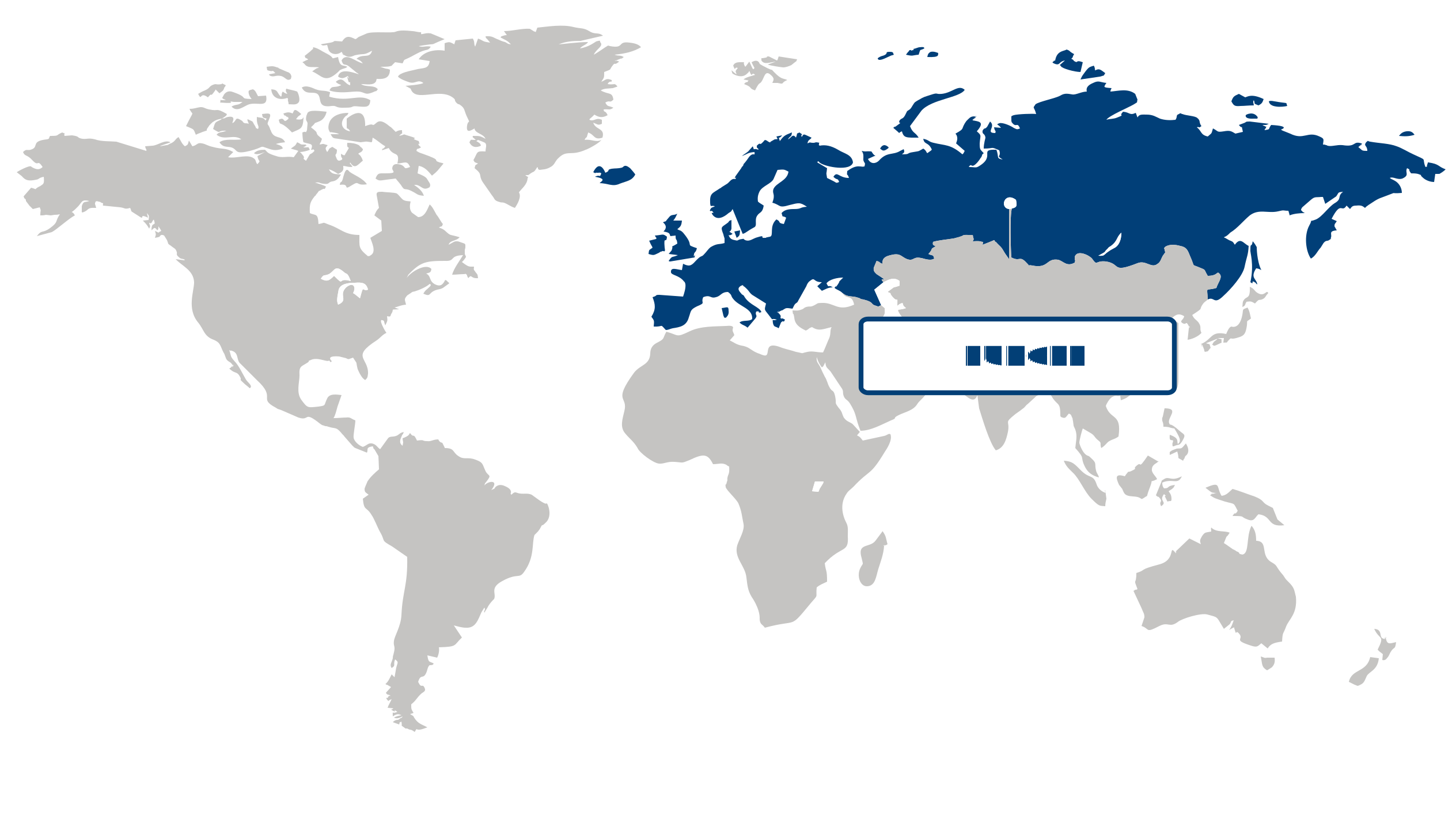
Largest Region
Europe
Largest Market Share in 2026
Europe (Largest Region) vs Asia Pacific (Fastest-Growing Region)
Europe held the largest share of the yeast extract market in 2026. The region benefits from a mature food processing industry, strong demand for natural flavoring ingredients, and widespread application of yeast-derived ingredients in savory foods, sauces, soups, snacks, and prepared meals. Yeast extract provides flavor enhancement and umami characteristics, making it valuable for manufacturers seeking to develop appealing formulations while responding to consumer interest in naturally derived ingredients. Continued innovation in processed foods, clean-label formulation, and flavor optimization is supporting demand across the regional food industry.
Asia Pacific is the fastest-growing regional market, supported by expanding processed food production, changing dietary preferences, and rising consumption of convenience foods. Increasing demand for savory flavors across sauces, snacks, instant foods, seasonings, and prepared meals is creating broader application opportunities for yeast extract. The expansion of food manufacturing and growing consumer exposure to diverse flavor profiles are encouraging manufacturers to adopt functional and flavor-enhancing ingredients. Rising interest in natural flavor solutions and continued innovation in food formulations are expected to strengthen demand for yeast extract across the region.
No card data available for this language/report.
Segment Leadership and Growth Trends
Form Segment Analysis: Powder (Largest & Fastest-Growing Segment)
The powder segment dominated the yeast extract market with an 89.28% share in 2026 and also represented the fastest-growing segment. Powdered yeast extract is widely preferred because it offers superior storage stability, convenient transportation, and easy incorporation into dry blends and processed food formulations. Its consistent flavor profile, long shelf life, and compatibility with large-scale food manufacturing processes support extensive use across savory foods, seasonings, soups, and processed products. Continued demand for convenient and functional food ingredients further reinforces the segment's leading position.
Technology Segment Analysis: Autolyzed Yeast (Largest & Fastest-Growing Segment)
In the yeast extract market, the autolyzed yeast segment accounted for the largest share of 70.37% in 2026 while also emerging as the fastest-growing technology segment. Autolyzed yeast is extensively adopted because it naturally develops rich savory flavor compounds and enhances taste without compromising formulation flexibility. Its broad applicability in processed foods and clean-label product development continues to encourage widespread adoption, while increasing consumer preference for naturally derived flavor-enhancing ingredients further supports sustained growth.
Source Segment Analysis: Baker's Yeast (Largest Segment) vs Torula Yeast (Fastest-Growing Segment)
The baker's yeast segment secured the largest share of 73.34% in 2026. Its established availability, reliable production processes, and favorable flavor characteristics make it the primary raw material for yeast extract manufacturing. The widespread use of baker's yeast across commercial production facilities supports consistent supply while meeting the growing demand for natural flavor ingredients across the food industry.
The torula yeast segment is anticipated to experience the fastest growth as manufacturers continue exploring alternative yeast sources that provide distinctive flavor profiles and formulation advantages. Rising interest in ingredient diversification, combined with increasing demand for specialty food products and innovative savory applications, is expected to strengthen the adoption of torula yeast in future product development.
| Report Segmentation | |||
| Segment | Sub-Segment | Largest Segment | Fastest Growing Segment |
|---|---|---|---|
| Form | Powder, Paste | Powder | Powder |
| Technology | Autolyzed Yeast, Hydrolyzed Yeast | Autolyzed Yeast | Autolyzed Yeast |
| Source | Baker's Yeast, Brewer's Yeast, Torula Yeast | Baker's Yeast | Torula Yeast |
| Application | Food & Beverages, Animal Feed, Pharma, Others | Food & Beverages | Animal Feed |
 Read our Research Approach
Competitive Landscape and Market Positioning
Prominent players in the yeast extract market:
- Lesaffre Group (France)
- Kerry Group plc (Ireland)
- Lallemand, Inc. (Canada)
- Angel Yeast Co., Ltd. (China)
- AB Mauri (United Kingdom)
- Biorigin (Brazil)
- Ohly (Germany)
- Leiber GmbH (Germany)
- Kohjin Life Sciences Co., Ltd. (Japan)
- Oriental Yeast Co., Ltd. (Japan)
The yeast extract market is becoming increasingly shaped by competition around functional performance, application specialization, and supply reliability rather than basic ingredient supply alone. Producers are differentiating through improvements in flavor enhancement, nutritional characteristics, and tailored solutions for food, biotechnology, and industrial applications, creating stronger positions in specialized segments. As end users seek cleaner labels and more versatile natural ingredients, companies with advanced processing capabilities and the ability to customize formulations are gaining competitive relevance. This shift is encouraging market participants to strengthen technical expertise and develop closer relationships with downstream industries.
Industry Development/News
| Company Name | Date | Key Development |
|---|---|---|
| Reduced | Feb-26 | Danish startup Reduced secured four million euros in funding to scale production of savory flavor enhancers derived from food processing waste. The investment advances its upcycling technology platform, expanding commercial capacity to convert residual food streams into functional flavor ingredients. |
| Lesaffre | Jun-25 | Lesaffre acquired a seventy percent stake in Biorigin from Zilor to form a joint venture pairing Biospringer with Biorigin's Brazilian facilities. This partnership leverages sustainable production capabilities to support advanced yeast-based applications in food and feed, while expanding market reach in emerging economies and reinforcing global competitiveness. |
| Fungu'it | Jun-25 | Fungu'it secured 4.6 million dollars in funding to scale its fermentation-based technology transforming food waste into natural flavor ingredients. This capital injection accelerates commercialization efforts targeting flavor development for meat and cocoa alternatives, thereby enhancing sustainable ingredient production capabilities. |
| Angel Yeast | Feb-25 | Angel Yeast scheduled the operational commencement of its yeast protein production workshop for August 2025. This project advances the company's innovation activities, broadens manufacturing capabilities for yeast-derived ingredients, and supports the commercial development of new biotechnology solutions. |
| Angel Yeast | Nov-24 | Angel Yeast announced plans for a new yeast production facility in Indonesia through a joint venture with PT Tunas Baru Lampung. The localized production base is designed to enhance supply chain agility, strengthen market presence, and support distribution across fast-growing markets in Southeast Asia. |
| Lesaffre | Oct-24 | Lesaffre completed the acquisition of dsm-firmenich's yeast extract business, integrating new processing technologies, product lines, and personnel into its Biospringer unit. This strategic transaction enhances production capacity, broadens product offerings, and strengthens the company's competitive position within the global savory ingredients sector. |
Why Choose Us
Specialized Expertise: Our team comprises industry experts with a deep understanding of your market segment. We bring specialized knowledge and experience that ensures our research and consulting services are tailored to your unique needs.
Customized Solutions: We understand that every client is different. That's why we offer customized research and consulting solutions designed specifically to address your challenges and capitalize on opportunities within your industry.
Proven Results: With a track record of successful projects and satisfied clients, we have demonstrated our ability to deliver tangible results. Our case studies and testimonials speak to our effectiveness in helping clients achieve their goals.
Cutting-Edge Methodologies: We leverage the latest methodologies and technologies to gather insights and drive informed decision-making. Our innovative approach ensures that you stay ahead of the curve and gain a competitive edge in your market.
Client-Centric Approach: Your satisfaction is our top priority. We prioritize open communication, responsiveness, and transparency to ensure that we not only meet but exceed your expectations at every stage of the engagement.
Continuous Innovation: We are committed to continuous improvement and staying at the forefront of our industry. Through ongoing learning, professional development, and investment in new technologies, we ensure that our services are always evolving to meet your evolving needs.
Value for Money: Our competitive pricing and flexible engagement models ensure that you get maximum value for your investment. We are committed to delivering high-quality results that help you achieve a strong return on your investment.
Select Licence Type

