Alginate Casing Market Size & Growth Forecast 2027–2036, By Segments (Type, End-Use Industry, Distribution Channel), Regional Demand Trends (North America, Asia Pacific, Europe), Key Country Insights (U.S., Japan, South Korea, Germany, France, Italy), and Competitive Landscape
Market Size and Growth Outlook
Alginate Casing Market size stood at USD 742.82 Million in 2026 and is predicted to grow at 11.13% CAGR from 2027 to 2036, reaching USD 2.13 Billion by 2036. The industry revenue for 2027 is calculated at USD 814.35 Million.
Get more details on this report
Request Free Sample ReportAlginate Casing Market Intelligence Snapshot
Regional Market Dynamics
- Europe leads due to its established processed food industry and strong demand for efficient, innovative casing solutions supporting meat and plant-based product development.
- Expanding food processing, organized retail, packaged food consumption, and demand for convenient and alternative-protein products are accelerating alginate casing adoption.
Segment Momentum
- The food industry led the market with a 64.61% share in 2026. Demand is supported by widespread use of alginate casings for efficient processing, consistent product quality, and convenient food production.
- Online retail is the fastest-growing distribution channel as digital procurement simplifies supplier comparisons and ordering. Expanding business-to-business e-commerce is accelerating purchases of specialized alginate casing products.
Market Expansion Drivers
- Rising plant-based food innovation driving alginate-based edible casing adoption
- Expanding processed meat alternatives increasing edible film usage in food industry
- Growth in sustainable food packaging solutions supporting biodegradable casing demand
Leading Market Participants
- Leading companies in the alginate casing market include ALGAIA S.A.S. (France), CEAMSA (Spain), J. Rettenmaier & Söhne GmbH + Co KG (Germany), FMC Corporation (United States), Cargill, Incorporated (United States), DuPont de Nemours, Inc. (United States), KIMICA Corporation (Japan), Qingdao Hyzlin Biology Development Co., Ltd. (China), CP Kelco (United States), Ingredion Incorporated (United States)
Global Market Forecast Snapshot
Market Outlook
- 2026 Market Size: USD 742.82 Million
- 2027 Estimated Market Size: USD 814.35 Million
- Projected Market Size: USD 2.13 Billion by 2036
- Growth Forecast: 11.13% CAGR (2027-2036)
Regional and Segment Outlook
- Leading Regional Market: Europe
- High-Growth Regional Hub: Asia Pacific
- Core Revenue Segment: Natural Alginate Casings (Type) | Food (End-Use Industry) | Distributors and Wholesalers (Distribution Channel)
- Emerging Opportunity Segment: Natural Alginate Casings (Type) | Pharmaceutical (End-Use Industry) | Online Retail (Distribution Channel)
Market Growth Drivers and Industry Trends
Rising plant-based food innovation driving alginate-based edible casing adoption
The shift toward plant-derived food formulations is creating new applications for the alginate casing market as food manufacturers seek functional alternatives that align with clean-label preferences. Alginate-based casings provide a flexible solution for developing vegetarian and vegan products by offering structure, moisture control, and visual appeal similar to traditional casing formats. Growing experimentation with plant-based sausages, meat substitutes, and specialty food products is encouraging processors to integrate edible casing technologies that support product differentiation while meeting changing consumer expectations around ingredient transparency.
Expanding processed meat alternatives increasing edible film usage in food industry
Rising demand for processed meat alternatives is accelerating the use of edible films and casings across modern food production systems. The alginate casing market benefits from manufacturers adopting these materials to improve the texture, presentation, and handling characteristics of alternative protein products that require innovative processing approaches. Alginate films offer functional properties such as gel formation and barrier performance, enabling food companies to develop products with improved stability while reducing reliance on conventional synthetic packaging materials.
Growth in sustainable food packaging solutions supporting biodegradable casing demand
Environmental concerns surrounding food packaging waste are strengthening interest in biodegradable solutions, supporting broader adoption of alginate-based materials within the alginate casing market. Food producers are increasingly exploring naturally derived casing options that can minimize packaging impact while maintaining performance during processing and consumption. The renewable origin and compostable characteristics of alginate materials make them suitable for companies seeking packaging innovations that complement sustainability initiatives across the food value chain.
| Growth Driver | Impact on CAGR | Regulatory Influence | Geographic Relevance | Adoption Rate | Impact Timeline |
|---|---|---|---|---|---|
| Rising plant-based food innovation driving alginate-based edible casing adoption | 3.6% | Moderate | Europe, Asia Pacific | High | Near Term |
| Expanding processed meat alternatives increasing edible film usage in food industry | 3.5% | Low | North America, Europe | High | Mid Term |
| Growth in sustainable food packaging solutions supporting biodegradable casing demand | 3.4% | Moderate | Asia Pacific, North America | High | Mid Term |
Explore Growth Opportunities
Request Free Sample ReportRegional Demand Dynamics
Europe (Largest Region)
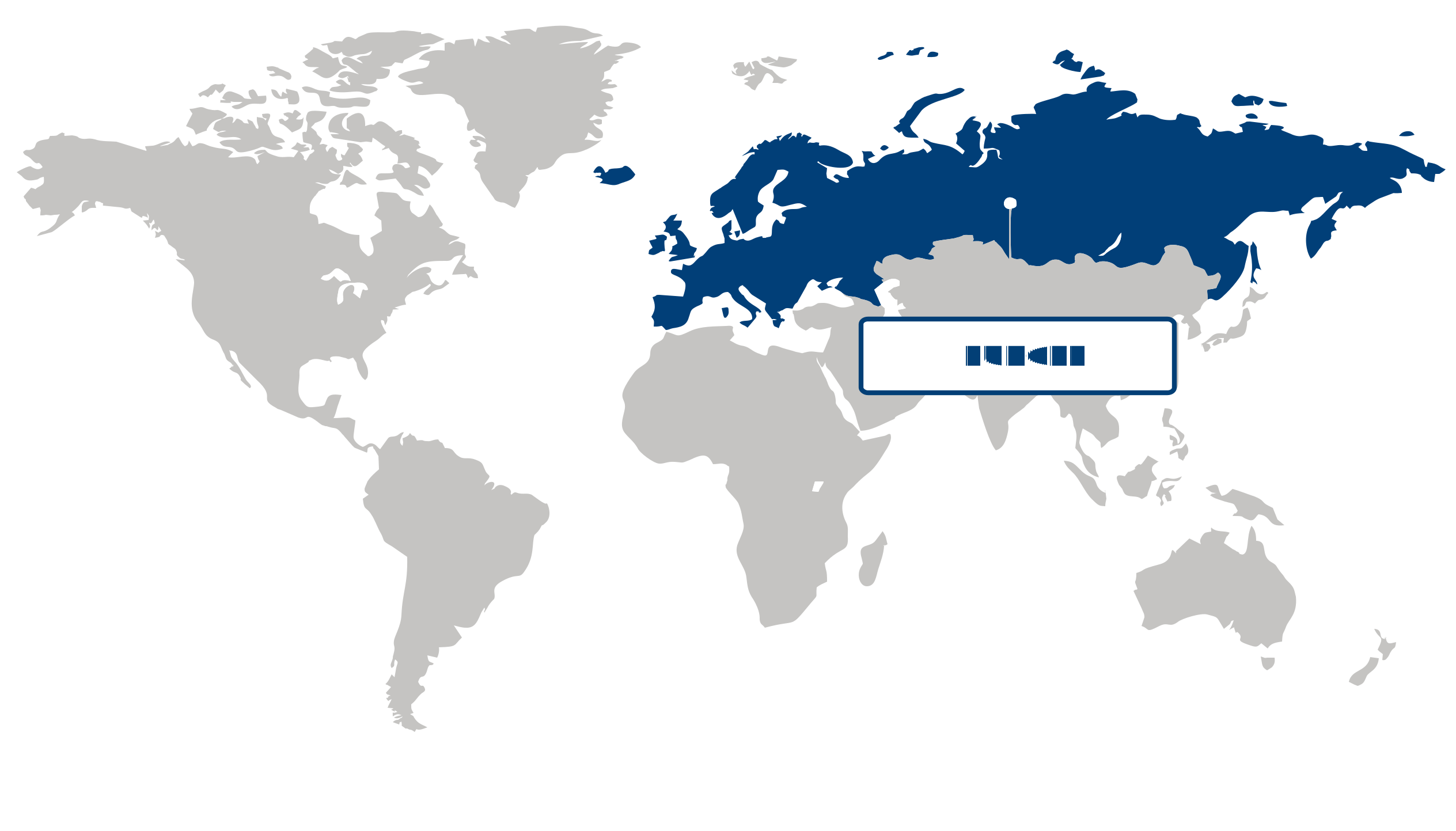
Europe accounted for the largest share of the alginate casing market in 2026, supported by a well-established processed food industry and strong demand for innovative alternatives to conventional sausage casings. Alginate casings offer manufacturers opportunities to improve production efficiency, achieve consistent product shapes, and develop meat and plant-based food products with distinctive formulations. Increasing consumer interest in convenience foods and cleaner-label alternatives is encouraging food processors to explore functional casing technologies. The region's emphasis on food quality, processing efficiency, and product innovation is providing a favorable environment for continued adoption.
Asia Pacific (Fastest-Growing Region)
Asia Pacific is emerging as the fastest-growing regional market as food processing industries expand and consumer demand for convenient processed meat and alternative-protein products increases. Rising urban populations and changing dietary preferences are encouraging manufacturers to modernize production processes and introduce more efficient food-processing technologies. Growth in organized food retail and expanding packaged food consumption are also creating opportunities for alginate casing applications. Increasing experimentation with plant-based and specialty food products is further broadening the potential use of alginate-based casing solutions.
| Parameter | North America | Asia Pacific | Europe | Latin America | MEA |
|---|---|---|---|---|---|
| Innovation Hub i Scale Nascent Developing Advanced | |||||
| Cost-Sensitive Region i Scale Low Medium High | |||||
| Regulatory Environment i Scale Restrictive Neutral Supportive | |||||
| Demand Drivers i Scale Weak Moderate Strong | |||||
| Development Stage i Scale Emerging Developing Developed | |||||
| Adoption Rate i Scale Low Medium High | |||||
| New Entrants / Startups i Scale Sparse Moderate Dense | |||||
| Macro Indicators i Scale Weak Stable Strong |
Key Country Insights
United States 🇺🇸
Clean Label ProcessingThe U.S. is expanding the use of alginate casings as food processors respond to demand for clean-label and plant-based product formulations. Manufacturers are improving production efficiency while ensuring consistent casing performance across diverse processed meat and alternative protein applications.
Germany 🇩🇪
Premium Food InnovationGermany is incorporating alginate casing technologies into premium sausage manufacturing where uniform quality and production consistency are priorities. Food producers are refining processing techniques to support product differentiation and operational efficiency.
Japan 🇯🇵
Functional Food SolutionsJapan is adopting alginate casings for value-added processed foods that require precision, hygiene, and reliable product presentation. Manufacturers are integrating advanced processing methods to support convenience foods and specialty protein products.
South Korea 🇰🇷
Alternative Protein SupportSouth Korea is increasing the application of alginate casings as food manufacturers diversify into plant-based and innovative protein products. Companies are prioritizing production flexibility while maintaining texture, appearance, and processing efficiency.
France 🇫🇷
Gourmet Product EnhancementFrance is utilizing alginate casings in specialty meat and gourmet food production where product consistency and ingredient quality are closely monitored. Manufacturers are balancing traditional processing methods with modern casing technologies to improve manufacturing performance.
Italy 🇮🇹
Specialty Food ProcessingItaly is integrating alginate casing solutions into premium processed food manufacturing to enhance production consistency and product quality. Food processors are focusing on efficient formulation techniques that support evolving consumer preferences and operational requirements.
Segment Leadership and Growth Trends
Alginate Casing Market Share (%), by Type, 2026
Go beyond the chart, access full insights & data tables
Request Free Sample ReportType Segment Analysis: Natural Alginate Casings (Largest & Fastest-Growing Segment)
Natural alginate casings dominated the alginate casing market and represented 63.49% of the market in 2026, while also remaining the fastest-growing type. Their strong position is supported by increasing demand for plant-derived and functional casing solutions in food processing applications. Natural alginate casings provide manufacturers with a flexible alternative to conventional animal-derived casings and are valued for their suitability in producing uniform, consistent, and convenient food products. Rising consumer interest in plant-based and alternative food ingredients, together with continued innovation in processed food manufacturing, is expected to sustain demand for natural alginate casing solutions.
End-Use Industry Segment Analysis: Food (Largest Segment) vs Pharmaceutical (Fastest-Growing Segment)
Food was the largest end-use industry in the alginate casing market, accounting for 64.61% in 2026. The segment benefits from the extensive use of alginate casings in food processing, particularly in applications requiring consistent product shape, controlled processing, and convenient preparation. Growing demand for processed and ready-to-consume food products is encouraging manufacturers to adopt casing technologies that support efficient production while meeting changing consumer preferences. The increasing emphasis on product consistency and alternative ingredient solutions continues to reinforce the food industry's leading position.
Pharmaceutical is expected to be the fastest-growing end-use industry as alginate-based materials gain attention for their functional properties and potential use in specialized delivery and encapsulation applications. The ability of alginate to support controlled formulation and encapsulation processes is creating opportunities beyond traditional food applications. Growing innovation in pharmaceutical formulations and increasing interest in biomaterial-based solutions are expected to expand the use of alginate casings and related materials in this industry.
Distribution Channel Segment Analysis: Distributors and Wholesalers (Largest Segment) vs Online Retail (Fastest-Growing Segment)
Distributors and wholesalers accounted for the largest share of the alginate casing market, representing 46.85% in 2026. These channels play an important role in connecting manufacturers with food processors, industrial users, and other commercial customers that require reliable access to specialized casing materials. Their established supply networks, product handling capabilities, and ability to serve customers across multiple geographic markets support their leading position. The specialized nature of alginate casing products also makes distributor relationships important for maintaining consistent supply and facilitating business-to-business procurement.
Online retail is projected to be the fastest-growing distribution channel as digital procurement platforms increasingly simplify access to specialized food processing and packaging materials. Online channels allow buyers to review product specifications, compare suppliers, and place orders with greater convenience. The expansion of business-to-business e-commerce and the increasing digitalization of procurement processes are expected to support faster growth in online sales of alginate casing products.
| Segment | Sub-Segment | Largest Segment | Fastest Growing |
|---|---|---|---|
| Type | Natural Alginate Casings, Synthetic Alginate Casings | Natural Alginate Casings | Natural Alginate Casings |
| End-Use Industry | Food, Pharmaceutical, Cosmetics, Others | Food | Pharmaceutical |
| Distribution Channel | Direct Sales, Distributors and Wholesalers, Online Retail, Supermarkets and Hypermarkets, Specialty Stores | Distributors and Wholesalers | Online Retail |
Unlock insights tailored to your business with our bespoke market research solutions.
Click to get your customized report now.
Competitive Landscape and Market Positioning
Key companies in the alginate casing market:
- ALGAIA S.A.S. (France)
- CEAMSA (Spain)
- J. Rettenmaier & Söhne GmbH + Co KG (Germany)
- FMC Corporation (United States)
- Cargill Incorporated (United States)
- DuPont de Nemours, Inc. (United States)
- KIMICA Corporation (Japan)
- Qingdao Hyzlin Biology Development Co., Ltd. (China)
- CP Kelco (United States)
- Ingredion Incorporated (United States)
Technological expertise is becoming the defining competitive force in the alginate casing market as processors seek casing solutions that enhance production efficiency while delivering consistent product appearance and structural performance. Manufacturers are investing in formulation improvements that provide greater process stability, uniform filling characteristics, and compatibility with increasingly automated food processing lines. Competitive positioning is also influenced by the ability to support customized production requirements across different sausage types and manufacturing environments, encouraging suppliers to combine application knowledge with technical service rather than competing primarily on product availability.
| Company | Market Share | Company Revenue | Revenue CAGR (%) | Product Portfolio | Geographic Presence | Innovation / R&D Focus | Strategic Developments |
|---|---|---|---|---|---|---|---|
| ALGAIA S.A.S. (France) | |||||||
| CEAMSA (Spain) | |||||||
| J. Rettenmaier & Söhne GmbH + Co KG (Germany) | |||||||
| FMC Corporation (United States) | |||||||
| Cargill Incorporated (United States) | |||||||
| DuPont de Nemours Inc. (United States) | |||||||
| KIMICA Corporation (Japan) | |||||||
| Qingdao Hyzlin Biology Development Co. Ltd. (China) | |||||||
| CP Kelco (United States) | |||||||
| Ingredion Incorporated (United States) |
Customize Your Report
Explore examples of how this report can be tailored to different research needs, including custom segments, additional topics or chapters, and related reports. Click a section of the wheel or its numbered marker to explore the available options.
Alginate Casing Market — Custom Segments
| Segment | Sub-Segment |
|---|---|
| Casing Form | Straight Casings, Curved Casings, Tubular Casings, Co-extruded Casings |
| Processing Method | Dry Processing, Wet Processing, Semi-Dry Processing |
| Customer Type | Sausage Manufacturers, Meat Processors, Foodservice Producers, Pharmaceutical Manufacturers |
Alginate Casing Market — Custom TOC
| Custom Chapter | Chapter Details |
|---|---|
| Natural Casing Conversion Opportunities |
|
| Sustainable Sausage Manufacturing Adoption |
|
| Alternative Casing Competitive Substitution |
|
Need a different cut of the data?
Request Custom ResearchWhat is the market valuation of alginate casing?
What is the projected value of the alginate casing industry by 2036?
How is plant-based food innovation expanding opportunities in the alginate casing market?
Why are sustainability initiatives accelerating demand for alginate-based casing materials?
Which end-use industry accounts for the largest share of the alginate casing market?
Which distribution channel is growing the fastest in the alginate casing market?
Why does Europe hold the largest share of the alginate casing market?
How is Asia Pacific emerging as the fastest-growing alginate casing market?
Which companies dominate the alginate casing landscape?
Our Clients
"The report provided a thorough look at market trends, technological advancements, and the competitive landscape. The depth of insights was really valuable."
ITC Limited
"We would highly recommend Fundamental Business Insights & Consulting to anyone looking for reliable, detailed, and comprehensive market research in the Food industry."
Tyson Foods
"The clarity and presentation of the information were commendable. The report was delivered timely, which made the overall experience smooth and convenient."
Mondelēz International
Our Research Team & Methodology
Every Fundamental Business Insights report is built by a dedicated vertical research team, validated through a structured primary-and-secondary methodology, and reviewed for accuracy before it reaches you.
Research Team Overview
Prepared by the Food & Beverage Research Team
Delivery
Published
Demand
Available
Support
Trust & Compliance
Research Intelligence
| Source | Reference |
|---|---|
| Food and Agriculture Organization (FAO) | www.fao.org |
| World Health Organization (WHO) | www.who.int |
| U.S. Food & Drug Administration (FDA) | www.fda.gov |
| European Food Safety Authority (EFSA) | www.efsa.europa.eu |
| U.S. Department of Agriculture (USDA) | www.usda.gov |
| Codex Alimentarius Commission | www.fao.org/fao-who-codexalimentarius |
| International Organization for Standardization (ISO) | www.iso.org |
| AOAC INTERNATIONAL | www.aoac.org |
| Institute of Food Technologists (IFT) | www.ift.org |
| International Dairy Foods Association (IDFA) | www.idfa.org |
| International Sweeteners Association (ISA) | www.sweeteners.org |
| International Probiotics Association (IPA) | internationalprobiotics.org |
| Good Food Institute (GFI) | gfi.org |
| American Feed Industry Association (AFIA) | www.afia.org |
| International Feed Industry Federation (IFIF) | ifif.org |
| Specialty Food Association (SFA) | www.specialtyfood.com |
| Brewers Association | www.brewersassociation.org |
| International Bottled Water Association (IBWA) | bottledwater.org |
| International Alliance for Dietary/Food Supplement Associations (IADSA) | www.iadsa.org |
| OECD Agriculture & Food | www.oecd.org/agriculture |
Research Workflow & Quality Assurance
Data Collection
Verified information gathered through primary and secondary research.
Data Triangulation
Cross-validation using multiple independent data sources.
Forecast Modelling
Market estimates developed using historical trends and analytical models.
Analyst Validation
Findings reviewed by domain experts for accuracy and consistency.
Editorial & Quality Review
Final editorial, quality, and compliance checks before publication.
Final Publication
Released after successful completion of the internal review process.
Report Coverage
📊 Market Assessment
- Market Size & Forecast
- Market Segmentation
- Regional Analysis
- Growth Drivers & Challenges
- Market Dynamics
🏢 Competitive Intelligence
- Competitive Landscape
- Company Profiles
- Competitive Benchmarking
- Mergers & Acquisitions
- Market Share Analysis or Key Company Strategies
🔍 Strategic Analysis
- Value Chain Analysis
- Porter's Five Forces
- PESTLE Analysis
- Pricing Trends
- Supply-Demand Analysis
🚀 Future Outlook
- Technology Landscape
- Regulatory Landscape
- Investment & Funding Landscape
- Emerging Opportunities
- Future Market Outlook
Have a question about this report or need a custom scope?
Request Customization