Alkalized Cocoa Powder Market Size & Growth Forecast 2027–2036, By Segments (Application), Regional Demand Trends (North America, Asia Pacific, Europe), Key Country Insights (U.S., Japan, South Korea, Germany, France, Italy), and Competitive Landscape
Jump to content
Market Size and Growth Outlook
Alkalized Cocoa Powder Market size was over USD 2.8 billion in 2026 and is likely to grow at a 3.42% CAGR between 2027 and 2036, crossing USD 3.92 billion by 2036. The industry revenue for 2027 is assessed at USD 2.88 billion.
Get more details on this report
Request Free Sample ReportAlkalized Cocoa Powder Market Intelligence Snapshot
Regional Market Dynamics
- Europe leads with a 40.49% share due to strong chocolate and bakery industries, established cocoa processing capabilities, and consistent demand for standardized flavor and color performance.
- North America grows at 4.22% CAGR driven by rising use in packaged bakery, beverages, and desserts, supported by food manufacturers prioritizing consistent large-scale ingredient performance.
Segment Momentum
- Food & Beverages accounted for 88.83% of the market in 2026, driven by widespread use in bakery, confectionery, dairy products, and beverages requiring consistent color, flavor, and processing performance.
- Cosmetics is the fastest-growing application as brands increasingly incorporate cocoa-derived ingredients into beauty formulations, supporting ingredient-focused product development and broader adoption in personal care products.
Market Expansion Drivers
- Rising demand for premium chocolate and cocoa-based beverages driving alkalized cocoa powder consumption.
- Advancements in cocoa processing technologies improving flavor customization and production efficiency.
- Expanding urban consumer preference for indulgent bakery and dessert products supporting market growth.
Leading Market Participants
- Top companies in the alkalized cocoa powder market include Barry Callebaut AG (Switzerland), Cargill, Incorporated (United States), Olam Group Limited (Singapore), ECOM Agroindustrial Corp. Limited (Switzerland), JB Cocoa Sdn. Bhd. (Malaysia), Dutch Cocoa B.V. (Netherlands), Indcresa S.A. (Spain), Bloomer Chocolate Company (United States), CCBOL Group (China), Carlyle Cocoa Company (United States).
Global Market Forecast Snapshot
Market Outlook
- 2026 Market Size: USD 2.8 billion
- 2027 Estimated Market Size: USD 2.88 billion.
- Projected Market Size: USD 3.92 billion by 2036
- Growth Forecast: 3.42% CAGR (2027-2036)
Regional and Segment Outlook
- Leading Regional Market: Europe
- High-Growth Regional Hub: North America
- Core Revenue Segment: Food & Beverages (Application)
- Emerging Opportunity Segment: Cosmetics (Application)
Market Growth Drivers and Industry Trends
Rising demand for premium chocolate and cocoa-based beverages driving alkalized cocoa powder consumption
The increasing consumption of premium chocolate products and sophisticated cocoa-based beverages will drive alkalized cocoa powder market growth by strengthening demand for cocoa ingredients with consistent color, smooth flavor, and formulation flexibility. Alkalized cocoa powder undergoes processing that modifies its acidity and enhances specific sensory characteristics, making it suitable for beverages, confectionery products, fillings, and other applications where controlled cocoa flavor and appearance are important. Premium product development often requires ingredients that can deliver predictable performance across formulations, while alkalized cocoa can provide deeper color and a smoother taste profile than natural cocoa in suitable applications. Food manufacturers are therefore incorporating specialized cocoa powders to achieve targeted sensory attributes in higher-value products.
Advancements in cocoa processing technologies improving flavor customization and production efficiency
Innovations in cocoa processing are enabling manufacturers to exercise greater control over alkalization conditions, particle characteristics, color intensity, and flavor development, supporting alkalized cocoa powder market growth. Improvements in processing equipment and production techniques allow cocoa ingredients to be tailored more precisely to the requirements of different food and beverage formulations. Greater process control can also promote consistency between production batches while supporting efficient handling and blending during downstream manufacturing. The ability to customize cocoa characteristics according to application requirements is particularly valuable for producers developing beverages, bakery products, confectionery items, and other formulations where cocoa color, acidity, dispersibility, and flavor intensity influence the finished product.
Expanding urban consumer preference for indulgent bakery and dessert products supporting market growth
Rising urban demand for indulgent bakery, confectionery, and dessert products is supporting alkalized cocoa powder market growth as consumers seek convenient foods that combine rich cocoa flavor with appealing visual characteristics. Urban lifestyles and changing consumption patterns are encouraging greater consumption of cakes, pastries, cookies, brownies, chocolate beverages, and other prepared treats in which cocoa powder serves both flavor and color functions. Alkalized cocoa is well suited to formulations requiring a darker appearance and smoother cocoa profile, helping manufacturers develop visually distinctive and indulgent products. Its compatibility with a broad range of bakery and dessert applications also allows food producers to incorporate cocoa into varied product formats and recipes.
| Growth Driver | Impact on CAGR | Regulatory Influence | Geographic Relevance | Adoption Rate | Impact Timeline |
|---|---|---|---|---|---|
| Rising demand for premium chocolate and cocoa-based beverages driving alkalized cocoa powder consumption | 1.80% | Low | Europe, Asia Pacific | High | Near Term |
| Advancements in cocoa processing technologies improving flavor customization and production efficiency | 1.50% | Moderate | Europe, North America | Medium | Mid Term |
| Expanding urban consumer preference for indulgent bakery and dessert products supporting market growth | 1.30% | Low | Asia Pacific, Latin America | Medium | Mid Term |
Unlock insights tailored to your business with our bespoke market research solutions.
Click to get your customized report now.
Regional Demand Dynamics
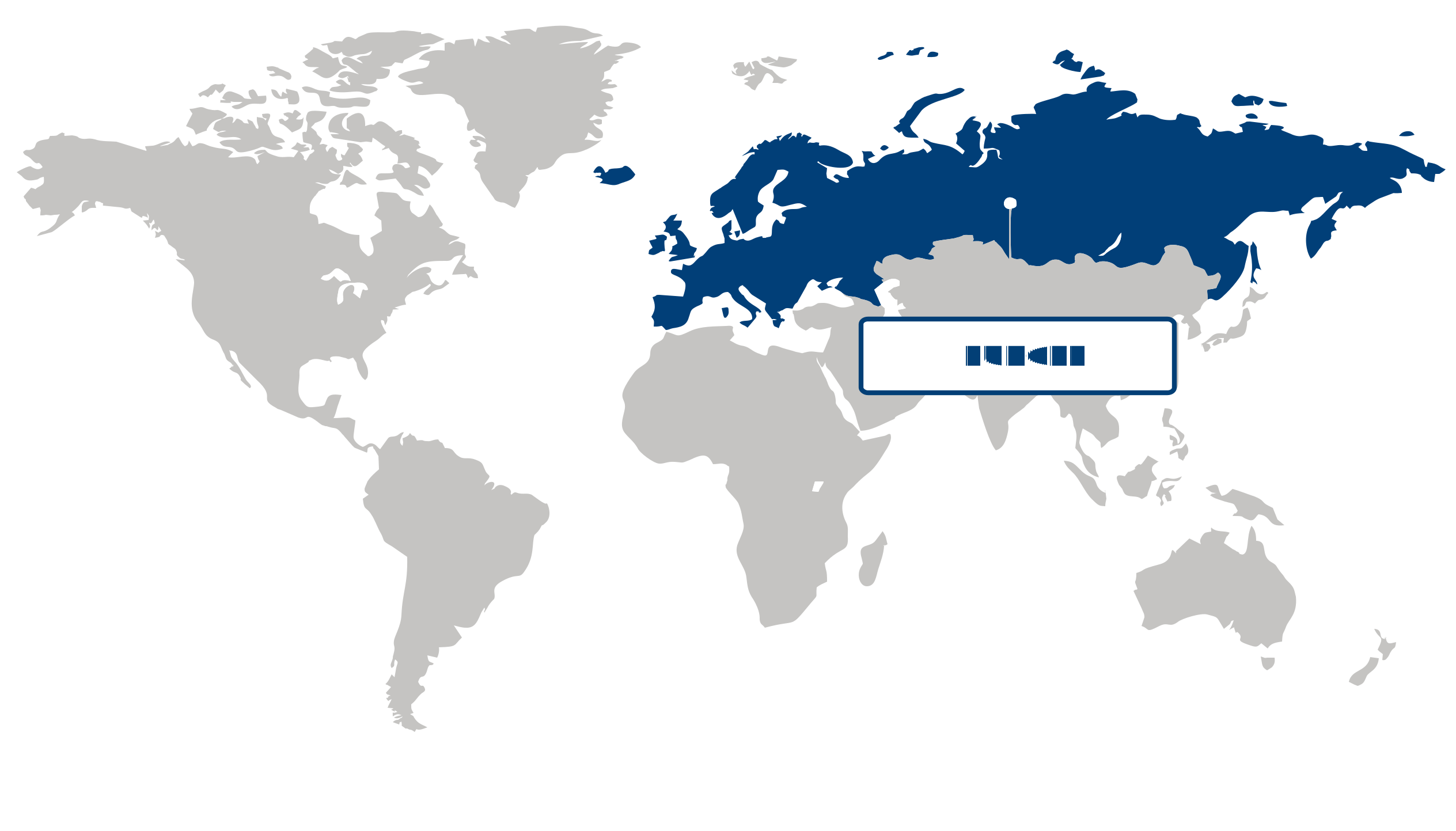
Europe (Largest Region)
Europe led the alkalized cocoa powder market with a 40.49% share in 2026, supported by its established chocolate, confectionery, bakery, and processed-food industries. The region has strong demand for cocoa ingredients that provide consistent flavor, color, and formulation characteristics, with alkalized cocoa powder offering particular value in products requiring a smoother taste and darker appearance. Europe's mature food manufacturing ecosystem enables widespread use of specialized cocoa ingredients across both mass-market and premium product categories. Consumer interest in indulgent foods, premium confectionery, and visually distinctive cocoa-based products continues to encourage formulation innovation. Well-developed food-processing capabilities and established ingredient supply networks further support the region's strong market position.
North America (Fastest-Growing Region)
North America represents the fastest-growing region, with expanding demand for cocoa-based bakery products, beverages, desserts, and confectionery applications supporting increased use of alkalized cocoa powder. Food manufacturers are placing greater emphasis on differentiated taste, appearance, and product quality, creating opportunities for cocoa ingredients with specialized functional and sensory characteristics. Growth in premium food offerings and evolving at-home consumption preferences are also supporting broader application across retail and foodservice channels. The region's innovative food-processing environment encourages frequent product development and reformulation, allowing alkalized cocoa powder to gain traction in new applications. Continued diversification of cocoa-based products is therefore strengthening demand across the North American market.
| Parameter | North America | Asia Pacific | Europe | Latin America | MEA |
|---|---|---|---|---|---|
| Innovation HubiScaleNascentDeveloping Advanced | |||||
| Cost-Sensitive RegioniScaleLowMedium High | |||||
| Regulatory EnvironmentiScaleRestrictiveNeutral Supportive | |||||
| Demand DriversiScaleWeakModerate Strong | |||||
| Development StageiScaleEmergingDeveloping Developed | |||||
| Adoption RateiScaleLowMedium High | |||||
| New Entrants / StartupsiScaleSparseModerate Dense | |||||
| Macro IndicatorsiScaleWeakStable Strong |
Key Country Insights
Germany 🇩🇪
Industrial Baking ExcellenceGermany relies on alkalized cocoa powder for high-quality bakery products, confectionery, and beverage manufacturing requiring consistent processing characteristics. German food manufacturers emphasize reliable ingredient quality and tailored cocoa profiles for premium finished products.
France 🇫🇷
Gourmet Chocolate ProductionFrance applies alkalized cocoa powder within premium chocolate, pastry, and dessert manufacturing where ingredient quality strongly influences product positioning. French producers continue refining formulations that deliver rich flavor, consistent color, and dependable processing characteristics.
Italy 🇮🇹
Premium Food IngredientsItaly utilizes alkalized cocoa powder across confectionery, bakery, and specialty dessert production where premium ingredient selection remains important. Italian manufacturers increasingly focus on cocoa formulations that support product differentiation while maintaining consistent quality across artisanal and industrial applications.
Japan 🇯🇵
Premium Confectionery ApplicationsJapan incorporates alkalized cocoa powder into premium confectionery, beverages, and bakery products where balanced taste and visual appeal are important. Japanese manufacturers increasingly favor customized cocoa ingredients that support product innovation and consistent production quality.
South Korea 🇰🇷
Modern Dessert InnovationSouth Korea uses alkalized cocoa powder across premium desserts, beverages, and bakery categories responding to changing consumer preferences. Food manufacturers continue introducing innovative chocolate-based products supported by high-quality cocoa ingredients with reliable processing performance.
United States 🇺🇸
Premium Bakery DemandThe U.S. alkalized cocoa powder market is driven by strong demand from bakery, beverage, and dessert manufacturers seeking consistent flavor and color performance. Producers continue expanding premium formulations that support clean-label product development and diverse food applications.
Alkalized Cocoa Powder Market Share (%), by Application, 2026
Go beyond the chart, access full insights & data tables
Request Free Sample ReportApplication Segment Analysis: Food & Beverages (Largest Segment) vs Cosmetics (Fastest-Growing Segment)
The food & beverages segment dominated the alkalized cocoa powder market in 2026, accounting for an 88.83% share, driven by its extensive use in bakery products, confectionery, beverages, desserts, and other processed food applications. Alkalized cocoa powder provides a darker color, smoother flavor profile, and improved dispersibility, making it well suited to formulations where appearance, taste consistency, and processing performance are important. Its broad compatibility with consumer food products and continued demand for cocoa-based formulations support sustained usage across large-scale food manufacturing and ingredient applications.
Cosmetics is expected to be the fastest-growing application segment as formulators increasingly explore cocoa-derived ingredients for color, texture, and functional attributes in personal care products. Alkalized cocoa powder can contribute natural-looking pigmentation and sensory characteristics to selected cosmetic formulations, while consumer interest in recognizable and plant-derived ingredients is encouraging greater experimentation with cocoa-based components. The broader movement toward ingredient-conscious beauty products and differentiated formulations is creating additional opportunities for alkalized cocoa powder beyond traditional food applications.
| Segment | Sub-Segment | Largest Segment | Fastest Growing |
|---|---|---|---|
| Application | Food & Beverages, Cosmetics, Others | Food & Beverages | Cosmetics |
Competitive Landscape and Market Positioning
Leading companies in the alkalized cocoa powder market:
1. Barry Callebaut AG (Switzerland)
2. Cargill Incorporated (United States)
3. Olam Group Limited (Singapore)
4. ECOM Agroindustrial Corp. Limited (Switzerland)
5. JB Cocoa Sdn. Bhd. (Malaysia)
6. Dutch Cocoa B.V. (Netherlands)
7. Indcresa S.A. (Spain)
8. Bloomer Chocolate Company (United States)
9. CCBOL Group (China)
10. Carlyle Cocoa Company (United States)
The alkalized cocoa powder market is growing due to rising demand in food and beverage applications. The alkalized cocoa powder market is witnessing innovation in flavor enhancement and processing efficiency. Continuous development is improving product quality and expanding industrial usage.
| Company | Market Share | Company Revenue | Revenue CAGR (%) | Product Portfolio | Geographic Presence | Innovation / R&D Focus | Strategic Developments |
|---|---|---|---|---|---|---|---|
| Barry Callebaut AG (Switzerland) | |||||||
| Cargill Incorporated (United States) | |||||||
| Olam Group Limited (Singapore) | |||||||
| ECOM Agroindustrial Corp. Limited (Switzerland) | |||||||
| JB Cocoa Sdn. Bhd. (Malaysia) | |||||||
| Dutch Cocoa B.V. (Netherlands) | |||||||
| Indcresa S.A. (Spain) | |||||||
| Bloomer Chocolate Company (United States) | |||||||
| CCBOL Group (China) | |||||||
| Carlyle Cocoa Company (United States). |
Customize Your Report
Explore examples of how this report can be tailored to different research needs, including custom segments, additional topics or chapters, and related reports. Click a section of the wheel or its numbered marker to explore the available options.
Alkalized Cocoa Powder Market — Custom Segments
| Segment | Sub-Segment |
|---|---|
| Processing Level | Standard Alkalization, Medium Alkalization, Heavy Alkalization |
| Certification Type | Conventional/Non-Certified, Organic Certified, Fair Trade Certified, Rainforest Alliance & Other Sustainability Certifications |
| Distribution Channel | Direct Sales, Food Ingredient Distributors, Retail & Wholesale, Online Channels |
Alkalized Cocoa Powder Market — Custom TOC
| Custom Chapter | Chapter Details |
|---|---|
| Food and Beverage Formulation Opportunity Assessment |
|
| Premium Cocoa Product Demand Analysis |
|
| Sustainable Cocoa Sourcing Impact Study |
|
Need a different cut of the data?
Request Custom ResearchFrequently Asked Questions
How much revenue does the alkalized cocoa powder market generate?
What are the growth projections for the alkalized cocoa powder industry?
How is premium chocolate and beverage demand driving adoption in the alkalized cocoa powder market?
How are processing innovations and urban dessert consumption influencing market growth?
Why does the food & beverages segment dominate the alkalized cocoa powder market?
Why is cosmetics the fastest-growing application for alkalized cocoa powder?
Why does Europe lead the alkalized cocoa powder market?
What is driving North America’s fastest growth in the alkalized cocoa powder market?
What are the prominent companies operating in the alkalized cocoa powder landscape?
Our Clients
"The report provided a thorough look at market trends, technological advancements, and the competitive landscape. The depth of insights was really valuable."
ITC Limited
"We would highly recommend Fundamental Business Insights & Consulting to anyone looking for reliable, detailed, and comprehensive market research in the Food industry."
Tyson Foods
"The clarity and presentation of the information were commendable. The report was delivered timely, which made the overall experience smooth and convenient."
Mondelēz International
Our Research Team & Methodology
Every Fundamental Business Insights report is built by a dedicated vertical research team, validated through a structured primary-and-secondary methodology, and reviewed for accuracy before it reaches you.
Delivery
Published
Available
Support
- Market Size & Forecast
- Market Segmentation
- Regional Analysis
- Growth Drivers & Challenges
- Market Dynamics
- Competitive Landscape
- Company Profiles
- Competitive Benchmarking
- Mergers & Acquisitions
- Market Share Analysis or Key Company Strategies
- Value Chain Analysis
- Porter's Five Forces
- PESTLE Analysis
- Pricing Trends
- Supply-Demand Analysis
- Technology Landscape
- Regulatory Landscape
- Investment & Funding Landscape
- Emerging Opportunities
- Future Market Outlook