Andalusite Market Size & Growth Forecast 2027–2036, By Segments (Application), Regional Demand Trends (North America, Asia Pacific, Europe), Key Country Insights (U.S., Japan, South Korea, Germany, France, Italy), and Competitive Landscape
Market Size and Growth Outlook
Andalusite Market size stood at USD 343.8 million in 2026 and is predicted to grow at a 4.28% CAGR from 2027 to 2036, reaching USD 522.78 million by 2036. The industry revenue for 2027 is estimated at USD 356.18 million.
Get more details on this report
Request Free Sample ReportAndalusite Market Intelligence Snapshot
Regional Market Dynamics
- Europe accounted for 58.69% of the market in 2026, supported by its established refractory manufacturing base and consistent demand from steel, foundry, and kiln operations requiring reliable thermal performance.
- Asia Pacific is projected to grow at a 5.36% CAGR, driven by expanding industrial capacity and rising refractory demand across steelmaking, cement processing, and other high-temperature industries.
Segment Momentum
- Refractories accounted for 83.89% of the market in 2026 due to andalusite’s strong thermal stability, dimensional reliability, and resistance to harsh furnace conditions in high-temperature industrial operations.
- Foundry is the fastest-growing application as casting operations increasingly require materials that support consistent thermal performance, improved casting quality, and greater operational efficiency.
Market Expansion Drivers
- Expanding steel production and construction activity driving refractory material consumption growth.
- Increasing automotive casting and foundry applications boosting high-temperature mineral demand.
- Supply concentration and mineral substitution pressures reshaping global raw material sourcing dynamics.
Leading Market Participants
- Key players in the andalusite market include Imerys S.A (France), Andalusite Resources (South Africa), Andalucita S.A. (Peru), Resco Products, Inc. (United States), LKAB Minerals AB (Sweden), Refratechnik Holding GmbH (Germany), Saint-Gobain S.A. (France), RHI Magnesita N.V. (Austria), Mineracao Curimbaba Ltda. (Brazil), Zhengzhou Rongsheng Refractory Co., Ltd. (China).
Global Market Forecast Snapshot
Market Outlook
- 2026 Market Size: USD 343.8 million
- 2027 Estimated Market Size: USD 356.18 million.
- Projected Market Size: USD 522.78 million by 2036
- Growth Forecast: 4.28% CAGR (2027-2036)
Regional and Segment Outlook
- Leading Regional Market: Europe
- High-Growth Regional Hub: Asia Pacific
- Core Revenue Segment: Refractories (Application)
- Emerging Opportunity Segment: Foundry (Application)
Market Growth Drivers and Industry Trends
Expanding steel production and construction activity driving refractory material consumption growth
The andalusite market will benefit from expanding steel production and construction activity, as high-temperature industrial processes require refractory materials capable of maintaining structural integrity under demanding operating conditions. Andalusite-based refractories offer thermal stability and resistance to heat-related deformation, making them suitable for applications across steelmaking and other industrial furnaces. As construction activity increases demand for steel and related materials, higher utilization of processing equipment and furnaces supports greater consumption of refractory solutions for lining and maintenance applications.
Increasing automotive casting and foundry applications boosting high-temperature mineral demand
Increasing automotive casting and foundry activity is supporting the andalusite market as manufacturers require refractory materials that can withstand the extreme temperatures associated with metal melting, casting, and heat treatment. Andalusite can be used in refractory products exposed to thermal cycling and molten metal environments, helping maintain furnace and casting equipment performance. The continued use of foundry processes for producing automotive components is therefore creating demand for minerals with suitable thermal resistance and durability characteristics.
Supply concentration and mineral substitution pressures reshaping global raw material sourcing dynamics
Supply concentration is influencing the andalusite market as manufacturers and refractory producers seek to manage raw material availability and reduce exposure to disruptions from concentrated sourcing regions. At the same time, competition from alternative refractory minerals is encouraging producers to evaluate material performance, cost, and application suitability when selecting inputs. These sourcing and substitution considerations are prompting greater attention to supply diversification, processing efficiency, and the technical characteristics of andalusite across refractory applications.
| Growth Driver | Impact on CAGR | Regulatory Influence | Geographic Relevance | Adoption Rate | Impact Timeline |
|---|---|---|---|---|---|
| Expanding steel production and construction activity driving refractory material consumption growth | 1.80% | Moderate | Asia Pacific, Europe | High | Mid Term |
| Increasing automotive casting and foundry applications boosting high-temperature mineral demand | 1.50% | Moderate | Asia Pacific, North America | Medium | Mid Term |
| Supply concentration and mineral substitution pressures reshaping global raw material sourcing dynamics | 1.20% | Moderate | Europe, Asia Pacific | Emerging | Long Term |
Unlock insights tailored to your business with our bespoke market research solutions.
Click to get your customized report now.
Regional Demand Dynamics
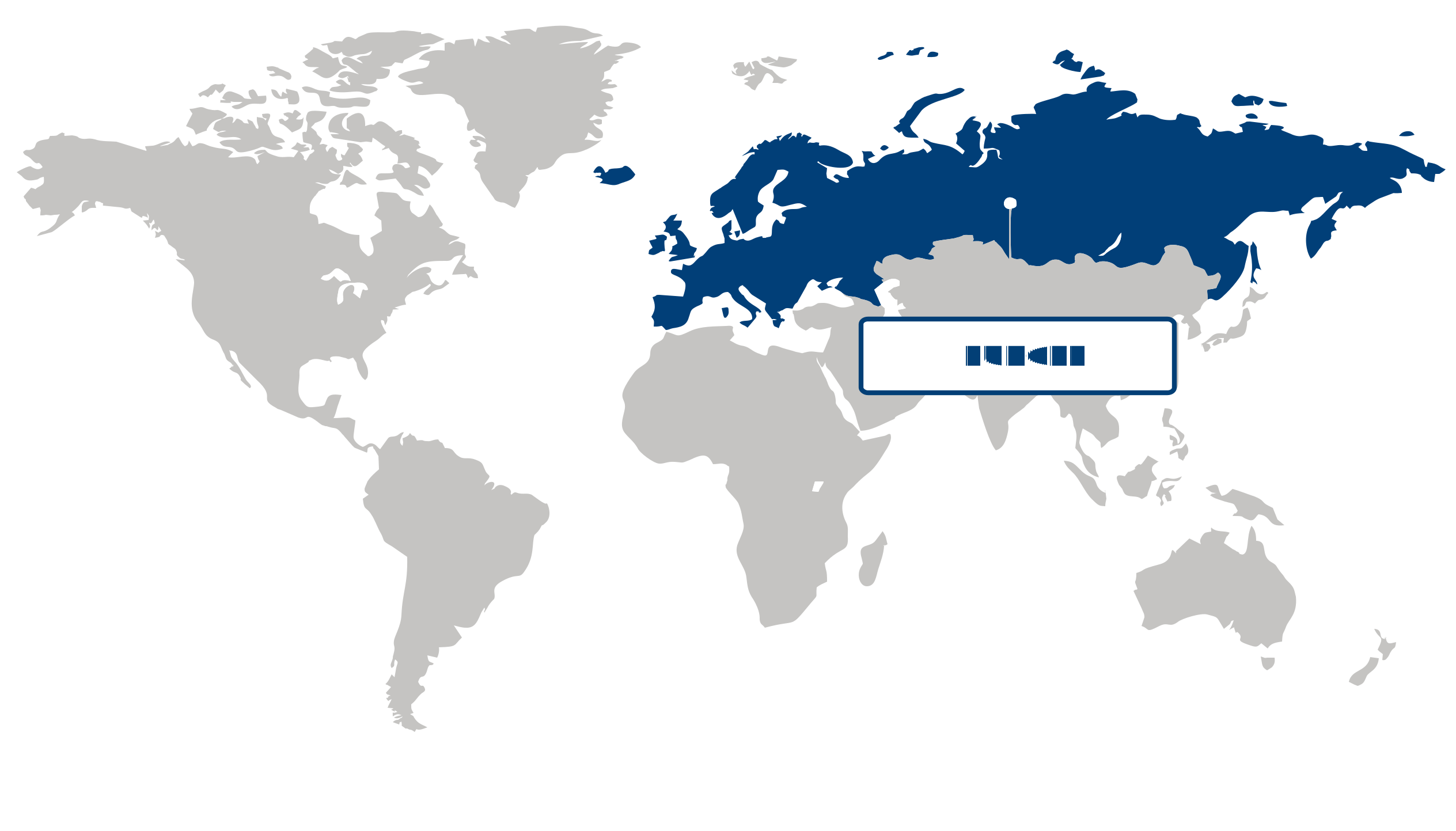
Europe (Largest Region)
Europe held the largest share of the andalusite market, accounting for 58.69% share in 2026. The region's leading position is supported by its established refractory and ceramics industries, where andalusite is valued for its high-temperature resistance and dimensional stability. Strong industrial manufacturing capabilities, specialized mineral processing infrastructure, and sustained demand for high-performance refractory materials support consumption across steelmaking, foundries, and other heat-intensive applications. The region's emphasis on industrial quality and advanced material performance further reinforces its position in the market.
Asia Pacific (Fastest-Growing Region)
Asia Pacific is expected to represent the fastest-growing regional market, driven by expanding industrial production, infrastructure development, and increasing demand for refractory materials across high-temperature manufacturing applications. Growing steel, ceramics, and foundry activities are creating broader opportunities for andalusite-based products, while investments in industrial capacity and modernization are encouraging the adoption of durable refractory solutions. The region's expanding manufacturing base and rising focus on production efficiency are likely to strengthen demand over the forecast period.
| Parameter | North America | Asia Pacific | Europe | Latin America | MEA |
|---|---|---|---|---|---|
| Innovation Hub i Scale Nascent Developing Advanced | |||||
| Cost-Sensitive Region i Scale Low Medium High | |||||
| Regulatory Environment i Scale Restrictive Neutral Supportive | |||||
| Demand Drivers i Scale Weak Moderate Strong | |||||
| Development Stage i Scale Emerging Developing Developed | |||||
| Adoption Rate i Scale Low Medium High | |||||
| New Entrants / Startups i Scale Sparse Moderate Dense | |||||
| Macro Indicators i Scale Weak Stable Strong |
Key Country Insights
Germany 🇩🇪
High-Performance Refractory FocusGermany emphasizes premium-grade andalusite for advanced refractory production serving metal processing and industrial furnace applications. German manufacturers focus on material consistency and thermal performance to enhance production efficiency in demanding operating environments.
France 🇫🇷
Specialty Refractory SolutionsFrance utilizes andalusite in specialized refractory products designed for industrial heat-intensive applications. French manufacturers increasingly emphasize material durability and operational efficiency while aligning sourcing strategies with evolving industrial sustainability objectives.
Italy 🇮🇹
Manufacturing Process SupportItaly's andalusite market is supported by refractory demand from ceramics, metallurgy, and industrial furnace operators. Italian processors prioritize mineral quality and dependable procurement to maintain production continuity across diverse high-temperature manufacturing environments.
Japan 🇯🇵
Precision Materials DemandJapan relies on high-quality andalusite for refractory products used in precision manufacturing and high-temperature industrial processes. Japanese end users prioritize stable mineral specifications and long service life to improve furnace reliability and maintenance planning.
South Korea 🇰🇷
Industrial Furnace ApplicationsSouth Korea integrates andalusite into refractory solutions supporting steelmaking, cement, and heavy industrial operations. Domestic buyers seek reliable supply partnerships and performance-oriented materials that withstand intensive production conditions and frequent thermal cycling.
United States 🇺🇸
Refractory Supply IntegrationThe U.S. andalusite market is driven by demand from steel, foundry, and high-temperature industrial applications requiring durable refractory materials. Buyers in the U.S. prioritize dependable raw material sourcing and consistent mineral quality to support uninterrupted industrial operations.
Segment Leadership and Growth Trends
Andalusite Market Share (%), by Application, 2026
Go beyond the chart, access full insights & data tables
Request Free Sample ReportApplication Segment Analysis: Refractories (Largest Segment) vs Foundry (Fastest-Growing Segment)
The refractories segment led the andalusite market with an 83.89% share in 2026, driven by the material's suitability for high-temperature industrial environments where thermal stability, resistance to heat-induced deformation, and durability are critical. Andalusite is valued as a refractory raw material because it can support products used in demanding applications such as furnace linings and other high-temperature processing equipment. Its performance characteristics make it particularly relevant to industries requiring reliable refractory materials under severe operating conditions. Continued demand for durable furnace and heat-resistant components therefore sustains the strong position of refractories within the market.
The foundry segment is expected to expand at the fastest pace as industrial production increasingly requires materials capable of withstanding demanding casting environments. Andalusite-based refractory solutions can contribute to thermal resistance and dimensional stability in foundry operations, where molds, linings, and related components are exposed to intense heat. The broader modernization of metal-processing facilities and emphasis on improving refractory performance are creating additional opportunities for specialized mineral inputs. Increasing focus on operational reliability and longer-lasting furnace materials further supports the growth of andalusite applications in foundry operations.
| Segment | Sub-Segment | Largest Segment | Fastest Growing |
|---|---|---|---|
| Application | Refractories, Foundry, Kiln Furniture, Others | Refractories | Foundry |
Competitive Landscape and Market Positioning
Top players in the andalusite market:
1. Imerys S.A (France)
2. Andalusite Resources (South Africa)
3. Andalucita S.A. (Peru)
4. Resco Products Inc. (United States)
5. LKAB Minerals AB (Sweden)
6. Refratechnik Holding GmbH (Germany)
7. Saint-Gobain S.A. (France)
8. RHI Magnesita N.V. (Austria)
9. Mineracao Curimbaba Ltda. (Brazil)
10. Zhengzhou Rongsheng Refractory Co. Ltd. (China)
In the andalusite market, producers are emphasizing production optimization and advanced processing technologies to improve mineral quality and operational efficiency amid rising industrial demand. Expansion into high-temperature refractory applications and infrastructure-related industries is also encouraging capacity enhancement initiatives and broader geographic market penetration.
| Company | Market Share | Company Revenue | Revenue CAGR (%) | Product Portfolio | Geographic Presence | Innovation / R&D Focus | Strategic Developments |
|---|---|---|---|---|---|---|---|
| Imerys S.A (France) | |||||||
| Andalusite Resources (South Africa) | |||||||
| Andalucita S.A. (Peru) | |||||||
| Resco Products Inc. (United States) | |||||||
| LKAB Minerals AB (Sweden) | |||||||
| Refratechnik Holding GmbH (Germany) | |||||||
| Saint-Gobain S.A. (France) | |||||||
| RHI Magnesita N.V. (Austria) | |||||||
| Mineracao Curimbaba Ltda. (Brazil) | |||||||
| Zhengzhou Rongsheng Refractory Co. Ltd. (China). |
Industry Development/News
| Company Name | Date | Key Development |
|---|---|---|
| RHI Magnesita | Jan-25 | RHI Magnesita completed the USD 410 million acquisition of Resco Group. The transaction integrates Resco’s U.S.-based fireclay and pyrophyllite-andalusite assets into RHI Magnesita’s global network, enhancing local-for-local production capabilities and supply chain security for high-temperature refractory applications across the North American petrochemical, cement, and aluminum industries. |
| Imerys | Sep-23 | Imerys continues to operate its Glomel mine in France, which maintains an annual andalusite production capacity of approximately 65,000 tons. The site, recognized as the largest andalusite mining operation in Europe, is currently conducting analytical studies for the development of a new pit to sustain long-term output and maintain its position in the high-temperature refractory minerals market. |
| ARM Andalusite | May-22 | ARM Andalusite successfully concluded the business rescue process for Andalusite Resources (Pty) Ltd. and assumed full ownership of the Maroeloesfontein mine in South Africa. Under new directorship, the company has focused on reinvesting free cash flow to modernize processing infrastructure, improve quality control, and secure long-term production of high-grade andalusite for international refractory markets. |
Customize Your Report
Explore examples of how this report can be tailored to different research needs, including custom segments, additional topics or chapters, and related reports. Click a section of the wheel or its numbered marker to explore the available options.
Andalusite Market — Custom Segments
| Segment | Sub-Segment |
|---|---|
| Grade | Standard Grade, High Grade, Premium Grade |
| Processing Type | Unprocessed Andalusite, Calcined Andalusite, Fused Andalusite |
| End-Product Industry | Steel & Iron, Non-Ferrous Metals, Ceramics, Glass & Cement |
Andalusite Market — Custom TOC
| Custom Chapter | Custom Details |
|---|---|
| Refractory Procurement & Supply Strategy |
|
| Synthetic Refractory Material Substitution Assessment |
|
| Mining Region Investment Attractiveness |
|
Need a different cut of the data?
Request Custom ResearchHow large is the andalusite market?
What is the expected industry size of andalusite by 2036?
How is expanding steel production influencing demand in the andalusite market?
How are supply concentration and substitution pressures affecting sourcing strategies in the andalusite market?
Why do refractories dominate the andalusite market?
Which application segment is growing fastest in the andalusite market?
Why does Europe lead the andalusite market?
Why is Asia Pacific the fastest-growing region in the andalusite market?
Who holds a significant market share in the andalusite landscape?
Our Clients
"The report helped us understand emerging consumer trends in our product category. It clarified where to focus innovation for the next product launch."
LyondellBasell
"The regional forecast section was incredibly useful. We were able to identify two new potential partners in Europe thanks to the vendor mapping you included."
SABIC
"We appreciated how actionable the recommendations were. It guided us to improve supply chain resilience."
Olin Corporation
Our Research Team & Methodology
Every Fundamental Business Insights report is built by a dedicated vertical research team, validated through a structured primary-and-secondary methodology, and reviewed for accuracy before it reaches you.
Research Team Overview
Prepared by the Chemicals & Materials Research Team
Delivery
Published
Demand
Available
Support
Trust & Compliance
Research Domains
10 coverage areasResearch Intelligence
| Source | Reference |
|---|---|
| American Chemistry Council (ACC) | www.americanchemistry.com |
| European Chemical Industry Council (Cefic) | cefic.org |
| International Council of Chemical Associations (ICCA) | icca-chem.org |
| European Chemicals Agency (ECHA) | echa.europa.eu |
| U.S. Environmental Protection Agency (EPA) | www.epa.gov |
| ASTM International | www.astm.org |
| International Organization for Standardization (ISO) | www.iso.org |
| National Institute of Standards and Technology (NIST) | www.nist.gov |
| Plastics Industry Association (PLASTICS) | www.plasticsindustry.org |
| European Biplastics | www.european-bioplastics.org |
| The Adhesive and Sealant Council (ASC) | www.ascouncil.org |
| National Association of Corrosion Engineers (AMPP) | www.ampp.org |
| Society of Plastics Engineers (SPE) | www.4spe.org |
| International Fertilizer Association (IFA) | www.fertilizer.org |
| CropLife International | croplife.org |
| Packaging Europe | packagingeurope.com |
| Flexible Packaging Association (FPA) | www.flexpack.org |
| Battery Council International (BCI) | batterycouncil.org |
| International Copper Association (ICA) | internationalcopper.org |
| World Steel Association | worldsteel.org |
Research Workflow & Quality Assurance
Data Collection
Verified information gathered through primary and secondary research.
Data Triangulation
Cross-validation using multiple independent data sources.
Forecast Modelling
Market estimates developed using historical trends and analytical models.
Analyst Validation
Findings reviewed by domain experts for accuracy and consistency.
Editorial & Quality Review
Final editorial, quality, and compliance checks before publication.
Final Publication
Released after successful completion of the internal review process.
Report Coverage
📊 Market Assessment
- Market Size & Forecast
- Market Segmentation
- Regional Analysis
- Growth Drivers & Challenges
- Market Dynamics
🏢 Competitive Intelligence
- Competitive Landscape
- Company Profiles
- Competitive Benchmarking
- Mergers & Acquisitions
- Market Share Analysis or Key Company Strategies
🔍 Strategic Analysis
- Value Chain Analysis
- Porter's Five Forces
- PESTLE Analysis
- Pricing Trends
- Supply-Demand Analysis
🚀 Future Outlook
- Technology Landscape
- Regulatory Landscape
- Investment & Funding Landscape
- Emerging Opportunities
- Future Market Outlook
Have a question about this report or need a custom scope?
Request Customization