Barley Market Size & Growth Forecast 2027–2036, By Segments (Application, Type, Distribution Channel), Regional Demand Trends (North America, Asia Pacific, Europe), Key Country Insights (U.S., Japan, South Korea, Germany, France, Italy), and Competitive Landscape
Jump to content
Market Size and Growth Outlook
Barley Market size stood at USD 155.2 billion in 2026 and is predicted to grow at a 3.23% CAGR from 2027 to 2036, exceeding USD 213.28 billion by 2036. The industry revenue for 2027 is assessed at USD 159.42 billion.
Get more details on this report
Request Free Sample ReportBarley Market Intelligence Snapshot
Regional Market Dynamics
- Europe led the barley market in 2026 through its established cultivation base, integrated grain infrastructure, and consistent demand from feed, malting, and food applications that support active production and trade.
- Asia Pacific is projected to grow at a 3.42% CAGR, driven by rising feed and food demand, stronger import activity, and increasingly responsive supply chains serving expanding consumption centers.
Segment Momentum
- Beverages held a 52.92% share in 2026, driven by barley's established role in brewing and malt-based beverage production, supported by consistent grain quality requirements and repeat industrial procurement.
- Whole Grain is expanding fastest as manufacturers increase its use in cereals, bakery products, snacks, and packaged foods, benefiting from broader food applications and greater formulation versatility.
Market Expansion Drivers
- Rising craft beer and premium spirits production increasing malted barley consumption demand.
- Expanding livestock feed demand driven by global meat and dairy consumption growth.
- Development of high-yield hybrid barley varieties improving productivity under climate variability conditions.
Leading Market Participants
- Leading players in the barley market include Cargill Incorporated (USA), Archer Daniels Midland Company (USA), GrainCorp Limited (Australia), Soufflet Group (France), Boortmalt Group (Belgium), Malteurop Groupe (France), Muntons plc (United Kingdom), Grain Millers, Inc. (USA), Crisp Malting Group (United Kingdom), Maltexco S.A. (Chile).
Global Market Forecast Snapshot
Market Outlook
- 2026 Market Size: USD 155.2 billion
- 2027 Estimated Market Size: USD 159.42 billion.
- Projected Market Size: USD 213.28 billion by 2036
- Growth Forecast: 3.23% CAGR (2027-2036)
Regional and Segment Outlook
- Leading Regional Market: Europe
- High-Growth Regional Hub: Asia Pacific
- Core Revenue Segment: Beverages (Application) | Malted (Type) | Food & Beverage Industry (Distribution Channel)
- Emerging Opportunity Segment: Food (Application) | Whole Grain (Type) | Retail (Distribution Channel)
Market Growth Drivers and Industry Trends
Rising craft beer and premium spirits production increasing malted barley consumption demand
Increasing production of craft beer and premium spirits will propel the barley market growth by strengthening demand for high-quality malted barley used in beverage production. The expansion of differentiated alcoholic beverage offerings creates greater requirements for barley with characteristics suitable for malting and consistent processing performance. Producers serving premium beverage segments may therefore place greater emphasis on dependable malt quality and specialized barley varieties, supporting demand from the malting and brewing value chain as beverage preferences diversify.
Expanding livestock feed demand driven by global meat and dairy consumption growth
Rising demand for meat and dairy products is supporting the barley market through increased requirements for livestock feed, particularly as producers seek dependable feed ingredients to support animal nutrition. Barley can serve as an important component of animal diets, creating a link between growth in livestock production and demand for feed-grade barley. Expansion of meat and dairy consumption encourages greater feed utilization across livestock operations, while changing feeding practices and efforts to maintain animal productivity can further influence the use of barley in feed formulations.
Development of high-yield hybrid barley varieties improving productivity under climate variability conditions
The development of high-yield hybrid varieties is strengthening the barley market by helping growers improve productivity while adapting cultivation to increasingly variable climate conditions. Advances in barley breeding can provide varieties with improved yield potential and characteristics suited to different growing environments, enabling producers to respond more effectively to weather-related cultivation challenges. Greater availability of productive varieties can also support more efficient land use and strengthen growers' ability to maintain barley output where changing environmental conditions affect conventional production practices.
| Growth Driver | Impact on CAGR | Regulatory Influence | Geographic Relevance | Adoption Rate | Impact Timeline |
|---|---|---|---|---|---|
| Rising craft beer and premium spirits production increasing malted barley consumption demand | 2.00% | Low | Europe, North America | High | Near Term |
| Expanding livestock feed demand driven by global meat and dairy consumption growth | 2.10% | Moderate | Asia Pacific, Europe | High | Near Term |
| Development of high-yield hybrid barley varieties improving productivity under climate variability conditions | 1.40% | Moderate | Europe, North America, Asia Pacific | Medium | Mid Term |
Unlock insights tailored to your business with our bespoke market research solutions.
Click to get your customized report now.
Regional Demand Dynamics
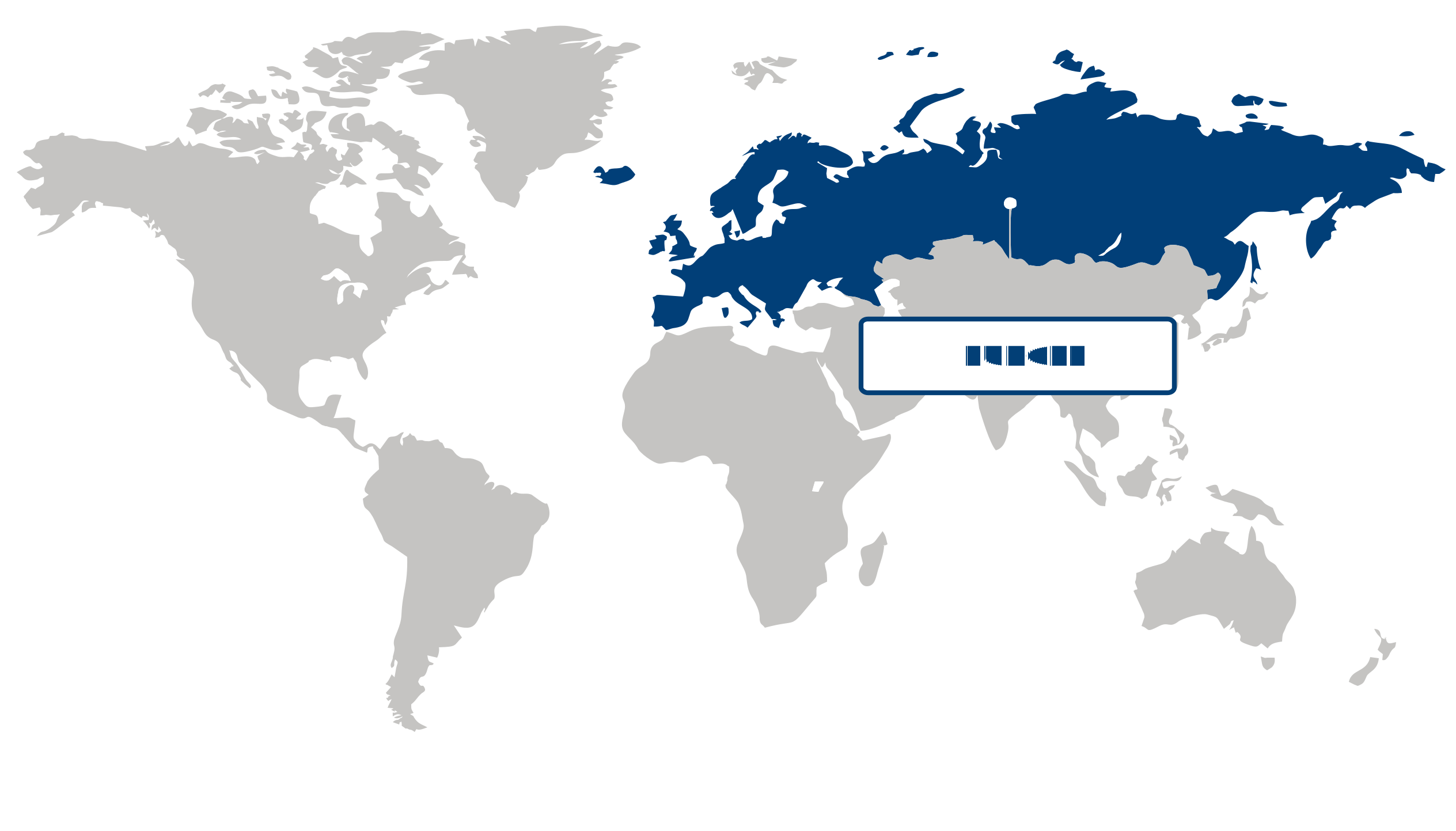
Europe (Largest Region)
Europe dominated the barley market in 2026, supported by its established agricultural base, strong livestock sector, and longstanding use of barley across food, feed, and beverage applications. Favorable farming expertise and developed grain-processing infrastructure provide a reliable foundation for production and distribution. Barley remains important as an animal feed ingredient, while demand from brewing and food processing contributes to the crop's diversified end-use profile. Increasing attention to sustainable agriculture, crop resilience, and efficient resource utilization is also influencing cultivation practices and supply-chain management, reinforcing Europe's established role in the market.
Asia Pacific (Fastest-Growing Region)
Asia Pacific is the fastest-growing region for barley, supported by expanding livestock production, changing dietary patterns, and increasing demand from food and beverage processing industries. Growth in animal husbandry is strengthening feed demand, while the development of modern food and beverage manufacturing is creating additional applications for processed barley and related ingredients. Agricultural modernization and improvements in storage, transportation, and grain-processing infrastructure are helping improve market accessibility. In several emerging economies, rising consumer purchasing power and evolving food preferences are also contributing to greater use of barley-based products, creating additional opportunities for regional producers and suppliers.
| Parameter | North America | Asia Pacific | Europe | Latin America | MEA |
|---|---|---|---|---|---|
| Innovation HubiScaleNascentDeveloping Advanced | |||||
| Cost-Sensitive RegioniScaleLowMedium High | |||||
| Regulatory EnvironmentiScaleRestrictiveNeutral Supportive | |||||
| Demand DriversiScaleWeakModerate Strong | |||||
| Development StageiScaleEmergingDeveloping Developed | |||||
| Adoption RateiScaleLowMedium High | |||||
| New Entrants/StartupsiScaleLowMedium High | |||||
| Macro IndicatorsiScaleWeakStable Strong |
Key Country Insights
Germany 🇩🇪
Malting Quality EmphasisGermany prioritizes barley production that satisfies the exacting standards of maltsters and brewing companies. German producers focus on grain quality, traceability, and reliable supply relationships that strengthen value across the malting and beverage industries.
France 🇫🇷
Value-Added Grain ProcessingFrance integrates barley into brewing, food processing, and livestock nutrition through established agricultural supply chains. French producers increasingly focus on quality preservation and processing efficiency to support commercial buyers with consistent raw material availability.
Italy 🇮🇹
Specialty Food UtilizationItaly applies barley in food products, brewing, and nutritional applications where ingredient quality is an important purchasing consideration. Italian processors continue expanding value-added barley applications while maintaining consistent sourcing and processing standards.
Japan 🇯🇵
Premium Ingredient SourcingJapan depends on carefully selected barley supplies for food processing, beverages, and specialty consumer products. Japanese buyers prioritize consistent quality, reliable imports, and processing characteristics that support premium product development and manufacturing efficiency.
South Korea 🇰🇷
Food Industry IntegrationSouth Korea utilizes barley across food manufacturing, beverage production, and health-oriented product segments. South Korean processors seek dependable raw material quality and diversified sourcing to maintain stable production and respond to evolving consumer preferences.
United States 🇺🇸
Brewing Supply AlignmentThe U.S. barley market continues to support brewing, animal feed, and food ingredient applications through quality-focused production. U.S. growers and processors increasingly emphasize crop consistency and supply coordination to meet changing industrial purchasing requirements.
Barley Market Share (%), by Application, 2026
Go beyond the chart, access full insights & data tables
Request Free Sample ReportApplication Segment Analysis: Beverages (Largest Segment) vs Food (Fastest-Growing Segment)
Beverages held the largest share of 52.92% in the barley market in 2026, driven by the extensive use of barley in brewing and other malt-based beverage applications. Barley provides important characteristics for malting and fermentation, including fermentable extract, flavor development, and desirable processing performance. Its established role in beverage production, together with continued demand for diverse malt-based beverages, reinforces the segment's strong position.
The food segment is advancing at the fastest pace as barley gains broader use in bakery products, cereals, snacks, and other food formulations. Its nutritional profile, fiber content, and versatility as a whole grain or processed ingredient are increasing its relevance among food manufacturers responding to interest in wholesome and minimally processed ingredients. Expanding applications beyond traditional beverage production are therefore widening the commercial role of barley.
Type Segment Analysis: Malted (Largest Segment) vs Whole Grain (Fastest-Growing Segment)
The malted segment represented the largest share of 59.12% in 2026, reflecting barley's well-established importance as a malting grain for beverage production and specialized food applications. Malting activates enzymes and develops the flavor, color, and functional characteristics required for downstream processing, making malted barley a critical ingredient in established value chains. Consistent processing performance and broad industrial acceptance continue to support its leading position.
Whole grain is the fastest-growing type segment, supported by increasing interest in nutrient-dense grains and ingredients that retain more of the grain's natural structure. Whole-grain barley is gaining attention in cereals, bakery products, side dishes, and health-oriented formulations because of its fiber content and versatility. Growing consumer preference for balanced and less-refined food choices is encouraging manufacturers to expand its use across food applications.
| Segment | Sub-Segment | Largest Segment | Fastest Growing |
|---|---|---|---|
| Application | Food, Feed, Beverages | Beverages | Food |
| Type | Whole Grain, Non-whole Grain, Flakes, Flour, Malted | Malted | Whole Grain |
| Distribution Channel | Food & Beverage Industry, Retail, Online, Hypermarkets/Supermarkets, Wholesale Stores, Others | Food & Beverage Industry | Retail |
Competitive Landscape and Market Positioning
Key companies in the barley market:
1. Cargill Incorporated (USA)
2. Archer Daniels Midland Company (USA)
3. GrainCorp Limited (Australia)
4. Soufflet Group (France)
5. Boortmalt Group (Belgium)
6. Malteurop Groupe (France)
7. Muntons plc (United Kingdom)
8. Grain Millers Inc. (USA)
9. Crisp Malting Group (United Kingdom)
10. Maltexco S.A. (Chile)
The barley market is evolving with improved cultivation practices and value-added processing techniques. Enhanced collaboration across supply chains is supporting better quality and yield optimization. The barley market is also influenced by growing demand for sustainable agricultural production and specialty crop applications.
| Company | Market Share | Company Revenue | Revenue CAGR (%) | Product Portfolio | Geographic Presence | Innovation / R&D Focus | Strategic Developments |
|---|---|---|---|---|---|---|---|
| Cargill Incorporated (USA) | |||||||
| Archer Daniels Midland Company (USA) | |||||||
| GrainCorp Limited (Australia) | |||||||
| Soufflet Group (France) | |||||||
| Boortmalt Group (Belgium) | |||||||
| Malteurop Groupe (France) | |||||||
| Muntons plc (United Kingdom) | |||||||
| Grain Millers Inc. (USA) | |||||||
| Crisp Malting Group (United Kingdom) | |||||||
| Maltexco S.A. (Chile). |
Industry Development / News
| Company Name | Date | Key Development |
|---|---|---|
| Jackton Distilling | May-26 | Jackton Distilling launched Raer Whisky, utilizing estate-grown barley and on-site water sources. This development emphasizes a vertically integrated production model, leveraging provenance and internal supply chain control to achieve product differentiation in the premium spirits segment. |
| Grasmere Distillery | Apr-26 | Grasmere Distillery announced plans to initiate small-scale malting operations using locally sourced Cumbrian barley by autumn 2026. The project focuses on vertical integration to support the production of whisky manufactured exclusively from Lake District-sourced ingredients, signaling a shift toward localized supply chain control. |
| RAGT | Jan-26 | RAGT completed the acquisition of Syngenta’s malting barley seeds business. This strategic move consolidates its position within the barley seed segment and enhances its competitive capabilities and portfolio depth across the malting barley value chain. |
| Isle of Arran Distillers | Oct-25 | Isle of Arran Distillers released a new Single Malt expression leveraging a decade-long partnership with local farmers. By securing a consistent supply of island-grown barley, the company strengthens its local sourcing footprint and utilizes regional provenance as a key component of its product differentiation strategy. |
| Vivagran | Apr-25 | Vivagran is advancing the commercial development of Tritordeum, a novel cereal crop derived from wild barley and durum wheat. This development aims to introduce a new ingredient option for the baking, brewing, and distilling sectors, potentially diversifying raw material utilization in these markets. |
| Port of Columbia | Jun-24 | The Port of Columbia secured a $5 million grant to develop a craft malt facility. This initiative represents a significant capacity expansion, intended to strengthen regional barley processing infrastructure and support local supply chain resilience for craft producers. |
| Muntons Plc | May-22 | Muntons Plc transitioned to utilizing 100% environmentally sustainable malt derived from British barley and wheat. This operational shift provides manufacturers with functional ingredients for plant-based food applications, including burgers and deli meats, highlighting a strategic expansion of malt utilization into alternative protein categories. |
Customize Your Report
Explore examples of how this report can be tailored to different research needs, including custom segments, additional topics or chapters, and related reports. Click a section of the wheel or its numbered marker to explore the available options.
Barley Market — Custom Segments
| Segment | Sub-Segment |
|---|---|
| Barley Variety | Two-row Barley, Six-row Barley, Hulless Barley, Other Varieties |
| Production System | Conventional, Organic |
| Procurement Model | Contract Procurement, Spot Procurement |
Barley Market — Custom TOC
| Custom Chapter | Chapter Details |
|---|---|
| Climate Resilience and Agricultural Supply Outlook |
|
| End-Use Demand Allocation and Market Priorities |
|
| Global Barley Trade Corridor Assessment |
|
Need a different cut of the data?
Request Custom ResearchFrequently Asked Questions
How much is the barley market worth?
How is the barley industry expected to grow over the next 10 years?
How is craft brewing and premium spirits production reshaping demand patterns in the barley market?
How is livestock feed demand influencing volume stability in the barley market?
Why do Beverages dominate the barley market?
Why is Whole Grain the fastest-growing barley type?
Why does Europe dominate the barley market?
Why is Asia Pacific emerging as the fastest-growing barley market?
What are the key competitors in the barley landscape?
Our Clients
"The report provided a thorough look at market trends, technological advancements, and the competitive landscape. The depth of insights was really valuable."
ITC Limited
"We would highly recommend Fundamental Business Insights & Consulting to anyone looking for reliable, detailed, and comprehensive market research in the Food industry."
Tyson Foods
"The clarity and presentation of the information were commendable. The report was delivered timely, which made the overall experience smooth and convenient."
Mondelēz International
Our Research Team & Methodology
Every Fundamental Business Insights report is built by a dedicated vertical research team, validated through a structured primary-and-secondary methodology, and reviewed for accuracy before it reaches you.
Delivery
Published
Available
Support
- Market Size & Forecast
- Market Segmentation
- Regional Analysis
- Growth Drivers & Challenges
- Market Dynamics
- Competitive Landscape
- Company Profiles
- Competitive Benchmarking
- Mergers & Acquisitions
- Market Share Analysis or Key Company Strategies
- Value Chain Analysis
- Porter's Five Forces
- PESTLE Analysis
- Pricing Trends
- Supply-Demand Analysis
- Technology Landscape
- Regulatory Landscape
- Investment & Funding Landscape
- Emerging Opportunities
- Future Market Outlook