Battery Diagnostics and Repair Market Size & Growth Forecast 2027–2036, By Segments (Test Type, Component, Vertical), Regional Demand Trends (North America, Asia Pacific, Europe), Key Country Insights (U.S., Japan, South Korea, Germany, France, Italy), and Competitive Landscape
Jump to content
Market Size and Growth Outlook
Battery Diagnostics and Repair Market size was worth USD 1.5 billion in 2026 and is expected to grow at a 5.99% CAGR between 2027 and 2036, exceeding USD 2.68 billion by 2036. The industry revenue for 2027 is assessed at USD 1.58 billion.
Get more details on this report
Request Free Sample ReportBattery Diagnostics and Repair Market Intelligence Snapshot
Regional Market Dynamics
- Europe accounted for 31.32% of the market in 2026, supported by a mature automotive service network, extensive diagnostic practices, and well-developed repair infrastructure across vehicle segments.
- North America is expected to grow at a 7.23% CAGR as fleet operators and repair providers increase battery testing, adopt advanced diagnostics, and prioritize vehicle uptime and cost-efficient maintenance.
Segment Momentum
- Battery Cell Test leads the market because cell-level assessment is essential for identifying degradation, performance loss, and repair feasibility, making it the primary step in battery diagnostics and restoration workflows.
- Services are expanding fastest as users increasingly rely on specialized expertise for diagnostics interpretation, repair execution, maintenance support, and managing more complex battery systems effectively.
Market Expansion Drivers
- Rising electric vehicle adoption driving demand for EV battery diagnostics and repair services.
- Integration of IoT-enabled monitoring systems enabling real-time battery health diagnostics and predictive maintenance.
- Growing battery safety and performance standards driving standardized diagnostic equipment and repair protocols.
Leading Market Participants
- Key companies in the battery diagnostics and repair market include Midtronics, Inc. (United States), Keysight Technologies, Inc. (United States), Bosch Automotive Service Solutions Inc. (Germany), AVILOO GmbH (Austria), DV Power (Sweden), Exponential Power, Inc. (United States), EnerSys (United States), Saft Groupe S.A. (France), SUN Mobility Private Limited (India), CycloChrome (United States).
Global Market Forecast Snapshot
Market Outlook
- 2026 Market Size: USD 1.5 billion
- 2027 Estimated Market Size: USD 1.58 billion.
- Projected Market Size: USD 2.68 billion by 2036
- Growth Forecast: 5.99% CAGR (2027-2036)
Regional and Segment Outlook
- Leading Regional Market: Europe
- High-Growth Regional Hub: North America
- Core Revenue Segment: Battery Cell Test (Test Type) | Hardware (Component) | Automotive (Vertical)
- Emerging Opportunity Segment: Battery Pack/Module Test (Test Type) | Services (Component) | Consumer Electronics (Vertical)
Market Growth Drivers and Industry Trends
Rising electric vehicle adoption driving demand for EV battery diagnostics and repair services
The increasing deployment of electric vehicles will drive the battery diagnostics and repair market as a growing installed base of battery-powered vehicles creates greater requirements for evaluating battery condition and maintaining pack performance. Battery diagnostics help identify degradation, abnormal cell behavior, thermal issues, and other conditions that can affect vehicle range and reliability, while repair services can address certain battery problems without requiring complete pack replacement. As EV owners and service providers place greater emphasis on extending battery usability and managing maintenance costs, specialized diagnostic and repair capabilities become increasingly important across the vehicle service ecosystem.
Integration of IoT-enabled monitoring systems enabling real-time battery health diagnostics and predictive maintenance
IoT-enabled monitoring technologies will propel the battery diagnostics and repair market by allowing battery operating conditions to be captured and analyzed continuously. Connected systems can collect information related to temperature, voltage, charging behavior, and other battery parameters, enabling technicians and service platforms to identify deviations from expected operating conditions. Real-time visibility supports predictive maintenance by helping detect emerging issues before they develop into more serious failures, while connected diagnostic information can improve service planning and provide more detailed assessments of battery health during maintenance activities.
Growing battery safety and performance standards driving standardized diagnostic equipment and repair protocols
Stronger requirements surrounding battery safety and performance will boost the battery diagnostics and repair market by increasing the need for reliable testing procedures and consistent service practices. Standardized diagnostic equipment can help technicians assess battery condition using defined parameters, while structured repair protocols support safer handling of high-voltage battery systems and damaged components. Greater emphasis on consistent battery evaluation also encourages service providers to adopt specialized tools and procedures for identifying faults, validating repairs, and maintaining battery systems within required operational and safety conditions.
| Growth Driver | Impact on CAGR | Regulatory Influence | Geographic Relevance | Adoption Rate | Impact Timeline |
|---|---|---|---|---|---|
| Rising electric vehicle adoption driving demand for EV battery diagnostics and repair services | 2.10% | Moderate | Asia Pacific, Europe, North America | High | Near Term |
| Integration of IoT-enabled monitoring systems enabling real-time battery health diagnostics and predictive maintenance | 1.90% | Low | North America, Europe, Asia Pacific | High | Near Term |
| Growing battery safety and performance standards driving standardized diagnostic equipment and repair protocols | 1.60% | High | North America, Europe, Asia Pacific | Medium | Mid Term |
Unlock insights tailored to your business with our bespoke market research solutions.
Click to get your customized report now.
Regional Demand Dynamics
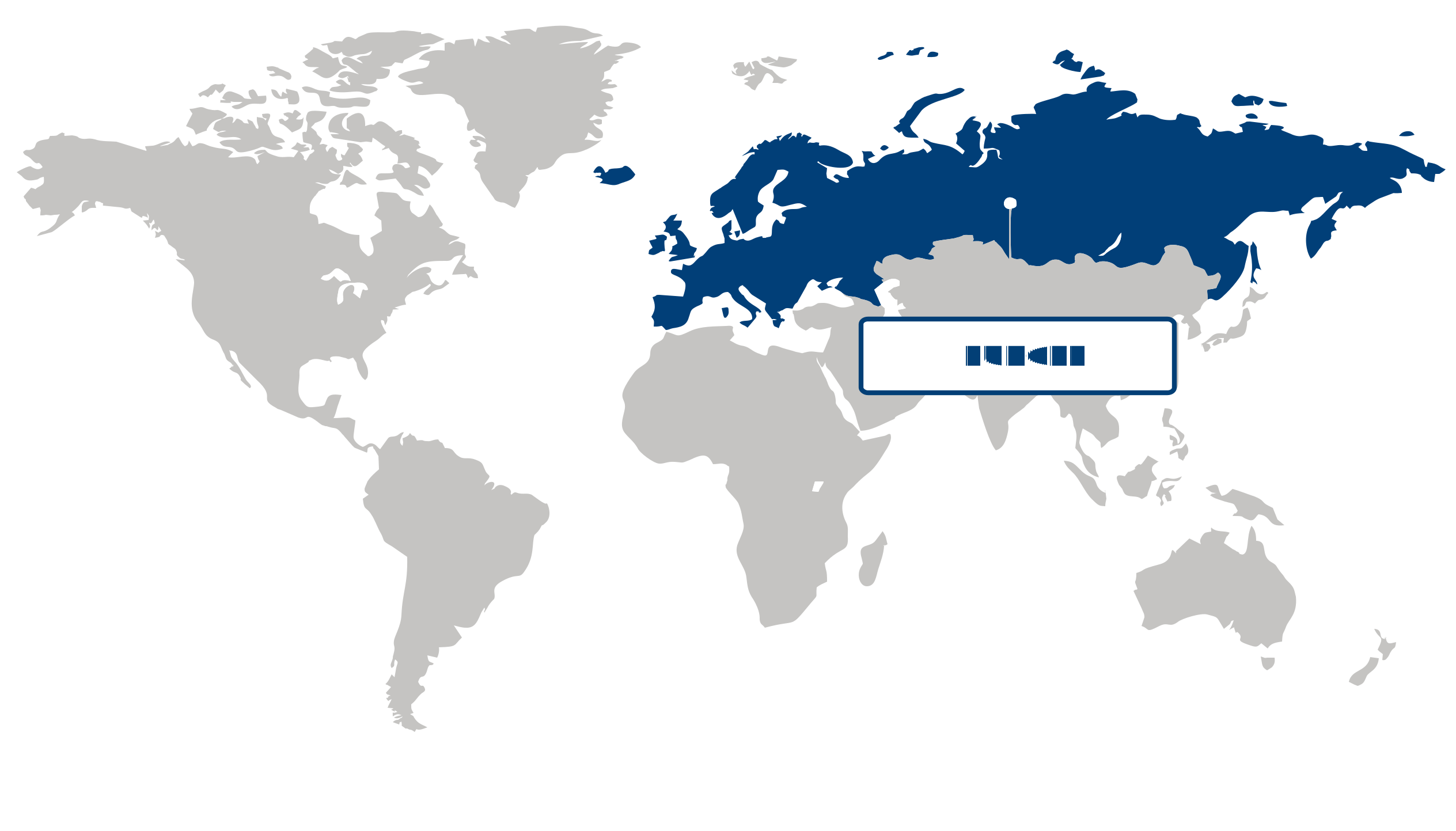
Europe (Largest Region)
Europe led the battery diagnostics and repair market in 2026, accounting for 31.32% share, supported by strong emphasis on vehicle electrification, battery lifecycle management, and resource efficiency. Established automotive and industrial sectors are increasingly focused on extending battery usability through accurate testing, condition assessment, maintenance, and repair rather than relying solely on replacement. Regulatory attention toward sustainability, circular economy practices, and responsible handling of battery materials further encourages diagnostic and repair activities. The region's developed automotive service infrastructure and growing technical capabilities also provide favorable conditions for specialized battery assessment solutions across mobility and energy-related applications.
North America (Fastest-Growing Region)
North America is the fastest-growing region, supported by rising adoption of electric vehicles, expanding battery-based energy systems, and growing awareness of battery health as a determinant of performance, safety, and operating costs. Increasing demand for reliable assessment tools is encouraging service providers and repair facilities to strengthen their battery testing and maintenance capabilities. The development of local battery-related supply chains and greater interest in extending asset life are further supporting market opportunities. Advancements in diagnostic technologies that can identify degradation, performance issues, and repair requirements with greater precision are expected to reinforce adoption across automotive, industrial, and energy applications.
| Parameter | North America | Asia Pacific | Europe | Latin America | MEA |
|---|---|---|---|---|---|
| Innovation HubiScaleNascentDeveloping Advanced | |||||
| Cost-Sensitive RegioniScaleLowMedium High | |||||
| Regulatory EnvironmentiScaleRestrictiveNeutral Supportive | |||||
| Demand DriversiScaleWeakModerate Strong | |||||
| Development StageiScaleEmergingDeveloping Developed | |||||
| Adoption RateiScaleLowMedium High | |||||
| New Entrants / StartupsiScaleSparseModerate Dense | |||||
| Macro IndicatorsiScaleWeakStable Strong |
Key Country Insights
Germany 🇩🇪
Lifecycle Performance ManagementGermany emphasizes battery diagnostics and repair solutions that maximize battery utilization across automotive and industrial applications. Companies invest in advanced testing and maintenance capabilities that support sustainable battery lifecycle management.
France 🇫🇷
Sustainable Battery MaintenanceFrance promotes battery diagnostics and repair to extend battery usability and support circular economy objectives within electric mobility. Organizations increasingly implement standardized maintenance processes that improve battery reliability and resource efficiency.
Italy 🇮🇹
Aftermarket Battery SolutionsItaly expands battery diagnostics and repair services across automotive and industrial sectors as battery-powered systems become more widely deployed. Companies prioritize practical maintenance technologies that reduce downtime and improve long-term equipment performance.
Japan 🇯🇵
Battery Health OptimizationJapan focuses on battery diagnostics technologies that improve long-term performance of electric mobility and energy storage systems. Businesses increasingly integrate accurate monitoring and repair solutions to enhance operational efficiency and maintenance planning.
South Korea 🇰🇷
Advanced Battery ServicingSouth Korea strengthens battery diagnostics and repair capabilities alongside expanding battery manufacturing and electric mobility activities. Service providers adopt intelligent diagnostic tools that improve battery evaluation accuracy and maintenance effectiveness.
United States 🇺🇸
Fleet Battery MaintenanceThe U.S. expands battery diagnostics and repair capabilities to support electric vehicles, energy storage systems, and commercial fleets. Organizations increasingly prioritize predictive battery assessment technologies that improve asset reliability and extend operational performance.
Battery Diagnostics and Repair Market Share (%), by Test Type, 2026
Go beyond the chart, access full insights & data tables
Request Free Sample ReportTest Type Segment Analysis: Battery Cell Test (Largest Segment) vs Battery Pack/Module Test (Fastest-Growing Segment)
The battery cell test segment held the largest share in 2026, supported by the need to assess the fundamental performance, safety, and condition of individual cells throughout battery manufacturing, maintenance, and repair activities. Cell-level testing enables the early identification of defects, degradation, capacity loss, and other performance issues before they affect the operation of larger battery assemblies. Its importance is further reinforced by the growing complexity of advanced battery systems, where accurate cell diagnostics are essential for quality control, failure analysis, and extending usable battery life.
In the battery diagnostics and repair market, the battery pack/module test segment is expected to be the fastest-growing segment, driven by the increasing need to evaluate the performance and integrity of complete battery assemblies. As batteries become more sophisticated, diagnostic requirements are expanding beyond individual cells to include modules, interconnections, thermal behavior, control systems, and overall pack performance. Growing emphasis on efficient repair, preventive maintenance, and the identification of system-level faults is supporting the adoption of comprehensive testing capabilities for battery packs and modules.
Component Segment Analysis: Hardware (Largest Segment) vs Services (Fastest-Growing Segment)
The hardware segment dominated the battery diagnostics and repair market with a 69.12% share in 2026, owing to the essential role of diagnostic instruments, testing equipment, sensors, and related systems in evaluating battery condition and identifying faults. These physical components form the foundation of battery assessment and repair workflows by enabling the measurement of key performance and safety parameters. Rising demand for accurate diagnostics across battery manufacturing, maintenance, and refurbishment activities has further strengthened the need for specialized and reliable hardware infrastructure.
The services segment is expected to be the fastest-growing segment, supported by the increasing technical complexity of modern battery systems and the need for specialized expertise in diagnostics, maintenance, and repair. As battery technologies continue to evolve, users are increasingly relying on professional services for advanced fault analysis, system inspection, calibration, and restoration activities. The expansion of battery reuse and lifecycle management practices is also creating greater demand for service-based offerings that help optimize battery performance and extend operational life.
| Segment | Sub-Segment | Largest Segment | Fastest Growing |
|---|---|---|---|
| Test Type | Battery Cell Test, Battery Pack/Module Test | Battery Cell Test | Battery Pack/Module Test |
| Component | Hardware, Software, Services | Hardware | Services |
| Vertical | Automotive, Consumer Electronics, Industrial Applications, Power Grid, Others | Automotive | Consumer Electronics |
Competitive Landscape and Market Positioning
Key companies in the battery diagnostics and repair market:
1. Midtronics Inc. (United States)
2. Keysight Technologies Inc. (United States)
3. Bosch Automotive Service Solutions Inc. (Germany)
4. AVILOO GmbH (Austria)
5. DV Power (Sweden)
6. Exponential Power Inc. (United States)
7. EnerSys (United States)
8. Saft Groupe S.A. (France)
9. SUN Mobility Private Limited (India)
10. CycloChrome (United States)
The battery diagnostics and repair market is expanding alongside rising electric vehicle adoption and increasing focus on battery lifecycle management. Companies are prioritizing predictive analytics, real-time performance monitoring, and automated fault detection technologies to improve maintenance efficiency. Demand for reliable battery health assessment tools is driving continuous advancements within the market.
| Company | Market Share | Company Revenue | Revenue CAGR (%) | Product Portfolio | Geographic Presence | Innovation / R&D Focus | Strategic Developments |
|---|---|---|---|---|---|---|---|
| Midtronics Inc. (United States) | |||||||
| Keysight Technologies Inc. (United States) | |||||||
| Bosch Automotive Service Solutions Inc. (Germany) | |||||||
| AVILOO GmbH (Austria) | |||||||
| DV Power (Sweden) | |||||||
| Exponential Power Inc. (United States) | |||||||
| EnerSys (United States) | |||||||
| Saft Groupe S.A. (France) | |||||||
| SUN Mobility Private Limited (India) | |||||||
| CycloChrome (United States). |
Industry Development / News
| Company Name | Date | Key Development |
|---|---|---|
| Bosch Car Service Philippines | Nov-25 | The company launched the first independent workshop in the Philippines dedicated to electric and hybrid vehicle servicing. This expansion strengthens local EV maintenance infrastructure by providing specialized diagnostic and repair capabilities for electrified powertrains, facilitating broader market adoption of electric mobility solutions in the region. |
| Autocraft | Sep-25 | Autocraft reported that its EV battery remanufacturing process achieves a 50% cost reduction compared to new battery production while decreasing CO2 emissions by 10,500 kg per unit. This development validates the commercial and environmental viability of its battery lifecycle management services, positioning the company as a leader in sustainable EV repair and reuse. |
| IZI | Oct-24 | E-mobility provider IZI is expanding its electric bus operations in Rwanda with support from the Rwanda Green Fund. The plan includes establishing a dedicated battery maintenance and repair facility in Kigali, a strategic initiative that enhances regional EV infrastructure and provides critical servicing and diagnostic support for the emerging East African e-mobility market. |
Customize Your Report
Explore examples of how this report can be tailored to different research needs, including custom segments, additional topics or chapters, and related reports. Click a section of the wheel or its numbered marker to explore the available options.
Battery Diagnostics and Repair Market — Custom Segments
| Segment | Sub-Segment |
|---|---|
| Battery Chemistry | Lithium-Ion, Lithium Iron Phosphate, Nickel-Based, Lead-Acid, Other Chemistries |
| Battery Lifecycle Stage | Manufacturing & Quality Control, In-Service Diagnostics, Maintenance & Repair, End-of-Life Assessment & Second-Life Evaluation |
| Service Delivery Model | In-House Diagnostics, Authorized Service Centers, Independent Repair Providers, Mobile & On-Site Services |
Battery Diagnostics and Repair Market — Custom TOC
| Custom Chapter | Chapter Details |
|---|---|
| EV Battery Second-Life and Remanufacturing Ecosystem |
|
| Battery Service Network and Aftermarket Channel Assessment |
|
| Fleet Battery Lifecycle Management Strategies |
|
Need a different cut of the data?
Request Custom ResearchFrequently Asked Questions
How large is the battery diagnostics and repair market?
What is the anticipated CAGR of the battery diagnostics and repair industry?
How is connected battery monitoring changing service delivery in the battery diagnostics and repair market?
Why are standardized diagnostic tools and repair protocols becoming increasingly important in the battery diagnostics and repair market?
Why is battery cell testing the leading test type in the battery diagnostics and repair market?
Why are services the fastest-growing component in the battery diagnostics and repair market?
Why is Europe the largest market for battery diagnostics and repair?
How is North America expanding in the battery diagnostics and repair market?
Who holds a significant market share in the battery diagnostics and repair landscape?
Our Clients
"The information presented in the report was genuinely insightful. The data was clear and easy to understand, which made it much easier to interpret the findings."
Amara Raja Group
"The responsiveness and professionalism exhibited by the team were exemplary. They were readily available to address queries, provide clarifications, and offer additional insights."
ONGC
"The reports offered a comprehensive analysis of various segments within the market. The detailed insights into market trends, and regulatory landscapes were excellent."
TotalEnergies
Our Research Team & Methodology
Every Fundamental Business Insights report is built by a dedicated vertical research team, validated through a structured primary-and-secondary methodology, and reviewed for accuracy before it reaches you.
Delivery
Published
Available
Support
- Market Size & Forecast
- Market Segmentation
- Regional Analysis
- Growth Drivers & Challenges
- Market Dynamics
- Competitive Landscape
- Company Profiles
- Competitive Benchmarking
- Mergers & Acquisitions
- Market Share Analysis or Key Company Strategies
- Value Chain Analysis
- Porter's Five Forces
- PESTLE Analysis
- Pricing Trends
- Supply-Demand Analysis
- Technology Landscape
- Regulatory Landscape
- Investment & Funding Landscape
- Emerging Opportunities
- Future Market Outlook