Biodegradable Tableware Market Size & Growth Forecast 2027–2036, By Segments (Application, Type, Raw Material), Regional Demand Trends (North America, Asia Pacific, Europe), Key Country Insights (U.S., Japan, South Korea, Germany, France, Italy), and Competitive Landscape
Jump to content
Market Size and Growth Outlook
Biodegradable Tableware Market size was estimated at USD 18.5 billion in 2026 and is projected to grow at a 6.75% CAGR from 2027 to 2036, surpassing USD 35.55 billion by 2036. The industry revenue for 2027 is assessed at USD 19.55 billion.
Get more details on this report
Request Free Sample ReportBiodegradable Tableware Market Intelligence Snapshot
Regional Market Dynamics
- Europe accounted for 35.51% of the market in 2026, supported by strict single-use plastic regulations, strong consumer acceptance, and consistent purchasing by foodservice, retail, and catering operators.
- Asia Pacific is projected to grow at a 7.12% CAGR, fueled by expanding takeaway and delivery services, rising urban food consumption, and increasing adoption of sustainable disposable products.
Segment Momentum
- Commercial applications accounted for 63.83% of the market in 2026 due to consistent bulk demand from restaurants, cafés, catering, and food delivery businesses seeking convenient, hygienic, and sustainable disposable solutions.
- Cutlery is the fastest-growing type as takeaway, delivery, and ready-to-eat meal services increasingly replace conventional plastic utensils with biodegradable alternatives across high-volume foodservice operations.
Market Expansion Drivers
- Government bans on single-use plastics driving adoption of biodegradable tableware alternatives.
- Rising food delivery and takeaway demand increasing sustainable disposable packaging consumption.
- Expansion of bio-based raw material supply chains enabling scalable eco-friendly tableware production.
Leading Market Participants
- Top players in the biodegradable tableware market include Huhtamäki Oyj (Finland), Dart Container Corporation (United States), Novolex Holdings, LLC (United States), Reynolds Consumer Products Inc. (United States), Genpak, LLC (United States), Pactiv Evergreen Inc. (United States), BioPak Pty Ltd. (Australia), PAPSTAR GmbH (Germany), Bionatic GmbH & Co. KG (Germany), Biotrem Sp. z o.o. (Poland).
Global Market Forecast Snapshot
Market Outlook
- 2026 Market Size: USD 18.5 billion
- 2027 Estimated Market Size: USD 19.55 billion.
- Projected Market Size: USD 35.55 billion by 2036
- Growth Forecast: 6.75% CAGR (2027-2036)
Regional and Segment Outlook
- Leading Regional Market: Europe
- High-Growth Regional Hub: Asia Pacific
- Core Revenue Segment: Commercial (Application) | Plates/Trays (Type) | Wood (Raw Material)
- Emerging Opportunity Segment: Institutional (Application) | Cutlery (Type) | Paper (Raw Material)
Market Growth Drivers and Industry Trends
Government bans on single-use plastics driving adoption of biodegradable tableware alternatives
Government restrictions on single-use plastics are encouraging businesses and consumers to consider alternative disposable products, which will propel the biodegradable tableware market as regulatory measures create greater demand for environmentally preferable serving solutions. Foodservice operators and other users of disposable tableware are increasingly required to adjust product choices where plastic restrictions affect conventional packaging and serving practices.
Rising food delivery and takeaway demand increasing sustainable disposable packaging consumption
Growth in food delivery and takeaway activity is increasing the need for convenient disposable serving products, supporting biodegradable tableware market growth as sustainability considerations influence packaging and tableware selection. Restaurants, foodservice providers, and delivery-oriented businesses require practical single-use solutions that can accommodate off-premise consumption while reducing reliance on conventional plastic-based tableware.
Expansion of bio-based raw material supply chains enabling scalable eco-friendly tableware production
Expansion of supply chains for bio-based raw materials is improving the production foundation for sustainable tableware, enabling biodegradable tableware market growth through greater access to inputs needed for eco-friendly manufacturing. More established sourcing networks can support producers in developing and scaling biodegradable products while helping align material availability with growing demand for alternatives to conventional disposable tableware.
| Growth Driver | Impact on CAGR | Regulatory Influence | Geographic Relevance | Adoption Rate | Impact Timeline |
|---|---|---|---|---|---|
| Government bans on single-use plastics driving adoption of biodegradable tableware alternatives | 2.00% | High | Europe, Asia Pacific | High | Near Term |
| Rising food delivery and takeaway demand increasing sustainable disposable packaging consumption | 1.70% | Moderate | Asia Pacific, North America | High | Near Term |
| Expansion of bio-based raw material supply chains enabling scalable eco-friendly tableware production | 1.50% | Moderate | Asia Pacific, Europe | Medium | Mid Term |
Unlock insights tailored to your business with our bespoke market research solutions.
Click to get your customized report now.
Regional Demand Dynamics
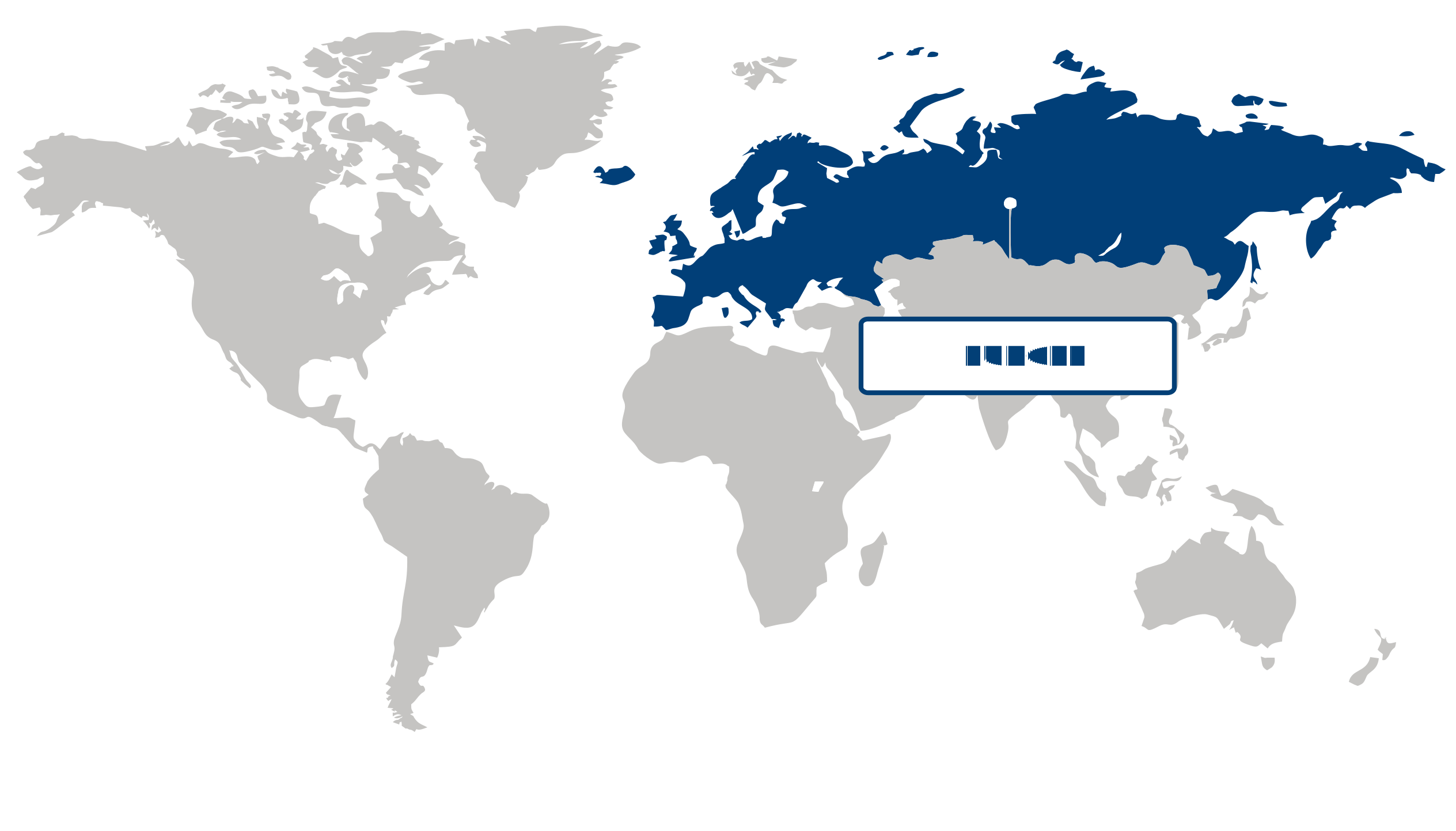
Europe (Largest Region)
Europe led the biodegradable tableware market with a 35.51% share in 2026, reflecting strong environmental awareness and a regulatory environment that favors reductions in conventional single-use plastics. Growing consumer preference for sustainable food-service products is encouraging restaurants, catering businesses, retailers, and institutional users to transition toward biodegradable and compostable alternatives. Established waste-management infrastructure and increasing attention to circular economy principles are also supporting demand for materials with improved end-of-life characteristics. Sustainability commitments across the food-service sector are further strengthening adoption as businesses seek packaging and serving solutions that align with environmental objectives and evolving regulatory expectations.
Asia Pacific (Fastest-Growing Region)
In Asia Pacific, the biodegradable tableware market is expanding at the fastest pace as urbanization, changing consumption patterns, and the growth of organized food-service channels increase demand for convenient disposable tableware. Governments and businesses are placing greater emphasis on reducing plastic waste, creating opportunities for plant-based and compostable alternatives. Rising environmental consciousness among consumers, combined with expanding food delivery, takeaway, hospitality, and institutional catering activities, is broadening the application base for biodegradable products. Improvements in domestic manufacturing capabilities and growing availability of sustainable raw materials are also supporting wider adoption across the region.
| Parameter | North America | Asia Pacific | Europe | Latin America | MEA |
|---|---|---|---|---|---|
| Innovation HubiScaleNascentDeveloping Advanced | |||||
| Cost-Sensitive RegioniScaleLowMedium High | |||||
| Regulatory EnvironmentiScaleRestrictiveNeutral Supportive | |||||
| Demand DriversiScaleWeakModerate Strong | |||||
| Development StageiScaleEmergingDeveloping Developed | |||||
| Adoption RateiScaleLowMedium High | |||||
| New Entrants / StartupsiScaleSparseModerate Dense | |||||
| Macro IndicatorsiScaleWeakStable Strong |
Key Country Insights
Germany 🇩🇪
Circular Packaging AdoptionGermany is encouraging biodegradable tableware alongside broader circular economy initiatives within hospitality and retail sectors. Suppliers are focusing on certified compostable materials, responsible sourcing, and product performance that supports environmentally conscious purchasing decisions.
France 🇫🇷
Hospitality Sustainability FocusFrance is reinforcing demand for biodegradable tableware through sustainability initiatives in restaurants, catering, and public events. Manufacturers are expanding renewable material options and improving product functionality to meet commercial expectations for environmentally responsible disposable products.
Italy 🇮🇹
Foodservice Material InnovationItaly is promoting biodegradable tableware for catering, hospitality, and packaged food applications where sustainability is becoming an important purchasing criterion. Companies are investing in plant-based materials and attractive product designs that balance environmental performance with customer experience.
Japan 🇯🇵
Functional Eco MaterialsJapan is emphasizing biodegradable tableware that combines convenience with consistent quality for foodservice and takeaway applications. Companies are improving material strength, heat resistance, and manufacturing efficiency while responding to growing environmental awareness among commercial buyers.
South Korea 🇰🇷
Convenience Sector TransitionSouth Korea is increasing adoption of biodegradable tableware across quick-service restaurants, cafés, and delivery platforms. Producers are introducing lightweight, durable products that satisfy operational requirements while supporting evolving sustainability initiatives within the foodservice industry.
United States 🇺🇸
Sustainable Foodservice DemandThe U.S. biodegradable tableware market is expanding through foodservice operators seeking practical alternatives to conventional disposable products. Manufacturers are developing durable compostable materials and scalable production capabilities that align with changing procurement and sustainability expectations.
Biodegradable Tableware Market Share (%), by Application, 2026
Go beyond the chart, access full insights & data tables
Request Free Sample ReportApplication Segment Analysis: Commercial (Largest Segment) vs Institutional (Fastest-Growing Segment)
The commercial segment led the biodegradable tableware market, capturing 63.83% share in 2026, supported by widespread use across restaurants, foodservice establishments, catering operations, and other settings with recurring demand for disposable serving products. Growing environmental awareness and increasing efforts to reduce dependence on conventional plastic tableware are encouraging commercial users to adopt biodegradable alternatives. The need to balance convenience, hygiene, and sustainability in high-volume foodservice environments further strengthens the segment's position.
Institutional applications represent the fastest-growing segment as schools, healthcare facilities, corporate campuses, and public organizations increasingly incorporate sustainable practices into foodservice operations. Institutional buyers are placing greater emphasis on environmentally responsible procurement while maintaining requirements for hygiene, convenience, and operational efficiency. The shift toward sustainable waste-management practices and greater adoption of environmentally preferable products across organized facilities is creating additional demand for biodegradable tableware.
Type Segment Analysis: Plates/Trays (Largest Segment) vs Cutlery (Fastest-Growing Segment)
Plates/Trays accounted for 36.25% of the biodegradable tableware market in 2026, making this product category the largest within the type segment. Their broad applicability across dine-in, takeaway, catering, and institutional foodservice settings supports consistent demand, particularly where disposable serving formats are preferred for convenience and hygiene. Growing replacement of conventional plastic products with compostable and biodegradable alternatives is further supporting adoption, while improvements in material performance are helping address requirements related to strength, heat resistance, and food compatibility.
Cutlery is the fastest-growing product type as consumers and foodservice operators increasingly seek complete sustainable alternatives to conventional disposable utensils. The expansion of takeaway, delivery, catering, and convenience-oriented food consumption is creating greater need for portable serving accessories that align with environmental objectives. Improvements in biodegradable materials, product durability, and user convenience are helping accelerate the transition toward sustainable cutlery across commercial and institutional foodservice applications.
| Segment | Sub-Segment | Largest Segment | Fastest Growing |
|---|---|---|---|
| Application | Household, Commercial, Institutional | Commercial | Institutional |
| Type | Plates/Trays, Bowls, Drinkware, Cutlery, Others | Plates/Trays | Cutlery |
| Raw Material | Wood, Bamboo, Paper, Bioplastic, Bagasse, Others | Wood | Paper |
Competitive Landscape and Market Positioning
Major players in the biodegradable tableware market:
1. Huhtamäki Oyj (Finland)
2. Dart Container Corporation (United States)
3. Novolex Holdings LLC (United States)
4. Reynolds Consumer Products Inc. (United States)
5. Genpak LLC (United States)
6. Pactiv Evergreen Inc. (United States)
7. BioPak Pty Ltd. (Australia)
8. PAPSTAR GmbH (Germany)
9. Bionatic GmbH & Co. KG (Germany)
10. Biotrem Sp. z o.o. (Poland)
The biodegradable tableware market is growing due to increasing environmental awareness and restrictions on single-use plastics. Manufacturers are developing plant-based and compostable alternatives. Product innovation is focused on durability and cost efficiency. The biodegradable tableware market reflects a strong shift toward sustainable consumption practices.
| Company | Market Share | Company Revenue | Revenue CAGR (%) | Product Portfolio | Geographic Presence | Innovation / R&D Focus | Strategic Developments |
|---|---|---|---|---|---|---|---|
| Huhtamäki Oyj (Finland) | |||||||
| Dart Container Corporation (United States) | |||||||
| Novolex Holdings LLC (United States) | |||||||
| Reynolds Consumer Products Inc. (United States) | |||||||
| Genpak LLC (United States) | |||||||
| Pactiv Evergreen Inc. (United States) | |||||||
| BioPak Pty Ltd. (Australia) | |||||||
| PAPSTAR GmbH (Germany) | |||||||
| Bionatic GmbH & Co. KG (Germany) | |||||||
| Biotrem Sp. z o.o. (Poland). |
Industry Development / News
| Company Name | Date | Key Development |
|---|---|---|
| Pakka Limited | Oct-25 | Pakka Limited scaled its compostable packaging operations to an annual production capacity of 50,000 tonnes. The facility utilizes rice husk as a primary feedstock and features an integrated soda recovery plant capable of recovering 95% of process chemicals, reflecting a strategic advancement in manufacturing scale, resource efficiency, and sustainable supply chain management. |
| Qudrat | Sep-25 | Qudrat, a Kerala-based startup, is scaling its commercial production of biodegradable tableware and packaging derived from agricultural waste. By upcycling rice husk and straw into compostable products, the company has achieved significant early-stage commercial traction, demonstrating the viability of localized, circular manufacturing models in the sustainable disposable tableware segment. |
| Seow Khim Polythelene Co | Jun-23 | Seow Khim Polythelene Co (SKP) expanded its sustainable food packaging and cutlery portfolio in Singapore through the launch of its EcoVue range. The initiative integrates green manufacturing technologies, including solar energy adoption and the production of fully biodegradable plastic alternatives, to meet rising B2B and B2C demand for eco-friendly, compostable food service solutions. |
| Novolex | Aug-21 | Novolex completed the acquisition of Vegware, an international provider of compostable foodservice packaging. The transaction integrates Vegware’s renewable, plant-based product line into Novolex’s Eco-Products portfolio, significantly expanding the company’s distribution reach in Europe and enhancing its competitive positioning in the North American market through a diversified range of sustainable and compostable packaging solutions. |
Customize Your Report
Explore examples of how this report can be tailored to different research needs, including custom segments, additional topics or chapters, and related reports. Click a section of the wheel or its numbered marker to explore the available options.
Biodegradable Tableware Market — Custom Segments
| Segment | Sub-Segment |
|---|---|
| Distribution Channel | Direct Sales, Foodservice & Institutional Distributors, Retail Stores, E-commerce |
| Foodservice Format | Quick-Service Restaurants, Full-Service Restaurants, Catering & Events, Cafés & Takeaway |
| Price Tier | Economy, Mid-Range, Premium |
Biodegradable Tableware Market — Custom TOC
| Custom Chapter | Chapter Details |
|---|---|
| Foodservice Conversion Strategy |
|
| Alternative Material Adoption |
|
| Circular Economy Business Models |
|
Need a different cut of the data?
Request Custom ResearchFrequently Asked Questions
How big is the biodegradable tableware market?
What is the anticipated CAGR of the biodegradable tableware industry?
How are government bans on single-use plastics shaping adoption of biodegradable tableware alternatives?
How is rising food delivery and takeaway demand influencing biodegradable tableware consumption?
Why do commercial applications dominate the biodegradable tableware market?
Which type segment is expanding the fastest in the biodegradable tableware market?
Why is Europe the leading region in the biodegradable tableware market?
Why is Asia Pacific the fastest-growing biodegradable tableware market?
Who are the major participants shaping the biodegradable tableware landscape?
Our Clients
"The report provided a thorough look at market trends, technological advancements, and the competitive landscape. The depth of insights was really valuable."
ITC Limited
"We would highly recommend Fundamental Business Insights & Consulting to anyone looking for reliable, detailed, and comprehensive market research in the Food industry."
Tyson Foods
"The clarity and presentation of the information were commendable. The report was delivered timely, which made the overall experience smooth and convenient."
Mondelēz International
Our Research Team & Methodology
Every Fundamental Business Insights report is built by a dedicated vertical research team, validated through a structured primary-and-secondary methodology, and reviewed for accuracy before it reaches you.
Delivery
Published
Available
Support
- Market Size & Forecast
- Market Segmentation
- Regional Analysis
- Growth Drivers & Challenges
- Market Dynamics
- Competitive Landscape
- Company Profiles
- Competitive Benchmarking
- Mergers & Acquisitions
- Market Share Analysis or Key Company Strategies
- Value Chain Analysis
- Porter's Five Forces
- PESTLE Analysis
- Pricing Trends
- Supply-Demand Analysis
- Technology Landscape
- Regulatory Landscape
- Investment & Funding Landscape
- Emerging Opportunities
- Future Market Outlook