Canned Fruits Market Size & Growth Forecast 2027–2036, By Segments (Packaging Type, Distribution Channel, Product Type), Regional Demand Trends (North America, Asia Pacific, Europe), Key Country Insights (U.S., Japan, South Korea, Germany, France, Italy), and Competitive Landscape
Jump to Content
Market Size and Growth Outlook
Canned Fruits Market size stood at USD 11.35 Billion in 2026 and is predicted to grow at 5.62% CAGR from 2027 to 2036, exceeding USD 19.61 Billion by 2036. The industry revenue for 2027 is calculated at USD 11.89 Billion.
Get more details on this report
Request Free Sample ReportCanned Fruits Market Intelligence Snapshot
Regional Market Dynamics
- Europe accounted for 47.28% of the market in 2026, supported by established food processing and retail infrastructure, strong consumer acceptance, convenience, and well-developed distribution networks.
- North America is projected to grow fastest as demand for convenient, shelf-stable foods rises, supported by busy lifestyles, expanding retail availability, and packaging and product innovation.
Segment Momentum
- Metal cans accounted for 50.99% of the market in 2026 because they provide excellent product protection, extended shelf life, reliable product quality preservation, and durability during storage and transportation.
- Online retail is the fastest-growing distribution channel as consumers increasingly prefer digital shopping, home delivery, and wider product availability, encouraging manufacturers and retailers to strengthen their e-commerce presence.
Market Expansion Drivers
- Growing demand for convenient ready-to-eat fruit products supporting household consumption growth
- Extended shelf life advantages reducing seasonal dependency and food waste
- Increasing foodservice usage in desserts and bakery applications driving bulk demand
Leading Market Participants
- Top companies in the canned fruits market include Del Monte Foods, Inc. (United States), Dole plc (Ireland), The Kraft Heinz Company (United States), Conserve Italia Soc. Coop. Agricola (Italy), Seneca Foods Corporation (United States), Princes Group (United Kingdom), Rhodes Food Group (South Africa), Goya Foods, Inc. (United States), Bonduelle S.A. (France), Ardo Group (Belgium)
Global Market Forecast Snapshot
Market Outlook
- 2026 Market Size: USD 11.35 Billion
- 2027 Estimated Market Size: USD 11.89 Billion
- Projected Market Size: USD 19.61 Billion by 2036
- Growth Forecast: 5.62% CAGR (2027-2036)
Regional and Segment Outlook
- Leading Regional Market: Europe
- High-Growth Regional Hub: North America
- Core Revenue Segment: Cans (metal) (Packaging Type) | Supermarkets/hypermarkets (Distribution Channel) | Canned Peaches (Product Type)
- Emerging Opportunity Segment: Pouches (Packaging Type) | Online Retail (Distribution Channel) | Canned Mixed Fruits (Product Type)
Market Growth Drivers and Industry Trends
Growing demand for convenient ready-to-eat fruit products supporting household consumption growth
Modern consumers increasingly favor food products that minimize preparation time while fitting into busy daily routines, encouraging greater adoption of preserved fruit options across households. The canned fruits market growth is driven by rising preference for ready-to-eat fruit products that offer consistent taste, year-round availability, and ease of storage without requiring immediate refrigeration before opening. Families, working professionals, and students also appreciate the convenience of portion-controlled formats that can be used directly in breakfasts, snacks, desserts, and meal preparation, encouraging repeat purchases through mainstream retail and grocery channels.
Extended shelf life advantages reducing seasonal dependency and food waste
The ability to preserve fruit quality for extended periods enables retailers, distributors, and consumers to overcome the limitations associated with seasonal harvest cycles. Extended storage capability will propel the canned fruits market by ensuring reliable product availability regardless of fresh fruit supply fluctuations while helping households reduce spoilage from perishable produce. This characteristic also simplifies inventory management for retailers and institutional buyers that require stable product availability throughout the year for consistent menu planning and merchandising.
Increasing foodservice usage in desserts and bakery applications driving bulk demand
Restaurants, bakeries, cafés, hotels, and institutional kitchens increasingly rely on preserved fruit ingredients to maintain consistency across high-volume food preparation. Growing utilization in commercial food applications will boost the canned fruits market demand because canned fruits provide standardized quality, uniform texture, and dependable availability for desserts, pastries, fillings, toppings, and baked goods. Foodservice operators also benefit from reduced preparation time and lower raw material losses compared with handling fresh fruit that may vary in ripeness and shelf life.
| Growth Driver | Impact on CAGR | Regulatory Influence | Geographic Relevance | Adoption Rate | Impact Timeline |
|---|---|---|---|---|---|
| Growing demand for convenient ready-to-eat fruit products supporting household consumption growth | 1.9% | Low | Global | High | Near Term |
| Extended shelf life advantages reducing seasonal dependency and food waste | 1.7% | Low | North America, Europe | High | Mid Term |
| Increasing foodservice usage in desserts and bakery applications driving bulk demand | 1.6% | Low | Asia Pacific, Latin America | High | Mid Term |
Unlock insights tailored to your business with our bespoke market research solutions.
Click to get your customized report now.
Regional Demand Dynamics
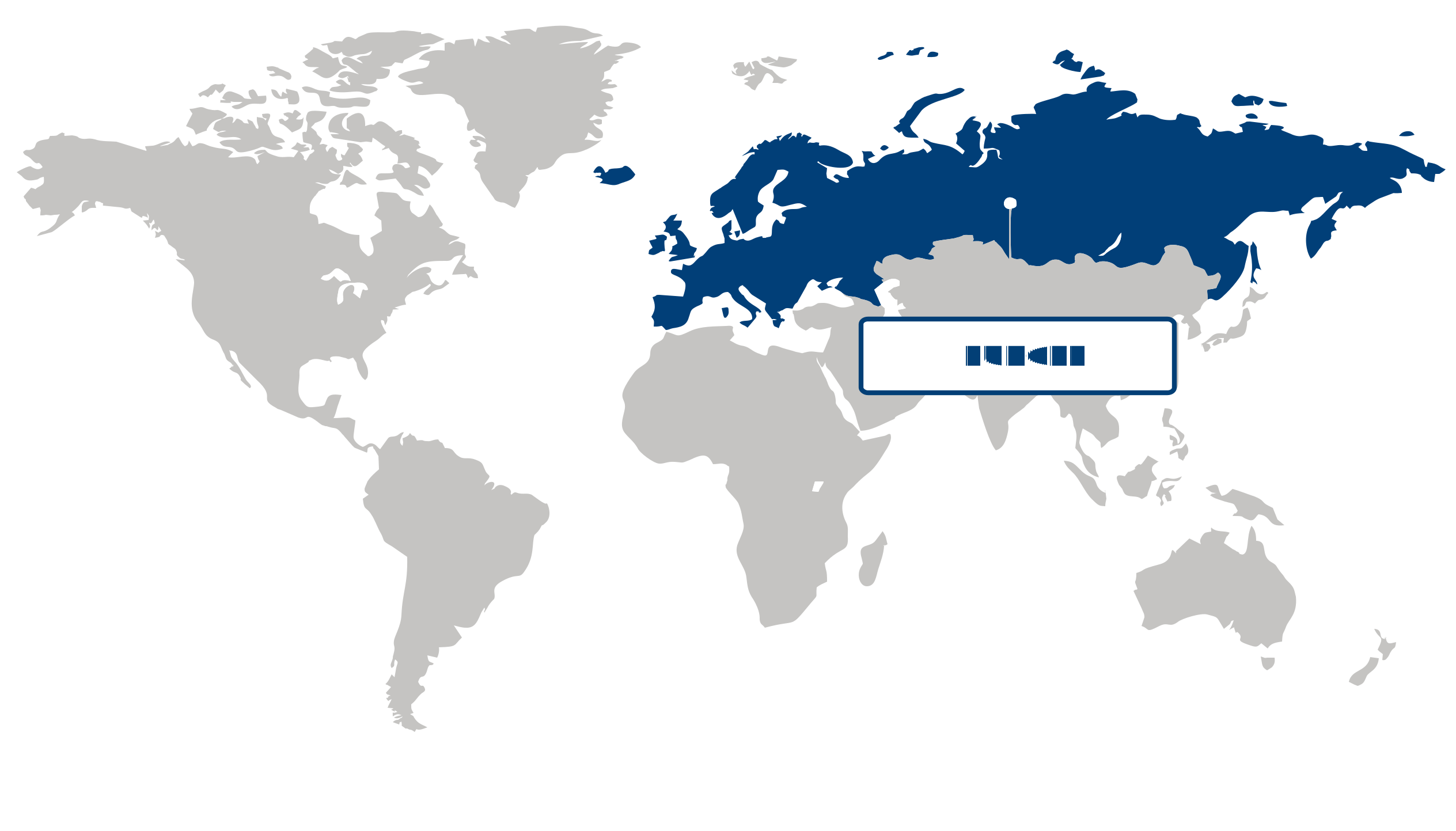
Europe (Largest Region)
Canned fruits market was led by Europe, which accounted for a 47.28% share in 2026, reflecting strong consumer acceptance of preserved fruit products and the region's established food processing and retail infrastructure. Demand is supported by the convenience offered by canned fruits, their extended shelf life, and their suitability for household consumption as well as foodservice applications. Well-developed distribution networks and established consumption patterns across European markets further support regional demand, while growing interest in convenient food options continues to sustain the position of canned fruits within the broader packaged food sector.
North America (Fastest-Growing Region)
North America is anticipated to experience the fastest growth, supported by increasing consumer demand for convenient and shelf-stable food products. Busy lifestyles and the preference for products that can be stored and consumed with minimal preparation are encouraging the use of canned fruits among households and foodservice operators. Expanding retail availability and continued innovation in fruit varieties, packaging formats, and product positioning are also contributing to market development. Growing consumer interest in practical food solutions that combine convenience with nutritional value is expected to provide further momentum to regional demand.
| Parameter | North America | Asia Pacific | Europe | Latin America | MEA |
|---|---|---|---|---|---|
| Innovation HubiScaleNascentDeveloping Advanced | |||||
| Cost-Sensitive RegioniScaleLowMedium High | |||||
| Regulatory EnvironmentiScaleRestrictiveNeutral Supportive | |||||
| Demand DriversiScaleWeakModerate Strong | |||||
| Development StageiScaleEmergingDeveloping Developed | |||||
| Adoption RateiScaleLowMedium High | |||||
| New Entrants / StartupsiScaleSparseModerate Dense | |||||
| Macro IndicatorsiScaleWeakStable Strong |
Key Country Insights
United States 🇺🇸
Retail Innovation HubThe U.S. canned fruits market emphasizes convenient packaging, clean-label ingredients, and premium fruit varieties. Retailers and foodservice operators in the U.S. continue expanding value-added offerings that align with demand for longer shelf life and healthier pantry staples.
Germany 🇩🇪
Quality Preservation FocusGermany prioritizes high-quality fruit preservation, recyclable packaging, and consistent product standards in the canned fruits market. Manufacturers increasingly align with consumer expectations for responsibly sourced ingredients and transparent labeling across retail channels.
Japan 🇯🇵
Convenience ConsumptionJapan supports canned fruits through demand for portion-controlled packaging and premium fruit selections suited to convenience retail. Japanese producers also focus on maintaining flavor, texture, and product consistency for urban consumers seeking ready-to-eat options.
South Korea 🇰🇷
Premium Retail ExpansionSouth Korea's canned fruits market is shaped by premium imports, attractive packaging, and demand for convenient dessert ingredients. Local distributors are expanding product assortments that appeal to younger consumers and modern grocery formats across South Korea.
France 🇫🇷
Gourmet Ingredient SupplyFrance emphasizes premium fruit quality and culinary applications within the canned fruits market. French buyers increasingly value products that balance convenience with natural ingredients, supporting demand from both retail and foodservice sectors.
Italy 🇮🇹
Culinary Processing DemandItaly utilizes canned fruits across bakery, confectionery, and household consumption, encouraging suppliers to maintain consistent fruit quality and packaging reliability. Italian manufacturers also respond to consumer interest in minimally processed fruit products with recognizable ingredients.
Canned Fruits Market Share (%), by Packaging Type, 2026
Go beyond the chart, access full insights & data tables
Request Free Sample ReportPackaging Type Segment Analysis: Cans (metal) (Largest Segment) vs Pouches (Fastest-Growing Segment)
Metal cans dominated the canned fruits market, accounting for a 50.99% share in 2026. Their leading position is supported by excellent product protection, extended shelf life, and strong resistance to physical damage during storage and transportation. Metal cans also preserve product quality and flavor effectively while meeting the packaging requirements of large-scale retail and foodservice distribution. Their established manufacturing infrastructure and widespread consumer familiarity continue to reinforce their importance within the canned fruits industry.
The pouch packaging segment is witnessing the fastest growth as consumers increasingly seek lightweight, convenient, and portable packaging formats. Pouches offer greater flexibility, reduced material usage, and ease of handling, making them attractive for on-the-go consumption and smaller household purchases. Advancements in flexible packaging technology are also improving barrier properties and product preservation, encouraging manufacturers to expand pouch-based product offerings to address evolving consumer preferences.
Distribution Channel Segment Analysis: Supermarkets/hypermarkets (Largest Segment) vs Online Retail (Fastest-Growing Segment)
Supermarkets and hypermarkets accounted for a 41.15% share in 2026, making them the largest distribution channel for canned fruits. These retail outlets provide consumers with extensive product assortments, competitive pricing, and the convenience of comparing multiple brands in one location. Strong promotional activities, established supply chains, and consistent product availability continue to support high sales volumes through these stores, maintaining their leadership within the market.
In the canned fruits market, the online retail segment is emerging as the fastest-growing distribution channel. Rising consumer preference for digital shopping, home delivery services, and easy access to a broad range of products is accelerating online purchases of packaged foods. Enhanced e-commerce platforms, subscription services, and personalized promotions are further improving customer convenience, encouraging manufacturers and retailers to strengthen their digital presence and expand online product availability.
Product Type Segment Analysis: Canned Peaches (Largest Segment) vs Canned Mixed Fruits (Fastest-Growing Segment)
Canned peaches secured the largest market share of 24.95% in 2026 due to their broad consumer acceptance, versatile culinary applications, and consistent availability throughout the year. They are widely used in desserts, bakery products, breakfast items, and ready-to-eat recipes, making them a staple product across both household and foodservice sectors. Their balanced flavor profile and long shelf life continue to support sustained demand, reinforcing their leadership among canned fruit products.
The canned mixed fruits segment is expected to experience the fastest growth as consumers increasingly favor products that offer greater variety and convenience in a single package. Mixed fruit combinations appeal to health-conscious buyers seeking diverse flavors and balanced fruit selections without additional preparation. Growing demand for convenient meal components, snack options, and versatile ingredients is encouraging manufacturers to introduce innovative mixed fruit assortments, supporting the continued expansion of this product category.
| Segment | Sub-Segment | Largest Segment | Fastest Growing |
|---|---|---|---|
| Packaging Type | Cans (metal), Glass Jars, Pouches, Others | Cans (metal) | Pouches |
| Distribution Channel | Supermarkets/hypermarkets, Convenience Stores, Online Retail, Specialty Stores, Others | Supermarkets/hypermarkets | Online Retail |
| Product Type | Canned Peaches, Canned Pineapples, Canned Pears, Canned Cherries, Canned Mixed Fruits, Others | Canned Peaches | Canned Mixed Fruits |
Competitive Landscape and Market Positioning
Major players in the canned fruits market:
- Del Monte Foods, Inc. (United States)
- Dole plc (Ireland)
- The Kraft Heinz Company (United States)
- Conserve Italia Soc. Coop. Agricola (Italy)
- Seneca Foods Corporation (United States)
- Princes Group (United Kingdom)
- Rhodes Food Group (South Africa)
- Goya Foods, Inc. (United States)
- Bonduelle S.A. (France)
- Ardo Group (Belgium)
Changing consumer preferences and evolving food quality expectations are influencing how companies compete within the canned fruits market. Producers are increasingly moving beyond traditional preservation methods by emphasizing product variety, ingredient transparency, and improved processing approaches that align with modern dietary preferences. Competition is shifting toward the ability to maintain consistent supply while adapting offerings to regional tastes and premium positioning opportunities. Suppliers that can balance cost efficiency with quality improvements, responsible sourcing practices, and flexible product development are strengthening their relationships with retailers and consumers.
| Company | Market Share | Company Revenue | Revenue CAGR (%) | Product Portfolio | Geographic Presence | Innovation / R&D Focus | Strategic Developments |
|---|---|---|---|---|---|---|---|
| Del Monte Foods Inc. (United States) | |||||||
| Dole plc (Ireland) | |||||||
| The Kraft Heinz Company (United States) | |||||||
| Conserve Italia Soc. Coop. Agricola (Italy) | |||||||
| Seneca Foods Corporation (United States) | |||||||
| Princes Group (United Kingdom) | |||||||
| Rhodes Food Group (South Africa) | |||||||
| Goya Foods Inc. (United States) | |||||||
| Bonduelle S.A. (France) | |||||||
| Ardo Group (Belgium) |
Customize Your Report
Explore examples of how this report can be tailored to different research needs, including custom segments, additional topics or chapters, and related reports. Click a section of the wheel or its numbered marker to explore the available options.
Canned Fruits Market — Custom Segments
| Segment | Sub-Segment |
|---|---|
| Fruit Form | Whole Fruits, Halves & Quarters, Sliced & Diced Fruits, Mixed Fruit Preparations |
| Brand Positioning | Branded Products, Private Label Products |
| Production Standard | Conventional Products, Organic Products |
Canned Fruits Market — Custom TOC
| Custom Chapter | Chapter Details |
|---|---|
| Premiumization & Product Innovation Strategy |
|
| Fruit Sourcing & Supply Resilience |
|
| Private Label Growth Opportunities |
|
Need a different cut of the data?
Request Custom ResearchFrequently Asked Questions
What is the market valuation of canned fruits?
How is the canned fruits industry size expected to evolve during the forecast period?
What consumer trends are driving sustained demand for canned fruits?
How are commercial foodservice operations supporting growth in the canned fruits market?
Why do metal cans remain the leading packaging choice in the canned fruits market?
Which distribution channel is expanding the fastest in the canned fruits market?
What makes Europe the leading region for canned fruits?
Why is North America expected to see the fastest growth in canned fruits?
Which companies dominate the canned fruits landscape?
Our Clients
"The report provided a thorough look at market trends, technological advancements, and the competitive landscape. The depth of insights was really valuable."
ITC Limited
"We would highly recommend Fundamental Business Insights & Consulting to anyone looking for reliable, detailed, and comprehensive market research in the Food industry."
Tyson Foods
"The clarity and presentation of the information were commendable. The report was delivered timely, which made the overall experience smooth and convenient."
Mondelēz International
Our Research Team & Methodology
Every Fundamental Business Insights report is built by a dedicated vertical research team, validated through a structured primary-and-secondary methodology, and reviewed for accuracy before it reaches you.
Delivery
Published
Available
Support
- Market Size & Forecast
- Market Segmentation
- Regional Analysis
- Growth Drivers & Challenges
- Market Dynamics
- Competitive Landscape
- Company Profiles
- Competitive Benchmarking
- Mergers & Acquisitions
- Market Share Analysis or Key Company Strategies
- Value Chain Analysis
- Porter's Five Forces
- PESTLE Analysis
- Pricing Trends
- Supply-Demand Analysis
- Technology Landscape
- Regulatory Landscape
- Investment & Funding Landscape
- Emerging Opportunities
- Future Market Outlook