Canned Mushroom Market Size & Growth Forecast 2027–2036, By Segments (Product, Nature, Application, Form, Distribution Channel), Regional Demand Trends (North America, Asia Pacific, Europe), Key Country Insights (U.S., Japan, South Korea, Germany, France, Italy), and Competitive Landscape
Jump to content
Market Size and Growth Outlook
Canned Mushroom Market size was over USD 10.5 billion in 2026 and is likely to grow at a 3.33% CAGR between 2027 and 2036, attaining USD 14.57 billion by 2036. The industry revenue for 2027 is assessed at USD 10.79 billion.
Get more details on this report
Request Free Sample ReportCanned Mushroom Market Intelligence Snapshot
Regional Market Dynamics
- Europe led the canned mushroom market in 2026, supported by established consumption habits, extensive retail distribution, and mature packaging and processing networks that sustain consistent household and foodservice demand.
- Asia Pacific is projected to grow at a 6.67% CAGR, fueled by rising urban consumption, expanding organized retail, and increasing use of canned mushrooms in ready meals, snacks, and foodservice.
Segment Momentum
- Button Mushrooms held a 60.06% share in 2026 due to their broad consumer familiarity, versatile use across retail and foodservice, and well-established processing and distribution networks that support consistent demand.
- Organic canned mushrooms are growing fastest as consumers increasingly value ingredient sourcing and production practices, extending premium organic purchasing preferences into shelf-stable pantry products.
Market Expansion Drivers
- Growing demand for convenient and long shelf-life food products among urban working populations.
- Increasing health awareness driving inclusion of nutrient-rich mushrooms in daily diets globally.
- Expansion of foodservice and hospitality sectors increasing bulk demand for preserved mushroom ingredients.
Leading Market Participants
- Prominent companies in the canned mushroom market include Bonduelle Group (France), B&G Foods, Inc. (United States), Monterey Mushrooms, Inc. (United States), Okechamp S.A. (Poland), Costa Group Holdings Limited (Australia), Giorgio Fresh Co. (United States), Prochamp B.V. (Netherlands), The Mushroom Company (United States), Bonduelle Fresh Americas (United States), Greenyard NV (Belgium).
Global Market Forecast Snapshot
Market Outlook
- 2026 Market Size: USD 10.5 billion
- 2027 Estimated Market Size: USD 10.79 billion.
- Projected Market Size: USD 14.57 billion by 2036
- Growth Forecast: 3.33% CAGR (2027-2036)
Regional and Segment Outlook
- Leading Regional Market: Europe
- High-Growth Regional Hub: Asia Pacific
- Core Revenue Segment: Button Mushroom (Product) | Conventional (Nature) | Household (Application) | Sliced (Form) | Supermarkets/Hypermarkets (Distribution Channel)
- Emerging Opportunity Segment: Shiitake Mushroom (Product) | Organic (Nature) | Restaurants (Application) | Sliced (Form) | Online (Distribution Channel)
Market Growth Drivers and Industry Trends
Growing demand for convenient and long shelf-life food products among urban working populations
Busy lifestyles and increasing urbanization are encouraging consumers to favor foods that require minimal preparation and can be stored for extended periods, supporting the canned mushroom market. Canned mushrooms offer convenience because they are ready to use and can be incorporated into meals without extensive cleaning or preparation. Their extended shelf life also reduces the pressure for immediate consumption compared with fresh alternatives, making them practical for households with limited time for frequent grocery shopping. This convenience aligns with changing meal preparation habits among working consumers and supports their use across a wide range of everyday dishes.
Increasing health awareness driving inclusion of nutrient-rich mushrooms in daily diets globally
Greater consumer attention to nutritious food choices is contributing to the canned mushroom market as mushrooms become increasingly recognized as a versatile source of beneficial dietary components. Mushrooms can be incorporated into meals while providing nutrients and adding flavor and texture without requiring substantial preparation. Canning also allows mushrooms to remain accessible for consumers who prefer convenient formats while incorporating mushroom-based foods into regular diets. Broader interest in balanced eating and plant-based food options is encouraging their use in home cooking, prepared meals, salads, soups, sauces, and other dietary applications.
Expansion of foodservice and hospitality sectors increasing bulk demand for preserved mushroom ingredients
The expansion of restaurants, hotels, catering operations, and other foodservice establishments is increasing demand for ingredients that can be stored and used consistently, supporting the canned mushroom market. Preserved mushrooms offer foodservice operators convenience, predictable availability, and simplified preparation across high-volume kitchens. Their compatibility with pizzas, pasta, sauces, soups, prepared meals, and other menu categories also provides broad application flexibility. Canned formats can help commercial kitchens maintain ingredient supplies without relying exclusively on short shelf-life fresh produce, particularly where consistent preparation and inventory management are important.
| Growth Driver | Impact on CAGR | Regulatory Influence | Geographic Relevance | Adoption Rate | Impact Timeline |
|---|---|---|---|---|---|
| Growing demand for convenient and long shelf-life food products among urban working populations | 2.00% | Low | Asia Pacific, Europe | High | Near Term |
| Increasing health awareness driving inclusion of nutrient-rich mushrooms in daily diets globally | 1.70% | Low | North America, Europe, Asia Pacific | High | Near Term |
| Expansion of foodservice and hospitality sectors increasing bulk demand for preserved mushroom ingredients | 1.50% | Low | Asia Pacific, Latin America | High | Mid Term |
Unlock insights tailored to your business with our bespoke market research solutions.
Click to get your customized report now.
Regional Demand Dynamics
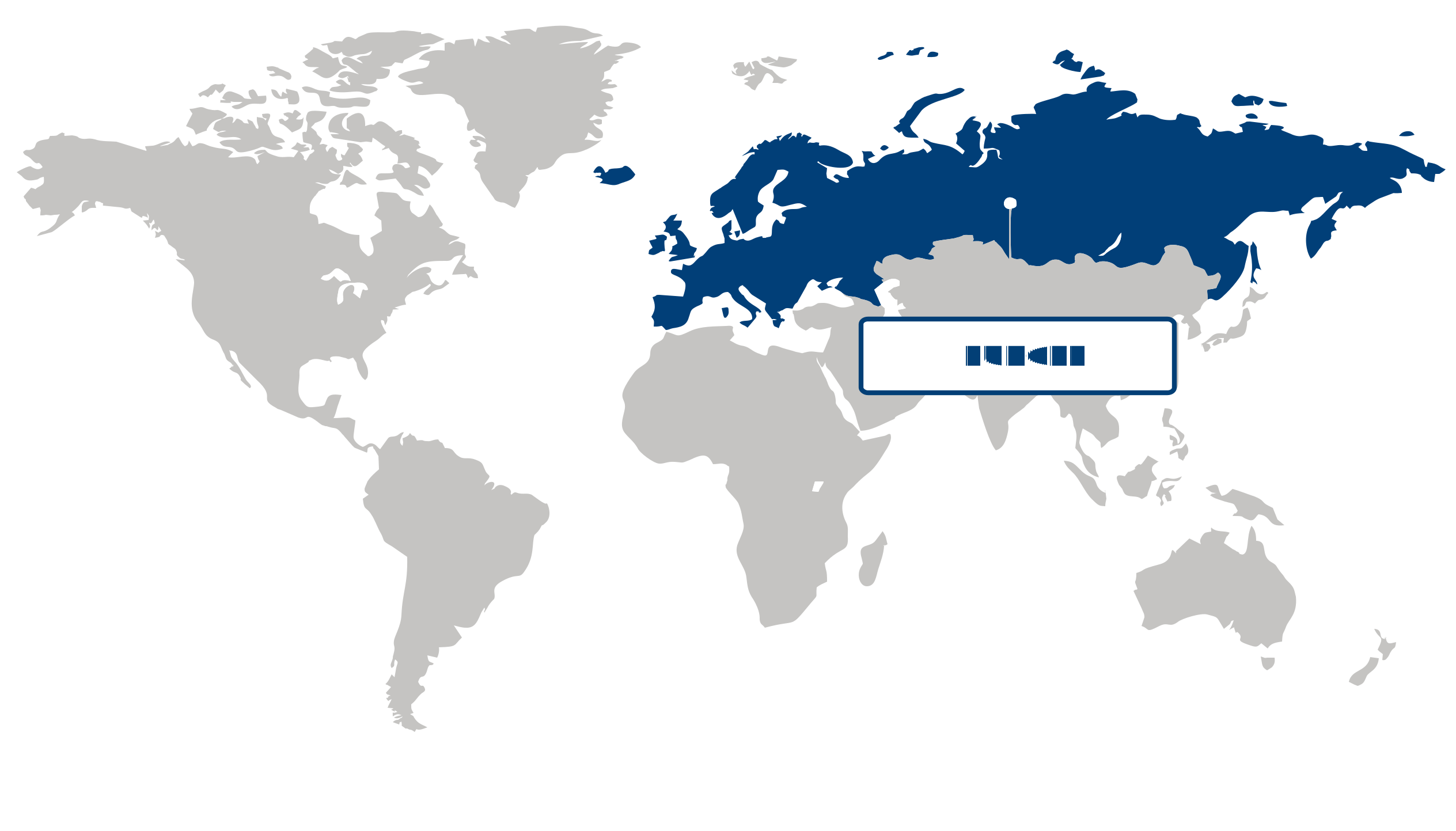
Europe (Largest Region)
Europe held the largest share of the canned mushroom market in 2026, supported by established consumption of preserved foods, strong demand for convenient meal ingredients, and mature food processing and distribution networks. Canned mushrooms offer extended shelf stability and ease of preparation, making them suitable for households, restaurants, and processed food manufacturers. Consumers are increasingly seeking convenient ingredients that can be incorporated into a variety of meals, while demand for plant-based foods is creating additional opportunities for mushrooms as versatile meat alternatives and complementary ingredients. Strong retail infrastructure and continued product innovation around flavors, packaging, and preparation formats further support regional demand.
Asia Pacific (Fastest-Growing Region)
Asia Pacific is expected to be the fastest-growing regional market, driven by expanding urban populations, changing lifestyles, and increasing demand for convenient packaged foods. Growth in modern retail and foodservice is improving access to preserved mushroom products, while rising consumer interest in plant-based and nutritious ingredients is broadening their applications. Food manufacturers are also incorporating mushrooms into ready-to-eat and ready-to-cook products to meet evolving preferences for convenience. Increasing household purchasing power and expanding food-processing capabilities across emerging economies are expected to support broader adoption of canned mushrooms throughout the region.
| Parameter | North America | Asia Pacific | Europe | Latin America | MEA |
|---|---|---|---|---|---|
| Innovation HubiScaleNascentDeveloping Advanced | |||||
| Cost-Sensitive RegioniScaleLowMedium High | |||||
| Regulatory EnvironmentiScaleRestrictiveNeutral Supportive | |||||
| Demand DriversiScaleWeakModerate Strong | |||||
| Development StageiScaleEmergingDeveloping Developed | |||||
| Adoption RateiScaleLowMedium High | |||||
| New Entrants / StartupsiScaleSparseModerate Dense | |||||
| Macro IndicatorsiScaleWeakStable Strong |
Key Country Insights
Germany 🇩🇪
Processed Food QualityGermany’s canned mushroom market is shaped by consumer preference for reliable packaged foods and quality ingredients. Suppliers are emphasizing sustainable sourcing, clean processing methods, and products suited for both retail and foodservice applications.
France 🇫🇷
Gourmet Food ApplicationsFrance’s canned mushroom market is supported by interest in premium ingredients and culinary convenience. Brands are emphasizing texture, flavor retention, and applications that align with gourmet cooking, restaurant preparation, and specialty food offerings.
Italy 🇮🇹
Mediterranean Cuisine SupportItaly’s canned mushroom market is connected to strong demand for versatile ingredients in traditional and modern cuisine. Producers are focusing on quality preservation and products suited for pasta, sauces, pizzas, and ready-to-cook meal segments.
Japan 🇯🇵
Culinary Ingredient VersatilityJapan’s canned mushroom market benefits from established use of mushrooms in diverse cuisines and prepared foods. Companies are developing convenient formats that support traditional recipes, meal preparation efficiency, and value-added food applications.
South Korea 🇰🇷
Ready Meal IntegrationSouth Korea’s canned mushroom market is influenced by demand for convenient cooking ingredients and expanding prepared food consumption. Manufacturers are focusing on versatile products suitable for home meals, restaurant use, and processed food formulations.
United States 🇺🇸
Convenient Food ConsumptionThe U.S. canned mushroom market is driven by demand for convenient ingredients across households, restaurants, and food manufacturers. Producers are focusing on product variety, consistent quality, and applications in ready meals, soups, sauces, and prepared foods.
Canned Mushroom Market Share (%), by Product, 2026
Go beyond the chart, access full insights & data tables
Request Free Sample ReportProduct Segment Analysis: Button Mushroom (Largest Segment) vs Shiitake Mushroom (Fastest-Growing Segment)
Button mushroom dominated the canned mushroom market in 2026, accounting for 60.06% share, supported by its widespread consumer familiarity, versatile culinary applications, and established presence in processed food products. Its mild flavor and adaptable texture make it suitable for pizzas, sauces, soups, ready meals, and other prepared foods, supporting consistent demand from both households and foodservice users. Established cultivation and processing practices also contribute to reliable availability and make button mushrooms a practical choice for canning and large-scale distribution.
Shiitake mushroom is gaining traction as consumers increasingly seek distinctive flavors and more premium mushroom varieties in convenient packaged formats. Its characteristic taste and perceived nutritional value support applications across asian-inspired foods, prepared meals, and specialty culinary products. Growing interest in diverse mushroom varieties and greater consumer experimentation with plant-based ingredients are creating additional opportunities for canned shiitake products.
Nature Segment Analysis: Conventional (Largest Segment) vs Organic (Fastest-Growing Segment)
The conventional segment held the largest share of the canned mushroom market in 2026, reflecting its broad availability, established processing infrastructure, and accessibility across mainstream food channels. Conventional mushrooms can be produced and processed at scale, supporting consistent supply for canned food manufacturers and enabling competitively positioned products for mass-market consumers. Their familiarity and integration into established distribution networks continue to reinforce their leading position.
Organic canned mushrooms are expanding as consumers place greater emphasis on ingredient sourcing, natural production practices, and cleaner food choices. Organic certification can provide additional product differentiation for consumers seeking foods aligned with sustainability and health-conscious purchasing preferences. Increasing interest in organic packaged foods is encouraging producers to broaden their canned mushroom offerings with products that appeal to these evolving consumer priorities.
| Segment | Sub-Segment | Largest Segment | Fastest Growing |
|---|---|---|---|
| Product | Button Mushroom, Shiitake Mushroom, Oyster Mushroom, Morel Mushroom, Others | Button Mushroom | Shiitake Mushroom |
| Nature | Organic, Conventional | Conventional | Organic |
| Application | Household, Restaurants | Household | Restaurants |
| Form | Whole, Sliced, Chopped, Others | Sliced | Sliced |
| Distribution Channel | Supermarkets/Hypermarkets, Departmental Store, Convenience Store, Online, Others | Supermarkets/Hypermarkets | Online |
Competitive Landscape and Market Positioning
Prominent players in the canned mushroom market:
1. Bonduelle Group (France)
2. B&G Foods Inc. (United States)
3. Monterey Mushrooms Inc. (United States)
4. Okechamp S.A. (Poland)
5. Costa Group Holdings Limited (Australia)
6. Giorgio Fresh Co. (United States)
7. Prochamp B.V. (Netherlands)
8. The Mushroom Company (United States)
9. Bonduelle Fresh Americas (United States)
10. Greenyard NV (Belgium)
The canned mushroom market is influenced by rising demand for convenient and shelf-stable food ingredients. Product innovation is focusing on flavor variety and improved preservation methods. Supply chain enhancements are also contributing to better availability and consistent product quality.
| Company | Market Share | Company Revenue | Revenue CAGR (%) | Product Portfolio | Geographic Presence | Innovation / R&D Focus | Strategic Developments |
|---|---|---|---|---|---|---|---|
| Bonduelle Group (France) | |||||||
| B&G Foods Inc. (United States) | |||||||
| Monterey Mushrooms Inc. (United States) | |||||||
| Okechamp S.A. (Poland) | |||||||
| Costa Group Holdings Limited (Australia) | |||||||
| Giorgio Fresh Co. (United States) | |||||||
| Prochamp B.V. (Netherlands) | |||||||
| The Mushroom Company (United States) | |||||||
| Bonduelle Fresh Americas (United States) | |||||||
| Greenyard NV (Belgium). |
Industry Development / News
| Company Name | Date | Key Development |
|---|---|---|
| Versilfood | Apr-26 | Versilfood initiated a major expansion of its Camaiore production facility in Italy, installing four fully automated production lines and an advanced processing unit. The upgrade is designed to significantly strengthen industrial capacity and operational efficiency, while improving supply chain control and supporting higher-quality processing and packaging standards across mushroom, fruit, and vegetable product lines. |
| Giorgi Mushroom Co. | Jul-25 | Giorgi Mushroom Co. acquired a majority stake in L.F. Lambert Spawn Co., strengthening its upstream spawn production capabilities. The acquisition enhances supply chain integration and agricultural input control, supporting greater operational stability and reinforcing the company’s ability to secure consistent raw material supply for mushroom production. |
| Urban Farm-It | Jul-25 | Urban Farm-It partnered with Oakland International to enhance UK-wide distribution of gourmet mushrooms. The collaboration strengthens logistics and supply chain infrastructure, enabling broader retail and foodservice penetration and supporting expansion of specialty mushroom offerings, including lion’s mane and other locally sourced varieties across the United Kingdom. |
Customize Your Report
Explore examples of how this report can be tailored to different research needs, including custom segments, additional topics or chapters, and related reports. Click a section of the wheel or its numbered marker to explore the available options.
Canned Mushroom Market — Custom Segments
| Segment | Sub-Segment |
|---|---|
| Packaging Type | Metal Cans, Glass Jars, Pouches, Other Flexible Packaging |
| Price Tier | Economy, Mid-Range, Premium |
| Cuisine & Recipe Application | Asian Cuisine, European Cuisine, North American Cuisine, Other International Cuisines |
Canned Mushroom Market — Custom TOC
| Custom Chapter | Chapter Details |
|---|---|
| Consumer Demand Evolution Analysis |
|
| Product Innovation Opportunity Assessment |
|
| Global Supply Network Optimization |
|
Need a different cut of the data?
Request Custom ResearchFrequently Asked Questions
How much revenue does the canned mushroom market generate?
How is the canned mushroom industry size expected to evolve during the forecast period?
How are convenience-driven consumption patterns reshaping demand in the canned mushroom market?
Why is foodservice demand becoming strategically important for the canned mushroom market?
Why do Button Mushrooms lead the canned mushroom market?
Why is Organic the fastest-growing nature segment in the canned mushroom market?
Why is Europe the leading region in the canned mushroom market?
What is driving growth in the canned mushroom market across Asia Pacific?
What are the prominent companies operating in the canned mushroom landscape?
Our Clients
"The report provided a thorough look at market trends, technological advancements, and the competitive landscape. The depth of insights was really valuable."
ITC Limited
"We would highly recommend Fundamental Business Insights & Consulting to anyone looking for reliable, detailed, and comprehensive market research in the Food industry."
Tyson Foods
"The clarity and presentation of the information were commendable. The report was delivered timely, which made the overall experience smooth and convenient."
Mondelēz International
Our Research Team & Methodology
Every Fundamental Business Insights report is built by a dedicated vertical research team, validated through a structured primary-and-secondary methodology, and reviewed for accuracy before it reaches you.
Delivery
Published
Available
Support
- Market Size & Forecast
- Market Segmentation
- Regional Analysis
- Growth Drivers & Challenges
- Market Dynamics
- Competitive Landscape
- Company Profiles
- Competitive Benchmarking
- Mergers & Acquisitions
- Market Share Analysis or Key Company Strategies
- Value Chain Analysis
- Porter's Five Forces
- PESTLE Analysis
- Pricing Trends
- Supply-Demand Analysis
- Technology Landscape
- Regulatory Landscape
- Investment & Funding Landscape
- Emerging Opportunities
- Future Market Outlook