Catamaran Market Size & Growth Forecast 2027–2036, By Segments (Product, Size, Application), Regional Demand Trends (North America, Asia Pacific, Europe), Key Country Insights (U.S., Japan, South Korea, Germany, France, Italy), and Competitive Landscape
Jump to content
Market Size and Growth Outlook
Catamaran Market size was assessed at USD 1.72 billion in 2026 and is poised to grow at a 5.51% CAGR between 2027 and 2036, reaching USD 2.94 billion by 2036. The industry revenue for 2027 is calculated at USD 1.8 billion.
Get more details on this report
Request Free Sample ReportCatamaran Market Intelligence Snapshot
Regional Market Dynamics
- Europe accounted for a 38.69% share in 2026, supported by established marina infrastructure, strong charter operations, specialized yacht builders, and mature recreational boating activity.
- Asia Pacific is projected to grow at a 6.67% CAGR as marine tourism, boating infrastructure, charter activity, and hospitality-driven demand increase adoption of multihull vessels.
Segment Momentum
- Sailing Catamarans held a 56.92% share in 2026 due to strong demand in cruising and charter use cases where fuel efficiency, stability, and onboard comfort drive preference.
- Power Catamarans are the fastest-growing segment as buyers increasingly prioritize speed, convenience, and predictable motor-driven performance over wind-dependent sailing dynamics.
Market Expansion Drivers
- Rising marine tourism and luxury travel demand driving recreational catamaran adoption.
- Increasing disposable income and leisure boating participation expanding consumer base.
- Advancements in fuel efficiency and smart navigation systems improving vessel appeal.
Leading Market Participants
- Major companies in the catamaran market include Groupe Beneteau (France), Fountaine Pajot S.A. (France), Leopard Catamarans (South Africa), Nautitech Catamarans (France), Outremer Yachting (France), Seawind Catamarans Pty Ltd (Australia), Voyage Yachts (South Africa), Bavaria Yachtbau GmbH (Germany), Catathai Co., Ltd. (Thailand), African Cats BV (Netherlands).
Global Market Forecast Snapshot
Market Outlook
- 2026 Market Size: USD 1.72 billion
- 2027 Estimated Market Size: USD 1.8 billion.
- Projected Market Size: USD 2.94 billion by 2036
- Growth Forecast: 5.51% CAGR (2027-2036)
Regional and Segment Outlook
- Leading Regional Market: Europe
- High-Growth Regional Hub: Asia Pacific
- Core Revenue Segment: Sailing Catamarans (Product) | Medium (Size) | Leisure (Application)
- Emerging Opportunity Segment: Power Catamarans (Product) | Small (Size) | Sport (Application)
Market Growth Drivers and Industry Trends
Rising marine tourism and luxury travel demand driving recreational catamaran adoption
Growing marine tourism and luxury travel demand will drive the catamaran market growth by increasing interest in spacious, comfortable, and versatile vessels for leisure activities. Catamarans offer greater stability, generous deck space, and accommodation advantages compared with many conventional recreational boats, making them attractive for island cruises, private charters, coastal exploration, and premium holiday experiences. The expansion of marine tourism destinations and the preference for experiential travel are encouraging tourism operators and private buyers to consider multihull vessels for recreational use. Luxury travelers are also showing greater interest in personalized boating experiences, including private excursions and extended coastal trips, which supports demand for vessels that combine onboard comfort with efficient cruising capabilities.
Increasing disposable income and leisure boating participation expanding consumer base
Higher disposable income and greater participation in leisure boating are broadening the pool of consumers able to consider recreational vessels, supporting growth in the catamaran market. As household spending capacity improves, consumers in established and emerging boating markets can allocate more resources toward premium leisure activities, including yacht ownership, chartering, and coastal recreation. Catamarans are particularly suited to social and family-oriented boating because their wide layouts provide additional living, entertainment, and outdoor spaces. Growth in boating clubs, marina infrastructure, charter experiences, and recreational marine activities can further introduce new consumers to catamaran ownership and rental, while rising interest in outdoor leisure encourages spending on marine-based experiences and equipment.
Advancements in fuel efficiency and smart navigation systems improving vessel appeal
Technological improvements in propulsion efficiency and onboard electronics are strengthening the appeal of modern vessels, which will boost the catamaran market demand among buyers seeking greater convenience and operating efficiency. Developments in hull design, propulsion systems, energy management, and lightweight construction can help improve fuel utilization while supporting smoother cruising performance. At the same time, smart navigation technologies are adding automated route planning, digital monitoring, advanced positioning, and integrated vessel-control functions that make recreational boating easier to manage. These capabilities can reduce the complexity associated with operating larger vessels and provide owners with greater visibility into navigation and onboard systems, increasing the attractiveness of technologically advanced catamarans for both experienced boaters and newer users.
| Growth Driver | Impact on CAGR | Regulatory Influence | Geographic Relevance | Adoption Rate | Impact Timeline |
|---|---|---|---|---|---|
| Rising marine tourism and luxury travel demand driving recreational catamaran adoption | 2.00% | Low | Europe, Asia Pacific | Medium | Mid Term |
| Increasing disposable income and leisure boating participation expanding consumer base | 1.80% | Low | North America, Europe | Medium | Mid Term |
| Advancements in fuel efficiency and smart navigation systems improving vessel appeal | 1.20% | Low | Europe, Asia Pacific | Emerging | Long Term |
Unlock insights tailored to your business with our bespoke market research solutions.
Click to get your customized report now.
Regional Demand Dynamics
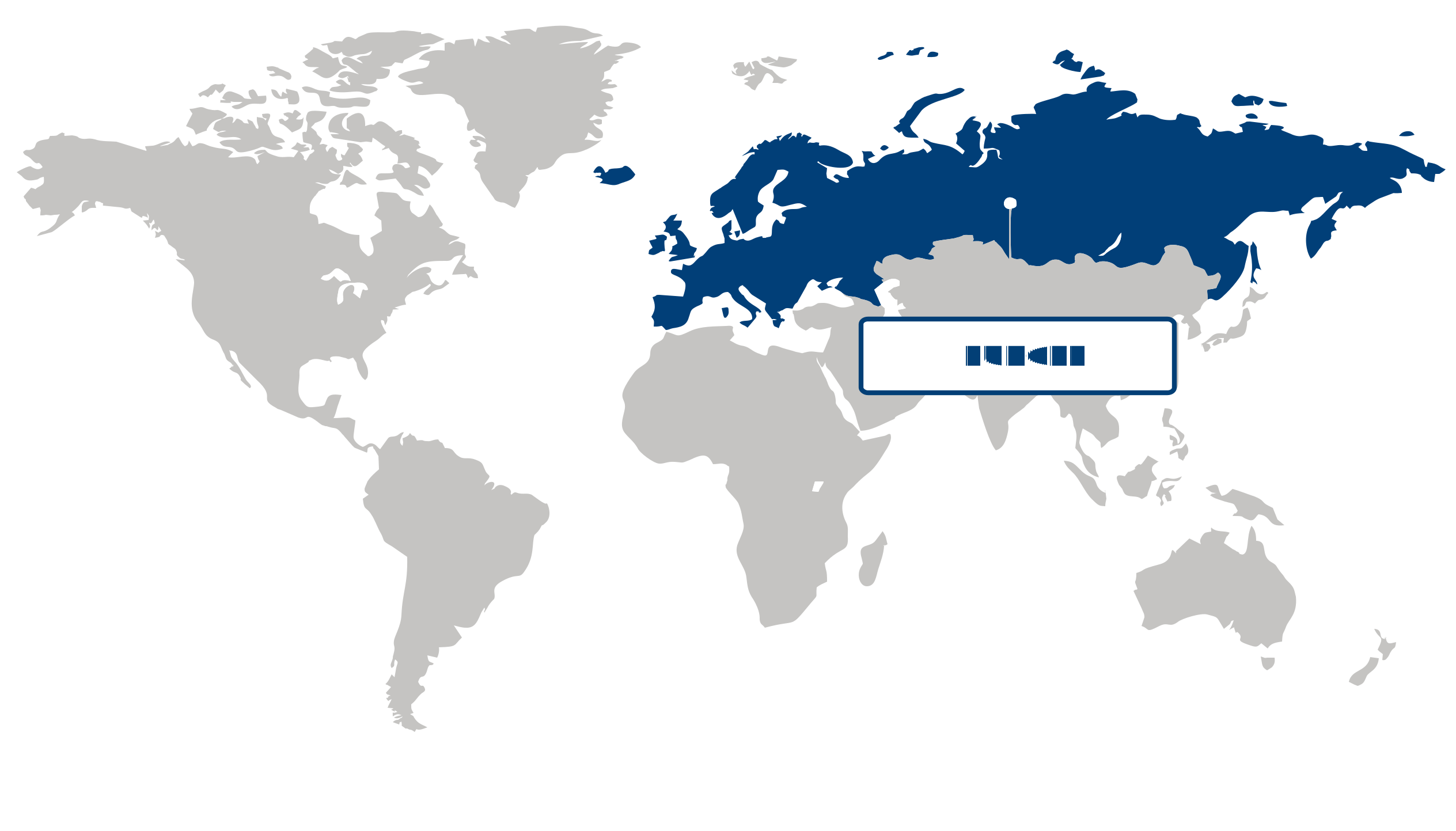
Europe (Largest Region)
The catamaran market in Europe held the largest share of 38.69% in 2026, supported by the region's established maritime leisure industry, strong boating culture, and extensive coastal tourism infrastructure. Demand is reinforced by interest in recreational sailing, luxury marine experiences, and vessels that combine spacious layouts with stability and efficient cruising characteristics. Well-developed marinas, yacht services, marine tourism networks, and consumer familiarity with recreational watercraft provide a strong foundation for continued regional market development.
Asia Pacific (Fastest-Growing Region)
Asia Pacific represents the fastest-growing regional market, driven by expanding marine tourism, rising interest in recreational boating, and the development of coastal leisure infrastructure. Increasing consumer participation in water-based activities is creating opportunities for catamarans across tourism, charter, and private recreational applications. Investments in marinas and coastal tourism destinations, together with growing demand for premium leisure experiences, are supporting broader adoption of multi-hull vessels throughout the region.
| Parameter | North America | Asia Pacific | Europe | Latin America | MEA |
|---|---|---|---|---|---|
| Innovation HubiScaleNascentDeveloping Advanced | |||||
| Cost-Sensitive RegioniScaleLowMedium High | |||||
| Regulatory EnvironmentiScaleRestrictiveNeutral Supportive | |||||
| Demand DriversiScaleWeakModerate Strong | |||||
| Development StageiScaleEmergingDeveloping Developed | |||||
| Adoption RateiScaleLowMedium High | |||||
| New Entrants / StartupsiScaleSparseModerate Dense | |||||
| Macro IndicatorsiScaleWeakStable Strong |
Key Country Insights
Germany 🇩🇪
Engineering Precision YachtingGermany’s catamaran market reflects strong focus on engineering quality and performance-oriented marine design. Demand is supported by sailing enthusiasts and charter operators seeking durable, efficient vessels with advanced navigation and build standards.
France 🇫🇷
Mediterranean Charter DemandFrance benefits from strong Mediterranean charter activity driving catamaran demand, particularly for leisure sailing and tourism operations. Buyers prioritize spacious layouts, comfort-driven design, and fuel-efficient sailing performance.
Italy 🇮🇹
Luxury Coastal SailingItaly’s catamaran market is influenced by luxury coastal tourism and high-end private ownership. Demand focuses on stylish, comfortable vessels tailored for Mediterranean cruising experiences and premium leisure boating lifestyles.
Japan 🇯🇵
Compact Coastal CruisingJapan’s catamaran market is shaped by limited marina space and preference for compact, efficient coastal cruising vessels. Manufacturers focus on space optimization, safety features, and adaptability for leisure use in domestic waters.
South Korea 🇰🇷
Leisure Marina ExpansionSouth Korea’s catamaran market is expanding alongside marina development and growing recreational boating culture. Demand is centered on modern, comfortable vessels suited for weekend leisure and emerging luxury tourism activities.
United States 🇺🇸
Recreational Marine UpgradeThe U.S. catamaran market is driven by recreational boating upgrades and rising interest in multi-hull stability for leisure and charter use. Buyers increasingly prioritize comfort features, fuel efficiency, and luxury customization in coastal and island boating regions.
Catamaran Market Share (%), by Product, 2026
Go beyond the chart, access full insights & data tables
Request Free Sample ReportProduct Segment Analysis: Sailing Catamarans (Largest Segment) vs Power Catamarans (Fastest-Growing Segment)
Sailing catamarans held the largest share of the catamaran market, representing 56.92% in 2026. Their appeal is supported by fuel-efficient cruising, spacious layouts, stability, and suitability for recreational sailing and extended leisure voyages. The combination of comfortable onboard living space and sailing performance makes these vessels attractive for private owners and charter operators seeking both leisure and cruising capabilities. Continued interest in marine tourism and experiential travel further reinforces demand for sailing-oriented catamarans.
Power catamarans are advancing as the fastest-growing product segment, supported by consumers seeking greater cruising convenience, speed, and ease of operation. Their motorized configuration enables efficient navigation without dependence on wind conditions, making them suitable for recreational cruising, coastal travel, and charter activities. Increasing demand for comfortable marine leisure experiences and vessels that combine spacious accommodations with dependable propulsion is creating additional opportunities for power catamarans.
Size Segment Analysis: Medium (Largest Segment) vs Small (Fastest-Growing Segment)
Medium-sized catamarans represented the largest share of the catamaran market at 40.33% in 2026, reflecting their balance between onboard space, maneuverability, operating practicality, and recreational functionality. These vessels can accommodate a broad range of leisure requirements while providing sufficient living and entertainment areas without the operational complexity associated with larger vessels. Their versatility makes medium-sized catamarans attractive for private cruising, family recreation, and charter use.
Small catamarans are witnessing the fastest growth as buyers increasingly seek more accessible and manageable vessels for recreational boating. Their compact dimensions can simplify handling, storage, and operation while reducing the practical barriers associated with larger boats. Rising interest in flexible coastal recreation and entry-level marine experiences is supporting demand for smaller catamarans among a broader group of boating enthusiasts.
| Segment | Sub-Segment | Largest Segment | Fastest Growing |
|---|---|---|---|
| Product | Sailing Catamarans, Power Catamarans | Sailing Catamarans | Power Catamarans |
| Size | Small, Medium, Large | Medium | Small |
| Application | Sport, Leisure, Transport, Others | Leisure | Sport |
Competitive Landscape and Market Positioning
Top players in the catamaran market:
1. Groupe Beneteau (France)
2. Fountaine Pajot S.A. (France)
3. Leopard Catamarans (South Africa)
4. Nautitech Catamarans (France)
5. Outremer Yachting (France)
6. Seawind Catamarans Pty Ltd (Australia)
7. Voyage Yachts (South Africa)
8. Bavaria Yachtbau GmbH (Germany)
9. Catathai Co. Ltd. (Thailand)
10. African Cats BV (Netherlands)
Advancements in marine engineering are driving innovation across the catamaran market, with manufacturers introducing lightweight materials, energy-efficient propulsion systems, and modern onboard technologies. Product development continues to improve sailing performance, comfort, and sustainability.
| Company | Market Share | Company Revenue | Revenue CAGR (%) | Product Portfolio | Geographic Presence | Innovation / R&D Focus | Strategic Developments |
|---|---|---|---|---|---|---|---|
| Groupe Beneteau (France) | |||||||
| Fountaine Pajot S.A. (France) | |||||||
| Leopard Catamarans (South Africa) | |||||||
| Nautitech Catamarans (France) | |||||||
| Outremer Yachting (France) | |||||||
| Seawind Catamarans Pty Ltd (Australia) | |||||||
| Voyage Yachts (South Africa) | |||||||
| Bavaria Yachtbau GmbH (Germany) | |||||||
| Catathai Co. Ltd. (Thailand) | |||||||
| African Cats BV (Netherlands). |
Industry Development / News
| Company Name | Date | Key Development |
|---|---|---|
| SMM Composites | Jun-26 | SMM Composites is collaborating with Multiplast and Avel Robotics on the construction of the 125-foot Nomad 7 sailing catamaran. The project utilizes advanced carbon fiber composite manufacturing and integrated robotics-driven fabrication to build a large-format, high-performance multihull vessel, showcasing significant industrial capability in the production of ultra-large, lightweight, and high-specification sailing catamarans. |
| Simbad Yachts | Apr-26 | Simbad Yachts has introduced new leasing and shared-access ownership models for its Simbad 55 model. By lowering upfront financial barriers and offering ready-to-sail configurations with integrated high-end systems, the company is attempting to increase market accessibility and accelerate the adoption of mid-sized bluewater cruising catamarans among a broader demographic of potential owners. |
| Aquila Yachts | Mar-26 | Aquila Yachts expanded its global distribution network by adding eight new international dealers. This strategic expansion is focused on scaling the market penetration of its combined power and sailing catamaran portfolio—including the 50 Sail model—improving regional availability and logistics support in key marine markets to enhance the company's competitive reach. |
| SEAmagine | Sep-25 | SEAmagine unveiled a 24-meter hybrid-electric catamaran concept engineered specifically for submersible, research, and scuba diving operations. By integrating electric propulsion with specialized support capabilities for commercial and marine tourism, the company is targeting niche growth in high-value, low-emission expedition vessels designed for exploration in sensitive marine ecosystems. |
| Silent Yachts | May-25 | Silent Yachts is developing the SY80 flagship, a solar-electric catamaran designed for near-zero emission cruising. The vessel emphasizes long-range autonomous operation and deep renewable energy integration, reinforcing the company's competitive position in the luxury electric multihull segment and catering to the growing market demand for environmentally conscious, sustainable yacht ownership. |
| Fountaine Pajot | May-25 | Fountaine Pajot partnered with Couach to launch the Veya powercat range. This strategic collaboration combines complementary design and manufacturing expertise to deliver premium, space-efficient motorized multihulls. The initiative supports the company’s broader corporate strategy to diversify its product portfolio and expand its competitive footprint within the rapidly growing power catamaran segment. |
| Green Navy | Jan-25 | Green Navy secured €1.5 million in funding for its PROMETEO project, which focuses on the development of an electro-hydrogen catamaran. This initiative is designed to advance hydrogen-powered marine propulsion systems and support regional renewable energy goals, directly contributing to the decarbonization of the marine sector and the technical maturation of alternative fuel solutions for catamarans. |
| Echo Yachts | Oct-24 | Echo Yachts commenced construction on a 57-meter sailing catamaran, positioning the vessel as one of the world’s largest multihull sailing yachts. This project represents a strategic expansion of the company’s large-scale custom manufacturing capacity, leveraging high-performance design expertise to address the growing demand for bespoke, high-capacity multihull vessels within the luxury superyacht market. |
| Brabus Marine | Oct-24 | Brabus Marine entered a strategic partnership with Sunreef Yachts to co-develop a high-performance super catamaran. This collaboration merges luxury automotive-inspired aesthetic design with advanced multihull marine engineering, targeting the premium performance market with high-specification vessels and expanding the market presence of both brands in the ultra-fast luxury powerboat sector. |
| Rossinavi | May-24 | Rossinavi introduced the Seawolf X, a solar-integrated catamaran featuring hybrid propulsion and energy-efficient systems. The vessel utilizes lightweight multihull architecture to optimize sustainable cruising performance. This launch underscores the increasing focus on eco-conscious innovation and renewable energy integration among manufacturers operating in the luxury superyacht catamaran segment. |
Customize Your Report
Explore examples of how this report can be tailored to different research needs, including custom segments, additional topics or chapters, and related reports. Click a section of the wheel or its numbered marker to explore the available options.
Catamaran Market — Custom Segments
| Segment | Sub-Segment |
|---|---|
| Hull Material | Fiberglass/Composite, Aluminum, Steel, Carbon Fiber |
| Ownership Model | Private Ownership, Charter Ownership, Commercial Ownership |
| Sales Channel | Direct Manufacturer Sales, Dealers & Distributors, Boat Brokers & Charter Networks |
Catamaran Market — Custom TOC
| Custom Chapter | Chapter Details |
|---|---|
| Charter Fleet Demand & Tourism Opportunity Assessment |
|
| Electric & Hybrid Catamaran Commercialization Outlook |
|
| Aftermarket Services & Refit Ecosystem Analysis |
|
Need a different cut of the data?
Request Custom ResearchFrequently Asked Questions
How much revenue does the catamaran market generate?
What are the growth projections for the catamaran industry?
Which market trends are accelerating catamaran adoption among leisure and tourism operators?
How are technological improvements influencing purchasing decisions in the catamaran market?
Why do Sailing Catamarans lead the catamaran market?
Which segment is growing the fastest in the catamaran market?
Why is Europe the largest regional market for catamarans?
How is Asia Pacific accelerating growth in the catamaran market?
What are the prominent companies operating in the catamaran landscape?
Our Clients
"The team surpassed our expectations with the report depth. The actionable insights provided proved crucial in navigating market challenges."
Tata Motors
"We found the report to be very informative. The expertise and attention to market nuances significantly influenced our business direction."
DENSO Corporation
"The consumer survey findings were quite good. We now have a clearer picture of the customer churning and retention strategy."
HL Mando
Our Research Team & Methodology
Every Fundamental Business Insights report is built by a dedicated vertical research team, validated through a structured primary-and-secondary methodology, and reviewed for accuracy before it reaches you.
Delivery
Published
Available
Support
- Market Size & Forecast
- Market Segmentation
- Regional Analysis
- Growth Drivers & Challenges
- Market Dynamics
- Competitive Landscape
- Company Profiles
- Competitive Benchmarking
- Mergers & Acquisitions
- Market Share Analysis or Key Company Strategies
- Value Chain Analysis
- Porter's Five Forces
- PESTLE Analysis
- Pricing Trends
- Supply-Demand Analysis
- Technology Landscape
- Regulatory Landscape
- Investment & Funding Landscape
- Emerging Opportunities
- Future Market Outlook