Collated Screws Market Size & Growth Forecast 2027–2036, By Segments (Application, Product), Regional Demand Trends (North America, Asia Pacific, Europe), Key Country Insights (U.S., Japan, South Korea, Germany, France, Italy), and Competitive Landscape
Market Size and Growth Outlook
Collated Screws Market size stood at USD 569 million in 2026 and is predicted to grow at a 4.18% CAGR from 2027 to 2036, reaching USD 856.95 million by 2036. The industry revenue for 2027 is calculated at USD 589.03 million.
Get more details on this report
Request Free Sample ReportCollated Screws Market Intelligence Snapshot
Regional Market Dynamics
- Europe leads with 46.85% share, supported by mature construction activity, widespread drywall usage, and contractor preference for efficient fastening systems across residential and commercial building projects.
- Asia Pacific is growing at a 5.24% CAGR, driven by rising construction volumes, mechanized fastening adoption, and increasing use of drywall and modular interior systems.
Segment Momentum
- Construction dominates with 67.78% share in 2026 due to high-volume fastening needs in drywall, framing, and installation work where speed and efficiency are critical.
- Collated Deck Screws are growing fastest due to rising outdoor decking projects requiring efficient, repetitive fastening and improved installation productivity in wood applications.
Market Expansion Drivers
- Expanding global construction and infrastructure activities increasing demand for automated fastening solutions.
- Rising adoption of power tools accelerating use of collated screws in renovation and assembly applications.
- Growing demand for modular and ready-to-assemble furniture supporting efficient fastening product consumption.
Leading Market Participants
- Key players in the collated screws market include Simpson Strong-Tie Company Inc. (United States), Hilti Corporation (Liechtenstein), KYOCERA SENCO Industrial Tools, Inc. (United States), PrimeSource Building Products, Inc. (United States), CAMO Fasteners, Inc. (United States), Grabber Construction Products, Inc. (United States), FastenMaster (United States), Beck Fastener Group (Germany), Muro North America Inc. (Canada), Zen-Young Industrial Co., Ltd. (Taiwan).
Global Market Forecast Snapshot
Market Outlook
- 2026 Market Size: USD 569 million
- 2027 Estimated Market Size: USD 589.03 million.
- Projected Market Size: USD 856.95 million by 2036
- Growth Forecast: 4.18% CAGR (2027-2036)
Regional and Segment Outlook
- Leading Regional Market: Europe
- High-Growth Regional Hub: Asia Pacific
- Core Revenue Segment: Construction (Application) | Collated Drywall Screws (Product)
- Emerging Opportunity Segment: Furniture (Application) | Collated Deck Screws (Product)
Market Growth Drivers and Industry Trends
Expanding global construction and infrastructure activities increasing demand for automated fastening solutions
Expanding construction and infrastructure activities are creating greater requirements for fast, consistent, and labor-efficient fastening methods, which will drive the collated screws market growth. Collated screws enable contractors to load multiple fasteners into compatible power tools, reducing manual handling and supporting faster installation across framing, decking, drywall, roofing, and other construction applications. As projects become more focused on productivity and installation efficiency, automated fastening systems can help reduce interruptions and improve consistency during repetitive fastening tasks.
Rising adoption of power tools accelerating use of collated screws in renovation and assembly applications
The increasing use of cordless and pneumatic power tools is strengthening the role of collated fasteners in professional construction and renovation activities, supporting the collated screws market growth. Collated screws are specifically suited to powered fastening equipment because their organized configuration allows users to drive fasteners rapidly without repeatedly positioning individual screws. Their compatibility with automated tools also supports applications requiring frequent fastening, including remodeling, interior construction, cabinetry, and general assembly, where improved handling efficiency can reduce installation effort.
Growing demand for modular and ready-to-assemble furniture supporting efficient fastening product consumption
The expansion of modular and ready-to-assemble furniture manufacturing is generating demand for fastening solutions that can support efficient and repeatable assembly processes, thereby boosting the collated screws market demand. Manufacturers and assembly operations benefit from fastening systems that can be integrated with power tools and used consistently across multiple production stages. Collated screws can facilitate rapid fastening during furniture construction and assembly, particularly where standardized components require repeated joining, helping improve workflow efficiency and reducing the time associated with handling individual fasteners.
| Growth Driver | Impact on CAGR | Regulatory Influence | Geographic Relevance | Adoption Rate | Impact Timeline |
|---|---|---|---|---|---|
| Expanding global construction and infrastructure activities increasing demand for automated fastening solutions | 1.90% | Low | Asia Pacific, Middle East & Africa | High | Near Term |
| Rising adoption of power tools accelerating use of collated screws in renovation and assembly applications | 1.60% | Low | North America, Europe | High | Mid Term |
| Growing demand for modular and ready-to-assemble furniture supporting efficient fastening product consumption | 1.20% | Low | Asia Pacific, Latin America | Emerging | Mid Term |
Unlock insights tailored to your business with our bespoke market research solutions.
Click to get your customized report now.
Regional Demand Dynamics
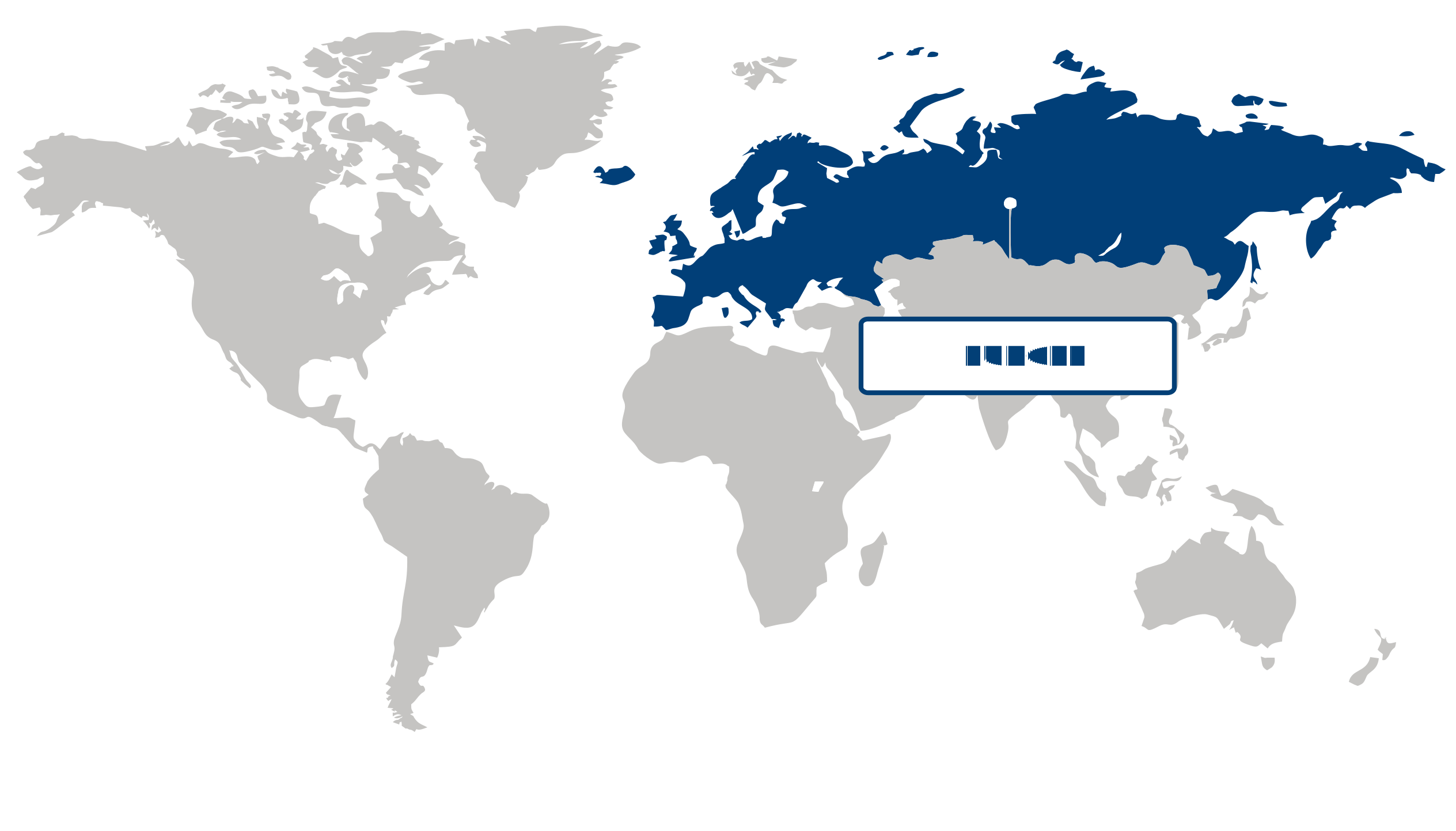
Europe (Largest Region)
Europe held the largest share of the collated screws market at 46.85% in 2026, supported by well-developed construction and industrial sectors, established standards for fastening systems, and strong demand for efficient installation solutions. The region's mature building industry increasingly favors tools and fastening products that improve productivity while maintaining consistent installation quality. Collated screws are particularly suited to applications requiring high fastening speed and reduced manual handling, supporting their use across construction, woodworking, interior installation, and renovation activities. Ongoing investment in building modernization, infrastructure development, and energy-efficient construction is also sustaining demand for reliable fastening systems.
Asia Pacific (Fastest-Growing Region)
Asia Pacific is the fastest-growing region, driven by expanding construction activity, industrialization, and investment in residential, commercial, and infrastructure projects. Rapid urban development is increasing the need for efficient fastening solutions that can support high-volume construction and improve labor productivity. Growing adoption of power tools and mechanized installation methods is further creating favorable conditions for collated screw systems, particularly as contractors seek to shorten installation time and improve consistency. Expansion of manufacturing and woodworking industries, coupled with increasing modernization of construction practices, is expected to strengthen regional demand.
| Parameter | North America | Asia Pacific | Europe | Latin America | MEA |
|---|---|---|---|---|---|
| Innovation Hub i Scale Nascent Developing Advanced | |||||
| Cost-Sensitive Region i Scale Low Medium High | |||||
| Regulatory Environment i Scale Restrictive Neutral Supportive | |||||
| Demand Drivers i Scale Weak Moderate Strong | |||||
| Development Stage i Scale Emerging Developing Developed | |||||
| Adoption Rate i Scale Low Medium High | |||||
| New Entrants / Startups i Scale Sparse Moderate Dense | |||||
| Macro Indicators i Scale Weak Stable Strong |
Key Country Insights
Germany 🇩🇪
Precision Fastening StandardsGermany emphasizes collated screws designed for precision fastening, engineered construction, and industrial woodworking applications. Customers in Germany increasingly value product consistency, compatibility with automated tools, and durable fastening performance across demanding projects.
France 🇫🇷
Professional Renovation DemandFrance experiences sustained demand for collated screws across renovation, interior construction, and professional building maintenance activities. Contractors in France increasingly adopt fastening systems that improve installation efficiency while maintaining reliable performance across varied building materials.
Italy 🇮🇹
Interior Fit-Out ApplicationsItaly utilizes collated screws extensively in interior fit-outs, furniture production, and building refurbishment projects. Manufacturers and distributors in Italy increasingly focus on fastening solutions that enhance workflow efficiency and accommodate a wide range of professional installation requirements.
Japan 🇯🇵
Compact Building SolutionsJapan favors collated screws that support efficient installation within space-constrained construction and interior finishing projects. Builders in Japan increasingly seek fastening products compatible with lightweight materials and advanced installation equipment for consistent project execution.
South Korea 🇰🇷
Modern Construction EfficiencySouth Korea expands the use of collated screws as contractors adopt mechanized fastening solutions for residential and commercial developments. Construction firms in South Korea prioritize products that improve installation consistency while reducing project completion time.
United States 🇺🇸
High-Efficiency Construction SupplyThe U.S. maintains steady demand for collated screws as contractors emphasize installation speed and labor productivity across residential and commercial construction projects. Manufacturers serving the U.S. increasingly align product offerings with automated fastening systems and professional-grade applications.
Segment Leadership and Growth Trends
Collated Screws Market Share (%), by Application, 2026
Go beyond the chart, access full insights & data tables
Request Free Sample ReportApplication Segment Analysis: Construction (Largest Segment) vs Furniture (Fastest-Growing Segment)
Construction represented the largest application segment in the collated screws market, accounting for 67.78% in 2026. Its leading position is driven by extensive requirements for fastening materials across framing, drywall installation, structural assemblies, and other construction activities. Collated screws improve installation efficiency by enabling faster and more consistent fastening, particularly in projects where productivity and labor utilization are important considerations. The continued emphasis on streamlined construction workflows, reduced installation time, and compatibility with powered fastening equipment supports sustained demand for collated fastening solutions within the construction sector.
Furniture is expanding at the fastest pace as manufacturers increasingly seek efficient fastening methods that can support high-volume and consistent assembly operations. Collated screws can facilitate rapid installation while helping improve workflow uniformity across furniture production processes. Growing demand for efficiently manufactured furniture, greater adoption of automated or semi-automated assembly practices, and the need to maintain consistent product quality are creating additional opportunities for these fastening systems. Their suitability for repetitive production environments further supports their increasing relevance within furniture manufacturing.
Product Segment Analysis: Collated Drywall Screws (Largest Segment) vs Collated Deck Screws (Fastest-Growing Segment)
The collated drywall screws segment led the product landscape of the collated screws market with a 40.6% share in 2026. Its established position reflects widespread use in drywall installation, where rapid and uniform fastening is essential for maintaining construction productivity. Collated formats allow installers to work efficiently with compatible fastening tools while reducing interruptions during repetitive applications. Demand is further supported by continued construction activity and the preference for fastening solutions that improve installation consistency and labor efficiency.
Collated deck screws are gaining momentum as outdoor construction and decking applications increasingly require fastening solutions that combine installation speed with reliable performance. The collated format can streamline repetitive fastening tasks and improve productivity across larger decking projects. Demand is also supported by the continued development of residential and commercial outdoor spaces, where efficient installation and dependable fastening are important considerations. Increasing use of specialized fastening products for exterior applications is therefore strengthening the growth potential of this segment.
| Segment | Sub-Segment | Largest Segment | Fastest Growing |
|---|---|---|---|
| Application | Construction, Furniture, Others | Construction | Furniture |
| Product | Collated Drywall Screws, Collated Sub-Floor Screws, Collated Deck Screws, Collated Self-Drilling Screw, Collated Chipboard Screws | Collated Drywall Screws | Collated Deck Screws |
Competitive Landscape and Market Positioning
Top players in the collated screws market:
1. Simpson Strong-Tie Company Inc. (United States)
2. Hilti Corporation (Liechtenstein)
3. KYOCERA SENCO Industrial Tools Inc. (United States)
4. PrimeSource Building Products Inc. (United States)
5. CAMO Fasteners Inc. (United States)
6. Grabber Construction Products Inc. (United States)
7. FastenMaster (United States)
8. Beck Fastener Group (Germany)
9. Muro North America Inc. (Canada)
10. Zen-Young Industrial Co. Ltd. (Taiwan)
Automation trends in construction and industrial fastening applications are driving innovation across the collated screws market. Manufacturers are introducing corrosion-resistant materials, precision-engineered designs, and high-speed fastening compatibility to improve installation efficiency and durability. Growing emphasis on labor productivity and ease of use is also encouraging the development of application-specific fastening solutions for residential and commercial projects.
| Company | Market Share | Company Revenue | Revenue CAGR (%) | Product Portfolio | Geographic Presence | Innovation / R&D Focus | Strategic Developments |
|---|---|---|---|---|---|---|---|
| Simpson Strong-Tie Company Inc. (United States) | |||||||
| Hilti Corporation (Liechtenstein) | |||||||
| KYOCERA SENCO Industrial Tools Inc. (United States) | |||||||
| PrimeSource Building Products Inc. (United States) | |||||||
| CAMO Fasteners Inc. (United States) | |||||||
| Grabber Construction Products Inc. (United States) | |||||||
| FastenMaster (United States) | |||||||
| Beck Fastener Group (Germany) | |||||||
| Muro North America Inc. (Canada) | |||||||
| Zen-Young Industrial Co. Ltd. (Taiwan). |
Industry Development/News
| Company Name | Date | Key Development |
|---|---|---|
| MURO | May-26 | MURO expanded the availability of its auto-feed screw driving systems across the United States by scaling its authorized distribution network. This move strengthens the company's market position in the North American fastening segment, enhancing product accessibility for contractors and industrial users while supporting the broader adoption of automated fastening technologies in key construction and manufacturing channels. |
| Technogips Pro | Apr-26 | Technogips Pro launched a new line of collated drywall screws specifically engineered for compatibility with auto-feed screw guns. The introduction targets efficiency improvements in construction and interior finishing, providing a solution that reduces manual handling and installation time while ensuring consistent fastening performance for professional users in high-volume applications. |
| Simpson Strong-Tie | Jan-26 | Simpson Strong-Tie commissioned a 496,000-square-foot facility in Gallatin, Tennessee, to scale manufacturing and distribution of its construction fastening products. This strategic expansion significantly enhances the company's North American supply chain capacity and operational footprint, positioning it to better serve the increasing demand within the residential and commercial construction sectors. |
Customize Your Report
Explore examples of how this report can be tailored to different research needs, including custom segments, additional topics or chapters, and related reports. Click a section of the wheel or its numbered marker to explore the available options.
Collated Screws Market — Custom Segments
| Segment | Sub-Segment |
|---|---|
| Distribution Channel | Direct Sales, Distributors & Wholesalers, Hardware & Building Supply Stores, Online Channels |
| End User | Professional Contractors, Specialty Trade Contractors, Furniture & Cabinet Manufacturers, Industrial Manufacturers, DIY Users |
| Power Tool Compatibility | Pneumatic Collated Screw Guns, Cordless Collated Screw Guns, Gas-Powered Collated Screw Guns |
Collated Screws Market — Custom TOC
| Custom Chapter | Custom Details |
|---|---|
| Construction Application Demand Assessment |
|
| Fastening System Adoption Analysis |
|
| Contractor Preference & Buying Behavior Study |
|
Need a different cut of the data?
Request Custom ResearchWhat is the market valuation of collated screws?
How is the collated screws industry size expected to evolve during the forecast period?
How are infrastructure expansion and construction productivity pressures influencing adoption of collated screw systems?
How is power tool penetration and modular assembly demand shaping collated screw consumption patterns?
Why does Construction lead the collated screws market?
What is driving demand for Collated Deck Screws in the market?
Why is Europe the largest market for collated screws?
What is supporting growth in the Asia Pacific collated screws market?
Which companies dominate the collated screws landscape?
Our Clients
"Your insights on workforce structures were spot-on. The analysis on mid-to-senior level roles validated some of our hiring decisions and highlighted gaps."
Ateliers De France
"The report gave us insights on competitors in the market. It helped our team refine our bidding strategy for upcoming contracts."
Clark Construction
"The reports provided a deep dive into market trends, and competitive landscape. The strategic insights and recommendations have been very helpful."
Rudolph and Sletten
Our Research Team & Methodology
Every Fundamental Business Insights report is built by a dedicated vertical research team, validated through a structured primary-and-secondary methodology, and reviewed for accuracy before it reaches you.
Research Team Overview
Prepared by the Construction & Manufacturing Research Team
Delivery
Published
Demand
Available
Support
Trust & Compliance
Research Domains
10 coverage areasResearch Intelligence
| Source | Reference |
|---|---|
| International Organization for Standardization (ISO) | www.iso.org |
| ASTM International | www.astm.org |
| National Institute of Standards and Technology (NIST) | www.nist.gov |
| International Code Council (ICC) | www.iccsafe.org |
| American Concrete Institute (ACI) | www.concrete.org |
| American Institute of Steel Construction (AISC) | www.aisc.org |
| Construction Industry Institute (CII) | www.construction-institute.org |
| Associated General Contractors of America (AGC) | www.agc.org |
| Association of Equipment Manufacturers (AEM) | www.aem.org |
| Building Owners and Managers Association (BOMA) | www.boma.org |
| American Society of Civil Engineers (ASCE) | www.asce.org |
| National Ready Mixed Concrete Association (NRMCA) | www.nrmca.org |
| International Facility Management Association (IFMA) | www.ifma.org |
| World Green Building Council (WorldGBC) | worldgbc.org |
| International Federation of Consulting Engineers (FIDIC) | fidic.org |
| International Labour Organization (ILO) | www.ilo.org |
| American Society of Mechanical Engineers (ASME) | www.asme.org |
| Society of Manufacturing Engineers (SME) | www.sme.org |
| National Association of Home Builders (NAHB) | www.nahb.org |
| European Construction Industry Federation (FIEC) | www.fiec.eu |
Research Workflow & Quality Assurance
Data Collection
Verified information gathered through primary and secondary research.
Data Triangulation
Cross-validation using multiple independent data sources.
Forecast Modelling
Market estimates developed using historical trends and analytical models.
Analyst Validation
Findings reviewed by domain experts for accuracy and consistency.
Editorial & Quality Review
Final editorial, quality, and compliance checks before publication.
Final Publication
Released after successful completion of the internal review process.
Report Coverage
📊 Market Assessment
- Market Size & Forecast
- Market Segmentation
- Regional Analysis
- Growth Drivers & Challenges
- Market Dynamics
🏢 Competitive Intelligence
- Competitive Landscape
- Company Profiles
- Competitive Benchmarking
- Mergers & Acquisitions
- Market Share Analysis or Key Company Strategies
🔍 Strategic Analysis
- Value Chain Analysis
- Porter's Five Forces
- PESTLE Analysis
- Pricing Trends
- Supply-Demand Analysis
🚀 Future Outlook
- Technology Landscape
- Regulatory Landscape
- Investment & Funding Landscape
- Emerging Opportunities
- Future Market Outlook
Have a question about this report or need a custom scope?
Request Customization