Commercial Gas Boiler Market Size & Growth Forecast 2027–2036, By Segments (Product, Technology, Capacity, Application), Regional Demand Trends (North America, Asia Pacific, Europe), Key Country Insights (U.S., Japan, South Korea, Germany, France, Italy), and Competitive Landscape
Market Size and Growth Outlook
Commercial Gas Boiler Market size was more than USD 7.15 Billion in 2026 and is set to grow at 6.78% CAGR between 2027 and 2036, crossing USD 13.78 Billion by 2036. The industry revenue for 2027 is estimated at USD 7.56 Billion.
Get more details on this report
Request Free Sample ReportCommercial Gas Boiler Market Intelligence Snapshot
Regional Market Dynamics
- Europe held 48.65% in 2026, supported by established commercial heating infrastructure, gas-based heating adoption, energy-efficiency requirements, and heating-system modernization.
- North America is growing fastest through commercial building modernization, aging equipment replacement, energy-efficiency investments, and demand for improved operational performance.
Segment Momentum
- The hot water segment held 62.4% of the market in 2026, supported by strong demand from commercial buildings seeking dependable hot water supply, energy-efficient heating, and replacement of aging boiler systems.
- The ≤0.3–2.5 MMBtu/hr capacity segment is projected to grow the fastest as small commercial establishments increasingly adopt compact, efficient, and cost-effective heating systems with greater installation flexibility.
Market Expansion Drivers
- Commercial building decarbonization policies accelerating shift toward high-efficiency boiler systems
- Rising demand for space heating in commercial infrastructure driving boiler replacement cycles
- Healthcare facility expansion increasing demand for reliable and energy-efficient heating systems
Leading Market Participants
- Top players in the commercial gas boiler market include Viessmann Group (Germany), Bosch Industriekessel GmbH (Germany), Vaillant Group (Germany), Ariston Holding N.V. (Italy), Babcock & Wilcox Enterprises, Inc. (United States), Cleaver-Brooks, Inc. (United States), Hoval AG (Liechtenstein), Weil-McLain (United States), Miura Co., Ltd. (Japan), Ferroli S.p.A. (Italy)
Global Market Forecast Snapshot
Market Outlook
- 2026 Market Size: USD 7.15 Billion
- 2027 Estimated Market Size: USD 7.56 Billion
- Projected Market Size: USD 13.78 Billion by 2036
- Growth Forecast: 6.78% CAGR (2027-2036)
Regional and Segment Outlook
- Leading Regional Market: Europe
- High-Growth Regional Hub: North America
- Core Revenue Segment: Hot Water (Product) | Condensing (Technology) | > 10 - 50 MMBtu/hr (Capacity) | Healthcare Facilities (Application)
- Emerging Opportunity Segment: Hot Water (Product) | Condensing (Technology) | ≤ 0.3 - 2.5 MMBtu/hr (Capacity) | Offices (Application)
Market Growth Drivers and Industry Trends
Commercial building decarbonization policies accelerating shift toward high-efficiency boiler systems
Increasing pressure to reduce building emissions is encouraging commercial property owners to upgrade heating infrastructure with more efficient technologies. The commercial gas boiler market growth is driven by decarbonization policies that promote the adoption of high-efficiency boiler systems capable of improving energy performance while supporting lower emissions. Building operators are evaluating modern boiler solutions to align with sustainability objectives and evolving energy standards. This transition is influencing equipment replacement strategies across offices, institutions, and commercial facilities.
Rising demand for space heating in commercial infrastructure driving boiler replacement cycles
Growing requirements for reliable indoor climate control are encouraging commercial facilities to modernize aging heating systems. Commercial gas boiler market growth will be supported by increasing demand for space heating solutions across commercial infrastructure, where efficient and dependable boilers remain essential for maintaining occupant comfort. Replacement cycles are accelerating as building owners seek improved performance, operational reliability, and reduced energy consumption from upgraded heating equipment. The need to maintain effective heating systems in expanding commercial spaces continues to support equipment modernization.
Healthcare facility expansion increasing demand for reliable and energy-efficient heating systems
The expansion of healthcare infrastructure is creating greater demand for heating systems that can deliver consistent performance in critical environments. The commercial gas boiler market demand will rise as hospitals and healthcare facilities require reliable heating solutions that support patient comfort, sanitation processes, and continuous operations. Energy-efficient boiler technologies are gaining importance in healthcare settings where operational stability and resource management are key priorities. Increasing investment in medical facilities is encouraging adoption of advanced heating equipment designed for long-term reliability.
| Growth Driver | Impact on CAGR | Regulatory Influence | Geographic Relevance | Adoption Rate | Impact Timeline |
|---|---|---|---|---|---|
| Commercial building decarbonization policies accelerating shift toward high-efficiency boiler systems | 2% | High | Europe, North America | High | Near Term |
| Rising demand for space heating in commercial infrastructure driving boiler replacement cycles | 1.8% | Moderate | North America, Asia Pacific | High | Mid Term |
| Healthcare facility expansion increasing demand for reliable and energy-efficient heating systems | 1.5% | Moderate | Europe, Asia Pacific | Medium | Mid Term |
Unlock insights tailored to your business with our bespoke market research solutions.
Click to get your customized report now.
Regional Demand Dynamics
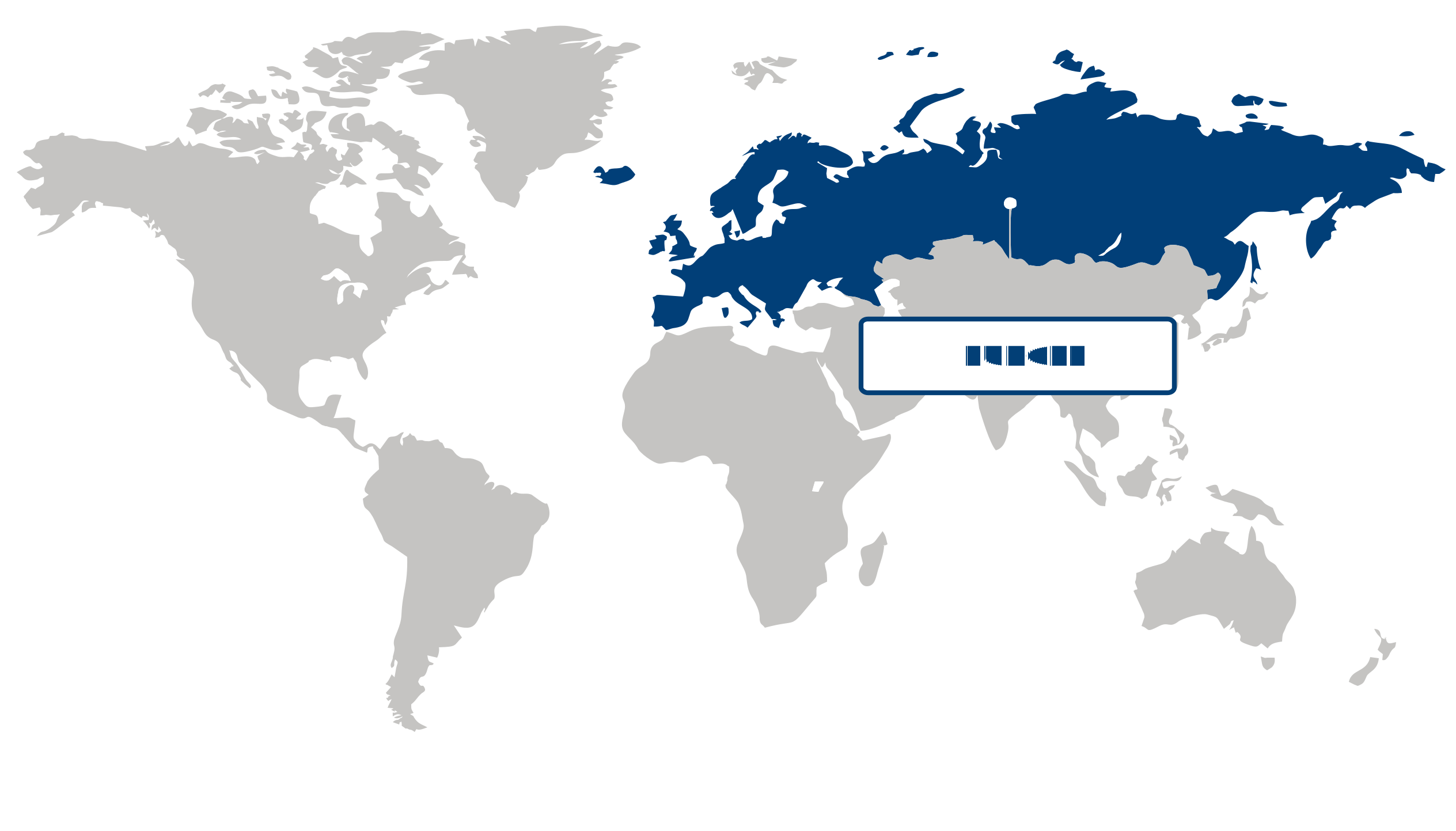
Europe (Largest Region)
Holding the largest share of the commercial gas boiler market, Europe accounted for 48.65% in 2026, supported by the region’s established commercial heating infrastructure, widespread use of gas-based heating systems, and continued demand for reliable space-heating solutions across commercial buildings. Energy-efficiency requirements and efforts to modernize aging heating systems are encouraging building owners to replace conventional equipment with more efficient boiler technologies. In addition, regulatory initiatives focused on reducing energy consumption and improving building performance are influencing investment in upgraded heating systems, while ongoing commercial construction and refurbishment activity continues to sustain demand.
North America (Fastest-Growing Region)
North America is emerging as the fastest-growing regional market, driven by increasing investment in commercial building modernization and the replacement of aging heating equipment. Growing attention to energy efficiency and operating-cost optimization is encouraging businesses and facility operators to adopt advanced boiler systems that can deliver improved thermal performance and more efficient fuel utilization. The expansion of commercial facilities, coupled with rising demand for dependable heating infrastructure in colder climates, is further supporting market development. Technological improvements in boiler controls and system integration are also strengthening adoption as commercial users seek greater operational efficiency and more effective energy management.
| Parameter | North America | Asia Pacific | Europe | Latin America | MEA |
|---|---|---|---|---|---|
| Innovation Hub i Scale Nascent Developing Advanced | |||||
| Cost-Sensitive Region i Scale Low Medium High | |||||
| Regulatory Environment i Scale Restrictive Neutral Supportive | |||||
| Demand Drivers i Scale Weak Moderate Strong | |||||
| Development Stage i Scale Emerging Developing Developed | |||||
| Adoption Rate i Scale Low Medium High | |||||
| New Entrants / Startups i Scale Sparse Moderate Dense | |||||
| Macro Indicators i Scale Weak Stable Strong |
Key Country Insights
United States 🇺🇸
Retrofit Heating DemandThe U.S. commercial gas boiler market is driven by retrofit activity across institutional, healthcare, and commercial buildings seeking dependable heating performance. Facility operators are prioritizing high-efficiency boiler systems with advanced controls that improve operational flexibility and simplify maintenance.
Germany 🇩🇪
Efficiency Compliance FocusGermany is emphasizing commercial gas boilers that meet stringent energy efficiency expectations while supporting modernization of existing heating infrastructure. Manufacturers are developing condensing technologies and intelligent control systems that align with evolving building performance requirements.
Japan 🇯🇵
Compact Building SolutionsJapan is adopting compact commercial gas boiler systems suited to space-constrained buildings and energy-conscious facility management. Demand centers on reliable, efficient equipment that integrates with building automation systems to enhance operational performance and heating consistency.
South Korea 🇰🇷
Smart Heating IntegrationSouth Korea is incorporating commercial gas boilers into digitally managed building environments where energy optimization is becoming a procurement priority. Suppliers are introducing connected boiler systems with remote monitoring capabilities to improve maintenance planning and operational efficiency.
France 🇫🇷
Building Renovation SupportFrance is upgrading commercial heating installations through renovation projects that favor efficient gas boiler technologies for existing buildings. Commercial buyers are seeking systems that balance dependable heating performance with improved fuel utilization and easier integration into modern building management platforms.
Italy 🇮🇹
Hospitality Infrastructure UpgradesItaly is strengthening demand for commercial gas boilers through modernization of hotels, public facilities, and mixed-use buildings. End users are selecting durable heating systems with enhanced efficiency and flexible installation options to support varied commercial applications.
Segment Leadership and Growth Trends
Commercial Gas Boiler Market Share (%), by Product, 2026
Go beyond the chart, access full insights & data tables
Request Free Sample ReportProduct Segment Analysis: Hot Water (Largest & Fastest-Growing Segment)
The commercial gas boiler market was led by the hot water product segment, which held a 62.4% share in 2026 while also representing the fastest-growing segment. Strong demand from offices, healthcare facilities, educational institutions, hospitality establishments, and other commercial buildings continues to support its leading position. The segment benefits from the growing preference for energy-efficient heating systems, dependable hot water supply, and modernization of commercial infrastructure, while ongoing replacement of aging boiler systems further contributes to sustained demand.
Technology Segment Analysis: Condensing (Largest &Fastest-Growing Segment)
Holding the largest share of the commercial gas boiler market, the condensing technology segment dominated in 2026 and also emerged as the fastest-growing segment. Its leadership is driven by its ability to recover heat from exhaust gases, resulting in higher energy efficiency and reduced fuel consumption compared with conventional systems. Increasing implementation of energy-efficiency regulations, rising focus on lowering operating expenses, and growing adoption of sustainable building technologies continue to strengthen demand for condensing boilers across commercial facilities.
Capacity Segment Analysis: > 10 - 50 MMBtu/hr (Largest Segment) vs ≤ 0.3 - 2.5 MMBtu/hr (Fastest-Growing Segment)
The more than 10 - 50 MMBtu/hr capacity segment held the largest share in 2026, owing to its suitability for medium- and large-scale commercial buildings requiring reliable and continuous heating performance. Its broad application across hospitals, educational campuses, industrial facilities, and large commercial complexes supports its dominant position, as these installations require systems capable of efficiently handling substantial heating loads.
The up to 0.3 - 2.5 MMBtu/hr capacity segment is anticipated to register the fastest growth, driven by increasing demand from small commercial establishments seeking compact, efficient, and cost-effective heating solutions. Rising construction of small offices, retail outlets, restaurants, and similar facilities, together with greater emphasis on energy optimization and installation flexibility, is expected to accelerate adoption of lower-capacity commercial gas boilers.
| Segment | Sub-Segment | Largest Segment | Fastest Growing |
|---|---|---|---|
| Product | Hot Water, Steam | Hot Water | Hot Water |
| Technology | Condensing, Non-Condensing | Condensing | Condensing |
| Capacity | ≤ 0.3 - 2.5 MMBtu/hr, > 2.5 - 10 MMBtu/hr, > 10 - 50 MMBtu/hr, > 50 - 100 MMBtu/hr, > 100 - 250 MMBtu/hr | > 10 - 50 MMBtu/hr | ≤ 0.3 - 2.5 MMBtu/hr |
| Application | Offices, Healthcare Facilities, Educational Institutions, Lodgings, Retail Stores, Others | Healthcare Facilities | Offices |
Competitive Landscape and Market Positioning
Leading companies in the commercial gas boiler market:
- Viessmann Group (Germany)
- Bosch Industriekessel GmbH (Germany)
- Vaillant Group (Germany)
- Ariston Holding N.V. (Italy)
- Babcock & Wilcox Enterprises, Inc. (United States)
- Cleaver-Brooks, Inc. (United States)
- Hoval AG (Liechtenstein)
- Weil-McLain (United States)
- Miura Co., Ltd. (Japan)
- Ferroli S.p.A. (Italy)
Changing building efficiency standards are redefining competition in the commercial gas boiler market, with manufacturers concentrating on intelligent heating systems that deliver improved operational control, lower emissions, and simplified maintenance. Product development increasingly emphasizes compatibility with building management platforms, remote diagnostics, and flexible system configurations that support both new commercial developments and modernization projects. Suppliers are also differentiating through lifecycle service offerings and technical support, recognizing that long-term performance, installation quality, and operational efficiency have become central considerations for commercial building owners and facility managers.
| Company | Market Share | Company Revenue | Revenue CAGR (%) | Product Portfolio | Geographic Presence | Innovation / R&D Focus | Strategic Developments |
|---|---|---|---|---|---|---|---|
| Viessmann Group (Germany) | |||||||
| Bosch Industriekessel GmbH (Germany) | |||||||
| Vaillant Group (Germany) | |||||||
| Ariston Holding N.V. (Italy) | |||||||
| Babcock & Wilcox Enterprises Inc. (United States) | |||||||
| Cleaver-Brooks Inc. (United States) | |||||||
| Hoval AG (Liechtenstein) | |||||||
| Weil-McLain (United States) | |||||||
| Miura Co. Ltd. (Japan) | |||||||
| Ferroli S.p.A. (Italy) |
Industry Development/News
| Company Name | Date | Key Development |
|---|---|---|
| Carrier Global Corporation | Jan-24 | Carrier Global Corporation completed the acquisition of Viessmann Climate Solutions, integrating the provider of efficient and renewable climate solutions to strengthen Carrier's competitive positioning within the residential and light commercial HVAC sectors across Europe. |
| Weil-McLain | May-23 | Weil-McLain expanded its commercial product portfolio by launching energy-compliant commercial cast iron boilers designed for light commercial applications, improving fuel efficiency, lowering operating costs, and streamlining the installation process for market participants. |
Customize Your Report
Explore examples of how this report can be tailored to different research needs, including custom segments, additional topics or chapters, and related reports. Click a section of the wheel or its numbered marker to explore the available options.
Commercial Gas Boiler Market — Custom Segments
| Segment | Sub-Segment |
|---|---|
| Installation Type | New Construction, Replacement, Retrofit & System Upgrade |
| Boiler Configuration | Single-Boiler Systems, Modular Boiler Systems, Multiple-Boiler Systems |
| Sales Channel | Direct Sales, HVAC Distributors, Mechanical Contractors & System Integrators, Online & Specialty Channels |
Commercial Gas Boiler Market — Custom TOC
| Custom Chapter | Custom Details |
|---|---|
| Commercial Boiler Replacement Economics |
|
| Low-Carbon Heating Transition Pathways |
|
| Commercial Heating Procurement Landscape |
|
Need a different cut of the data?
Request Custom ResearchWhat is the current size of the commercial gas boiler market?
What is the forecasted size of the commercial gas boiler industry?
How are decarbonization policies influencing commercial gas boiler replacement strategies?
Why is healthcare infrastructure supporting demand for commercial gas boilers?
Why is the hot water product segment leading the commercial gas boiler market?
Which capacity segment is expected to grow the fastest in the commercial gas boiler market?
Why does Europe lead the commercial gas boiler market?
What is driving commercial gas boiler growth in North America?
Who are the leading players in the commercial gas boiler landscape?
Our Clients
"The team at Fundamental Business Insights & Consulting demonstrated a commitment to excellence, not only in the quality of the report but also in their client-centric approach."
FANUC
"The level of detail in the market segmentation provided were particularly noteworthy. The detailed country-level insights were also very helpful."
B&R Industrial Automation GmbH
"The consultant took the time to understand our specific business objectives, ensuring that the reports were tailored to address our unique challenges and opportunities."
KUKA SE & Co. KGaA
Our Research Team & Methodology
Every Fundamental Business Insights report is built by a dedicated vertical research team, validated through a structured primary-and-secondary methodology, and reviewed for accuracy before it reaches you.
Research Team Overview
Prepared by the Industrial Automation & Equipment Research Team
Delivery
Published
Demand
Available
Support
Trust & Compliance
Research Domains
10 coverage areasResearch Intelligence
| Source | Reference |
|---|---|
| International Society of Automation (ISA) | www.isa.org |
| International Organization for Standardization (ISO) | www.iso.org |
| National Institute of Standards and Technology (NIST) | www.nist.gov |
| IEEE | www.ieee.org |
| VDMA (German Mechanical Engineering Industry Association) | www.vdma.org |
| Association for Advancing Automation (A3) | www.automate.org |
| International Federation of Robotics (IFR) | ifr.org |
| ASME (American Society of Mechanical Engineers) | www.asme.org |
| ASHRAE | www.ashrae.org |
| American Society of Heating, Refrigerating and Air-Conditioning Engineers (ASHRAE) | www.ashrae.org |
| Material Handling Industry (MHI) | www.mhi.org |
| OSHA (Occupational Safety and Health Administration) | www.osha.gov |
| National Fire Protection Association (NFPA) | www.nfpa.org |
| ASTM International | www.astm.org |
| International Electrotechnical Commission (IEC) | www.iec.ch |
| Open Process Automation Forum (The Open Group) | www.opengroup.org/open-process-automation-forum |
| AGMA (American Gear Manufacturers Association) | www.agma.org |
| Association of Equipment Manufacturers (AEM) | www.aem.org |
| Food and Agriculture Organization (FAO) | www.fao.org |
| International Labour Organization (ILO) | www.ilo.org |
Research Workflow & Quality Assurance
Data Collection
Verified information gathered through primary and secondary research.
Data Triangulation
Cross-validation using multiple independent data sources.
Forecast Modelling
Market estimates developed using historical trends and analytical models.
Analyst Validation
Findings reviewed by domain experts for accuracy and consistency.
Editorial & Quality Review
Final editorial, quality, and compliance checks before publication.
Final Publication
Released after successful completion of the internal review process.
Report Coverage
📊 Market Assessment
- Market Size & Forecast
- Market Segmentation
- Regional Analysis
- Growth Drivers & Challenges
- Market Dynamics
🏢 Competitive Intelligence
- Competitive Landscape
- Company Profiles
- Competitive Benchmarking
- Mergers & Acquisitions
- Market Share Analysis or Key Company Strategies
🔍 Strategic Analysis
- Value Chain Analysis
- Porter's Five Forces
- PESTLE Analysis
- Pricing Trends
- Supply-Demand Analysis
🚀 Future Outlook
- Technology Landscape
- Regulatory Landscape
- Investment & Funding Landscape
- Emerging Opportunities
- Future Market Outlook
Have a question about this report or need a custom scope?
Request Customization