Confectionery Packaging Market Size & Growth Forecast 2027–2036, By Segments (Type, Application, Material), Regional Demand Trends (North America, Asia Pacific, Europe), Key Country Insights (U.S., Japan, South Korea, Germany, France, Italy), and Competitive Landscape
Jump to content
Market Size and Growth Outlook
Confectionery Packaging Market size was valued at USD 11.8 billion in 2026 and is anticipated to grow at a 9.69% CAGR from 2027 to 2036, reaching USD 29.75 billion by 2036. The industry revenue for 2027 is calculated at USD 12.76 billion.
Get more details on this report
Request Free Sample ReportConfectionery Packaging Market Intelligence Snapshot
Regional Market Dynamics
- Europe leads due to its mature confectionery base, advanced packaging supply chains, and strong demand for premium, differentiated formats focused on freshness, branding, and retail presentation.
- Asia Pacific grows at 5.13% CAGR driven by rising confectionery consumption, expanding local production, and increasing demand for cost-efficient, visually appealing packaging formats across modern retail channels.
Segment Momentum
- Rigid packaging held a 53.55% market share in 2026 because it provides stronger protection against crushing and handling damage while supporting product presentation, shelf appeal, and shape retention for premium confectionery products.
- Sugar confectionary is the fastest-growing application segment due to rising demand for portable, resealable, and impulse-oriented packaging formats that accommodate frequent product variation and convenient retail distribution.
Market Expansion Drivers
- Rising premium confectionery consumption increasing demand for aesthetically differentiated packaging solutions.
- Growth of e-commerce channels driving need for durable and visually appealing confectionery packaging.
- Increasing adoption of sustainable and recyclable packaging materials supporting industry transformation.
Leading Market Participants
- Key players in the confectionery packaging market include Amcor plc (Switzerland), Smurfit Kappa Group plc (Ireland), Rengo Co., Ltd. (Japan), Coveris Management GmbH (Austria), Huhtamaki Oyj (Finland), Constantia Flexibles Group GmbH (Austria), Printpack Inc. (United States), Toppan Holdings Inc. (Japan), Sonoco Products Company (United States), Berry Global Group, Inc. (United States).
Global Market Forecast Snapshot
Market Outlook
- 2026 Market Size: USD 11.8 billion
- 2027 Estimated Market Size: USD 12.76 billion.
- Projected Market Size: USD 29.75 billion by 2036
- Growth Forecast: 9.69% CAGR (2027-2036)
Regional and Segment Outlook
- Leading Regional Market: Europe
- High-Growth Regional Hub: Asia Pacific
- Core Revenue Segment: Rigid (Type) | Chocolate Confectionary (Application) | Plastic (Material)
- Emerging Opportunity Segment: Flexible (Type) | Sugar Confectionary (Application) | Aluminum Foil (Material)
Market Growth Drivers and Industry Trends
Rising premium confectionery consumption increasing demand for aesthetically differentiated packaging solutions
The confectionery packaging market is benefiting from increasing consumer interest in premium sweets and gifting-oriented confectionery products, where packaging plays an important role in perceived product value. High-end chocolates, specialty candies, and other premium products often require packaging that communicates quality through distinctive structures, finishes, graphics, and presentation formats. Manufacturers are consequently placing greater emphasis on packaging designs that provide both product protection and visual differentiation, particularly for products positioned around indulgence, gifting, celebrations, and elevated consumer experiences.
Growth of e-commerce channels driving need for durable and visually appealing confectionery packaging
Expansion of online confectionery sales is strengthening the confectionery packaging market by increasing the importance of packaging that can withstand handling, transportation, and delivery conditions while preserving product presentation. Unlike traditional retail environments, e-commerce products may pass through multiple logistics stages before reaching consumers, creating greater requirements for structural strength, protective barriers, and secure closures. At the same time, attractive packaging remains important because the package serves as a major visual touchpoint for consumers receiving products through direct delivery, encouraging manufacturers to balance durability with presentation quality.
Increasing adoption of sustainable and recyclable packaging materials supporting industry transformation
Growing environmental awareness among consumers and increasing sustainability priorities across the packaging industry are encouraging confectionery manufacturers to reconsider material selection, supporting the confectionery packaging market. Recyclable, lightweight, and more resource-efficient packaging formats can help reduce material consumption and improve end-of-life handling while maintaining the protective characteristics required for confectionery products. Manufacturers are also exploring packaging structures that reduce unnecessary components and incorporate materials compatible with established recycling systems, particularly as brands seek to align product presentation with broader environmental objectives.
| Growth Driver | Impact on CAGR | Regulatory Influence | Geographic Relevance | Adoption Rate | Impact Timeline |
|---|---|---|---|---|---|
| Rising premium confectionery consumption increasing demand for aesthetically differentiated packaging solutions | 1.80% | Low | Europe, North America, Asia Pacific | High | Near Term |
| Growth of e-commerce channels driving need for durable and visually appealing confectionery packaging | 1.60% | Moderate | North America, Asia Pacific | High | Near Term |
| Increasing adoption of sustainable and recyclable packaging materials supporting industry transformation | 1.40% | High | Europe, North America | Medium | Mid Term |
Unlock insights tailored to your business with our bespoke market research solutions.
Click to get your customized report now.
Regional Demand Dynamics
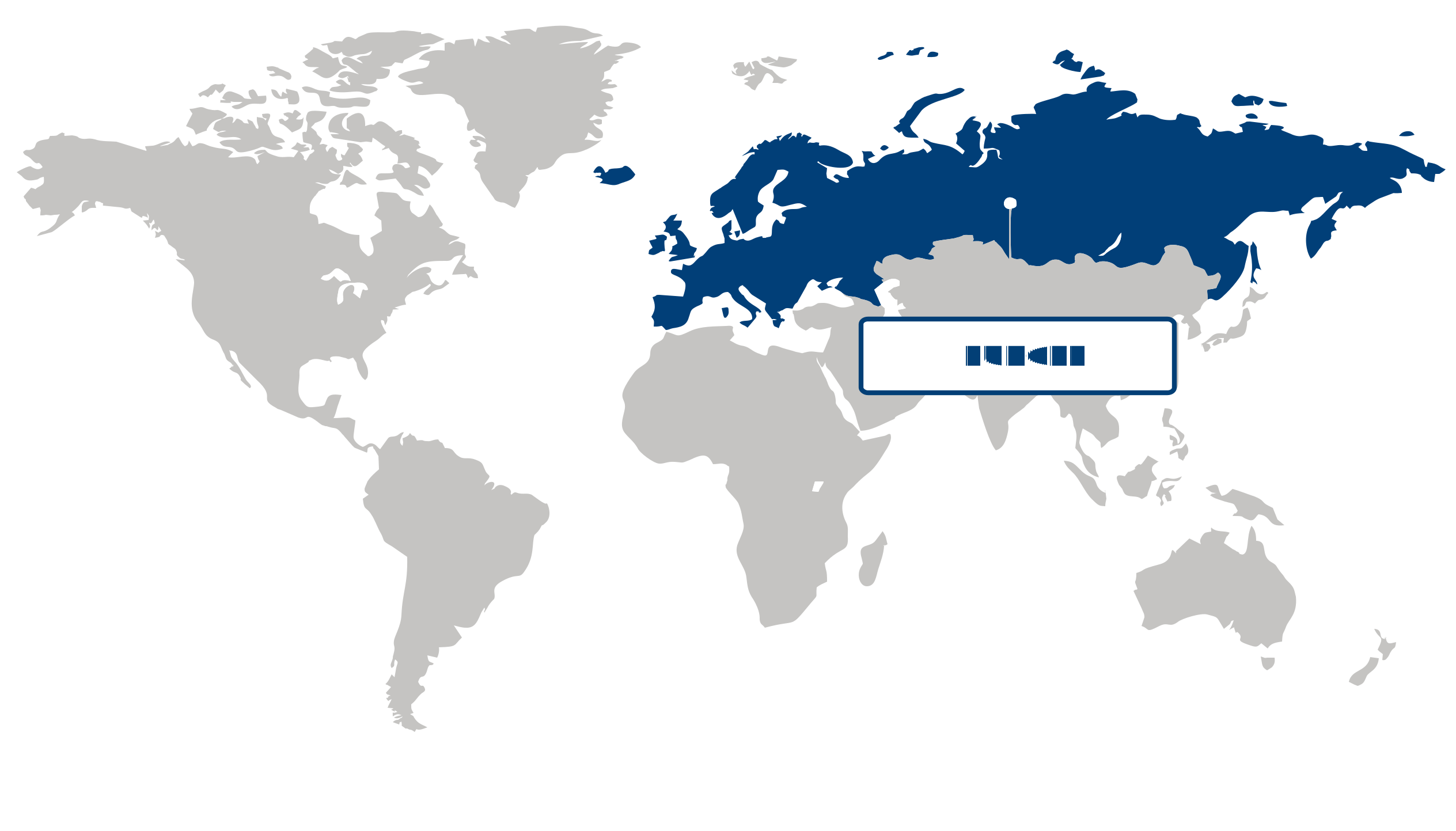
Europe (Largest Region)
Holding the largest share of the confectionery packaging market in 2026, Europe benefits from a mature confectionery industry and sustained demand for packaging that supports product protection, presentation, convenience, and differentiation. The region's established food manufacturing base, emphasis on premium product offerings, and increasing focus on sustainable and recyclable packaging solutions are supporting continued packaging innovation and demand across diverse confectionery categories.
Asia Pacific (Fastest-Growing Region)
Asia Pacific is the fastest-growing region, driven by expanding consumer markets, changing lifestyles, and rising demand for packaged confectionery products. Increasing urbanization and disposable incomes are supporting greater consumption of convenience and branded food products, while the expansion of organized retail and modern distribution channels is creating additional opportunities for packaging manufacturers. Growing attention to product appeal, portability, and packaging functionality is also contributing to the region's strong growth potential.
| Parameter | North America | Asia Pacific | Europe | Latin America | MEA |
|---|---|---|---|---|---|
| Innovation HubiScaleNascentDeveloping Advanced | |||||
| Cost-Sensitive RegioniScaleLowMedium High | |||||
| Regulatory EnvironmentiScaleRestrictiveNeutral Supportive | |||||
| Demand DriversiScaleWeakModerate Strong | |||||
| Development StageiScaleEmergingDeveloping Developed | |||||
| Adoption RateiScaleLowMedium High | |||||
| New Entrants / StartupsiScaleSparseModerate Dense | |||||
| Macro IndicatorsiScaleWeakStable Strong |
Key Country Insights
Germany 🇩🇪
Sustainable Material AdoptionGermany emphasizes recyclable and resource-efficient confectionery packaging that aligns with evolving environmental expectations and retail requirements. Manufacturers continue refining packaging designs that preserve product quality while supporting responsible material selection and efficient production processes.
France 🇫🇷
Premium Brand PackagingFrance focuses on confectionery packaging that reinforces product quality, premium positioning, and attractive shelf presentation. French confectionery producers increasingly adopt sustainable packaging materials while preserving the visual appeal expected across specialty and premium product categories.
Italy 🇮🇹
Artisan Product ProtectionItaly's confectionery packaging market supports both premium and traditional confectionery products through packaging that safeguards freshness and enhances brand identity. Italian manufacturers prioritize flexible and decorative packaging solutions that accommodate diverse product formats and retail channels.
Japan 🇯🇵
Premium Presentation StandardsJapan prioritizes confectionery packaging that combines product protection with refined visual presentation for premium and seasonal confectionery products. Japanese manufacturers continue investing in high-quality packaging formats that enhance consumer perception while maintaining product freshness.
South Korea 🇰🇷
Innovative Packaging FormatsSouth Korea's confectionery packaging market is driven by demand for modern packaging designs that support convenience, branding, and product differentiation. Companies increasingly adopt advanced materials and flexible packaging solutions that improve functionality while responding to changing consumer preferences.
United States 🇺🇸
Convenience Packaging DemandThe U.S. confectionery packaging market is evolving toward convenient, resealable, and visually appealing packaging formats that enhance product protection and consumer experience. Brand owners increasingly invest in packaging materials that balance shelf appeal, operational efficiency, and sustainability objectives.
Confectionery Packaging Market Share (%), by Type, 2026
Go beyond the chart, access full insights & data tables
Request Free Sample ReportType Segment Analysis: Rigid (Largest Segment) vs Flexible (Fastest-Growing Segment)
The rigid packaging segment led the confectionery packaging market with a 53.55% share in 2026, owing to its ability to provide strong physical protection, preserve product presentation, and support premium branding. Rigid formats are particularly suitable for confectionery products that require protection against crushing or damage during storage and transportation. Their structural durability and visual appeal also make them valuable for gift packs, premium assortments, and products designed for retail display. Continued demand for attractive packaging that enhances shelf presence and protects product quality is sustaining the segment's strong market position.
The flexible packaging segment is expected to be the fastest-growing segment, driven by its lightweight nature, material efficiency, and adaptability across a broad range of confectionery products. Flexible formats can support convenient portion sizes, resealable designs, and efficient packaging of products with varying shapes and quantities. Manufacturers are also increasingly seeking packaging solutions that can reduce material use and improve transportation efficiency. Growing demand for convenience-oriented products and ongoing innovation in high-barrier and more sustainable flexible materials are expected to support the segment's growth.
Application Segment Analysis: Chocolate Confectionary (Largest Segment) vs Sugar Confectionary (Fastest-Growing Segment)
The chocolate confectionary segment dominated the confectionery packaging market with a 49.08% share in 2026, reflecting the substantial packaging requirements associated with protecting chocolate products from moisture, temperature exposure, and physical damage. Chocolate confectionery also relies heavily on packaging to communicate brand value and support premium product positioning. The diversity of formats, including bars, boxed assortments, and individually wrapped products, generates demand for a wide range of packaging solutions. Increasing consumer interest in premium, gift-oriented, and innovative chocolate offerings is further supporting the segment's leading position.
The sugar confectionary segment is expected to be the fastest-growing segment as manufacturers introduce a broader variety of candies, gummies, hard-boiled sweets, and other products tailored to changing consumer preferences. Packaging plays an important role in maintaining freshness, enabling portion control, and creating distinctive visual appeal in a highly competitive retail environment. Demand for convenient, portable, and individually packaged products is encouraging innovation in packaging formats. The expansion of product varieties and the need for efficient packaging across diverse sugar confectionery categories are expected to drive segment growth.
| Segment | Sub-Segment | Largest Segment | Fastest Growing |
|---|---|---|---|
| Type | Flexible, Rigid | Rigid | Flexible |
| Application | Chocolate Confectionary, Sugar Confectionary, Gums, Others | Chocolate Confectionary | Sugar Confectionary |
| Material | Plastic, Paper & Paperboard, Metal, Glass, Aluminum Foil | Plastic | Aluminum Foil |
Competitive Landscape and Market Positioning
Top players in the confectionery packaging market:
1. Amcor plc (Switzerland)
2. Smurfit Kappa Group plc (Ireland)
3. Rengo Co. Ltd. (Japan)
4. Coveris Management GmbH (Austria)
5. Huhtamaki Oyj (Finland)
6. Constantia Flexibles Group GmbH (Austria)
7. Printpack Inc. (United States)
8. Toppan Holdings Inc. (Japan)
9. Sonoco Products Company (United States)
10. Berry Global Group Inc. (United States)
In the confectionery packaging market, competitive activity is increasingly centered around sustainable material development and innovative packaging formats designed to improve shelf appeal and environmental performance. Industry participants are introducing recyclable and biodegradable packaging solutions to align with changing consumer preferences and regulatory expectations. Consolidation activities and portfolio expansion strategies are further enabling manufacturers to strengthen production capabilities and diversify packaging offerings across premium and mass-market confectionery segments.
| Company | Market Share | Company Revenue | Revenue CAGR (%) | Product Portfolio | Geographic Presence | Innovation / R&D Focus | Strategic Developments |
|---|---|---|---|---|---|---|---|
| Amcor plc (Switzerland) | |||||||
| Smurfit Kappa Group plc (Ireland) | |||||||
| Rengo Co. Ltd. (Japan) | |||||||
| Coveris Management GmbH (Austria) | |||||||
| Huhtamaki Oyj (Finland) | |||||||
| Constantia Flexibles Group GmbH (Austria) | |||||||
| Printpack Inc. (United States) | |||||||
| Toppan Holdings Inc. (Japan) | |||||||
| Sonoco Products Company (United States) | |||||||
| Berry Global Group Inc. (United States). |
Industry Development / News
| Company Name | Date | Key Development |
|---|---|---|
| Coveris | May-26 | Coveris launched MonoFlexFibre Pure Twist, a paper-based alternative to plastic twist-wraps for confectionery applications. This development provides a functionally differentiated solution designed to ensure regulatory compliance regarding packaging waste and recycling, signaling a material shift toward fiber-based substrates in primary packaging for chocolates and candies. |
| DE Converter | Jan-26 | DE Converter expanded its high-performance packaging production capacity through the installation of a Gallus Labelmaster 440 press. This operational investment supports the company's strategic growth in the mid-web packaging segment, enhancing manufacturing throughput and service capabilities for label and flexible packaging requirements in the market. |
| SmartSolve | Jan-26 | SmartSolve launched PureNil 0, a 100% bio-based and flushable packaging substrate intended to replace single-use plastics in consumer goods. This development offers a sustainable material alternative for packaging manufacturers, expanding the technical options available for brand owners seeking to reduce plastic footprints in secondary and primary confectionery packaging applications. |
| OQ Group | Dec-25 | OQ Group inaugurated nine new factories under its Ladayn Plastics Industries Programme in Suhar Industrial City. This major capital investment expands regional plastics manufacturing capacity and strengthens the industrial infrastructure supporting the production of various packaging materials utilized across the confectionery sector. |
| Atlantic Štark | Jul-25 | Atlantic Štark integrated advanced automation technology from Schubert into its packaging lines to optimize flexible packaging processes for its confectionery portfolio. This digital and hardware upgrade enhances operational efficiency and flexibility in manufacturing, demonstrating the increasing adoption of automated systems to improve scalability and output quality in confectionery production. |
| Coesia | Jan-25 | Coesia expanded its market offering by showcasing new paper-based packaging systems and integrated robotics designed specifically for the confectionery industry. These technological advancements focus on improving high-speed line efficiency and sustainability, providing manufacturers with scalable tools to transition away from traditional plastic packaging formats. |
| Smurfit Westrock | Jul-24 | Smurfit Kappa and WestRock completed a merger to form Smurfit Westrock, creating one of the largest global packaging organizations. This consolidation significantly alters the competitive landscape and market structure, enhancing the new entity's operational scale and capacity to provide integrated packaging solutions across diverse confectionery market segments. |
| Saica | Jun-24 | Saica entered a strategic partnership with Mondelēz International to co-develop paper-based packaging for confectionery and snacks. By aligning production capabilities with circular packaging objectives, the collaboration facilitates the commercialization of sustainable packaging alternatives that meet European industry standards, impacting material adoption across the confectionery value chain. |
| Constantia Flexibles | Jun-24 | Constantia Flexibles introduced EcoTwistPaper, a recyclable, wax-free, and polymer-free paper solution for confectionery twist-wraps. This technological innovation represents a material shift in substrate composition for the segment, allowing manufacturers to improve the recyclability profile of their packaging portfolio while maintaining performance standards required for high-speed confectionery wrapping machinery. |
| ProAmpac | Mar-24 | ProAmpac acquired UP Paper, a producer of recycled kraft paper, to integrate fiber- and film-based materials expertise. This strategic acquisition enhances the company's capability to develop and scale sustainable flexible packaging solutions, directly impacting supply chain depth and material innovation within the broader confectionery packaging segment. |
Customize Your Report
Explore examples of how this report can be tailored to different research needs, including custom segments, additional topics or chapters, and related reports. Click a section of the wheel or its numbered marker to explore the available options.
Confectionery Packaging Market — Custom Segments
| Segment | Sub-Segment |
|---|---|
| Closure Type | Heat-Sealed, Snap-On, Screw-On, Adhesive-Sealed |
| Packaging Function | Primary Packaging, Secondary Packaging, Transport Packaging |
| Distribution Channel | Supermarkets and Hypermarkets, Convenience Stores, Specialty Confectionery Stores, E-Commerce |
Confectionery Packaging Market — Custom TOC
| Custom Chapter | Chapter Details |
|---|---|
| Sustainable Materials Adoption Roadmap |
|
| Brand Differentiation Through Packaging Innovation |
|
| E-commerce & Omnichannel Packaging Readiness |
|
Need a different cut of the data?
Request Custom ResearchFrequently Asked Questions
How large is the confectionery packaging market?
What is the expected industry size of confectionery packaging by 2036?
How are premium confectionery trends reshaping packaging investment priorities?
Why is e-commerce accelerating innovation in confectionery packaging solutions?
Why is rigid packaging the leading type segment in the confectionery packaging market?
What is driving the growth of sugar confectionary packaging in the market?
Why does Europe lead the confectionery packaging market?
What is driving growth in Asia Pacific?
Who holds a significant market share in the confectionery packaging landscape?
Our Clients
"The report provided a thorough look at market trends, technological advancements, and the competitive landscape. The depth of insights was really valuable."
ITC Limited
"We would highly recommend Fundamental Business Insights & Consulting to anyone looking for reliable, detailed, and comprehensive market research in the Food industry."
Tyson Foods
"The clarity and presentation of the information were commendable. The report was delivered timely, which made the overall experience smooth and convenient."
Mondelēz International
Our Research Team & Methodology
Every Fundamental Business Insights report is built by a dedicated vertical research team, validated through a structured primary-and-secondary methodology, and reviewed for accuracy before it reaches you.
Delivery
Published
Available
Support
- Market Size & Forecast
- Market Segmentation
- Regional Analysis
- Growth Drivers & Challenges
- Market Dynamics
- Competitive Landscape
- Company Profiles
- Competitive Benchmarking
- Mergers & Acquisitions
- Market Share Analysis or Key Company Strategies
- Value Chain Analysis
- Porter's Five Forces
- PESTLE Analysis
- Pricing Trends
- Supply-Demand Analysis
- Technology Landscape
- Regulatory Landscape
- Investment & Funding Landscape
- Emerging Opportunities
- Future Market Outlook