



Dashboard Camera Market Size & Growth Forecast 2027–2036, By Segments (Application, Product, Video Quality, Distribution Channel, Technology), Regional Demand Trends (North America, Asia Pacific, Europe), Key Country Insights (U.S., Japan, South Korea, Germany, France, Italy), and Competitive Landscape
Market Size and Growth Outlook
Dashboard Camera Market size was valued at USD 5.3 billion in 2026 and is anticipated to grow at a 9.12% CAGR from 2027 to 2036, surpassing USD 12.69 billion by 2036. The industry revenue for 2027 is assessed at USD 5.71 billion.
Base Year Value (2026)
USD 5.3 billion
CAGR (2027-2036)
9.12%
Forecast Year Value (2036)
USD 12.69 billion

Historical Data Period
2022-2026

Largest Region
Europe

Forecast Period
2027-2036
Dashboard Camera Market Intelligence Snapshot:
-
Regional Market Dynamics:
- Europe held a 34.98% share in 2026, driven by strong awareness of vehicle safety, widespread use of connected automotive technologies, and consistent demand from both private vehicle owners and fleet operators.
- Asia Pacific is projected to expand at a 10.96% CAGR as rising vehicle ownership, growing adoption of digital automotive accessories, and demand for affordable safety solutions increase dashcam purchases.
-
Segment Momentum:
- Personal Vehicles remain the largest application because widespread private vehicle ownership supports strong demand for accident documentation, parking surveillance, and insurance-related evidence, creating the broadest installed user base.
- 2-Channel dashboard cameras are the fastest-growing product segment as buyers increasingly prefer simultaneous front and rear recording for broader incident coverage and more complete evidence collection.
-
Market Expansion Drivers:
- Increasing insurance fraud prevention and road safety awareness boosting dashcam adoption.
- Regulatory mandates and fleet compliance requirements accelerating vehicle camera installations.
- Integration of AI-based ADAS features enhancing value proposition of advanced dashcams.
-
Leading Market Participants:
Top players in the dashboard camera market include Garmin Ltd. (United States), Panasonic Holdings Corporation (Japan), Pittasoft Co., Ltd. (South Korea), Cobra Electronics Corporation (United States), Nexar Inc. (United States), Amcrest Technologies LLC (United States), Steelmate Co., Ltd. (China), Waylens, Inc. (United States), DOD Technologies Inc. (Taiwan), WatchGuard Video, Inc. (United States).
Global Market Forecast Snapshot:
-
Market Outlook:
- 2026 Market Size: USD 5.3 billion
- 2027 Estimated Market Size: USD 5.71 billion.
- Projected Market Size: USD 12.69 billion by 2036
- Growth Forecasts: 9.12% CAGR (2027-2036)
-
Regional and Segment Outlook:
- Leading Regional Market: Europe
- High-Growth Regional Hub: Asia Pacific
- Core Revenue Segment: Personal Vehicle (Application) | 1-Channel (Product) | Full HD & 4K Video Quality (Video Quality) | In-Store (Distribution Channel) | Advanced (Technology)
- Emerging Opportunity Segment: Commercial Vehicle (Application) | 2-Channel (Product) | Full HD & 4K Video Quality (Video Quality) | Online (Distribution Channel) | Smart (Technology)
Market Growth Drivers and Industry Trends
Increasing insurance fraud prevention and road safety awareness boosting dashcam adoption
Greater emphasis on insurance fraud prevention and road safety is driving the dashboard camera market as vehicle owners increasingly value recorded evidence and greater visibility of road incidents. Dashcams can document driving events and support clearer assessment of disputes, while heightened safety awareness encourages their use as an additional in-vehicle monitoring tool.
Regulatory mandates and fleet compliance requirements accelerating vehicle camera installations
Regulatory mandates and fleet compliance requirements will drive the dashboard camera market by encouraging commercial vehicle operators to install cameras as part of broader safety and monitoring practices. Fleet managers can use vehicle camera systems to strengthen oversight of driving activity and support compliance with operational requirements across commercial transportation environments.
Integration of AI-based ADAS features enhancing value proposition of advanced dashcams
The dashboard camera market is gaining value from the integration of AI-based ADAS capabilities, which expands dashcams beyond basic video recording into more advanced driver-assistance functionality. Features associated with intelligent monitoring can improve the usefulness of these devices for drivers and fleets seeking additional safety-oriented capabilities within a single vehicle camera system.
| Growth Driver Assessment Framework | |||||
| Growth Driver | Impact On CAGR | Regulatory Influence | Geographic Relevance | Adoption Rate | Impact Timeline |
|---|---|---|---|---|---|
| Increasing insurance fraud prevention and road safety awareness boosting dashcam adoption | 2.30% | Moderate | Europe, North America | High | Near Term |
| Regulatory mandates and fleet compliance requirements accelerating vehicle camera installations | 2.00% | High | Asia Pacific, Europe | High | Near Term |
| Integration of AI-based ADAS features enhancing value proposition of advanced dashcams | 1.70% | Moderate | North America, Asia Pacific | Emerging | Mid Term |
Unlock insights tailored to your business with our bespoke market research solutions - Click to get your customized report now!
Regional Demand Dynamics
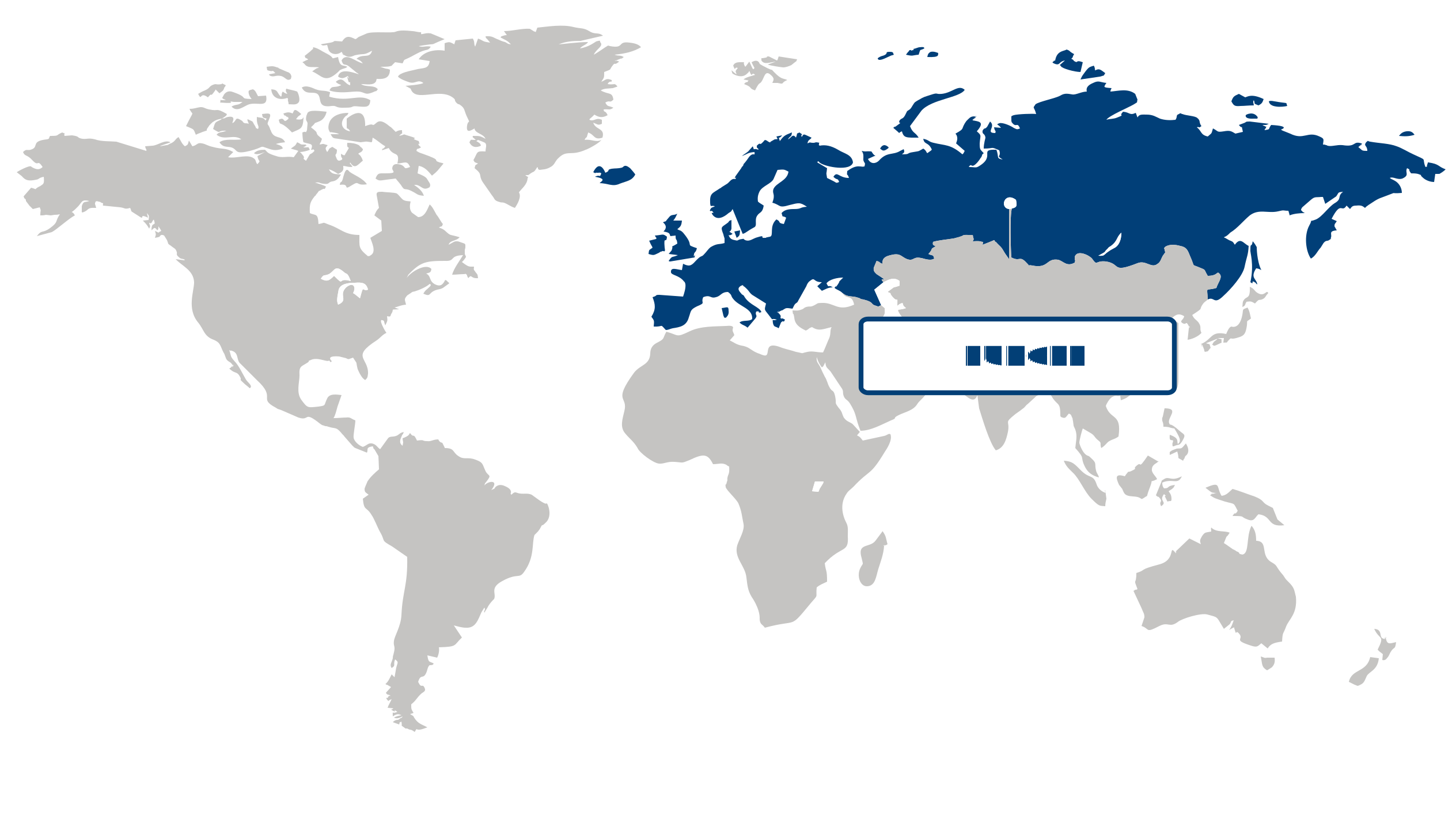
Largest Region
Europe
34.98% Market Share in 2026
Europe (Largest Region) vs Asia Pacific (Fastest-Growing Region)
Europe led the dashboard camera market with a 34.98% share in 2026, supported by strong consumer awareness of vehicle safety, growing interest in road incident documentation, and an established automotive technology ecosystem. Dashboard cameras are increasingly valued for providing video evidence in the event of accidents, supporting driver awareness, and enhancing vehicle security. Demand is further supported by the region's developed automotive aftermarket and growing integration of connected vehicle technologies. Consumer preference for advanced driver-assistance features and greater adoption of smart in-car devices are encouraging demand for cameras with enhanced recording, connectivity, and monitoring capabilities.
Asia Pacific is the fastest-growing regional market, driven by rising vehicle ownership, expanding urban transportation networks, and increasing awareness of in-car safety technologies. Growing traffic density and greater consumer interest in vehicle monitoring are encouraging adoption of dashboard cameras across passenger and commercial vehicles. The expansion of e-commerce and digital retail is improving access to a wide range of camera products, while declining technology barriers are making advanced features more accessible to consumers. Increasing integration of connected devices and smart vehicle technologies is also creating opportunities for dashboard cameras with cloud connectivity, driver monitoring, and enhanced security functions.
Key Country Insights
The U.S. dashboard camera market benefits from increasing use of video evidence, connected vehicle technologies, and fleet safety management. Businesses and consumers in the U.S. are adopting AI-enabled dash cameras with cloud storage and driver monitoring capabilities.
Japan favors compact dashboard cameras offering reliable recording quality, ease of installation, and advanced driver assistance compatibility. Japanese consumers increasingly seek features such as night vision, parking surveillance, and efficient storage management for everyday driving.
South Korea advances dashboard camera innovation through expertise in consumer electronics and connected automotive technologies. Manufacturers focus on AI-powered recording, real-time alerts, and enhanced imaging capabilities to improve road safety and user convenience.
Germany prioritizes dashboard camera technologies that complement advanced vehicle safety systems while complying with privacy requirements. Manufacturers increasingly integrate high-resolution recording, incident detection, and intelligent data management into connected mobility solutions.
France is witnessing broader dashboard camera adoption as drivers seek reliable documentation for accident reporting and vehicle security. Product development in France increasingly emphasizes image clarity, secure data storage, and straightforward integration with connected vehicle platforms.
Italy continues expanding dashboard camera usage among private motorists and commercial fleets seeking improved road incident documentation. Manufacturers serving Italy prioritize affordable feature-rich devices with enhanced recording performance, parking monitoring, and simplified mobile connectivity.
Segment Leadership and Growth Trends
Application Segment Analysis: Personal Vehicle (Largest Segment) vs Commercial Vehicle (Fastest-Growing Segment)
The personal vehicle segment held the largest share of the dashboard camera market in 2026, supported by increasing consumer emphasis on road safety, incident documentation, and protection against insurance and liability disputes. Dashcams are increasingly viewed as practical in-vehicle safety accessories, providing drivers with recorded evidence during accidents, traffic incidents, and other unexpected events. Growing awareness of driver assistance technologies, improved camera quality, and greater availability of feature-rich dashboard cameras are further supporting adoption among personal vehicle owners.
Commercial vehicle applications are positioned as the fastest-growing segment, driven by the expanding use of video monitoring to improve fleet safety, driver accountability, and operational visibility. Fleet operators increasingly rely on dashboard cameras to document road incidents, monitor driving behavior, and support risk management across commercial transportation activities. The integration of features such as real-time monitoring, connected technologies, and advanced recording capabilities is strengthening the value proposition of dashboard cameras for commercial fleets, particularly as businesses place greater emphasis on safety and efficient vehicle management.
Product Segment Analysis: 1-Channel (Largest Segment) vs 2-Channel (Fastest-Growing Segment)
The 1-channel segment represented the largest share of the dashboard camera market in 2026, reflecting its straightforward installation, lower system complexity, and suitability for drivers seeking basic forward-facing recording. These systems provide an accessible means of documenting road conditions and traffic incidents without requiring extensive hardware or configuration. Their broad compatibility with personal vehicles, relatively simple operation, and increasing consumer awareness of the benefits of video evidence continue to support demand for single-camera dashboard solutions.
The 2-channel segment is expected to experience the fastest growth as users increasingly seek broader visual coverage from both the front and rear of the vehicle. Dual-camera configurations provide more comprehensive incident documentation and can enhance awareness of events occurring behind the vehicle, making them attractive for safety-conscious drivers. Growing demand for advanced vehicle monitoring, improved image quality, and integrated features that enhance overall recording coverage is encouraging a shift toward more comprehensive multi-camera dashboard systems.
| Report Segmentation | |||
| Segment | Sub-Segment | Largest Segment | Fastest Growing Segment |
|---|---|---|---|
| Application | Commercial Vehicle, Personal Vehicle | Personal Vehicle | Commercial Vehicle |
| Product | 1-Channel, 2-Channel | 1-Channel | 2-Channel |
| Video Quality | SD & HD Video Quality, Full HD & 4K Video Quality | Full HD & 4K Video Quality | Full HD & 4K Video Quality |
| Distribution Channel | Online, In-Store | In-Store | Online |
| Technology | Basic, Advanced, Smart | Advanced | Smart |
 Read our Research Approach
Competitive Landscape and Market Positioning
Major players in the dashboard camera market:
1. Garmin Ltd. (United States)
2. Panasonic Holdings Corporation (Japan)
3. Pittasoft Co. Ltd. (South Korea)
4. Cobra Electronics Corporation (United States)
5. Nexar Inc. (United States)
6. Amcrest Technologies LLC (United States)
7. Steelmate Co. Ltd. (China)
8. Waylens Inc. (United States)
9. DOD Technologies Inc. (Taiwan)
10. WatchGuard Video Inc. (United States)
The dashboard camera market is evolving with rising demand for safety, surveillance, and driving analytics features. Advanced imaging and connectivity functions are enhancing user value. The dashboard camera market is also shaped by product differentiation focused on intelligent recording and real-time monitoring capabilities.
Industry Development/News
| Company Name | Date | Key Development |
|---|---|---|
| Garmin Ltd. | Jan-23 | Garmin launched the Dash Cam Live, an LTE-connected device providing drivers with persistent, remote access to live exterior vehicle views. This product integration highlights a strategic shift toward cloud-based connectivity in the consumer dash camera market, enabling real-time surveillance and enhanced security monitoring capabilities for vehicle owners beyond traditional local recording. |
| Pioneer Corporation | Sep-25 | Pioneer India expanded its Mobility AI portfolio with the VREC series, introducing AI-enabled smart dash cameras ranging from Full HD to 4K. By integrating ADAS alerts and remote mobile app connectivity, the company is targeting the growing demand for advanced driver-assistance systems and digital safety solutions in the Indian automotive aftermarket. |
| 70mai | Sep-25 | 70mai introduced the A810 Lite 4K dash cam, featuring 4G cloud connectivity and real-time app-based alerting. This launch strengthens the company’s competitive positioning in the value-oriented segment by combining high-resolution recording with connected safety features, directly addressing the evolving consumer requirement for integrated, real-time in-vehicle monitoring solutions at an accessible price point. |
| Firsttech LLC | Sep-23 | Firsttech launched the DroneMobile XC Dash Cam, engineered for seamless integration with existing remote start and vehicle security systems. This strategic product introduction facilitates a comprehensive ecosystem approach, allowing users to consolidate security and monitoring functions into a unified interface, thereby increasing the utility of aftermarket vehicle surveillance solutions. |
| Bolt | Aug-25 | Bolt launched a software-based dash cam feature for its ride-hailing fleet in Nigeria, enabling existing smartphones to function as dashboard cameras. This operational development enhances safety and incident documentation transparency for both drivers and passengers, representing a significant shift in fleet management by leveraging mobile technology to achieve surveillance capabilities without requiring dedicated hardware investments. |
| Qubo | Oct-23 | Qubo, a division of Hero Electronix, expanded its smart device portfolio with the release of the Dashcam Pro X and Pro 3K systems. Incorporating features such as GPS tracking, time-lapse, and multi-channel camera support, these products reflect a strategic entry into the connected vehicle surveillance market aimed at providing real-time fleet and personal vehicle tracking capabilities. |
| WatchGuard Technologies, Inc. | Sep-21 | WatchGuard Technologies launched an AI-enabled in-car video system designed for law enforcement applications. By integrating artificial intelligence into its dash camera architecture, the company addressed specialized demand for advanced incident recording and evidence management, demonstrating the application of high-performance, intelligent surveillance technology within professional public safety and fleet operations. |
Why Choose Us
Specialized Expertise: Our team comprises industry experts with a deep understanding of your market segment. We bring specialized knowledge and experience that ensures our research and consulting services are tailored to your unique needs.
Customized Solutions: We understand that every client is different. That's why we offer customized research and consulting solutions designed specifically to address your challenges and capitalize on opportunities within your industry.
Proven Results: With a track record of successful projects and satisfied clients, we have demonstrated our ability to deliver tangible results. Our case studies and testimonials speak to our effectiveness in helping clients achieve their goals.
Cutting-Edge Methodologies: We leverage the latest methodologies and technologies to gather insights and drive informed decision-making. Our innovative approach ensures that you stay ahead of the curve and gain a competitive edge in your market.
Client-Centric Approach: Your satisfaction is our top priority. We prioritize open communication, responsiveness, and transparency to ensure that we not only meet but exceed your expectations at every stage of the engagement.
Continuous Innovation: We are committed to continuous improvement and staying at the forefront of our industry. Through ongoing learning, professional development, and investment in new technologies, we ensure that our services are always evolving to meet your evolving needs.
Value for Money: Our competitive pricing and flexible engagement models ensure that you get maximum value for your investment. We are committed to delivering high-quality results that help you achieve a strong return on your investment.
Select Licence Type

