



Dispersing Agents Market Size & Growth Forecast 2027–2036, By Segments (Type, Structure, End Use), Regional Demand Trends (North America, Asia Pacific, Europe), Key Country Insights (U.S., Japan, South Korea, Germany, France, Italy), and Competitive Landscape
Market Size and Growth Outlook
Dispersing Agents Market size was around USD 2.8 billion in 2026 and is slated to grow at a 5.51% CAGR from 2027 to 2036, exceeding USD 4.79 billion by 2036. The industry revenue for 2027 is assessed at USD 2.93 billion.
Base Year Value (2026)
USD 2.8 billion
CAGR (2027-2036)
5.51%
Forecast Year Value (2036)
USD 4.79 billion

Historical Data Period
2022-2026

Largest Region
Europe

Forecast Period
2027-2036
Dispersing Agents Market Intelligence Snapshot:
-
Regional Market Dynamics:
- Europe held 53.76% share due to established coatings construction and industrial manufacturing base supporting stable demand for high-performance formulation-stability-focused dispersing agents across mature production systems
- Asia Pacific growth is driven by expanding manufacturing capacity and rising coatings and construction demand increasing need for additives ensuring uniform dispersion and scalable cost-effective production
-
Segment Momentum:
- Water-Borne held a 76.32% market share in 2026, supported by compatibility with water-based applications and easier production integration, allowing manufacturers to meet application requirements while maintaining established processing practices.
- Non-Ionic is the fastest-growing structure segment as formulators seek greater flexibility across varied system conditions and material combinations, supporting stable dispersion performance under evolving compatibility requirements.
-
Market Expansion Drivers:
- Expanding paints and coatings production increasing demand for high-performance pigment dispersion additives.
- Rising global construction activity accelerating usage of dispersing agents in adhesives and sealants.
- Growing shift toward water-borne formulations supporting adoption of environmentally compliant dispersing technologies.
-
Leading Market Participants:
Leading players in the dispersing agents market include BASF SE (Germany), Arkema S.A. (France), Dow Inc. (United States), Evonik Industries AG (Germany), Clariant AG (Switzerland), Solvay S.A. (Belgium), Kemira Oyj (Finland), Nouryon Holding B.V. (Netherlands), ALTANA AG (Germany), The Lubrizol Corporation (United States).
Global Market Forecast Snapshot:
-
Market Outlook:
- 2026 Market Size: USD 2.8 billion
- 2027 Estimated Market Size: USD 2.93 billion.
- Projected Market Size: USD 4.79 billion by 2036
- Growth Forecasts: 5.51% CAGR (2027-2036)
-
Regional and Segment Outlook:
- Leading Regional Market: Europe
- High-Growth Regional Hub: Asia Pacific
- Core Revenue Segment: Water-Borne (Type) | Anionic (Structure) | Paints, Coatings & Inks (End Use)
- Emerging Opportunity Segment: Water-Borne (Type) | Non-Ionic (Structure) | Construction (End Use)
Market Growth Drivers and Industry Trends
Expanding paints and coatings production increasing demand for high-performance pigment dispersion additives
Expanding production of paints and coatings is increasing the requirement for additives that enable uniform distribution and stability of pigments within formulations. The dispersing agents market will benefit from the need to achieve consistent color, appearance, viscosity, and formulation performance across architectural, industrial, and specialty coatings. High-performance dispersing technologies help prevent pigment agglomeration and improve formulation stability, allowing manufacturers to develop coatings with reliable application characteristics and surface properties.
Rising global construction activity accelerating usage of dispersing agents in adhesives and sealants
Rising construction activity is supporting greater consumption of adhesives and sealants used across building, infrastructure, and installation applications. As formulation complexity increases, the dispersing agents market is supported by the role of these additives in maintaining the uniform distribution of solid particles and functional ingredients within adhesive and sealant systems. Effective dispersion contributes to formulation stability and processing performance, helping manufacturers maintain consistent product characteristics across construction-related applications.
Growing shift toward water-borne formulations supporting adoption of environmentally compliant dispersing technologies
The shift toward water-borne formulations is encouraging manufacturers to adopt additive technologies compatible with lower-emission formulation systems and evolving environmental requirements. In this environment, the dispersing agents market is gaining traction as formulators require effective solutions for stabilizing pigments and other solid components in aqueous systems. Development of dispersants suited to water-based products can support formulation performance while helping coatings and related products align with preferences for environmentally compliant manufacturing and application practices.
| Growth Driver Assessment Framework | |||||
| Growth Driver | Impact On CAGR | Regulatory Influence | Geographic Relevance | Adoption Rate | Impact Timeline |
|---|---|---|---|---|---|
| Expanding paints and coatings production increasing demand for high-performance pigment dispersion additives | 1.90% | Moderate | Europe, Asia Pacific | High | Near Term |
| Rising global construction activity accelerating usage of dispersing agents in adhesives and sealants | 1.70% | Moderate | Asia Pacific, Middle East & Africa | High | Mid Term |
| Growing shift toward water-borne formulations supporting adoption of environmentally compliant dispersing technologies | 1.30% | High | Europe, North America | Emerging | Mid Term |
Unlock insights tailored to your business with our bespoke market research solutions - Click to get your customized report now!
Regional Demand Dynamics
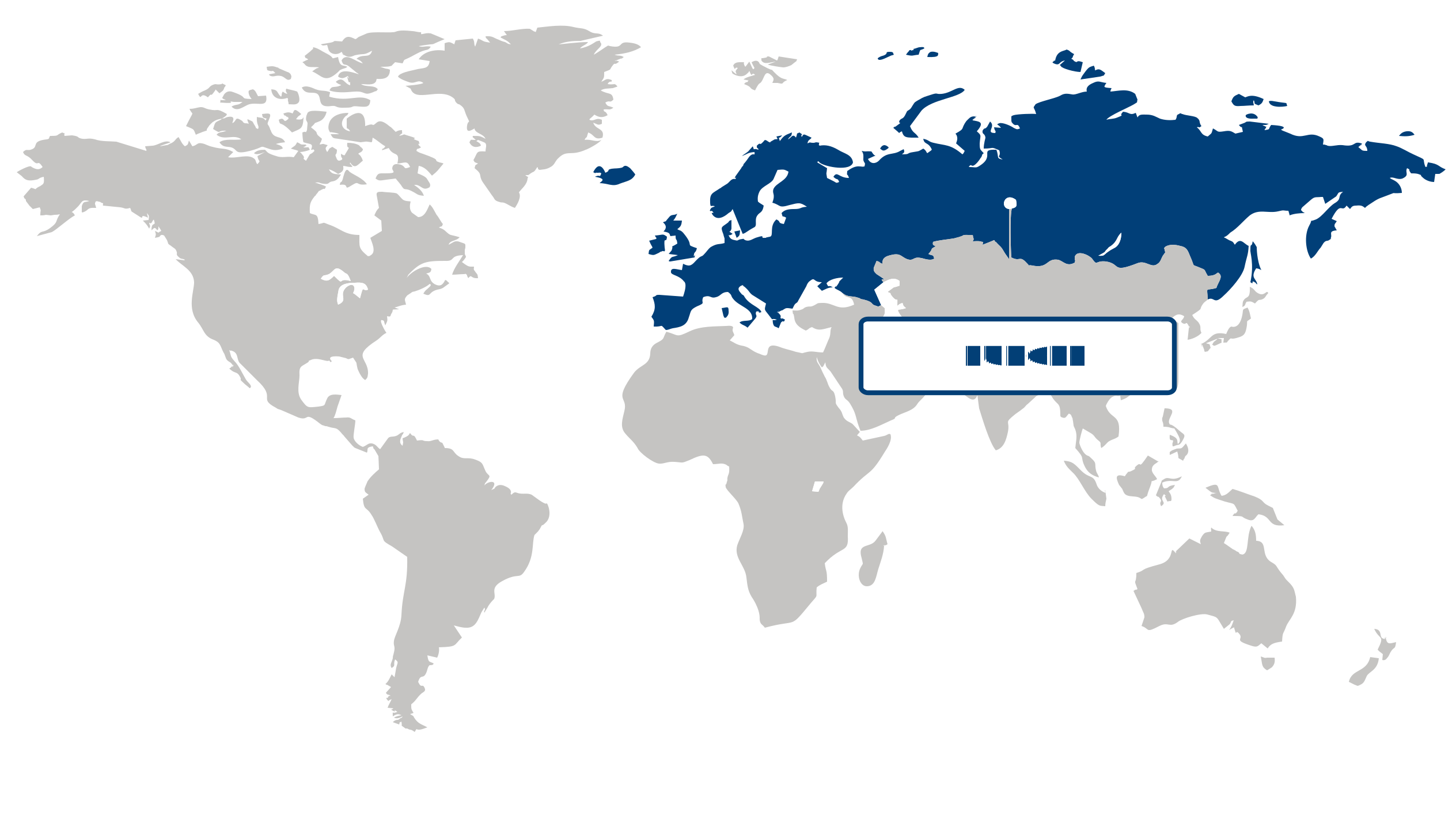
Largest Region
Europe
53.76% Market Share in 2026
Europe (Largest Region) vs Asia Pacific (Fastest-Growing Region)
Europe accounted for a 53.76% share of the dispersing agents market in 2026, reflecting its sophisticated chemical processing base and strong demand for high-performance formulations across coatings, paints, plastics, and other industrial applications. Manufacturers increasingly require effective dispersion to improve product consistency, processing performance, and material quality, supporting sustained consumption of specialized additives. The region's emphasis on product performance, sustainable formulation practices, and advanced materials development further reinforces its established market position.
Asia Pacific is the fastest-growing region, driven by expanding manufacturing activity, construction development, and rising production of paints, coatings, plastics, and specialty materials. Increasing industrial output is creating greater requirements for additives that improve formulation stability and processing efficiency. Growing investments in manufacturing infrastructure, urban development, and advanced material production are supporting broader adoption of dispersing technologies across diverse end-use industries.
Key Country Insights
The U.S. dispersing agents market benefits from demand for advanced coatings, construction chemicals, and high-performance polymers. Producers emphasize multifunctional dispersants that improve formulation stability while supporting evolving performance and sustainability expectations across industrial applications.
Japan develops dispersing agents tailored for high-value electronics, specialty coatings, and advanced material formulations. The market emphasizes precise particle control and stable dispersion characteristics to meet demanding manufacturing specifications.
South Korea utilizes dispersing agents extensively in electronic materials, specialty coatings, and performance plastics. Suppliers focus on formulations that improve processing consistency while supporting advanced manufacturing requirements across technology-intensive industries.
Germany focuses on dispersing agents that enhance pigment dispersion and formulation efficiency in coatings and industrial materials. Manufacturers prioritize consistent product quality and compatibility with environmentally responsible production processes.
France promotes dispersing agents compatible with lower-emission coatings, construction products, and industrial formulations. Market participants increasingly align product development with environmental compliance while maintaining reliable dispersion performance for commercial applications.
Italy applies dispersing agents across paints, coatings, inks, and construction materials where formulation stability is essential. Manufacturers seek solutions that improve production efficiency, pigment utilization, and finished product consistency in diverse industrial applications.
Segment Leadership and Growth Trends
Type Segment Analysis: Water-Borne (Largest & Fastest-Growing Segment)
The water-borne segment dominated the dispersing agents market, accounting for a 76.32% share in 2026, while also emerging as the fastest-growing segment. Its strong position is supported by the increasing preference for environmentally compatible formulations with lower volatile organic compound content and improved workplace safety characteristics. Water-borne dispersing agents are widely used to enhance pigment distribution, maintain formulation stability, and improve the performance of water-based coatings, paints, inks, and other industrial formulations. Growing regulatory attention toward solvent reduction, together with rising demand for sustainable and high-performance chemical products, is further strengthening adoption. Continued innovation in water-based technologies and the expanding use of eco-conscious formulations across end-use industries are expected to support the segment's continued growth.
Structure Segment Analysis: Anionic (Largest Segment) vs Non-Ionic (Fastest-Growing Segment)
Holding the largest share in the dispersing agents market, the anionic segment accounted for 40.7% in 2026. Anionic dispersing agents are widely valued for their ability to provide effective particle separation and suspension stability in formulations containing pigments, fillers, and other solid materials. Their broad compatibility with numerous water-based applications, along with their effectiveness in improving dispersion quality and reducing particle agglomeration, supports strong demand across coatings, inks, and related industrial uses. The established use of anionic chemistries and their functional versatility continue to reinforce the segment's leading position.
The non-ionic segment is the fastest-growing structure segment, driven by rising demand for dispersing solutions that offer broad formulation compatibility and stable performance under varying processing conditions. Non-ionic dispersing agents are increasingly preferred in applications where reduced sensitivity to ph or ionic interactions is important, making them suitable for a range of specialized formulations. Growth in advanced coatings and other performance-oriented chemical products is encouraging the development of non-ionic solutions that can improve dispersion efficiency while supporting product consistency and durability.
| Report Segmentation | |||
| Segment | Sub-Segment | Largest Segment | Fastest Growing Segment |
|---|---|---|---|
| Type | Water-Borne, Other | Water-Borne | Water-Borne |
| Structure | Anionic, Non-Ionic, Hydrophilic, Amphoteric, Other | Anionic | Non-Ionic |
| End Use | Paints, Coatings & Inks, Adhesives & Sealants, Personal Care & Cosmetics, Agriculture, Construction, Household and Industrial/Institutional Cleaning, Other | Paints, Coatings & Inks | Construction |
 Read our Research Approach
Competitive Landscape and Market Positioning
Key companies in the dispersing agents market:
1. BASF SE (Germany)
2. Arkema S.A. (France)
3. Dow Inc. (United States)
4. Evonik Industries AG (Germany)
5. Clariant AG (Switzerland)
6. Solvay S.A. (Belgium)
7. Kemira Oyj (Finland)
8. Nouryon Holding B.V. (Netherlands)
9. ALTANA AG (Germany)
10. The Lubrizol Corporation (United States)
The dispersing agents market is experiencing increasing innovation aimed at improving formulation stability, processing efficiency, and environmental performance. Manufacturers are investing in advanced chemical technologies to develop sustainable and application-specific dispersing solutions for coatings, inks, and construction materials. Competitive differentiation is increasingly tied to the ability to deliver high-performance products aligned with evolving regulatory expectations.
Industry Development/News
| Company Name | Date | Key Development |
|---|---|---|
| BASF SE | Aug-23 | BASF SE introduced a new production plant in Dilovasi, Turkey, dedicated to manufacturing water-soluble dispersants based on acrylic acid. This capital investment expands the company's regional production footprint to support industrial cleaning, detergent, and chemical processing customers across Europe, the Middle East, and Africa. |
| BASF | Sep-21 | BASF and Sanyo Chemical signed a Memorandum of Understanding for a strategic collaboration focused on developing sustainable polyurethane dispersions. The partnership combines corporate technical expertise to co-develop innovative, eco-friendly solutions that enhance the sustainability profile of specialized dispersing agents across international markets. |
| Evonik | Mar-25 | Evonik launched ORTEGOL DA 801, a specialized polyurethane-based dispersing agent designed for thermal interface materials in electric vehicle batteries. The technical innovation addresses critical automotive energy storage needs by reducing formulation viscosity while securing essential thermal conductivity and long-term operational performance. |
| BASF | Apr-24 | BASF commercialized Efka PX 4360, a next-generation solvent-based dispersing agent utilizing controlled free radical polymerization technology. This product innovation delivers exceptional performance, extended durability, and excellent storage stability, providing industrial ink and coatings formulators with advanced rheology control solutions. |
| Evonik | Jul-22 | Evonik introduced TEGO Dispers 658, a sustainable and readily biodegradable dispersing additive for pigment and colored coatings production. The eco-friendly solution enables chemical formulators to satisfy stringent environmental standards without compromising on pigment stabilization, optical quality, or functional performance profiles. |
| Clariant AG | Oct-21 | Clariant AG commercialized its Licosperse product line, representing an eco-friendlier pigment-dispersing agent range for polish and surface care applications. The readily non-hazardous formulations simplify the manufacturing process by incorporating seamlessly into base media, achieving consistent color development and processing efficiencies. |
| Altana | Jul-21 | Altana expanded its portfolio with two wetting and dispersing additives, DisperBYK-2018 and DisperBYK-2019, engineered for industrial coatings. The additives provide advanced viscosity reduction combined with Newtonian flow behavior, ensuring exceptional pigment stabilization and pristine optical characteristics for high-performance applications. |
| Clariant AG | May-21 | Clariant AG launched the Hostatint AU aqueous pigment-dispersing agent product line, targeting architectural coatings markets. This product commercialization expands the accessible color spectrum for both interior and exterior applications, providing paint manufacturers in North and South America with enhanced custom tinting capabilities. |
Why Choose Us
Specialized Expertise: Our team comprises industry experts with a deep understanding of your market segment. We bring specialized knowledge and experience that ensures our research and consulting services are tailored to your unique needs.
Customized Solutions: We understand that every client is different. That's why we offer customized research and consulting solutions designed specifically to address your challenges and capitalize on opportunities within your industry.
Proven Results: With a track record of successful projects and satisfied clients, we have demonstrated our ability to deliver tangible results. Our case studies and testimonials speak to our effectiveness in helping clients achieve their goals.
Cutting-Edge Methodologies: We leverage the latest methodologies and technologies to gather insights and drive informed decision-making. Our innovative approach ensures that you stay ahead of the curve and gain a competitive edge in your market.
Client-Centric Approach: Your satisfaction is our top priority. We prioritize open communication, responsiveness, and transparency to ensure that we not only meet but exceed your expectations at every stage of the engagement.
Continuous Innovation: We are committed to continuous improvement and staying at the forefront of our industry. Through ongoing learning, professional development, and investment in new technologies, we ensure that our services are always evolving to meet your evolving needs.
Value for Money: Our competitive pricing and flexible engagement models ensure that you get maximum value for your investment. We are committed to delivering high-quality results that help you achieve a strong return on your investment.
Select Licence Type

