E-fuel Market Size & Growth Forecast 2027–2036, By Segments (Application, Renewable Source, Technology, Product), Regional Demand Trends (North America, Asia Pacific, Europe), Key Country Insights (U.S., Japan, South Korea, Germany, France, Italy), and Competitive Landscape
Market Size and Growth Outlook
E-fuel Market size was over USD 12.74 Billion in 2026 and is likely to grow at 32.84% CAGR between 2027 and 2036, surpassing USD 218 Billion by 2036. The industry revenue for 2027 is assessed at USD 16.43 Billion.
Get more details on this report
Request Free Sample ReportE-fuel Market Intelligence Snapshot
Regional Market Dynamics
- Europe led in 2026 through strong decarbonization objectives, cleaner transport policies, renewable energy capabilities, and investment in sustainable aviation and maritime fuels.
- North America is expanding rapidly through low-carbon fuel investment, renewable energy potential, transportation decarbonization efforts, and advances in electrolyzers and carbon utilization.
Segment Momentum
- The automotive segment accounted for 36.29% of the market in 2026, driven by the large global vehicle fleet, regulatory support, and demand for lower-emission fuels compatible with existing vehicles and fueling infrastructure.
- Aviation is expanding the fastest as airlines pursue sustainable fuel alternatives that reduce lifecycle emissions while remaining compatible with existing aircraft and airport infrastructure, supported by growing decarbonization investments.
Market Expansion Drivers
- Strong government policy support and carbon neutrality targets accelerating synthetic fuel adoption
- Increasing renewable energy penetration enabling scalable production of synthetic fuels via green hydrogen
- Expansion of aviation and maritime decarbonization initiatives driving demand for low-carbon alternative fuels
Leading Market Participants
- Leading players in the E-fuel market include ExxonMobil Corporation (United States), Porsche AG (Germany), Siemens Energy AG (Germany), MAN Energy Solutions SE (Germany), LanzaJet, Inc. (United States), HIF Global (Chile), Climeworks AG (Switzerland), Sunfire GmbH (Germany), Norsk e-Fuel AS (Norway), Archer Daniels Midland Company (United States)
Global Market Forecast Snapshot
Market Outlook
- 2026 Market Size: USD 12.74 Billion
- 2027 Estimated Market Size: USD 16.43 Billion
- Projected Market Size: USD 218 Billion by 2036
- Growth Forecast: 32.84% CAGR (2027-2036)
Regional and Segment Outlook
- Leading Regional Market: Europe
- High-Growth Regional Hub: North America
- Core Revenue Segment: Automotive (Application) | On-Site Solar (Renewable Source) | Fischer-Tropsch (Technology) | E-Kerosene (Product)
- Emerging Opportunity Segment: Aviation (Application) | On-Site Solar (Renewable Source) | Fischer-Tropsch (Technology) | E-Kerosene (Product)
Market Growth Drivers and Industry Trends
Strong government policy support and carbon neutrality targets accelerating synthetic fuel adoption
Governments across major economies are introducing climate policies, emissions reduction frameworks, and carbon neutrality commitments that encourage the transition toward sustainable energy alternatives. These initiatives will drive the E-fuel market growth by creating favorable regulatory conditions for synthetic fuels in sectors where direct electrification remains challenging. Policy incentives, emissions compliance requirements, and decarbonization roadmaps are also encouraging investments in production facilities, research programs, and supporting infrastructure for low-carbon fuel deployment.
Increasing renewable energy penetration enabling scalable production of synthetic fuels via green hydrogen
The rapid expansion of renewable electricity generation is improving the availability of clean energy required for green hydrogen production, a critical feedstock in synthetic fuel manufacturing. As renewable resources become more accessible, the E-fuel market benefits from greater opportunities to produce carbon-neutral fuels with lower lifecycle emissions. Enhanced integration between renewable power generation, electrolysis technologies, and carbon capture processes is strengthening production efficiency while supporting the development of commercially viable synthetic fuel value chains.
Expansion of aviation and maritime decarbonization initiatives driving demand for low-carbon alternative fuels
The aviation and maritime industries are intensifying efforts to reduce greenhouse gas emissions while maintaining operational reliability for long-distance transportation. This transition will propel the E-fuel market growth as synthetic fuels provide a practical alternative for applications where conventional fossil fuels remain difficult to replace with fully electric solutions. Industry-wide decarbonization strategies are encouraging fuel suppliers, transport operators, and infrastructure stakeholders to incorporate low-carbon fuels into existing operations without requiring extensive modifications to established engines and fueling systems.
| Growth Driver | Impact on CAGR | Regulatory Influence | Geographic Relevance | Adoption Rate | Impact Timeline |
|---|---|---|---|---|---|
| Strong government policy support and carbon neutrality targets accelerating synthetic fuel adoption | 4.2% | High | Europe, North America | High | Near Term |
| Increasing renewable energy penetration enabling scalable production of synthetic fuels via green hydrogen | 4% | High | Europe, Asia Pacific | High | Near Term |
| Expansion of aviation and maritime decarbonization initiatives driving demand for low-carbon alternative fuels | 3.8% | High | Europe, Middle East | High | Mid Term |
Unlock insights tailored to your business with our bespoke market research solutions.
Click to get your customized report now.
Regional Demand Dynamics
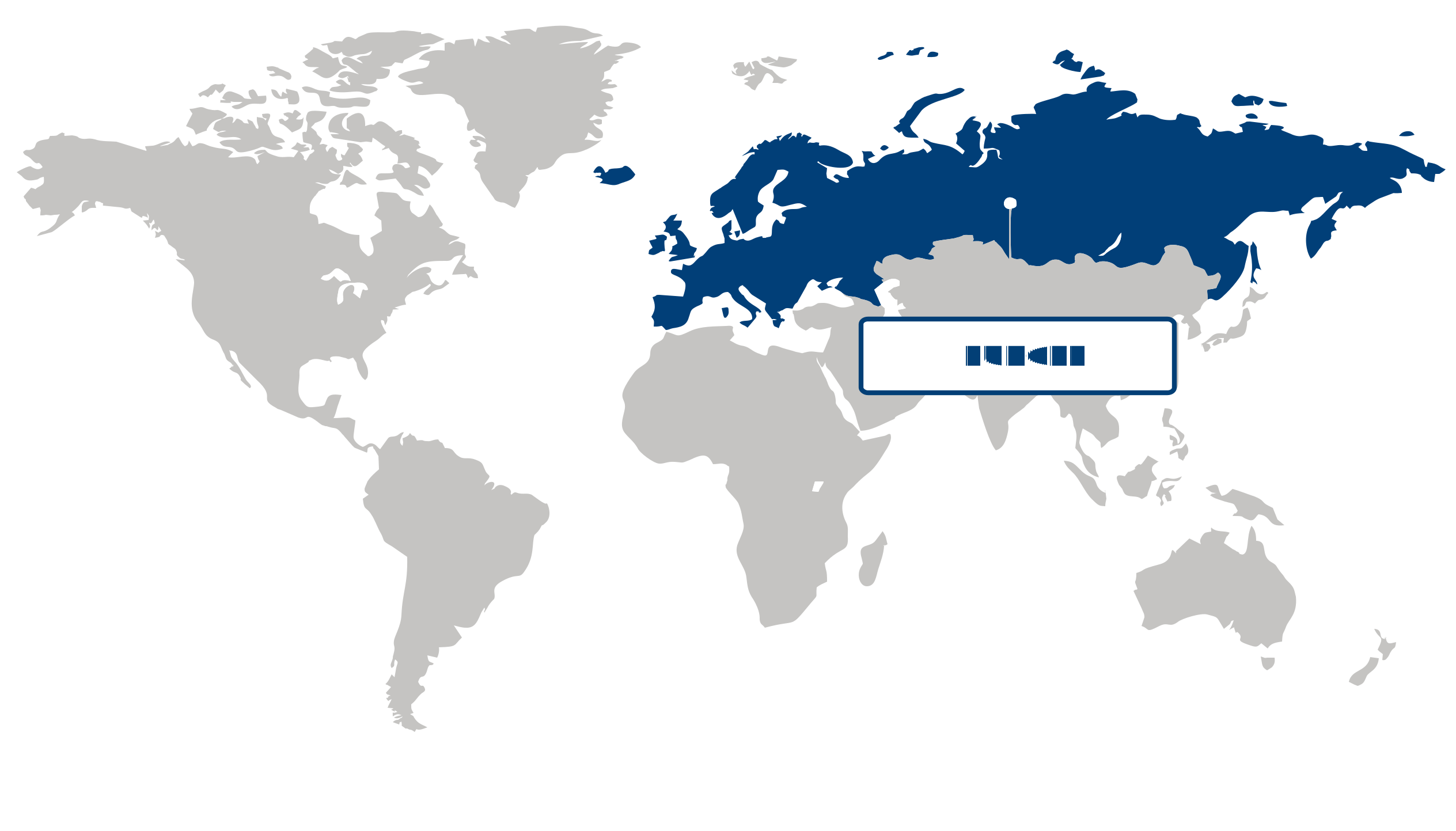
Europe (Largest Region)
Europe represented the largest regional market for the E-fuel market in 2026, supported by strong decarbonization objectives and an established policy focus on reducing emissions from difficult-to-electrify transport applications. The region’s emphasis on sustainable aviation, maritime transportation, and low-carbon mobility is encouraging investment in synthetic fuels that can utilize existing fuel infrastructure while reducing dependence on conventional fossil fuels. Regulatory initiatives promoting renewable energy and cleaner transportation are further strengthening the investment environment. In addition, Europe’s established renewable energy ecosystem and growing interest in power-to-liquid and power-to-gas technologies provide an important foundation for e-fuel production and deployment.
North America (Fastest-Growing Region)
North America is projected to experience the fastest growth, driven by increasing investment in low-carbon fuels and rising interest in technologies capable of decarbonizing aviation, shipping, and other energy-intensive applications. The region’s abundant renewable energy potential provides favorable conditions for producing synthetic fuels using renewable electricity and captured carbon. Growing efforts to reduce transportation emissions, together with expanding interest in domestic clean-energy production, are encouraging development across the e-fuel value chain. Technological advances in electrolyzers, carbon utilization, and synthetic fuel production are further improving the commercial potential of e-fuels and supporting their adoption across hard-to-abate sectors.
| Parameter | North America | Asia Pacific | Europe | Latin America | MEA |
|---|---|---|---|---|---|
| Innovation Hub i Scale Nascent Developing Advanced | |||||
| Cost-Sensitive Region i Scale Low Medium High | |||||
| Regulatory Environment i Scale Restrictive Neutral Supportive | |||||
| Demand Drivers i Scale Weak Moderate Strong | |||||
| Development Stage i Scale Emerging Developing Developed | |||||
| Adoption Rate i Scale Low Medium High | |||||
| New Entrants / Startups i Scale Sparse Moderate Dense | |||||
| Macro Indicators i Scale Weak Stable Strong |
Key Country Insights
United States 🇺🇸
Industrial Decarbonization PathwaysThe U.S. e-fuel market is advancing through investments in synthetic fuel production for aviation, heavy transport, and industrial applications where direct electrification remains challenging. Collaboration between energy companies and technology developers supports commercialization of scalable production technologies.
Germany 🇩🇪
Renewable Fuel IntegrationGermany promotes e-fuel adoption by linking renewable electricity with synthetic fuel production to support transportation and industrial decarbonization. German stakeholders prioritize compatibility with existing fuel infrastructure while expanding low-carbon energy solutions across multiple sectors.
Japan 🇯🇵
Alternative Fuel DiversificationJapan is developing the e-fuel market to diversify energy sources and reduce emissions in sectors requiring liquid fuels. Japanese companies actively evaluate production technologies and international supply partnerships to strengthen future fuel availability.
South Korea 🇰🇷
Clean Industrial EnergySouth Korea is expanding e-fuel initiatives to complement broader industrial decarbonization and sustainable transportation strategies. The country supports technology development and infrastructure planning that improve the practical deployment of synthetic fuels across industrial value chains.
France 🇫🇷
Sustainable Aviation SupportFrance focuses on e-fuel development for aviation and other transport applications that require lower-carbon liquid fuels. French industry participants emphasize technology partnerships and renewable energy integration to strengthen sustainable fuel production capabilities.
Italy 🇮🇹
Energy Transition CollaborationItaly is incorporating e-fuels into broader energy transition initiatives by encouraging cooperation between fuel producers, industrial users, and research organizations. The Italian market emphasizes practical deployment opportunities that complement existing transportation and energy infrastructure.
Segment Leadership and Growth Trends
E-fuel Market Share (%), by Application, 2026
Go beyond the chart, access full insights & data tables
Request Free Sample ReportApplication Segment Analysis: Automotive (Largest Segment) vs Aviation (Fastest-Growing Segment)
The automotive segment accounted for 36.29% in 2026, making it the largest application within the E-fuel market. The segment's dominance is driven by the substantial global vehicle fleet and the growing emphasis on reducing transport-related emissions without requiring complete replacement of existing internal combustion engine vehicles. E-fuels provide a practical pathway for lowering carbon emissions while leveraging established fueling infrastructure, encouraging adoption across passenger and commercial transportation. Continued regulatory support for cleaner mobility solutions and increasing investments in sustainable transportation further reinforce the segment's leading position.
The aviation segment is projected to register the fastest growth during the forecast period. Airlines and aviation stakeholders are increasingly pursuing sustainable fuel alternatives to reduce lifecycle emissions while maintaining compatibility with existing aircraft and airport infrastructure. Growing industry commitments to decarbonization, combined with increasing investment in sustainable aviation fuel production technologies, are accelerating the adoption of e-fuels across the aviation sector.
Renewable Source Segment Analysis: On-Site Solar (Largest & Fastest-Growing Segment)
The E-fuel market was led by the on-site solar segment, which held the largest share in 2026, while also emerging as the fastest-growing renewable source. On-site solar power enables e-fuel production facilities to generate renewable electricity directly at the production site, improving operational efficiency while reducing dependence on external power supplies. The declining cost of solar installations, increasing availability of suitable project locations, and growing emphasis on low-carbon fuel production continue to strengthen the adoption of this renewable energy source. These advantages reinforce both its market leadership and its strong growth outlook.
Technology Segment Analysis: Fischer-Tropsch (Largest & Fastest-Growing Segment)
The E-fuel market was led by the fischer-tropsch technology segment, which held the largest share in 2026 and also represented the fastest-growing technology category. Fischer-Tropsch synthesis is widely recognized for its ability to convert renewable feedstocks into high-quality synthetic fuels compatible with existing transportation infrastructure. The technology supports the production of multiple fuel types while delivering consistent fuel quality, making it suitable for diverse end-use applications. Continued technological improvements, expanding investments in synthetic fuel production facilities, and increasing demand for scalable low-carbon fuel solutions continue to strengthen the segment's dominant market position and future growth.
| Segment | Sub-Segment | Largest Segment | Fastest Growing |
|---|---|---|---|
| Application | Automotive, Marine, Aviation, Industrial, Others | Automotive | Aviation |
| Renewable Source | On-Site Solar, Wind | On-Site Solar | On-Site Solar |
| Technology | Fischer-Tropsch, eRWGS, Others | Fischer-Tropsch | Fischer-Tropsch |
| Product | E-Gasoline, E-Diesel, E-Kerosene, Ethanol, E-Methanol, Others | E-Kerosene | E-Kerosene |
Competitive Landscape and Market Positioning
Major players in the E-fuel market:
- ExxonMobil Corporation (United States)
- Porsche AG (Germany)
- Siemens Energy AG (Germany)
- MAN Energy Solutions SE (Germany)
- LanzaJet, Inc. (United States)
- HIF Global (Chile)
- Climeworks AG (Switzerland)
- Sunfire GmbH (Germany)
- Norsk e-Fuel AS (Norway)
- Archer Daniels Midland Company (United States)
The competitive direction of the e-fuel market is increasingly influenced by the race to establish commercially viable production pathways while securing dependable access to renewable energy resources and sustainable carbon feedstocks. Market participants are refining production technologies to improve efficiency and reduce operational complexity, recognizing that scalable manufacturing capabilities will become a defining competitive advantage as demand broadens across hard-to-decarbonize transportation sectors. Suppliers are also expanding technical expertise around fuel compatibility, certification requirements, and integration with existing infrastructure, creating a market where process innovation and execution capability are becoming more influential than early market entry alone.
| Company | Market Share | Company Revenue | Revenue CAGR (%) | Product Portfolio | Geographic Presence | Innovation / R&D Focus | Strategic Developments |
|---|---|---|---|---|---|---|---|
| ExxonMobil Corporation (United States) | |||||||
| Porsche AG (Germany) | |||||||
| Siemens Energy AG (Germany) | |||||||
| MAN Energy Solutions SE (Germany) | |||||||
| LanzaJet Inc. (United States) | |||||||
| HIF Global (Chile) | |||||||
| Climeworks AG (Switzerland) | |||||||
| Sunfire GmbH (Germany) | |||||||
| Norsk e-Fuel AS (Norway) | |||||||
| Archer Daniels Midland Company (United States) |
Industry Development/News
| Company Name | Date | Key Development |
|---|---|---|
| Twelve | Jun-26 | The company commenced operations at AirPlant One in Washington, its initial commercial-scale domestic facility. The site utilizes captured carbon dioxide, water, and renewable energy to synthesize sustainable aviation fuel, accelerating the commercialization of synthetic aviation alternatives. |
| Airco | May-26 | The company established a new production plant in New Britain, Pennsylvania, to scale up the domestic manufacturing of its proprietary e-fuel production systems. The capital expansion directly enhances supply chain capacities for defense-centric synthetic fuel technologies. |
| Rheinmetall | Mar-26 | The defense conglomerate co-developed a mobile, green hydrogen-based e-fuel production system alongside INERATEC. The decentralized technology integration targets military operational applications, offering secure and localized synthetic fuel supply chains in tactical environments. |
| Norsk e-Fuel | Jan-26 | The developer's Finnish subsidiary secured €150 million in tax credit backing to construct a large-scale Power-to-Liquid plant. The funding strengthens institutional capital flow into industrial sustainable aviation fuel infrastructure and expands regional production capacities. |
| Infinium | Nov-25 | International Airlines Group executed a binding 10-year offtake contract to source Power-to-Liquid sustainable aviation fuel from the developer. The long-term agreement solidifies multi-year commercial market demand and visibility for synthetic alternative fuels. |
| INERATEC | Jun-25 | The company inaugurated ERA ONE in Frankfurt, Europe's largest commercial-scale Power-to-Liquid production facility. The plant will manufacture up to 2,500 tonnes of carbon-neutral synthetic fuels annually using biogenic carbon dioxide and hydrogen, scaling up industrial-scale infrastructure. |
| Uniper | May-25 | The utility provider, in coordination with Sasol EcoFT, canceled development plans for a proposed 200 MW hydrogen-based sustainable aviation fuel plant in Sweden. The strategic exit reflects challenging market economics and insufficient regulatory frameworks. |
| Shanxi International Energy Group | Apr-25 | The state-backed energy group unveiled plans for a US$1.5 billion investment to build a green aviation fuel complex in Inner Mongolia. The infrastructure project leverages wind-powered hydrogen generation to produce 350,000 tonnes of synthetic e-kerosene annually. |
| Prime Capital | Feb-25 | The investment firm formed a strategic consortium with Norsk e-Fuel and RES to execute Project Alby in northern Sweden. The planned facility targets an annual production output of at least 80,000 tonnes of sustainable aviation fuel, anchoring geographic expansion. |
| Cargolux | Jan-25 | The cargo carrier, alongside Norwegian Air Shuttle, formalized long-term commercial offtake commitments with Norsk e-Fuel for over 140,000 tonnes of future synthetic fuel supply, cementing market demand and enabling project financing scalability. |
Customize Your Report
Explore examples of how this report can be tailored to different research needs, including custom segments, additional topics or chapters, and related reports. Click a section of the wheel or its numbered marker to explore the available options.
E-fuel Market — Custom Segments
| Segment | Sub-Segment |
|---|---|
| Carbon Source | Biogenic Carbon, Direct Air Capture Carbon, Industrial Point-Source Carbon |
| Production Scale | Pilot-Scale Facilities, Demonstration-Scale Facilities, Commercial-Scale Facilities |
| Offtake Model | Long-Term Offtake Agreements, Direct Corporate Supply, Merchant Sales, Joint Venture Offtake |
E-fuel Market — Custom TOC
| Custom Chapter | Custom Details |
|---|---|
| E-Fuel Production Economics |
|
| E-Fuel Offtake and Demand Development |
|
| E-Fuel Infrastructure Readiness |
|
Need a different cut of the data?
Request Custom ResearchWhat is the market size of e-fuel?
How is the e-fuel industry projected to perform over the next decade?
How are government decarbonization policies shaping growth in the E-fuel market?
Why are aviation and maritime sectors becoming key demand drivers for E-fuels?
Why is the automotive segment the largest application in the E-fuel market?
Why is aviation the fastest-growing application in the E-fuel market?
What supports Europe's leadership in the e-fuel market?
Why is North America expected to see the fastest e-fuel market growth?
Which organizations are considered leaders in the e-fuel landscape?
Our Clients
"The information presented in the report was genuinely insightful. The data was clear and easy to understand, which made it much easier to interpret the findings."
Amara Raja Group
"The responsiveness and professionalism exhibited by the team were exemplary. They were readily available to address queries, provide clarifications, and offer additional insights."
ONGC
"The reports offered a comprehensive analysis of various segments within the market. The detailed insights into market trends, and regulatory landscapes were excellent."
TotalEnergies
Our Research Team & Methodology
Every Fundamental Business Insights report is built by a dedicated vertical research team, validated through a structured primary-and-secondary methodology, and reviewed for accuracy before it reaches you.
Research Team Overview
Prepared by the Energy & Power Research Team
Delivery
Published
Demand
Available
Support
Trust & Compliance
Research Domains
10 coverage areasResearch Intelligence
| Source | Reference |
|---|---|
| International Energy Agency (IEA) | www.iea.org |
| U.S. Energy Information Administration (EIA) | www.eia.gov |
| International Renewable Energy Agency (IRENA) | www.irena.org |
| International Electrotechnical Commission (IEC) | www.iec.ch |
| International Organization for Standardization (ISO) | www.iso.org |
| IEEE | www.ieee.org |
| CIGRE (International Council on Large Electric Systems) | www.cigre.org |
| World Energy Council (WEC) | www.worldenergy.org |
| U.S. Department of Energy (DOE) | www.energy.gov |
| International Atomic Energy Agency (IAEA) | www.iaea.org |
| American Petroleum Institute (API) | www.api.org |
| Society of Petroleum Engineers (SPE) | www.spe.org |
| Hydrogen Council | hydrogencouncil.com |
| Battery Council International (BCI) | batterycouncil.org |
| Global Wind Energy Council (GWEC) | gwec.net |
| SolarPower Europe | www.solarpowereurope.org |
| World Bioenergy Association (WBA) | worldbioenergy.org |
| International Hydropower Association (IHA) | www.hydropower.org |
| Edison Electric Institute (EEI) | www.eei.org |
| National Renewable Energy Laboratory (NREL) | www.nrel.gov |
Research Workflow & Quality Assurance
Data Collection
Verified information gathered through primary and secondary research.
Data Triangulation
Cross-validation using multiple independent data sources.
Forecast Modelling
Market estimates developed using historical trends and analytical models.
Analyst Validation
Findings reviewed by domain experts for accuracy and consistency.
Editorial & Quality Review
Final editorial, quality, and compliance checks before publication.
Final Publication
Released after successful completion of the internal review process.
Report Coverage
📊 Market Assessment
- Market Size & Forecast
- Market Segmentation
- Regional Analysis
- Growth Drivers & Challenges
- Market Dynamics
🏢 Competitive Intelligence
- Competitive Landscape
- Company Profiles
- Competitive Benchmarking
- Mergers & Acquisitions
- Market Share Analysis or Key Company Strategies
🔍 Strategic Analysis
- Value Chain Analysis
- Porter's Five Forces
- PESTLE Analysis
- Pricing Trends
- Supply-Demand Analysis
🚀 Future Outlook
- Technology Landscape
- Regulatory Landscape
- Investment & Funding Landscape
- Emerging Opportunities
- Future Market Outlook
Have a question about this report or need a custom scope?
Request Customization