E-Scooter Sharing Market Size & Growth Forecast 2027–2036, By Segments (Type, Distribution Channel), Regional Demand Trends (North America, Asia Pacific, Europe), Key Country Insights (U.S., Japan, South Korea, Germany, France, Italy), and Competitive Landscape
Market Size and Growth Outlook
E-Scooter Sharing Market size was valued at USD 1.94 billion in 2026 and is projected to grow at a 17.86% CAGR from 2027 to 2036, surpassing USD 10.03 billion by 2036. The industry revenue for 2027 is estimated at USD 2.23 billion.
Get more details on this report
Request Free Sample ReportE-Scooter Sharing Market Intelligence Snapshot
Regional Market Dynamics
- Europe leads because of mature shared mobility ecosystems, dense urban rental networks, established operational frameworks, and widespread adoption for commuting, tourism, and last-mile transportation.
- Asia Pacific is forecast to grow at a 20.83% CAGR, driven by rising urban mobility demand, smartphone-based booking, digital payments, and scalable fleet deployment across densely populated cities.
Segment Momentum
- Free-Floating leads due to flexible pick-up and drop-off convenience in dense urban areas, improving accessibility and utilization while aligning with short-distance commuter needs in the e-scooter sharing market.
- Online channels dominate growth because the model is fully app-based, covering booking, unlocking, and payments, making digital platforms central to user engagement and service delivery efficiency.
Market Expansion Drivers
- Growing urban traffic congestion increasing demand for shared micro-mobility transportation solutions.
- Expansion of dockless and free-floating e-scooter services improving last-mile connectivity adoption.
- Rising government support for sustainable urban mobility encouraging shared electric scooter deployments.
Leading Market Participants
- Top players in the E-scooter sharing market include Bird Global, Inc. (United States), Lime (Neutron Holdings, Inc.) (United States), Lyft, Inc. (United States), Voi Technology AB (Sweden), Cityscoot SAS (France), Cooltra Motosharing S.L.U. (Spain), GoTo Global Mobility Ltd. (Israel), Vogo Automotive Pvt. Ltd. (India), Tier Mobility SE (Germany), Dott B.V. (Netherlands).
Global Market Forecast Snapshot
Market Outlook
- 2026 Market Size: USD 1.94 billion
- 2027 Estimated Market Size: USD 2.23 billion.
- Projected Market Size: USD 10.03 billion by 2036
- Growth Forecast: 17.86% CAGR (2027-2036)
Regional and Segment Outlook
- Leading Regional Market: Europe
- High-Growth Regional Hub: Asia Pacific
- Core Revenue Segment: Free-Floating (Type) | Online (Distribution Channel)
- Emerging Opportunity Segment: Station-Bound (Type) | Online (Distribution Channel)
Market Growth Drivers and Industry Trends
Growing urban traffic congestion increasing demand for shared micro-mobility transportation solutions
Increasing congestion on urban roads is creating a strong need for flexible transportation options, and the E-scooter sharing market growth is benefiting as commuters look for alternatives to private vehicles and crowded conventional transit routes. Shared electric scooters can provide convenient point-to-point mobility across relatively short urban distances while helping users avoid parking constraints and delays associated with congested road networks. Their suitability for short trips also makes them complementary to buses, rail systems, and other public transportation modes, particularly where travelers need an efficient connection between transit stations and final destinations. As cities become denser and commuting patterns increasingly favor flexible mobility, shared scooters are gaining relevance for everyday trips, errands, and short-distance urban travel.
Expansion of dockless and free-floating e-scooter services improving last-mile connectivity adoption
Dockless operating models are strengthening the E-scooter sharing market by making vehicles accessible without requiring users to return them to fixed stations. Free-floating fleets can be positioned across high-demand areas and accessed through digital platforms, allowing riders to locate, unlock, and end trips at convenient points within designated operating zones. This flexibility is particularly valuable for last-mile journeys, where gaps between public transportation stops and homes, workplaces, retail areas, or other destinations can make conventional transport less convenient. The ability to dynamically manage vehicle availability and expand coverage across urban corridors also enables shared mobility providers to address changing travel demand while improving accessibility for short-distance commuters.
Rising government support for sustainable urban mobility encouraging shared electric scooter deployments
Supportive government initiatives focused on sustainable transportation are encouraging cities to consider shared electric scooters as part of broader urban mobility strategies, which will propel the E-scooter sharing market growth. Policies aimed at reducing transport emissions, improving public mobility, and limiting dependence on private automobiles can create a more favorable environment for electric micro-mobility services. Municipal investments in cycling infrastructure, designated riding areas, traffic-management measures, and integrated mobility planning can further improve the practicality of shared scooter use. Regulatory frameworks that establish operating standards while incorporating these services into urban transportation networks can also provide greater clarity for deployments, supporting wider acceptance of shared electric mobility among commuters and city authorities.
| Growth Driver | Impact on CAGR | Regulatory Influence | Geographic Relevance | Adoption Rate | Impact Timeline |
|---|---|---|---|---|---|
| Growing urban traffic congestion increasing demand for shared micro-mobility transportation solutions | 2.00% | High | Europe, Asia Pacific | High | Near Term |
| Expansion of dockless and free-floating e-scooter services improving last-mile connectivity adoption | 1.80% | Moderate | Europe, North America | High | Mid Term |
| Rising government support for sustainable urban mobility encouraging shared electric scooter deployments | 1.50% | High | Asia Pacific, Europe | Medium | Long Term |
Explore Growth Opportunities
Request Free Sample ReportRegional Demand Dynamics
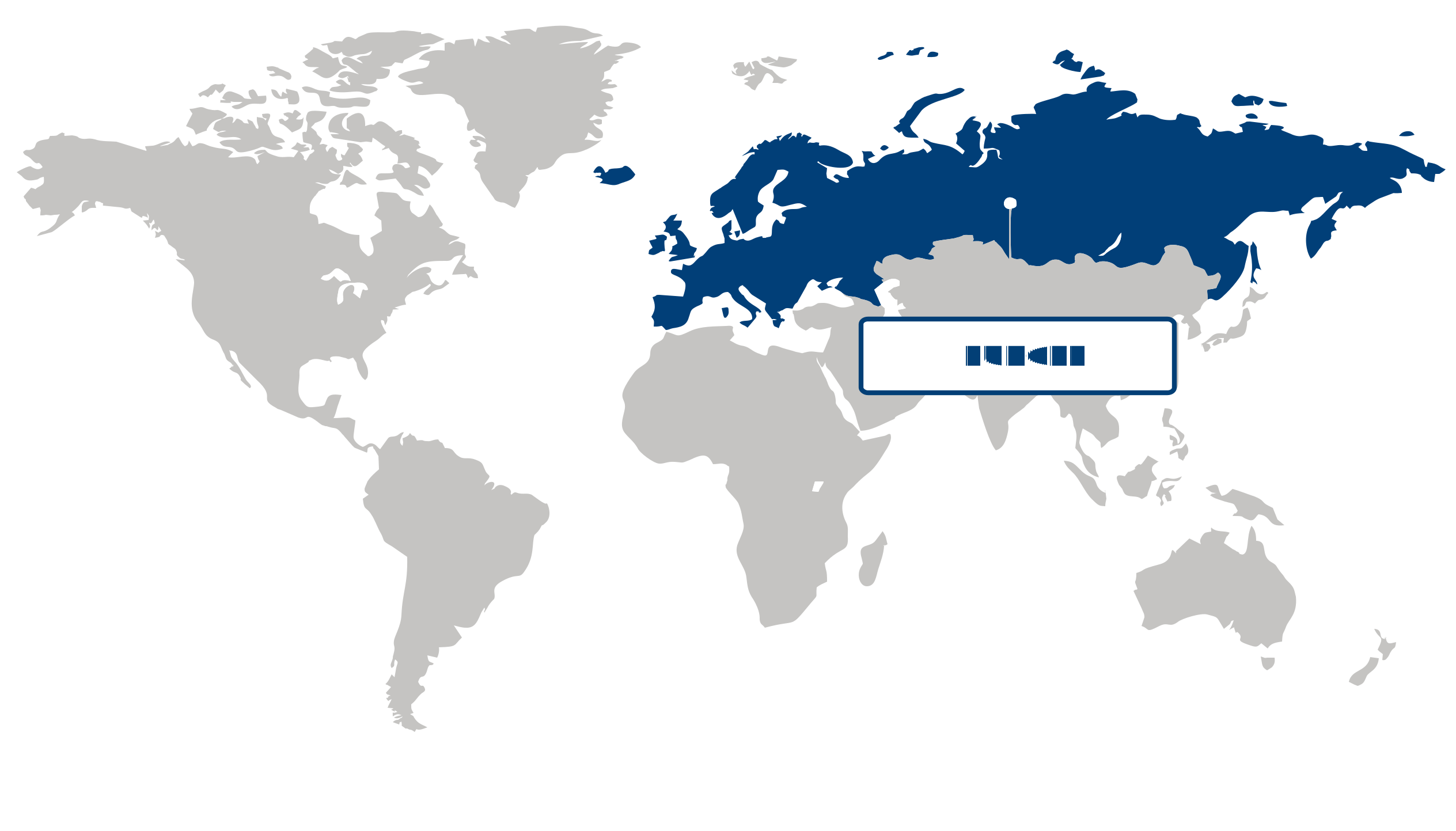
Europe (Largest Region)
Europe held the largest share of the E-scooter sharing market in 2026, reflecting established shared-mobility infrastructure, high urban density, and strong demand for convenient alternatives to private transportation. Supportive urban mobility policies, investments in sustainable transport, and integration of micromobility into broader public transportation networks continue to strengthen the regional market.
Asia Pacific (Fastest-Growing Region)
Asia Pacific represents the fastest-growing region as rapid urbanization, increasing traffic congestion, and demand for flexible last-mile transportation encourage adoption of shared e-scooters. Expanding digital mobility platforms, improving urban infrastructure, and growing emphasis on lower-emission transportation are supporting wider deployment and increasing consumer acceptance of shared micromobility services.
| Parameter | North America | Asia Pacific | Europe | Latin America | MEA |
|---|---|---|---|---|---|
| Innovation Hub i Scale Nascent Developing Advanced | |||||
| Cost-Sensitive Region i Scale Low Medium High | |||||
| Regulatory Environment i Scale Restrictive Neutral Supportive | |||||
| Demand Drivers i Scale Weak Moderate Strong | |||||
| Development Stage i Scale Emerging Developing Developed | |||||
| Adoption Rate i Scale Low Medium High | |||||
| New Entrants / Startups i Scale Sparse Moderate Dense | |||||
| Macro Indicators i Scale Weak Stable Strong |
Key Country Insights
Germany 🇩🇪
Regulated Urban NetworksGermany prioritizes structured e-scooter sharing operations through municipal regulations, designated parking, and multimodal transport integration. Service providers are adapting fleet management and compliance practices to support sustainable urban mobility across major cities.
France 🇫🇷
Sustainable City MobilityFrance supports e-scooter sharing through policies encouraging cleaner urban transportation and organized fleet operations. Operators in France are focusing on responsible deployment, designated parking, and collaboration with local authorities to improve service quality.
Italy 🇮🇹
Tourism Mobility IntegrationItaly is expanding e-scooter sharing across urban centers and tourist destinations where short-distance travel demand is increasing. Providers are tailoring fleet distribution and seasonal operations to serve both residents and visitors efficiently.
Japan 🇯🇵
Transit Connectivity FocusJapan emphasizes e-scooter sharing as a complement to established public transportation systems. Operators in Japan are expanding services with controlled deployment, digital platforms, and safety-oriented initiatives suited to dense urban environments.
South Korea 🇰🇷
Smart Fleet ManagementSouth Korea is advancing e-scooter sharing through connected fleet technologies, mobile-first customer experiences, and operational analytics. Companies are improving vehicle availability and maintenance while aligning services with smart city mobility initiatives.
United States 🇺🇸
Urban Mobility ExpansionThe U.S. e-scooter sharing market is centered on city-specific fleet optimization, partnerships with municipalities, and integration with public transit. Operators are refining deployment strategies to improve utilization while addressing safety, parking compliance, and operational efficiency.
Segment Leadership and Growth Trends
E-Scooter Sharing Market Share (%), by Type, 2026
Go beyond the chart, access full insights & data tables
Request Free Sample ReportType Segment Analysis: Free-Floating (Largest Segment) vs Station-Bound (Fastest-Growing Segment)
The free-floating segment dominated the E-scooter sharing market in 2026 with a 90.25% share, reflecting the strong appeal of flexible point-to-point mobility without dependence on fixed pickup or drop-off locations. Free-floating services allow users to access scooters across broader urban areas, making them particularly suitable for short-distance travel, first- and last-mile connectivity, and spontaneous trips. Smartphone-based access and digitally managed fleet operations further enhance convenience, while expanding urban mobility needs continue to support adoption.
Station-bound services are gaining traction as cities and mobility operators increasingly emphasize structured deployment, predictable parking, and improved control over shared scooter fleets. Fixed locations can help address concerns related to sidewalk obstruction, vehicle organization, and fleet management while providing users with clearly defined pickup and return points. Greater integration of shared mobility into organized urban transportation systems is supporting the expansion of station-bound models.
Distribution Channel Segment Analysis: Online (Largest & Fastest-Growing Segment)
Online channels represented both the largest and fastest-growing distribution channel in the E-scooter sharing market, reflecting the inherently digital nature of shared micromobility services. Users can locate available scooters, complete payments, unlock vehicles, and manage trips through digital platforms, making online access central to the service experience. Continued improvements in mobile applications, digital payments, location-based functionality, and connected fleet management are strengthening online channels as the primary interface between operators and riders.
| Segment | Sub-Segment | Largest Segment | Fastest Growing |
|---|---|---|---|
| Type | Free-Floating, Station-Bound | Free-Floating | Station-Bound |
| Distribution Channel | Online, Offline | Online | Online |
Unlock insights tailored to your business with our bespoke market research solutions.
Click to get your customized report now.
Competitive Landscape and Market Positioning
Major players in the E-scooter sharing market:
1. Bird Global Inc. (United States)
2. Lime (Neutron Holdings Inc.) (United States)
3. Lyft Inc. (United States)
4. Voi Technology AB (Sweden)
5. Cityscoot SAS (France)
6. Cooltra Motosharing S.L.U. (Spain)
7. GoTo Global Mobility Ltd. (Israel)
8. Vogo Automotive Pvt. Ltd. (India)
9. Tier Mobility SE (Germany)
10. Dott B.V. (Netherlands)
Smart urban mobility initiatives are accelerating innovation in the E-scooter sharing market, with connected fleet management, GPS tracking, and intelligent battery systems improving operational efficiency. Expanding mobility ecosystems continue to support convenient and sustainable transportation services.
| Company | Market Share | Company Revenue | Revenue CAGR (%) | Product Portfolio | Geographic Presence | Innovation / R&D Focus | Strategic Developments |
|---|---|---|---|---|---|---|---|
| Bird Global Inc. (United States) | |||||||
| Lime (Neutron Holdings Inc.) (United States) | |||||||
| Lyft Inc. (United States) | |||||||
| Voi Technology AB (Sweden) | |||||||
| Cityscoot SAS (France) | |||||||
| Cooltra Motosharing S.L.U. (Spain) | |||||||
| GoTo Global Mobility Ltd. (Israel) | |||||||
| Vogo Automotive Pvt. Ltd. (India) | |||||||
| Tier Mobility SE (Germany) | |||||||
| Dott B.V. (Netherlands). |
Industry Development/News
| Company Name | Date | Key Development |
|---|---|---|
| JET Group | Oct-25 | Kazakhstan-based micromobility operator JET Group announced intentions to launch a driverless taxi service by 2027. This shift indicates a strategic pivot beyond standard e-scooter sharing toward autonomous urban mobility, positioning the company to diversify its service offerings and address the growing demand for automated transport solutions within the regional mobility ecosystem. |
| Yamaha Motor Co. | May-25 | Yamaha Motor Co. announced a strategic partnership with River to develop its first India-focused electric scooter. This move signifies Yamaha's entry into localized electric vehicle design, aimed at capturing market share in India's rapidly expanding urban mobility segment and diversifying its portfolio toward sustainable, two-wheeler electrified transport solutions. |
| BCAA | Jan-25 | The British Columbia Automobile Association (BCAA) expanded its e-bike share program in Burnaby, Canada, to address increasing demand for micromobility solutions. This initiative serves as a strategic pilot for integrating shared electric vehicle systems into local public transport infrastructure, aimed at enhancing first- and last-mile connectivity for urban residents. |
| Maha Metro Nagpur | Jan-25 | Maha Metro Nagpur signed a memorandum of understanding with Switch E-Ride to introduce e-scooter services across its transit network. By integrating shared micromobility into public transit infrastructure, the project enhances last-mile connectivity for metro commuters and promotes the transition toward a more cohesive, multi-modal urban transportation system in Nagpur. |
| Bo Mobility | Oct-24 | Bo Mobility expanded its international operations into Ireland with the launch of its urban e-scooter platform. This geographic expansion is part of the company's broader strategy to scale its micromobility footprint in the European market, leveraging its urban-focused hardware to compete in the growing regional shared mobility ecosystem. |
Customize Your Report
Explore examples of how this report can be tailored to different research needs, including custom segments, additional topics or chapters, and related reports. Click a section of the wheel or its numbered marker to explore the available options.
E-Scooter Sharing Market — Custom Segments
| Segment | Sub-Segment |
|---|---|
| Trip Purpose | Daily Commuting, Short-Distance Urban Travel, Tourism & Leisure, First-/Last-Mile Connectivity |
| Pricing Model | Pay-Per-Minute, Pay-Per-Ride, Subscription-Based, Membership-Based |
| Fleet Size Category | Small Fleets, Medium Fleets, Large Fleets |
E-Scooter Sharing Market — Custom TOC
| Custom Chapter | Chapter Details |
|---|---|
| Urban Market Attractiveness and City Entry Prioritization |
|
| Fleet Operations Benchmarking and Unit Economics |
|
| Charging and Battery Swapping Ecosystem Assessment |
|
Need a different cut of the data?
Request Custom ResearchHow big is the E-scooter sharing market?
How is the E-scooter sharing industry expected to grow over the next 10 years?
How is urban congestion influencing adoption in the E-scooter sharing market?
Why is government support becoming critical for growth in the E-scooter sharing market?
Why does free-floating dominate the e-scooter sharing market?
How is online distribution driving growth in e-scooter sharing services?
Why is Europe the leading region in the E-scooter sharing market?
What is fueling rapid growth in Asia Pacific's E-scooter sharing market?
Who are the major participants shaping the E-scooter sharing landscape?
Our Clients
"The team surpassed our expectations with the report depth. The actionable insights provided proved crucial in navigating market challenges."
Tata Motors
"We found the report to be very informative. The expertise and attention to market nuances significantly influenced our business direction."
DENSO Corporation
"The consumer survey findings were quite good. We now have a clearer picture of the customer churning and retention strategy."
HL Mando
Our Research Team & Methodology
Every Fundamental Business Insights report is built by a dedicated vertical research team, validated through a structured primary-and-secondary methodology, and reviewed for accuracy before it reaches you.
Research Team Overview
Prepared by the Automotive & Transportation Research Team
Delivery
Published
Demand
Available
Support
Trust & Compliance
Research Intelligence
| Source | Reference |
|---|---|
| International Organization of Motor Vehicle Manufacturers (OICA) | www.oica.net |
| SAE International | www.sae.org |
| International Energy Agency (IEA) | www.iea.org |
| International Transport Forum (ITF) | www.itf-oecd.org |
| International Road Federation (IRF) | www.irf.global |
| International Organization for Standardization (ISO) | www.iso.org |
| United Nations Economic Commission for Europe (UNECE) | unece.org |
| National Highway Traffic Safety Administration (NHTSA) | www.nhtsa.gov |
| U.S. Department of Transportation (USDOT) | www.transportation.gov |
| European Automobile Manufacturers' Association (ACEA) | www.acea.auto |
| Society of Indian Automobile Manufacturers (SIAM) | www.siam.in |
| International Air Transport Association (IATA) | www.iata.org |
| International Civil Aviation Organization (ICAO) | www.icao.int |
| International Maritime Organization (IMO) | www.imo.org |
| International Union of Railways (UIC) | uic.org |
| American Public Transportation Association (APTA) | www.apta.com |
| International Federation of Robotics (IFR) | ifr.org |
| CharIN | www.charin.global |
| World Shipping Council | www.worldshipping.org |
| International Federation of Freight Forwarders Associations (FIATA) | fiata.org |
Research Workflow & Quality Assurance
Data Collection
Verified information gathered through primary and secondary research.
Data Triangulation
Cross-validation using multiple independent data sources.
Forecast Modelling
Market estimates developed using historical trends and analytical models.
Analyst Validation
Findings reviewed by domain experts for accuracy and consistency.
Editorial & Quality Review
Final editorial, quality, and compliance checks before publication.
Final Publication
Released after successful completion of the internal review process.
Report Coverage
📊 Market Assessment
- Market Size & Forecast
- Market Segmentation
- Regional Analysis
- Growth Drivers & Challenges
- Market Dynamics
🏢 Competitive Intelligence
- Competitive Landscape
- Company Profiles
- Competitive Benchmarking
- Mergers & Acquisitions
- Market Share Analysis or Key Company Strategies
🔍 Strategic Analysis
- Value Chain Analysis
- Porter's Five Forces
- PESTLE Analysis
- Pricing Trends
- Supply-Demand Analysis
🚀 Future Outlook
- Technology Landscape
- Regulatory Landscape
- Investment & Funding Landscape
- Emerging Opportunities
- Future Market Outlook
Have a question about this report or need a custom scope?
Request Customization