Floor Screed Market Size & Growth Forecast 2027–2036, By Segments (Application, Type), Regional Demand Trends (North America, Asia Pacific, Europe), Key Country Insights (U.S., Japan, South Korea, Germany, France, Italy), and Competitive Landscape
Jump to Content
Market Size and Growth Outlook
Floor Screed Market size was over USD 15.87 Billion in 2026 and is likely to grow at 6.57% CAGR between 2027 and 2036, attaining USD 29.99 Billion by 2036. The industry revenue for 2027 is calculated at USD 16.76 Billion.
Get more details on this report
Request Free Sample ReportFloor Screed Market Intelligence Snapshot
Regional Market Dynamics
- Europe held the largest share in 2026, supported by established construction, renovation activity, stringent building requirements, and investment in sustainable, energy-efficient flooring.
- Asia Pacific is the fastest-growing region, driven by rapid urban development, expanding construction, infrastructure investment, and wider adoption of modern building materials.
Segment Momentum
- The residential segment accounted for 61.48% of the market in 2026, driven by strong demand for housing construction, renovation, and durable subfloors that enhance flooring quality and long-term performance.
- Heated screed is the fastest-growing type due to rising installation of underfloor heating systems and growing demand for energy-efficient buildings that require effective heat transfer and durable flooring solutions.
Market Expansion Drivers
- Expanding construction activity driving demand for durable and efficient flooring systems
- Rising renovation and remodeling projects boosting residential and commercial flooring upgrades
- Sustainable low-emission screed materials gaining traction in green building construction projects
Leading Market Participants
- Top companies in the floor screed market include Sika AG (Switzerland), Saint-Gobain S.A. (France), Ardex GmbH (Germany), Mapei S.p.A. (Italy), BASF SE (Germany), Cemex S.A.B. de C.V. (Mexico), Fosroc International Ltd. (United Kingdom), Terraco Group (Sweden), Saint-Gobain Weber (France)
Global Market Forecast Snapshot
Market Outlook
- 2026 Market Size: USD 15.87 Billion
- 2027 Estimated Market Size: USD 16.76 Billion
- Projected Market Size: USD 29.99 Billion by 2036
- Growth Forecast: 6.57% CAGR (2027-2036)
Regional and Segment Outlook
- Leading Regional Market: Europe
- High-Growth Regional Hub: Asia Pacific
- Core Revenue Segment: Residential (Application) | Bonded Screed (Type)
- Emerging Opportunity Segment: Non-Residential (Application) | Heated Screed (Type)
Market Growth Drivers and Industry Trends
Expanding construction activity driving demand for durable and efficient flooring systems
Expanding residential, commercial, and infrastructure construction activity will drive the floor screed market growth as developers increasingly require stable substrates that support durable, level, and high-quality floor finishes. Screed systems provide an important intermediate layer between structural slabs and final flooring materials, helping manage surface irregularities, distribute loads, accommodate underfloor heating, and improve the performance of tiles, vinyl, wood, and other finishes. The growing emphasis on efficient construction also supports demand for formulations that can be installed consistently, cure effectively, and reduce project delays, particularly where large floor areas must be prepared within demanding construction schedules. Increased use of modern flooring systems in new buildings further strengthens requirements for screeds with application characteristics suited to different substrates, environmental conditions, and finish specifications.
Rising renovation and remodeling projects boosting residential and commercial flooring upgrades
Renovation and remodeling activity will boost the floor screed market demand as property owners increasingly upgrade worn, uneven, or outdated flooring systems without replacing entire structural assemblies. In residential projects, refurbishment of kitchens, bathrooms, living spaces, and other high-use areas often requires a smooth and stable base before new finishes are installed, while commercial renovations require screeding solutions capable of supporting upgraded surfaces in offices, retail properties, hospitality facilities, and other occupied buildings. The expansion of refurbishment work also favors products that can accommodate varying substrate conditions and provide reliable adhesion, leveling, and surface preparation. Contractors are consequently placing greater importance on screed solutions that simplify installation during renovation work, particularly where limited access, existing floor conditions, and compressed project schedules influence material selection.
Sustainable low-emission screed materials gaining traction in green building construction projects
Sustainable construction practices are reshaping material selection, and the floor screed market is benefiting from growing interest in low-emission formulations that support healthier indoor environments and broader green-building objectives. Developers and contractors are increasingly evaluating screed products according to factors such as indoor air quality, material efficiency, resource consumption, and compatibility with environmentally responsible building specifications. Low-emission formulations can be particularly relevant in residential, healthcare, educational, and commercial buildings where occupants remain indoors for extended periods and material emissions are closely considered during project planning. Demand is also supported by the broader integration of sustainable flooring systems, including energy-efficient underfloor heating and responsibly sourced finish materials, creating opportunities for screed products designed to work effectively within environmentally focused building assemblies.
| Growth Driver | Impact on CAGR | Regulatory Influence | Geographic Relevance | Adoption Rate | Impact Timeline |
|---|---|---|---|---|---|
| Expanding construction activity driving demand for durable and efficient flooring systems | 2% | Moderate | Asia Pacific, Europe | High | Near Term |
| Rising renovation and remodeling projects boosting residential and commercial flooring upgrades | 1.8% | Low | North America, Europe | High | Near Term |
| Sustainable low-emission screed materials gaining traction in green building construction projects | 1.5% | Moderate | Europe, Asia Pacific | Emerging | Mid Term |
Go beyond the chart, access full insights & data tables
Request Free Sample ReportRegional Demand Dynamics
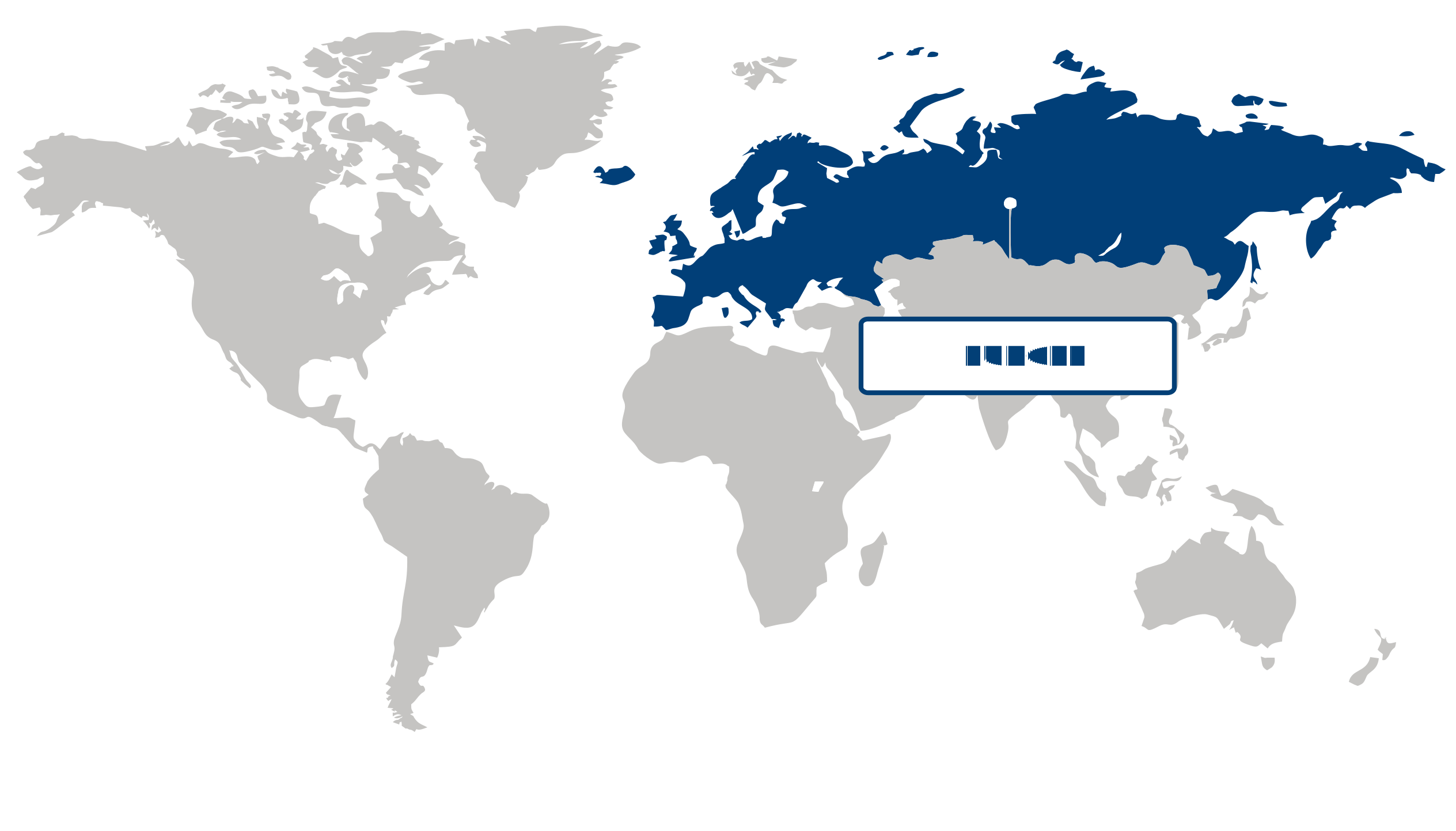
Europe (Largest Region)
Europe held the largest share of the floor screed market in 2026, supported by established construction activity, stringent building performance requirements, and increasing attention to durable and energy-efficient flooring systems. Renovation of existing residential and commercial buildings is generating demand for high-performance screed solutions, while the region’s focus on improving building quality and energy efficiency is encouraging the use of advanced flooring materials. Infrastructure modernization and continued investment in sustainable construction practices are further contributing to the adoption of floor screeds across diverse building applications.
Asia Pacific (Fastest-Growing Region)
Asia Pacific is the fastest-growing region, driven by rapid urban development, expanding construction activity, and increasing investment in residential, commercial, and infrastructure projects. Growing urban populations and the development of modern buildings are creating stronger demand for efficient flooring systems that support durability and installation performance. Rising construction standards, greater use of modern building materials, and the expansion of organized construction practices are also encouraging wider adoption of floor screed solutions throughout the region.
| Parameter | North America | Asia Pacific | Europe | Latin America | MEA |
|---|---|---|---|---|---|
| Innovation HubiScaleNascentDeveloping Advanced | |||||
| Cost-Sensitive RegioniScaleLowMedium High | |||||
| Regulatory EnvironmentiScaleRestrictiveNeutral Supportive | |||||
| Demand DriversiScaleWeakModerate Strong | |||||
| Development StageiScaleEmergingDeveloping Developed | |||||
| Adoption RateiScaleLowMedium High | |||||
| New Entrants / StartupsiScaleSparseModerate Dense | |||||
| Macro IndicatorsiScaleWeakStable Strong |
Key Country Insights
United States 🇺🇸
Commercial Renovation DemandThe U.S. floor screed market benefits from commercial renovation projects and modern construction practices requiring durable floor preparation systems. Contractors in the U.S. increasingly adopt high-performance screed materials that improve installation efficiency and floor longevity.
Germany 🇩🇪
Precision Construction MaterialsGermany prioritizes floor screed solutions that deliver dimensional accuracy, durability, and compatibility with energy-efficient building systems. German construction projects increasingly utilize advanced screed formulations designed for high-performance flooring applications.
Japan 🇯🇵
Space-Efficient ApplicationsJapan emphasizes floor screed products suitable for compact residential and commercial developments requiring precise installation quality. Japanese builders increasingly adopt fast-curing screed systems that support efficient project completion and reliable flooring performance.
South Korea 🇰🇷
High-Rise Building SupportSouth Korea utilizes advanced floor screed materials across high-rise residential and commercial construction projects requiring consistent finishing quality. South Korean contractors increasingly select screed systems that improve installation productivity and compatibility with modern flooring solutions.
France 🇫🇷
Sustainable Building MaterialsFrance encourages floor screed solutions that align with sustainable construction practices and evolving building performance requirements. French developers increasingly favor low-emission and efficient screed materials that contribute to durable and environmentally conscious building projects.
Italy 🇮🇹
Renovation Project FocusItaly supports the floor screed market through ongoing residential renovation and restoration projects requiring reliable subfloor preparation. Italian construction professionals continue adopting versatile screed systems that accommodate diverse flooring materials while improving installation quality.
Floor Screed Market Share (%), by Application, 2026
Unlock insights tailored to your business with our bespoke market research solutions.
Click to get your customized report now.
Go beyond the chart, access full insights & data tables
Request Free Sample ReportApplication Segment Analysis: Residential (Largest Segment) vs Non-Residential (Fastest-Growing Segment)
The residential segment accounted for 61.48% of the floor screed market share in 2026, supported by strong demand for housing construction, renovation, and flooring upgrades. Residential projects require durable and level subfloors to ensure the long-term performance of floor finishes, making screed an essential component of modern building practices. Increasing consumer preference for high-quality interior finishes and improved flooring performance has further contributed to the segment's dominant position.
The floor screed market is expected to witness the fastest growth in the non-residential segment. Expanding commercial buildings, industrial facilities, healthcare infrastructure, educational institutions, and hospitality developments are driving the need for high-performance screed systems capable of supporting heavy traffic and specialized flooring requirements. Growing investments in large-scale infrastructure and commercial construction continue to create favorable conditions for rapid expansion within this segment.
Type Segment Analysis: Bonded Screed (Largest Segment) vs Heated Screed (Fastest-Growing Segment)
The bonded screed segment captured 53.74% of the market share in 2026, making it the leading type in the market. Bonded screeds provide strong adhesion to the underlying concrete substrate, delivering excellent load-bearing capacity and durability for a wide range of construction applications. Their suitability for refurbishment projects, industrial flooring, and areas requiring high mechanical strength has supported widespread adoption across residential and commercial developments.
In the floor screed market, the heated screed segment is projected to experience the fastest growth. The increasing installation of underfloor heating systems in residential and commercial buildings is driving demand for screeds that offer efficient heat transfer and long-term structural stability. Growing emphasis on energy-efficient buildings, occupant comfort, and modern construction techniques is further encouraging the adoption of heated screed solutions in new construction and renovation projects.
| Segment | Sub-Segment | Largest Segment | Fastest Growing |
|---|---|---|---|
| Application | Residential, Non-Residential | Residential | Non-Residential |
| Type | Bonded Screed, Unbonded Screed, Floating Screed, Heated Screed | Bonded Screed | Heated Screed |
Competitive Landscape and Market Positioning
Top players in the floor screed market:
- Sika AG (Switzerland)
- Saint-Gobain S.A. (France)
- Ardex GmbH (Germany)
- Mapei S.p.A. (Italy)
- BASF SE (Germany)
- Cemex S.A.B. de C.V. (Mexico)
- Fosroc International Ltd. (United Kingdom)
- Terraco Group (Sweden)
- Saint-Gobain Weber (France)
The floor screed market is evolving as suppliers compete through performance-enhanced materials designed for faster construction cycles, improved durability, and specialized building applications. Manufacturers are developing advanced formulations that address requirements such as reduced installation complexity, stronger surface performance, and compatibility with modern flooring systems. Competitive dynamics are increasingly centered on delivering application-specific solutions that support efficiency in increasingly demanding construction environments.
| Company | Market Share | Company Revenue | Revenue CAGR (%) | Product Portfolio | Geographic Presence | Innovation / R&D Focus | Strategic Developments |
|---|---|---|---|---|---|---|---|
| Sika AG (Switzerland) | |||||||
| Saint-Gobain S.A. (France) | |||||||
| Ardex GmbH (Germany) | |||||||
| Mapei S.p.A. (Italy) | |||||||
| BASF SE (Germany) | |||||||
| Cemex S.A.B. de C.V. (Mexico) | |||||||
| Fosroc International Ltd. (United Kingdom) | |||||||
| Terraco Group (Sweden) | |||||||
| Saint-Gobain Weber (France) |
Customize Your Report
Explore examples of how this report can be tailored to different research needs, including custom segments, additional topics or chapters, and related reports. Click a section of the wheel or its numbered marker to explore the available options.
Floor Screed Market — Custom Segments
| Segment | Sub-Segment |
|---|---|
| Construction Stage | New Construction, Renovation & Refurbishment, Repair & Remediation |
| Project Size | Small-Scale Projects, Medium-Scale Projects, Large-Scale Projects |
| Procurement Channel | Direct Sales, Distributors & Building Material Suppliers, Specialist Contractors & Applicators |
Floor Screed Market — Custom TOC
| Custom Chapter | Chapter Details |
|---|---|
| Sustainable Building Materials Adoption Outlook |
|
| Prefabrication and Modern Construction Impact |
|
| Installer and Contractor Purchasing Behavior |
|
Need a different cut of the data?
Request Custom ResearchFrequently Asked Questions
How much revenue does the floor screed market generate?
What is the projected value of the floor screed industry by 2036?
Why are modern construction projects increasing demand for advanced floor screed solutions?
How are sustainability trends influencing material selection in the floor screed market?
Why is the residential segment the largest application in the floor screed market?
Why is heated screed the fastest-growing type in the floor screed market?
Why does Europe lead the floor screed market?
How is Asia Pacific driving future floor screed demand?
What are the prominent companies operating in the floor screed landscape?
Our Clients
"Your insights on workforce structures were spot-on. The analysis on mid-to-senior level roles validated some of our hiring decisions and highlighted gaps."
Ateliers De France
"The report gave us insights on competitors in the market. It helped our team refine our bidding strategy for upcoming contracts."
Clark Construction
"The reports provided a deep dive into market trends, and competitive landscape. The strategic insights and recommendations have been very helpful."
Rudolph and Sletten
Our Research Team & Methodology
Every Fundamental Business Insights report is built by a dedicated vertical research team, validated through a structured primary-and-secondary methodology, and reviewed for accuracy before it reaches you.
Delivery
Published
Available
Support
- Market Size & Forecast
- Market Segmentation
- Regional Analysis
- Growth Drivers & Challenges
- Market Dynamics
- Competitive Landscape
- Company Profiles
- Competitive Benchmarking
- Mergers & Acquisitions
- Market Share Analysis or Key Company Strategies
- Value Chain Analysis
- Porter's Five Forces
- PESTLE Analysis
- Pricing Trends
- Supply-Demand Analysis
- Technology Landscape
- Regulatory Landscape
- Investment & Funding Landscape
- Emerging Opportunities
- Future Market Outlook