Fructooligosaccharides (FOS) Market Size & Growth Forecast 2027–2036, By Segments (Source, Form, Application), Regional Demand Trends (North America, Asia Pacific, Europe), Key Country Insights (U.S., Japan, South Korea, Germany, France, Italy), and Competitive Landscape
Jump to Content
Market Size and Growth Outlook
Fructooligosaccharides Market size stood at USD 3.3 billion in 2026 and is predicted to grow at a 8.36% CAGR from 2027 to 2036, crossing USD 7.37 billion by 2036. The industry revenue for 2027 is calculated at USD 3.53 billion.
Get more details on this report
Request Free Sample ReportFructooligosaccharides (FOS) Market Intelligence Snapshot
Regional Market Dynamics
- Europe held a 31.43% share in 2026, supported by established prebiotic ingredient use, strong suppliers, and mature functional food development capabilities.
- Asia Pacific is expected to grow at a 10.17% CAGR, driven by rising functional food, beverage, and supplement adoption.
Segment Momentum
- Chicory held a 67.97% share in 2026 due to its established commercial use, reliable raw material availability, and compatibility with existing production processes that support consistent supply and product quality.
- Powder is growing fastest because it offers easier storage, transportation, and formulation flexibility, making it attractive for manufacturers seeking broader application compatibility and longer shelf stability.
Market Expansion Drivers
- Rising gut health awareness driving demand for prebiotic functional ingredients.
- Expanding use in functional foods, beverages, and dietary supplements globally.
- Cost-efficient sucrose-based production scaling improving industrial supply efficiency.
Leading Market Participants
- Prominent players in the fructooligosaccharides market include BENEO GmbH (Germany), Cargill, Incorporated (United States), Ingredion Incorporated (United States), Tereos S.A. (France), Meiji Holdings Co., Ltd. (Japan), Tata Chemicals Ltd. (India), Galam Ltd. (Israel), Cosucra Groupe Warcoing SA (Belgium), Sensus B.V. (Netherlands), Samyang Corporation (South Korea).
Global Market Forecast Snapshot
Market Outlook
- 2026 Market Size: USD 3.3 billion
- 2027 Estimated Market Size: USD 3.53 billion.
- Projected Market Size: USD 7.37 billion by 2036
- Growth Forecast: 8.36% CAGR (2027-2036)
Regional and Segment Outlook
- Leading Regional Market: Europe
- High-Growth Regional Hub: Asia Pacific
- Core Revenue Segment: Chicory (Source) | Liquid (Form) | Infant Formulation (Application)
- Emerging Opportunity Segment: Sucrose (Source) | Powder (Form) | Dietary Supplements (Application)
Market Growth Drivers and Industry Trends
Rising gut health awareness driving demand for prebiotic functional ingredients
Growing awareness of the relationship between digestive health and overall wellness will drive the fructooligosaccharides market as consumers increasingly seek foods and ingredients associated with beneficial gut microbiota. Fructooligosaccharides are used as prebiotic ingredients that support the growth of beneficial intestinal bacteria, making them relevant to products positioned around digestive and functional health. Increasing consumer attention to nutrition and preventive wellness is encouraging food manufacturers and supplement producers to incorporate prebiotic ingredients into formulations designed to provide added functional benefits.
Expanding use in functional foods, beverages, and dietary supplements globally
Broader incorporation of prebiotic ingredients into functional foods, beverages, and dietary supplements will propel the fructooligosaccharides market by creating multiple consumption formats across different product categories. Fructooligosaccharides can be incorporated into formulations where manufacturers seek to add prebiotic functionality while maintaining convenient delivery through everyday foods and beverages or concentrated supplement products. Their application across diverse product types allows producers to address consumer demand for health-oriented formulations through products ranging from nutrition-focused beverages to dietary supplementation.
Cost-efficient sucrose-based production scaling improving industrial supply efficiency
Cost-efficient production based on sucrose is strengthening the fructooligosaccharides market by supporting greater manufacturing efficiency and improving the ability of producers to supply prebiotic ingredients at industrial scale. Efficient conversion of sucrose into fructooligosaccharides can help manufacturers optimize raw material utilization and production processes while supporting consistent ingredient availability for downstream applications. Improved production economics also facilitate broader incorporation of the ingredient into food, beverage, and supplement formulations where manufacturers remain attentive to formulation costs and supply reliability.
| Growth Driver | Impact on CAGR | Regulatory Influence | Geographic Relevance | Adoption Rate | Impact Timeline |
|---|---|---|---|---|---|
| Rising gut health awareness driving demand for prebiotic functional ingredients | 2.60% | Moderate | Europe, North America | High | Near Term |
| Expanding use in functional foods, beverages, and dietary supplements globally | 2.40% | Low | Europe, Asia Pacific | High | Mid Term |
| Cost-efficient sucrose-based production scaling improving industrial supply efficiency | 1.80% | Low | Asia Pacific, Latin America | Medium | Mid Term |
Unlock insights tailored to your business with our bespoke market research solutions.
Click to get your customized report now.
Regional Demand Dynamics
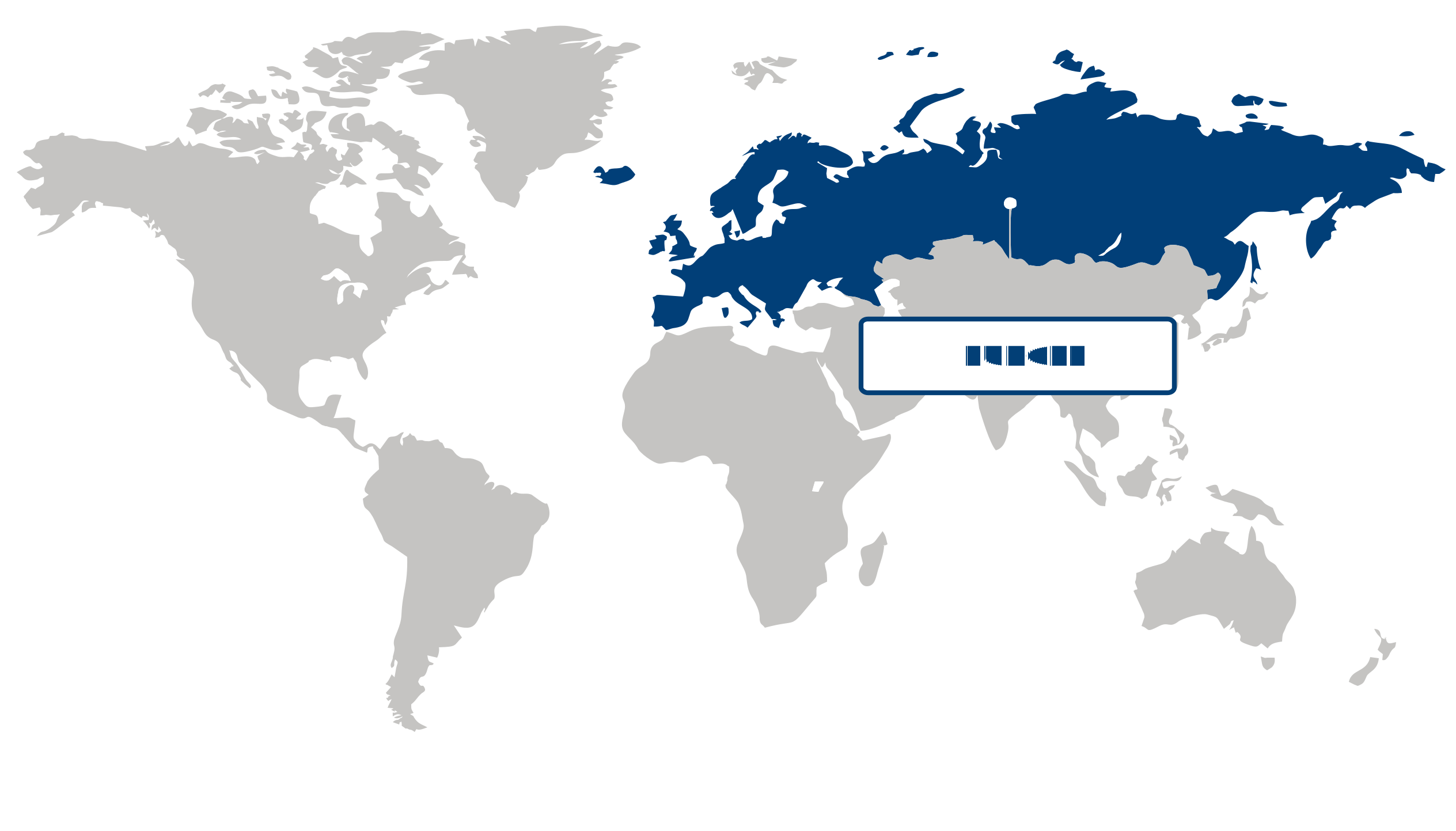
Europe (Largest Region)
In the fructooligosaccharides market, Europe held the largest share of 31.43% in 2026, supported by strong consumer interest in digestive wellness, functional foods, and nutrition products with added health benefits. The region has a well-developed market for prebiotic ingredients, while increasing attention to gut health is encouraging food and beverage manufacturers to incorporate fructooligosaccharides into products positioned around digestive and nutritional benefits. Demand is also supported by established functional food consumption patterns and growing interest in healthier formulations. In addition, a mature food processing industry and continued product development across dairy alternatives, beverages, dietary products, and other functional categories provide a favorable environment for sustained use of prebiotic ingredients.
Asia Pacific (Fastest-Growing Region)
Asia Pacific is the fastest-growing regional market, propelled by rising consumer awareness of digestive health and expanding demand for functional and fortified food products. Urbanization and changing dietary habits are encouraging consumers to seek convenient foods that combine nutritional value with perceived wellness benefits, creating opportunities for prebiotic ingredients such as fructooligosaccharides. The region's expanding food and beverage processing sector is also broadening the application base for functional ingredients across diverse product categories. Increasing interest in preventive nutrition, greater availability of health-oriented products, and the development of modern retail and foodservice channels are further supporting regional market expansion.
| Parameter | North America | Asia Pacific | Europe | Latin America | MEA |
|---|---|---|---|---|---|
| Innovation HubiScaleNascentDeveloping Advanced | |||||
| Cost-Sensitive RegioniScaleLowMedium High | |||||
| Regulatory EnvironmentiScaleRestrictiveNeutral Supportive | |||||
| Demand DriversiScaleWeakModerate Strong | |||||
| Development StageiScaleEmergingDeveloping Developed | |||||
| Adoption RateiScaleLowMedium High | |||||
| New Entrants / StartupsiScaleSparseModerate Dense | |||||
| Macro IndicatorsiScaleWeakStable Strong |
Key Country Insights
Germany 🇩🇪
Clean Label IngredientsGermany prioritizes fructooligosaccharides for premium food formulations emphasizing digestive health and ingredient transparency. Food producers in Germany continue expanding applications across dairy alternatives, nutritional products, and fiber-enriched packaged foods.
France 🇫🇷
Premium Food FormulationFrance applies fructooligosaccharides across premium dairy, bakery, and nutrition products where ingredient quality remains important. Food manufacturers in France increasingly balance sugar reduction initiatives with consumer demand for improved taste and digestive wellness.
Italy 🇮🇹
Value-Added Food InnovationItaly expands fructooligosaccharides use in bakery, dairy, and specialty food applications that complement evolving nutrition preferences. Producers in Italy emphasize ingredient functionality while maintaining product quality and traditional food characteristics valued by consumers.
Japan 🇯🇵
Science-Backed Wellness ApplicationsJapan maintains strong interest in fructooligosaccharides through products targeting gut health and balanced nutrition. Manufacturers in Japan focus on scientifically supported ingredient positioning and product innovation across beverages, dairy products, and functional foods.
South Korea 🇰🇷
Innovative Functional FoodsSouth Korea incorporates fructooligosaccharides into functional foods, beverages, and nutritional supplements addressing changing dietary preferences. Companies in South Korea continue developing value-added formulations that combine digestive health benefits with convenient consumer formats.
United States 🇺🇸
Functional Nutrition DemandThe U.S. fructooligosaccharides market is supported by growing demand for digestive wellness ingredients in functional foods, beverages, and dietary supplements. Manufacturers in the U.S. increasingly incorporate fructooligosaccharides into clean-label formulations that appeal to health-conscious consumers.
Fructooligosaccharides (FOS) Market Share (%), by Source, 2026
Go beyond the chart, access full insights & data tables
Request Free Sample ReportSource Segment Analysis: Chicory (Largest Segment) vs Sucrose (Fastest-Growing Segment)
Chicory held the largest share of the fructooligosaccharides (FOS) market in 2026, accounting for 67.97% of the market, owing to its established role as a natural and commercially important source of FOS. Chicory-derived FOS is valued for its prebiotic properties and compatibility with functional food, beverage, and nutritional formulations. Growing consumer interest in digestive health and naturally sourced functional ingredients is supporting continued demand for chicory as manufacturers seek ingredients that can enhance nutritional profiles while supporting clean-label product positioning.
Sucrose is expected to grow at the fastest rate as manufacturers increasingly explore efficient and flexible approaches to FOS production using readily available carbohydrate feedstocks. Sucrose-based production can support controlled manufacturing processes and broaden opportunities for producing functional ingredients for food and nutrition applications. Rising demand for prebiotic ingredients across processed foods and dietary formulations is creating additional opportunities for sucrose-derived FOS.
Form Segment Analysis: Liquid (Largest Segment) vs Powder (Fastest-Growing Segment)
The liquid segment dominated the fructooligosaccharides (FOS) market in 2026, representing a 56.91% share, supported by its ease of incorporation into beverages, liquid nutritional products, syrups, and other formulations. Liquid FOS can be readily blended into various food and beverage systems, making it attractive for manufacturers seeking functional ingredients with convenient processing characteristics. Increasing demand for prebiotic-enriched products and functional beverages is reinforcing the use of liquid formulations.
Powder is projected to be the fastest-growing form as manufacturers and consumers increasingly favor convenient, stable, and versatile ingredient formats. Powdered FOS can be incorporated into dry mixes, supplements, functional foods, and nutritional formulations while offering flexibility in storage and handling. Its suitability for a broad range of applications is supporting wider adoption as product developers expand the use of prebiotic ingredients across different categories.
| Segment | Sub-Segment | Largest Segment | Fastest Growing |
|---|---|---|---|
| Source | Sucrose, Chicory | Chicory | Sucrose |
| Form | Liquid, Powder | Liquid | Powder |
| Application | Infant Formulation, Food & Beverages, Dietary Supplements, Pet/Animal Feed | Infant Formulation | Dietary Supplements |
Competitive Landscape and Market Positioning
Leading companies in the fructooligosaccharides (FOS) market:
1. BENEO GmbH (Germany)
2. Cargill Incorporated (United States)
3. Ingredion Incorporated (United States)
4. Tereos S.A. (France)
5. Meiji Holdings Co. Ltd. (Japan)
6. Tata Chemicals Ltd. (India)
7. Galam Ltd. (Israel)
8. Cosucra Groupe Warcoing SA (Belgium)
9. Sensus B.V. (Netherlands)
10. Samyang Corporation (South Korea)
The fructooligosaccharides (FOS) market is gaining momentum due to increasing consumer preference for digestive health ingredients and functional food products. Manufacturers are introducing innovative formulations for beverages, nutritional supplements, and dairy alternatives to address demand for prebiotic-rich solutions. Growing awareness regarding gut health and clean-label nutrition is further supporting expansion within the market.
| Company | Market Share | Company Revenue | Revenue CAGR (%) | Product Portfolio | Geographic Presence | Innovation / R&D Focus | Strategic Developments |
|---|---|---|---|---|---|---|---|
| BENEO GmbH (Germany) | |||||||
| Cargill Incorporated (United States) | |||||||
| Ingredion Incorporated (United States) | |||||||
| Tereos S.A. (France) | |||||||
| Meiji Holdings Co. Ltd. (Japan) | |||||||
| Tata Chemicals Ltd. (India) | |||||||
| Galam Ltd. (Israel) | |||||||
| Cosucra Groupe Warcoing SA (Belgium) | |||||||
| Sensus B.V. (Netherlands) | |||||||
| Samyang Corporation (South Korea). |
Industry Development/News
| Company Name | Date | Key Development |
|---|---|---|
| CJ Wellcare | May-26 | CJ Wellcare launched a patented herbal formulation for prostate health, expanding its functional ingredients portfolio. This move deepens the company’s focus on the specialty wellness segment, reinforcing its strategic positioning within the prebiotic and gut-health ecosystem by targeting preventive health applications. |
| Harke | Oct-25 | Harke acquired Green Bioactives’ Memory Complex, a cognitive health formulation integrating FOS and L-theanine. The acquisition secures the commercialization of this prebiotic-based solution and facilitates expansion into European and North American markets, aligning with rising demand for gut-brain axis health products. |
| FutureCeuticals | Mar-25 | FutureCeuticals published clinical findings demonstrating that its NatureKnit ingredient delivers superior prebiotic efficacy compared to standard fibers like inulin. The results validate the ingredient's competitive advantage in digestive and metabolic health, providing a strategic boost to its market share in the functional fiber segment. |
| Meiji | Jul-24 | Meiji introduced functional chocolate products utilizing FOS as a sugar substitute. This innovation targets the confectionery sector by balancing consumer demand for indulgence with the health benefits of prebiotic-driven intestinal flora regulation, demonstrating successful commercial application of FOS in mass-market food categories. |
| Tate & Lyle | Jun-22 | Tate & Lyle completed the acquisition of Quantum Hi-Tech, a leading Chinese prebiotic dietary fiber business. This strategic integration enhances Tate & Lyle’s global fortification platform and R&D capabilities, significantly expanding its market presence in the FOS and GOS sectors across Asia and international markets. |
Customize Your Report
Explore examples of how this report can be tailored to different research needs, including custom segments, additional topics or chapters, and related reports. Click a section of the wheel or its numbered marker to explore the available options.
Fructooligosaccharides (FOS) Market — Custom Segments
| Segment | Sub-Segment |
|---|---|
| Processing Method | Enzymatic Synthesis, Microbial Fermentation, Integrated Processing |
| Functional Benefit | Digestive Health, Prebiotic & Gut Microbiome Support, Immune Health, Metabolic Health |
| Sales Channel | Direct Sales, Specialty Ingredient Distributors, Online Channels, Retail & Foodservice Channels |
Fructooligosaccharides (FOS) Market — Custom TOC
| Custom Chapter | Chapter Details |
|---|---|
| High-Growth Application Opportunity Mapping |
|
| Ingredient Substitution and Competitive Positioning Analysis |
|
| Supply Chain Resilience and Raw Material Sourcing Analysis |
|
Need a different cut of the data?
Request Custom ResearchFrequently Asked Questions
What is the market size of fructooligosaccharides (FOS)?
What is the expected industry size of fructooligosaccharides by 2036?
How is rising gut health awareness driving demand for fructooligosaccharides in food and supplement formulations?
How is expanding product application in functional foods and beverages influencing global FOS market growth?
Why does chicory remain the leading source in the fructooligosaccharides (FOS) market?
Why is powder the fastest-growing form segment in the fructooligosaccharides (FOS) market?
Which factors support Europe’s leadership in the fructooligosaccharides market?
What is driving Asia Pacific growth in the fructooligosaccharides market?
Which organizations are considered leaders in the fructooligosaccharides landscape?
Our Clients
"The report provided a thorough look at market trends, technological advancements, and the competitive landscape. The depth of insights was really valuable."
ITC Limited
"We would highly recommend Fundamental Business Insights & Consulting to anyone looking for reliable, detailed, and comprehensive market research in the Food industry."
Tyson Foods
"The clarity and presentation of the information were commendable. The report was delivered timely, which made the overall experience smooth and convenient."
Mondelēz International
Our Research Team & Methodology
Every Fundamental Business Insights report is built by a dedicated vertical research team, validated through a structured primary-and-secondary methodology, and reviewed for accuracy before it reaches you.
Delivery
Published
Available
Support
- Market Size & Forecast
- Market Segmentation
- Regional Analysis
- Growth Drivers & Challenges
- Market Dynamics
- Competitive Landscape
- Company Profiles
- Competitive Benchmarking
- Mergers & Acquisitions
- Market Share Analysis or Key Company Strategies
- Value Chain Analysis
- Porter's Five Forces
- PESTLE Analysis
- Pricing Trends
- Supply-Demand Analysis
- Technology Landscape
- Regulatory Landscape
- Investment & Funding Landscape
- Emerging Opportunities
- Future Market Outlook