Green Fertilizer Market Size & Growth Forecast 2027–2036, By Segments (Technology, Fertilizer, Application), Regional Demand Trends (North America, Asia Pacific, Europe), Key Country Insights (U.S., Japan, South Korea, Germany, France, Italy), and Competitive Landscape
Jump to content
Market Size and Growth Outlook
Green Fertilizer Market size was over USD 2.72 Billion in 2026 and is likely to grow at 4.43% CAGR between 2027 and 2036, exceeding USD 4.2 Billion by 2036. The industry revenue for 2027 is assessed at USD 2.82 Billion.
Get more details on this report
Request Free Sample ReportGreen Fertilizer Market Intelligence Snapshot
Regional Market Dynamics
- Europe held the largest share in 2026, supported by environmental policies, sustainable agriculture priorities, and efforts to reduce the ecological impact of conventional fertilizers.
- Expanding agricultural production, rising food demand, sustainable farming awareness, and investment in agricultural modernization are encouraging broader regional adoption.
Segment Momentum
- Alkaline water electrolysis held a 50.88% market share in 2026 thanks to its commercial maturity, operational reliability, lower implementation costs, and suitability for large-scale green hydrogen production.
- Horticulture is the fastest-growing application as demand rises for sustainable fertilizers that improve crop quality and resource efficiency in fruits, vegetables, ornamental plants, and other high-value crops.
Market Expansion Drivers
- Rising shift toward sustainable agriculture reducing chemical fertilizer dependency
- Expanding organic farming practices increasing demand for eco-friendly soil enhancers
- Government incentives for carbon-neutral farming accelerating green fertilizer adoption
Leading Market Participants
- Prominent players in the green fertilizer market include Yara International ASA (Norway), CF Industries Holdings Inc. (United States), Nutrien Ltd. (Canada), OCI N.V. (Netherlands), Fertiberia S.A. (Spain), BASF SE (Germany), Tata Chemicals Ltd. (India), Haldor Topsoe A/S (Denmark), Nel Hydrogen ASA (Norway), Thyssenkrupp Uhde GmbH (Germany)
Global Market Forecast Snapshot
Market Outlook
- 2026 Market Size: USD 2.72 Billion
- 2027 Estimated Market Size: USD 2.82 Billion
- Projected Market Size: USD 4.2 Billion by 2036
- Growth Forecast: 4.43% CAGR (2027-2036)
Regional and Segment Outlook
- Leading Regional Market: Europe
- High-Growth Regional Hub: Asia Pacific
- Core Revenue Segment: Alkaline Water Electrolysis (Technology) | Ammonium Nitrate (AN) (Fertilizer) | Agriculture (Application)
- Emerging Opportunity Segment: Proton Exchange Membrane (Technology) | Calcium Ammonium Nitrate (CAN) (Fertilizer) | Horticulture (Application)
Market Growth Drivers and Industry Trends
Rising shift toward sustainable agriculture reducing chemical fertilizer dependency
Increasing awareness of the environmental impacts associated with intensive chemical fertilizer use is encouraging farmers to adopt more sustainable nutrient management practices. The green fertilizer market is benefiting from this transition as agricultural producers seek alternatives that improve soil health, support biodiversity, and reduce the environmental footprint of crop production. Sustainable fertilization strategies also help maintain long-term soil productivity by enhancing nutrient cycling and minimizing degradation associated with prolonged reliance on conventional synthetic inputs.
Expanding organic farming practices increasing demand for eco-friendly soil enhancers
The continued expansion of organic farming systems is creating stronger demand for environmentally responsible agricultural inputs that align with certified cultivation practices and sustainable production standards. This trend will drive the green fertilizer market growth by increasing the use of bio-based nutrient solutions and eco-friendly soil enhancers that improve soil fertility while supporting healthy crop development. Organic producers also prioritize fertilizers that promote beneficial microbial activity, improve soil structure, and contribute to balanced nutrient availability without introducing harmful synthetic residues.
Government incentives for carbon-neutral farming accelerating green fertilizer adoption
Governments are increasingly implementing agricultural policies that encourage lower-emission farming practices and support the transition toward environmentally sustainable food production systems. These initiatives are strengthening the green fertilizer market by promoting the adoption of fertilizer solutions that contribute to carbon reduction objectives, improve resource efficiency, and support climate-conscious farming practices. Incentive programs, sustainability frameworks, and environmental compliance measures are encouraging producers to integrate greener nutrient management approaches into both conventional and regenerative agricultural operations.
| Growth Driver | Impact on CAGR | Regulatory Influence | Geographic Relevance | Adoption Rate | Impact Timeline |
|---|---|---|---|---|---|
| Rising shift toward sustainable agriculture reducing chemical fertilizer dependency | 2% | High | Europe, Asia Pacific | High | Near Term |
| Expanding organic farming practices increasing demand for eco-friendly soil enhancers | 1.7% | High | North America, Europe | High | Mid Term |
| Government incentives for carbon-neutral farming accelerating green fertilizer adoption | 1.4% | High | Europe, Latin America | Medium | Mid Term |
Unlock insights tailored to your business with our bespoke market research solutions.
Click to get your customized report now.
Regional Demand Dynamics
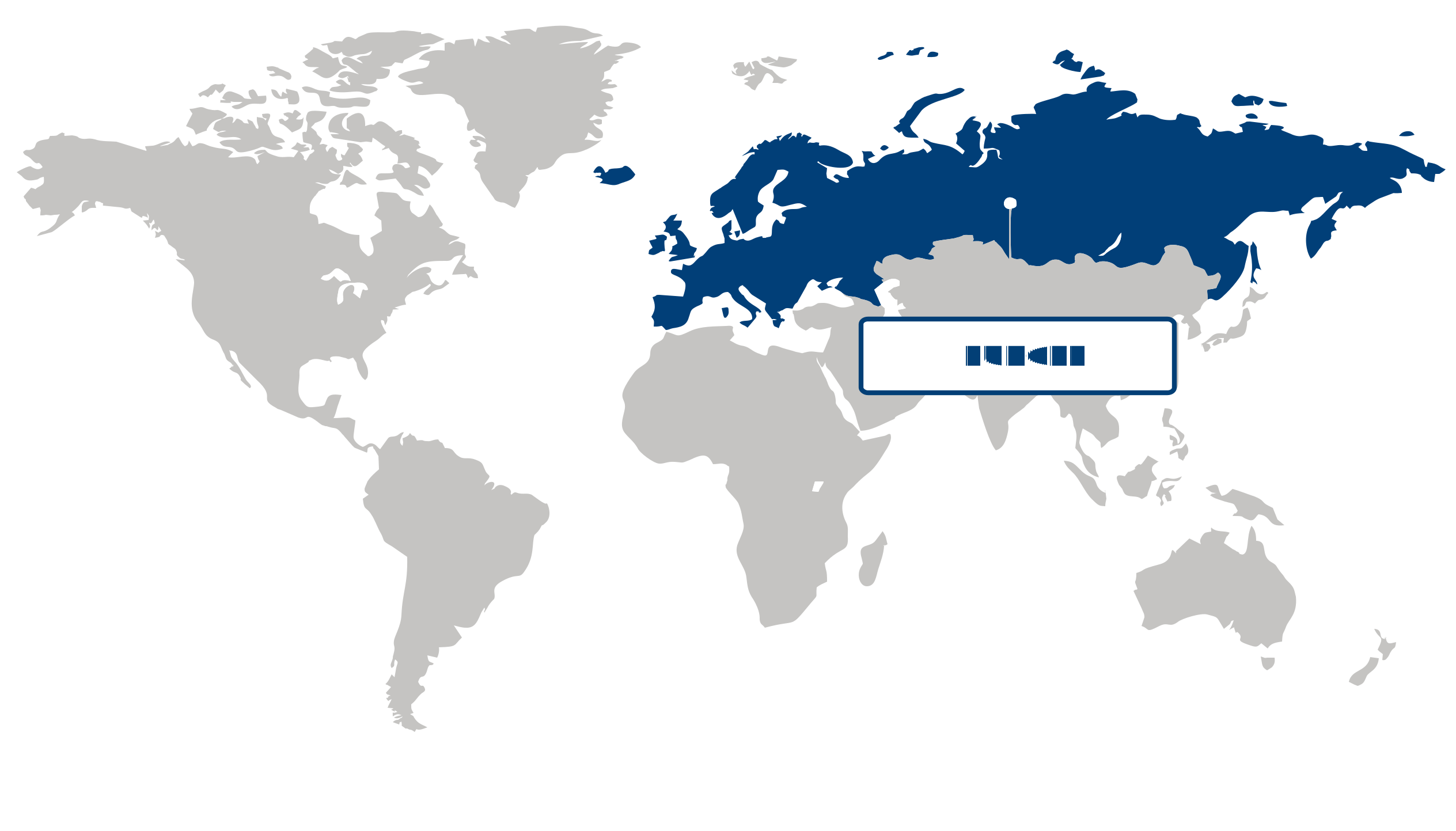
Europe (Largest Region)
Europe held the largest share of the green fertilizer market in 2026, supported by strong environmental policies, growing emphasis on sustainable agriculture, and efforts to reduce the ecological impact of conventional fertilizer use. Farmers and agricultural producers are increasingly adopting nutrient solutions that improve soil health and resource efficiency while aligning with sustainability objectives. The region's established agricultural infrastructure, focus on reducing emissions from farming, and increasing preference for environmentally responsible inputs are reinforcing demand for green fertilizer solutions.
Asia Pacific (Fastest-Growing Region)
Asia Pacific is emerging as the fastest-growing regional market, driven by expanding agricultural production, rising food demand, and growing awareness of sustainable farming practices. Pressure to improve crop productivity while limiting soil degradation and environmental impacts is encouraging producers to explore more efficient nutrient management approaches. Government initiatives supporting agricultural modernization, combined with increasing investment in sustainable farming technologies, are creating favorable conditions for broader adoption of green fertilizers across the region.
| Parameter | North America | Asia Pacific | Europe | Latin America | MEA |
|---|---|---|---|---|---|
| Innovation HubiScaleNascentDeveloping Advanced | |||||
| Cost-Sensitive RegioniScaleLowMedium High | |||||
| Regulatory EnvironmentiScaleRestrictiveNeutral Supportive | |||||
| Demand DriversiScaleWeakModerate Strong | |||||
| Development StageiScaleEmergingDeveloping Developed | |||||
| Adoption RateiScaleLowMedium High | |||||
| New Entrants / StartupsiScaleSparseModerate Dense | |||||
| Macro IndicatorsiScaleWeakStable Strong |
Key Country Insights
United States 🇺🇸
Sustainable Crop NutritionThe U.S. is expanding green fertilizer adoption through low-carbon agricultural practices and precision farming initiatives. Producers and growers in the U.S. are evaluating bio-based and renewable fertilizer solutions that improve nutrient efficiency while supporting sustainability objectives across commercial agriculture.
Germany 🇩🇪
Low-Emission InputsGermany emphasizes green fertilizers that align with climate-focused farming and responsible nutrient management. Agricultural suppliers in Germany are investing in renewable production methods and environmentally efficient fertilizer formulations to reduce emissions while maintaining soil productivity.
Japan 🇯🇵
Resource-Efficient FertilityJapan is promoting green fertilizers that complement resource-efficient agriculture and high-value crop cultivation. Fertilizer manufacturers in Japan are developing innovative nutrient solutions that improve application efficiency while supporting environmentally responsible farming practices.
South Korea 🇰🇷
Circular Agriculture SolutionsSouth Korea is integrating green fertilizers into sustainable farming strategies supported by circular resource utilization. Agricultural stakeholders in South Korea are adopting environmentally friendly nutrient products that reduce environmental impact while improving crop management efficiency.
France 🇫🇷
Regenerative Farming SupportFrance is encouraging green fertilizer adoption as regenerative farming practices gain wider commercial acceptance. Agricultural producers in France are incorporating renewable nutrient products to improve soil health and comply with evolving environmental expectations across crop production.
Italy 🇮🇹
Specialty Crop NutritionItaly is applying green fertilizers across specialty crops where sustainable nutrient management is becoming increasingly important. Growers in Italy are selecting environmentally conscious fertilizer solutions that support crop quality while reducing reliance on conventional chemical inputs.
Green Fertilizer Market Share (%), by Technology, 2026
Go beyond the chart, access full insights & data tables
Request Free Sample ReportTechnology Segment Analysis: Alkaline Water Electrolysis (Largest Segment) vs Proton Exchange Membrane (Fastest-Growing Segment)
The alkaline water electrolysis technology segment led the green fertilizer market, accounting for a 50.88% share in 2026. Its established commercial maturity, proven operational reliability, and comparatively lower implementation costs have encouraged widespread deployment for green hydrogen production. The technology remains a preferred option for large-scale fertilizer manufacturing facilities due to its ability to support consistent production while integrating with renewable energy sources.
The proton exchange membrane technology segment is anticipated to experience the fastest growth as the industry increasingly focuses on higher operational flexibility and improved responsiveness to variable renewable electricity generation. Its ability to deliver efficient hydrogen production with rapid system start-up makes it well suited for next-generation green fertilizer projects. Ongoing investments in clean energy infrastructure and technological advancements are expected to further strengthen demand for this electrolysis approach.
Fertilizer Segment Analysis: Ammonium Nitrate (AN) (Largest Segment) vs Calcium Ammonium Nitrate (CAN) (Fastest-Growing Segment)
The ammonium nitrate (AN) fertilizer segment held the largest share in 2026. Its leadership is supported by its broad agricultural application, high nitrogen content, and effectiveness in improving crop productivity across a wide range of farming systems. Strong demand from large-scale agricultural operations and the continued emphasis on sustainable nutrient management have reinforced its prominent position within the market.
In the green fertilizer market, the calcium ammonium nitrate (CAN) fertilizer segment is expected to record the fastest growth. Increasing interest in balanced nutrient delivery and improved soil health is encouraging the adoption of CAN across modern farming practices. Its ability to provide a stable nitrogen source while supporting efficient nutrient utilization is contributing to its growing acceptance among farmers seeking environmentally responsible fertilizer solutions.
Application Segment Analysis: Agriculture (Largest Segment) vs Horticulture (Fastest-Growing Segment)
The agriculture application segment represented the largest share in 2026. Its dominance is driven by the extensive use of green fertilizers across field crops to enhance productivity while reducing the environmental impact associated with conventional fertilizer production. Growing efforts to promote sustainable farming and lower carbon emissions are further supporting adoption within mainstream agricultural activities.
The horticulture application segment is projected to expand at the fastest rate in the green fertilizer market. Rising cultivation of fruits, vegetables, ornamental plants, and high-value crops is creating stronger demand for sustainable nutrient inputs that improve crop quality and resource efficiency. Increasing emphasis on environmentally friendly cultivation methods and premium agricultural production is expected to accelerate the adoption of green fertilizers in horticultural applications.
| Segment | Sub-Segment | Largest Segment | Fastest Growing |
|---|---|---|---|
| Technology | Alkaline Water Electrolysis, Proton Exchange Membrane, Solid Oxide Electrolysis | Alkaline Water Electrolysis | Proton Exchange Membrane |
| Fertilizer | Ammonium Nitrate (AN), Calcium Ammonium Nitrate (CAN) | Ammonium Nitrate (AN) | Calcium Ammonium Nitrate (CAN) |
| Application | Agriculture, Horticulture, Forestry | Agriculture | Horticulture |
Competitive Landscape and Market Positioning
Major players in the green fertilizer market:
- Yara International ASA (Norway)
- CF Industries Holdings, Inc. (United States)
- Nutrien Ltd. (Canada)
- OCI N.V. (Netherlands)
- Fertiberia S.A. (Spain)
- BASF SE (Germany)
- Tata Chemicals Ltd. (India)
- Haldor Topsoe A/S (Denmark)
- Nel Hydrogen ASA (Norway)
- Thyssenkrupp Uhde GmbH (Germany)
Market rivalry is being reshaped by the transition toward lower-emission production pathways and the growing importance of supply chain resilience, creating competition that extends well beyond fertilizer formulation. Producers are investing in cleaner manufacturing technologies, alternative feedstocks, and regional production capabilities to strengthen environmental positioning while improving security of supply for agricultural customers. Competitive differentiation is also emerging through certification frameworks, traceability, and the ability to demonstrate reduced environmental impact across the production cycle, particularly as sustainability expectations become embedded in procurement decisions. These developments are encouraging participants to balance technological innovation with scalable manufacturing and dependable distribution networks to secure long-term commercial relevance.
| Company | Market Share | Company Revenue | Revenue CAGR (%) | Product Portfolio | Geographic Presence | Innovation / R&D Focus | Strategic Developments |
|---|---|---|---|---|---|---|---|
| Yara International ASA (Norway) | |||||||
| CF Industries Holdings Inc. (United States) | |||||||
| Nutrien Ltd. (Canada) | |||||||
| OCI N.V. (Netherlands) | |||||||
| Fertiberia S.A. (Spain) | |||||||
| BASF SE (Germany) | |||||||
| Tata Chemicals Ltd. (India) | |||||||
| Haldor Topsoe A/S (Denmark) | |||||||
| Nel Hydrogen ASA (Norway) | |||||||
| Thyssenkrupp Uhde GmbH (Germany) |
Customize Your Report
Explore examples of how this report can be tailored to different research needs, including custom segments, additional topics or chapters, and related reports. Click a section of the wheel or its numbered marker to explore the available options.
Green Fertilizer Market — Custom Segments
| Segment | Sub-Segment |
|---|---|
| Feedstock Source | Water, Natural Gas with Carbon Capture, Renewable Electricity-derived Feedstocks, Biomass-derived Feedstocks |
| Carbon Intensity | Low-carbon, Near-zero-carbon, Zero-carbon |
| Production Scale | Small-scale, Medium-scale, Large-scale Production |
Green Fertilizer Market — Custom TOC
| Custom Chapter | Chapter Details |
|---|---|
| Green Fertilizer Adoption Economics |
|
| Carbon Market Integration |
|
| Decarbonization Pathways for Fertilizer Buyers |
|
Need a different cut of the data?
Request Custom ResearchFrequently Asked Questions
How large is the green fertilizer market?
How will the green fertilizer industry grow in terms of size and CAGR by 2036?
How is the shift toward sustainable agriculture influencing demand in the green fertilizer market?
Why are government sustainability initiatives accelerating adoption in the green fertilizer market?
Why is alkaline water electrolysis the leading technology in the green fertilizer market?
What is driving the rapid growth of horticulture applications in the green fertilizer market?
Why does Europe lead the green fertilizer market?
What is driving faster green fertilizer growth in Asia Pacific?
Who holds a significant market share in the green fertilizer landscape?
Our Clients
"The report helped us understand emerging consumer trends in our product category. It clarified where to focus innovation for the next product launch."
LyondellBasell
"The regional forecast section was incredibly useful. We were able to identify two new potential partners in Europe thanks to the vendor mapping you included."
SABIC
"We appreciated how actionable the recommendations were. It guided us to improve supply chain resilience."
Olin Corporation
Our Research Team & Methodology
Every Fundamental Business Insights report is built by a dedicated vertical research team, validated through a structured primary-and-secondary methodology, and reviewed for accuracy before it reaches you.
Delivery
Published
Available
Support
- Market Size & Forecast
- Market Segmentation
- Regional Analysis
- Growth Drivers & Challenges
- Market Dynamics
- Competitive Landscape
- Company Profiles
- Competitive Benchmarking
- Mergers & Acquisitions
- Market Share Analysis or Key Company Strategies
- Value Chain Analysis
- Porter's Five Forces
- PESTLE Analysis
- Pricing Trends
- Supply-Demand Analysis
- Technology Landscape
- Regulatory Landscape
- Investment & Funding Landscape
- Emerging Opportunities
- Future Market Outlook