Grow Lights Market Size & Growth Forecast 2027–2036, By Segments (Application, Component, Spectrum, Technology), Regional Demand Trends (North America, Asia Pacific, Europe), Key Country Insights (U.S., Japan, South Korea, Germany, France, Italy), and Competitive Landscape
Market Size and Growth Outlook
Grow Lights Market size was valued at USD 5.07 Billion in 2026 and is anticipated to grow at 16.12% CAGR from 2027 to 2036, reaching USD 22.6 Billion by 2036. The industry revenue for 2027 is assessed at USD 5.78 Billion.
Get more details on this report
Request Free Sample ReportGrow Lights Market Intelligence Snapshot
Regional Market Dynamics
- Europe accounted for 32.4% in 2026, supported by established controlled-environment agriculture, sustainable food production, greenhouse and vertical farming, and demand for energy-efficient lighting systems.
- Asia Pacific is the fastest-growing region, driven by urbanization, indoor farming, limited agricultural land, rising food demand, LED adoption, and investments in resource-efficient cultivation.
Segment Momentum
- Indoor farming held 43.2% of the market in 2026 because it relies on artificial lighting to maintain consistent crop growth, improve cultivation efficiency, and enable year-round production in controlled environments.
- Software is the fastest-growing component as growers increasingly adopt monitoring, automation, and lighting control platforms to optimize crop production, improve energy efficiency, and support precision cultivation practices.
Market Expansion Drivers
- Expanding indoor farming and vertical agriculture driving advanced grow light deployment
- Commercial greenhouse expansion increasing demand for energy-efficient full-spectrum lighting systems
- Rising AI-enabled precision agriculture optimizing LED grow light intensity and yield efficiency
Leading Market Participants
- Prominent companies in the grow lights market include Signify N.V. (Netherlands), Cree LED (United States), Fluence by OSRAM (Germany), Heliospectra AB (Sweden), Gavita International B.V. (Netherlands), California LightWorks (United States), Valoya Ltd. (Finland), Current Lighting Solutions LLC (United States)
Global Market Forecast Snapshot
Market Outlook
- 2026 Market Size: USD 5.07 Billion
- 2027 Estimated Market Size: USD 5.78 Billion
- Projected Market Size: USD 22.6 Billion by 2036
- Growth Forecast: 16.12% CAGR (2027-2036)
Regional and Segment Outlook
- Leading Regional Market: Europe
- High-Growth Regional Hub: Asia Pacific
- Core Revenue Segment: Indoor Farming (Application) | Hardware (Component) | Full Spectrum (Spectrum) | LED (Technology)
- Emerging Opportunity Segment: Vertical Farming (Application) | Software (Component) | Full Spectrum (Spectrum) | Plasma (Technology)
Market Growth Drivers and Industry Trends
Expanding indoor farming and vertical agriculture driving advanced grow light deployment
The rapid expansion of indoor farming and vertical cultivation is transforming agricultural production by enabling year-round crop cultivation independent of seasonal conditions. This trend will drive the grow lights market growth as controlled-environment farms increasingly rely on advanced lighting systems to deliver consistent illumination tailored to different crop varieties and growth stages. Modern grow lights help optimize photosynthesis, improve space utilization, and support higher productivity within compact cultivation facilities where natural sunlight is limited. As commercial growers focus on maximizing crop quality while reducing dependence on external weather conditions, demand continues to increase for lighting solutions capable of delivering uniform performance across intensive cultivation environments.
Commercial greenhouse expansion increasing demand for energy-efficient full-spectrum lighting systems
Commercial greenhouse operators are expanding production capacity to meet rising demand for fresh produce, ornamental plants, and specialty crops throughout the year. The grow lights market benefits from this expansion because energy-efficient full-spectrum lighting enables growers to supplement natural daylight while maintaining favorable growing conditions during periods of insufficient sunlight. Advanced lighting technologies support healthier plant development by providing balanced spectral output that promotes germination, vegetative growth, flowering, and fruit production. Lower energy consumption, extended operating life, and improved operational efficiency also make these systems attractive for greenhouse operators seeking to manage production costs while maintaining consistent crop performance.
Rising AI-enabled precision agriculture optimizing LED grow light intensity and yield efficiency
Artificial intelligence is becoming an integral component of precision agriculture by enabling real-time monitoring and automated control of cultivation environments. This evolution will propel the grow lights market growth as AI-powered systems continuously adjust LED lighting intensity, duration, and spectral composition according to crop requirements and environmental conditions. Intelligent lighting management minimizes energy waste while supporting uniform plant growth through data-driven optimization of cultivation parameters. Integration with environmental sensors, predictive analytics, and automated farm management platforms further enhances production efficiency by allowing growers to respond dynamically to changing crop needs throughout the cultivation cycle.
| Growth Driver | Impact on CAGR | Regulatory Influence | Geographic Relevance | Adoption Rate | Impact Timeline |
|---|---|---|---|---|---|
| Expanding indoor farming and vertical agriculture driving advanced grow light deployment | 2% | Moderate | Asia Pacific, North America | High | Near Term |
| Commercial greenhouse expansion increasing demand for energy-efficient full-spectrum lighting systems | 1.8% | Low | Europe, North America | High | Near Term |
| Rising AI-enabled precision agriculture optimizing LED grow light intensity and yield efficiency | 1.6% | Low | Asia Pacific, Europe | Emerging | Mid Term |
Explore Growth Opportunities
Request Free Sample ReportRegional Demand Dynamics
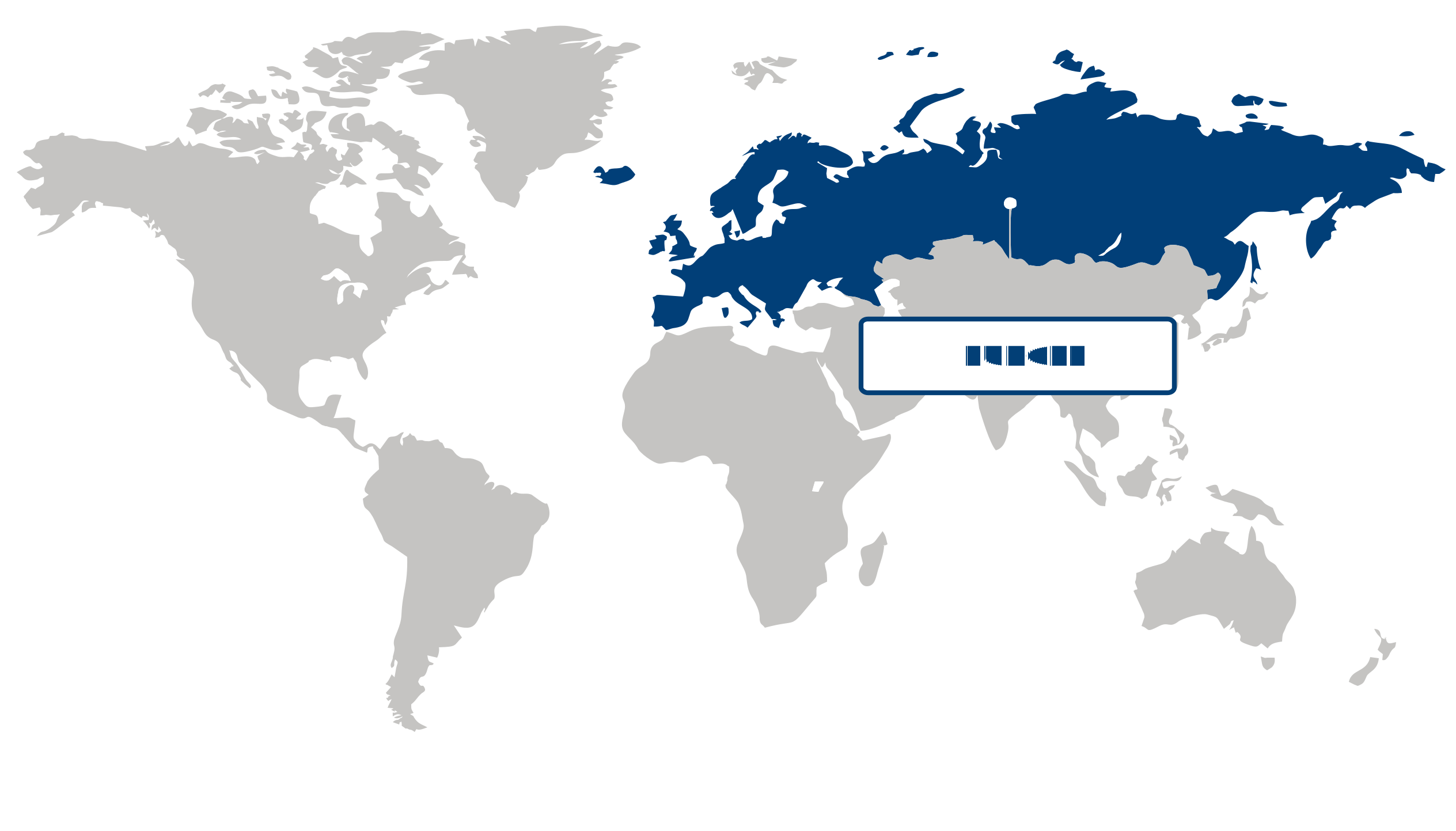
Europe (Largest Region)
Europe held the largest share of 32.4% in the grow lights market in 2026, supported by the region's established controlled-environment agriculture sector, strong focus on sustainable food production, and increasing adoption of indoor cultivation technologies. Grow lights are becoming increasingly important for maintaining consistent plant development where natural sunlight is limited or insufficient, particularly in greenhouse and vertical farming applications. European growers are also emphasizing energy efficiency and resource optimization, encouraging the adoption of advanced lighting systems with improved control over light intensity and spectral output. Growing interest in local food production and year-round cultivation is further supporting regional demand.
Asia Pacific (Fastest-Growing Region)
Asia Pacific is anticipated to be the fastest-growing region, driven by rapid urbanization, expanding indoor farming activity, and increasing efforts to strengthen food production efficiency. Limited agricultural land in densely populated areas is encouraging the development of vertical farms, controlled-environment facilities, and greenhouse cultivation systems that depend on artificial lighting. Rising food demand and the need for stable crop production are further encouraging investments in agricultural technologies. In addition, increasing adoption of LED-based lighting, improvements in cultivation controls, and growing awareness of resource-efficient farming are creating favorable conditions for grow light deployment across the region.
| Parameter | North America | Asia Pacific | Europe | Latin America | MEA |
|---|---|---|---|---|---|
| Innovation Hub i Scale Nascent Developing Advanced | |||||
| Cost-Sensitive Region i Scale Low Medium High | |||||
| Regulatory Environment i Scale Restrictive Neutral Supportive | |||||
| Demand Drivers i Scale Weak Moderate Strong | |||||
| Development Stage i Scale Emerging Developing Developed | |||||
| Adoption Rate i Scale Low Medium High | |||||
| New Entrants / Startups i Scale Sparse Moderate Dense | |||||
| Macro Indicators i Scale Weak Stable Strong |
Key Country Insights
United States 🇺🇸
Controlled Environment ExpansionThe U.S. grow lights market is driven by investments in indoor farming, greenhouse modernization, and energy-efficient cultivation technologies. Suppliers in the U.S. focus on advanced LED systems with programmable lighting to improve crop consistency and operational efficiency.
Germany 🇩🇪
Energy-Efficient CultivationGermany prioritizes grow lighting solutions that reduce energy consumption while supporting precision horticulture. Manufacturers in Germany increasingly develop intelligent LED systems integrated with automated greenhouse management and sustainability objectives.
Japan 🇯🇵
Space-Optimized FarmingJapan advances grow light adoption through compact indoor farming systems designed for efficient food production in limited spaces. Companies in Japan emphasize high-performance LED technologies that enable precise environmental control and reliable crop quality.
South Korea 🇰🇷
Smart Farming IntegrationSouth Korea strengthens grow light deployment through connected smart farming platforms and automated cultivation facilities. Technology providers in South Korea increasingly integrate lighting controls with data-driven crop management to improve production efficiency.
France 🇫🇷
Greenhouse ModernizationFrance focuses on upgrading greenhouse operations with efficient grow lighting solutions that support year-round horticultural production. French growers increasingly adopt LED technologies that balance crop productivity with lower operational energy requirements.
Italy 🇮🇹
Specialty Crop OptimizationItaly adopts grow lighting technologies that enhance productivity for specialty crops cultivated in greenhouses and controlled environments. Manufacturers and growers in Italy prioritize adaptable lighting systems capable of supporting diverse crop requirements and quality standards.
Segment Leadership and Growth Trends
Grow Lights Market Share (%), by Application, 2026
Go beyond the chart, access full insights & data tables
Request Free Sample ReportApplication Segment Analysis: Indoor Farming (Largest Segment) vs Vertical Farming (Fastest-Growing Segment)
The indoor farming segment dominated the grow lights market with a share of 43.2% in 2026. Indoor farming operations depend heavily on artificial lighting systems to maintain consistent crop growth regardless of external environmental conditions. Grow lights enable producers to optimize light exposure, improve cultivation efficiency, and support year-round production of fruits, vegetables, herbs, and other crops. Rising demand for controlled-environment agriculture and increased focus on food security have further strengthened the segment’s leading position.
The vertical farming segment is emerging as the fastest-growing application category as agricultural producers seek innovative solutions to maximize crop yields within limited urban spaces. Vertical farming systems rely extensively on advanced lighting technologies to support stacked cultivation environments and precise crop management. Increasing urbanization, resource efficiency concerns, and the need for sustainable food production methods are driving investment in vertical farming operations and associated lighting infrastructure.
Component Segment Analysis: Hardware (Largest Segment) vs Software (Fastest-Growing Segment)
The hardware segment held the largest share in 2026, reflecting the essential role of lighting fixtures, drivers, controllers, and related equipment in grow light installations. The deployment of controlled-environment agriculture systems requires substantial investment in physical lighting infrastructure capable of delivering consistent and efficient illumination. Continued expansion of indoor cultivation facilities has sustained strong demand for hardware components across the market.
The software segment is anticipated to experience the fastest growth as cultivators increasingly adopt data-driven approaches to optimize crop production. Software platforms enable monitoring, automation, and control of lighting schedules, environmental conditions, and energy consumption. As growers focus on improving operational efficiency and achieving greater precision in cultivation practices, the adoption of intelligent software solutions continues to accelerate.
Spectrum Segment Analysis: Full Spectrum (Largest & Fastest-Growing Segment)
The full spectrum segment held the dominant position in the grow lights market in 2026 and also represented the fastest-growing spectrum category. Full spectrum grow lights closely replicate natural sunlight and provide plants with a broad range of wavelengths necessary for different growth stages, from germination to flowering. Their ability to support healthier crop development, improve productivity, and simplify lighting management has made them a preferred choice across indoor farming, vertical farming, and greenhouse applications. As cultivators increasingly prioritize crop quality, yield optimization, and energy-efficient cultivation methods, demand for full spectrum lighting solutions continues to expand across controlled-environment agriculture settings.
| Segment | Sub-Segment | Largest Segment | Fastest Growing |
|---|---|---|---|
| Application | Indoor Farming, Vertical Farming, Commercial Greenhouse, Others | Indoor Farming | Vertical Farming |
| Component | Hardware, Software | Hardware | Software |
| Spectrum | Partial Spectrum, Full Spectrum | Full Spectrum | Full Spectrum |
| Technology | High Intensity Discharge (HID), LED, Fluorescent, Plasma | LED | Plasma |
Unlock insights tailored to your business with our bespoke market research solutions.
Click to get your customized report now.
Competitive Landscape and Market Positioning
Top players in the grow lights market:
- Signify N.V. (Netherlands)
- Cree LED (United States)
- Fluence by OSRAM (Germany)
- Heliospectra AB (Sweden)
- Gavita International B.V. (Netherlands)
- California LightWorks (United States)
- Valoya Ltd. (Finland)
- Current Lighting Solutions LLC (United States)
Competition in the grow lights market is increasingly shaped by the ability to deliver complete cultivation solutions rather than standalone lighting equipment. Suppliers are combining advanced lighting controls, environmental monitoring, and cultivation software to help commercial growers optimize crop consistency and energy efficiency across diverse production environments. As purchasing decisions become more performance-driven, manufacturers that can demonstrate long-term reliability, flexible installation options, and compatibility with automated greenhouse and indoor farming systems are strengthening their position, while providers focused primarily on hardware specifications face growing pressure to differentiate.
| Company | Market Share | Company Revenue | Revenue CAGR (%) | Product Portfolio | Geographic Presence | Innovation / R&D Focus | Strategic Developments |
|---|---|---|---|---|---|---|---|
| Signify N.V. (Netherlands) | |||||||
| Cree LED (United States) | |||||||
| Fluence by OSRAM (Germany) | |||||||
| Heliospectra AB (Sweden) | |||||||
| Gavita International B.V. (Netherlands) | |||||||
| California LightWorks (United States) | |||||||
| Valoya Ltd. (Finland) | |||||||
| Current Lighting Solutions LLC (United States) |
Industry Development/News
| Company Name | Date | Key Development |
|---|---|---|
| Nature's Miracle Holding Inc. | Feb-26 | The company established an exclusive supply agreement with Megaphoton USA LLC to deliver Made-in-USA grow lights tailored for the controlled environment agriculture industry. This strategic partnership expands the firm's specialized lighting portfolio and strengthens commercial product distribution capabilities for large-scale indoor cultivation applications. |
| MechaTronix | Dec-25 | The manufacturer expanded its European production capacity to address growing global demand for LED grow lighting systems and secure higher market share. The manufacturing footprint expansion scales up production volumes, directly strengthening the company's supply chain logistics and fulfillment capabilities for commercial horticulture clients. |
| SGL | Jul-25 | The entity expanded its professional portfolio by introducing the vertically manufactured LED60, LED30, and LED10 grow lighting systems. This product launch broadens the firm's commercial portfolio, offering specialized, scalable lighting solutions designed to meet distinct performance and turf management criteria for grounds teams. |
| Hydrofarm | Dec-24 | The company entered a strategic partnership with TrolMaster to combine technical expertise in controlled-environment cultivation systems. This collaborative initiative aims to integrate specialized product portfolios and accelerate technological innovations for commercial growers across diverse cultivation sizes and crop segments. |
| MechaTronix | May-24 | The firm established two new corporate entities in Leamington, Canada, to strengthen its North American geographic footprint. This expansion enhances regional distribution capabilities, scales customer engagement networks, and accelerates the deployment of its specialized LED grow light systems across major agricultural zones. |
| Signify (Philips GreenPower) | Apr-24 | The brand deployed its advanced LED toplighting solutions at Glass House Farms to optimize cannabis cultivation facilities. The technology integration secures uniform, year-round light levels, materially boosting winter production volumes and validating the commercial scalability of LED agricultural lighting in controlled environments. |
Customize Your Report
Explore examples of how this report can be tailored to different research needs, including custom segments, additional topics or chapters, and related reports. Click a section of the wheel or its numbered marker to explore the available options.
Grow Lights Market — Custom Segments
| Segment | Sub-Segment |
|---|---|
| Crop Type | Leafy Greens, Herbs, Fruits & Vegetables, Flowers & Ornamentals, Cannabis |
| Control Method | Manual Control, Timer-Based Control, Sensor-Based Control, Automated/IoT-Enabled Control |
| Fixture Form Factor | Bar/Linear Fixtures, Panel Fixtures, Bulb/Reflector Fixtures, High-Bay Fixtures, Interlighting Fixtures |
Grow Lights Market — Custom TOC
| Custom Chapter | Chapter Details |
|---|---|
| Controlled Environment Agriculture Adoption Strategy |
|
| Grow Light ROI and Payback Economics |
|
| Horticulture Crop-Specific Lighting Strategies |
|
Need a different cut of the data?
Request Custom ResearchWhat is the market size of grow lights?
What is the expected industry size of grow lights by 2036?
How is controlled-environment agriculture driving demand for advanced grow light systems?
How is AI transforming lighting strategies in the grow lights market?
Why is indoor farming the largest application in the grow lights market?
Why is software the fastest-growing component in the grow lights market?
Why does Europe lead the grow lights market?
How is Asia Pacific accelerating grow lights market growth?
Which organizations are considered leaders in the grow lights landscape?
Our Clients
"The report provided us with a clear direction, and the level of detail was beyond what we expected. I would definitely recommend their services to others."
Haier Appliances
"The collaboration with Fundamental Business Insights has added significant value to our decision-making process, and we look forward to continuing this partnership for our future market research requirements."
Luxottica Group S.p.A.
"The team at FBI delivered an exceptional research report. The insights on industry innovations were particularly impressive and added a lot of value to the overall report."
Nike
Our Research Team & Methodology
Every Fundamental Business Insights report is built by a dedicated vertical research team, validated through a structured primary-and-secondary methodology, and reviewed for accuracy before it reaches you.
Research Team Overview
Prepared by the Consumer Goods & Services Research Team
Delivery
Published
Demand
Available
Support
Trust & Compliance
Research Intelligence
| Source | Reference |
|---|---|
| International Organization for Standardization (ISO) | www.iso.org |
| ASTM International | www.astm.org |
| U.S. Consumer Product Safety Commission (CPSC) | www.cpsc.gov |
| European Commission – Consumer Safety | ec.europa.eu/safety-gate |
| Consumer Technology Association (CTA) | www.cta.tech |
| National Retail Federation (NRF) | nrf.com |
| World Retail Congress | www.worldretailcongress.com |
| World Travel & Tourism Council (WTTC) | wttc.org |
| UN Tourism | www.unwto.org |
| Personal Care Products Council (PCPC) | www.personalcarecouncil.org |
| Cosmetics Europe | cosmeticseurope.eu |
| International Housewares Association (IHA) | www.housewares.org |
| American Apparel & Footwear Association (AAFA) | www.aafaglobal.org |
| World Federation of the Sporting Goods Industry (WFSGI) | wfsgi.org |
| Juvenile Products Manufacturers Association (JPMA) | www.jpma.org |
| Pet Industry Joint Advisory Council (PIJAC) | pijac.org |
| International Council of Toy Industries (ICTI) | www.toy-icti.org |
| International Association of Amusement Parks and Attractions (IAAPA) | iaapa.org |
| Organisation for Economic Co-operation and Development (OECD) | www.oecd.org |
| World Bank Data | data.worldbank.org |
Research Workflow & Quality Assurance
Data Collection
Verified information gathered through primary and secondary research.
Data Triangulation
Cross-validation using multiple independent data sources.
Forecast Modelling
Market estimates developed using historical trends and analytical models.
Analyst Validation
Findings reviewed by domain experts for accuracy and consistency.
Editorial & Quality Review
Final editorial, quality, and compliance checks before publication.
Final Publication
Released after successful completion of the internal review process.
Report Coverage
📊 Market Assessment
- Market Size & Forecast
- Market Segmentation
- Regional Analysis
- Growth Drivers & Challenges
- Market Dynamics
🏢 Competitive Intelligence
- Competitive Landscape
- Company Profiles
- Competitive Benchmarking
- Mergers & Acquisitions
- Market Share Analysis or Key Company Strategies
🔍 Strategic Analysis
- Value Chain Analysis
- Porter's Five Forces
- PESTLE Analysis
- Pricing Trends
- Supply-Demand Analysis
🚀 Future Outlook
- Technology Landscape
- Regulatory Landscape
- Investment & Funding Landscape
- Emerging Opportunities
- Future Market Outlook
Have a question about this report or need a custom scope?
Request Customization