Infertility Treatment Devices and Equipment Market Size & Growth Forecast 2027–2036, By Segments (End-use, Type), Regional Demand Trends (North America, Asia Pacific, Europe), Key Country Insights (U.S., Japan, South Korea, Germany, France, Italy), and Competitive Landscape
Market Size and Growth Outlook
Infertility Treatment Devices and Equipment Market size was estimated at USD 370.3 million in 2026 and is projected to grow at a 9.98% CAGR from 2027 to 2036, reaching USD 958.72 million by 2036. The industry revenue for 2027 is assessed at USD 401.41 million.
Get more details on this report
Request Free Sample ReportInfertility Treatment Devices and Equipment Market Intelligence Snapshot
Regional Market Dynamics
- Europe held a 42.19% share in 2026, supported by established fertility care infrastructure, widespread use of assisted reproductive technologies, and strong adoption of advanced clinical equipment.
- Asia Pacific is projected to grow at an 11.65% CAGR as fertility clinics expand, reproductive care investment rises, and providers adopt modern technologies to meet increasing treatment demand.
Segment Momentum
- Fertility Clinics held a 79.12% share in 2026 as they provide specialized reproductive procedures, advanced laboratory infrastructure, and comprehensive treatment workflows requiring dedicated fertility equipment.
- Imaging Systems are expanding fastest because clinics increasingly invest in technologies that improve procedural precision, treatment monitoring, and clinical decision-making during assisted reproduction procedures.
Market Expansion Drivers
- Rising infertility prevalence driving increased adoption of ART procedures globally.
- Delayed pregnancies and lifestyle factors increasing demand for fertility interventions.
- Expansion of IVF clinics and automation in fertility laboratory systems.
Leading Market Participants
- Key players in the infertility treatment devices and equipment market include The Cooper Companies, Inc. (United States), Cook Medical LLC (United States), Vitrolife AB (Sweden), Hamilton Thorne Ltd. (Canada), Eppendorf SE (Germany), Rocket Medical plc (United Kingdom), Esco Lifesciences Group Ltd. (Singapore), FUJIFILM Irvine Scientific, Inc. (United States), Genea Biomedx Pty Ltd. (Australia), Nidacon International AB (Sweden).
Global Market Forecast Snapshot
Market Outlook
- 2026 Market Size: USD 370.3 million
- 2027 Estimated Market Size: USD 401.41 million.
- Projected Market Size: USD 958.72 million by 2036
- Growth Forecast: 9.98% CAGR (2027-2036)
Regional and Segment Outlook
- Leading Regional Market: Europe
- High-Growth Regional Hub: Asia Pacific
- Core Revenue Segment: Fertility Clinics (End-use) | Sperm Separation Device (Type)
- Emerging Opportunity Segment: Fertility Clinics (End-use) | Imaging System (Type)
Market Growth Drivers and Industry Trends
Rising infertility prevalence driving increased adoption of ART procedures globally
Increasing infertility prevalence is encouraging more individuals and couples to seek assisted reproductive technology procedures, expanding the need for specialized equipment across fertility treatment facilities. The infertility treatment devices and equipment market benefits from the broader use of procedures such as in vitro fertilization, where precise laboratory and clinical technologies are required for processes including gamete handling, embryo culture, fertilization, and embryo transfer. As fertility specialists address increasingly complex reproductive cases, treatment centers require dependable devices capable of supporting controlled and accurate procedures throughout the assisted reproduction workflow. Greater acceptance of ART as a treatment pathway is consequently expanding utilization of the equipment used across fertility clinics and reproductive laboratories.
Delayed pregnancies and lifestyle factors increasing demand for fertility interventions
Delayed childbearing and changing lifestyle patterns are contributing to greater demand for fertility assessment and treatment services, supporting the infertility treatment devices and equipment market. As individuals postpone pregnancy for education, career development, financial considerations, or other personal circumstances, the need for reproductive evaluation and assisted fertility interventions can increase with age-related changes in reproductive potential. Lifestyle-related influences can further encourage patients to seek specialized fertility care when conception does not occur naturally. This growing requirement for clinical evaluation and intervention is increasing the use of diagnostic and treatment equipment in fertility centers, including technologies that assist physicians and laboratory specialists throughout reproductive procedures.
Expansion of IVF clinics and automation in fertility laboratory systems
The expansion of IVF clinics is creating additional demand for specialized equipment while automation is transforming the way fertility laboratories manage complex reproductive workflows. Modern fertility centers require integrated systems for embryo culture, cryopreservation, micromanipulation, incubation, and laboratory monitoring, with automated technologies helping improve process consistency and reduce manual intervention. Automation can also assist laboratories in maintaining tightly controlled environmental conditions and standardized procedures, which are important for sensitive reproductive materials. As more clinics establish or upgrade IVF capabilities, investments in advanced laboratory infrastructure and automated equipment are increasing across different stages of fertility treatment operations.
| Growth Driver | Impact on CAGR | Regulatory Influence | Geographic Relevance | Adoption Rate | Impact Timeline |
|---|---|---|---|---|---|
| Rising Infertility Prevalence | 4.00% | Short term (≤ 2 yrs) | North America, Europe (spillover: Asia Pacific) | Medium | Fast |
| Technological Advancements in Treatment Devices | 3.00% | Medium term (2–5 yrs) | Europe, North America (spillover: Asia Pacific) | Low | Moderate |
| Regulatory Approvals & Insurance Coverage | 2.50% | Long term (5+ yrs) | North America, Europe (spillover: MEA) | High | Moderate |
| Rising infertility prevalence driving increased adoption of ART procedures globally | 2.40% | High | North America, Europe, Asia Pacific | High | Near Term |
| Delayed pregnancies and lifestyle factors increasing demand for fertility interventions | 1.90% | High | Global | High | Near Term |
| Expansion of IVF clinics and automation in fertility laboratory systems | 1.60% | High | Asia Pacific, North America | Medium | Mid Term |
Unlock insights tailored to your business with our bespoke market research solutions.
Click to get your customized report now.
Regional Demand Dynamics
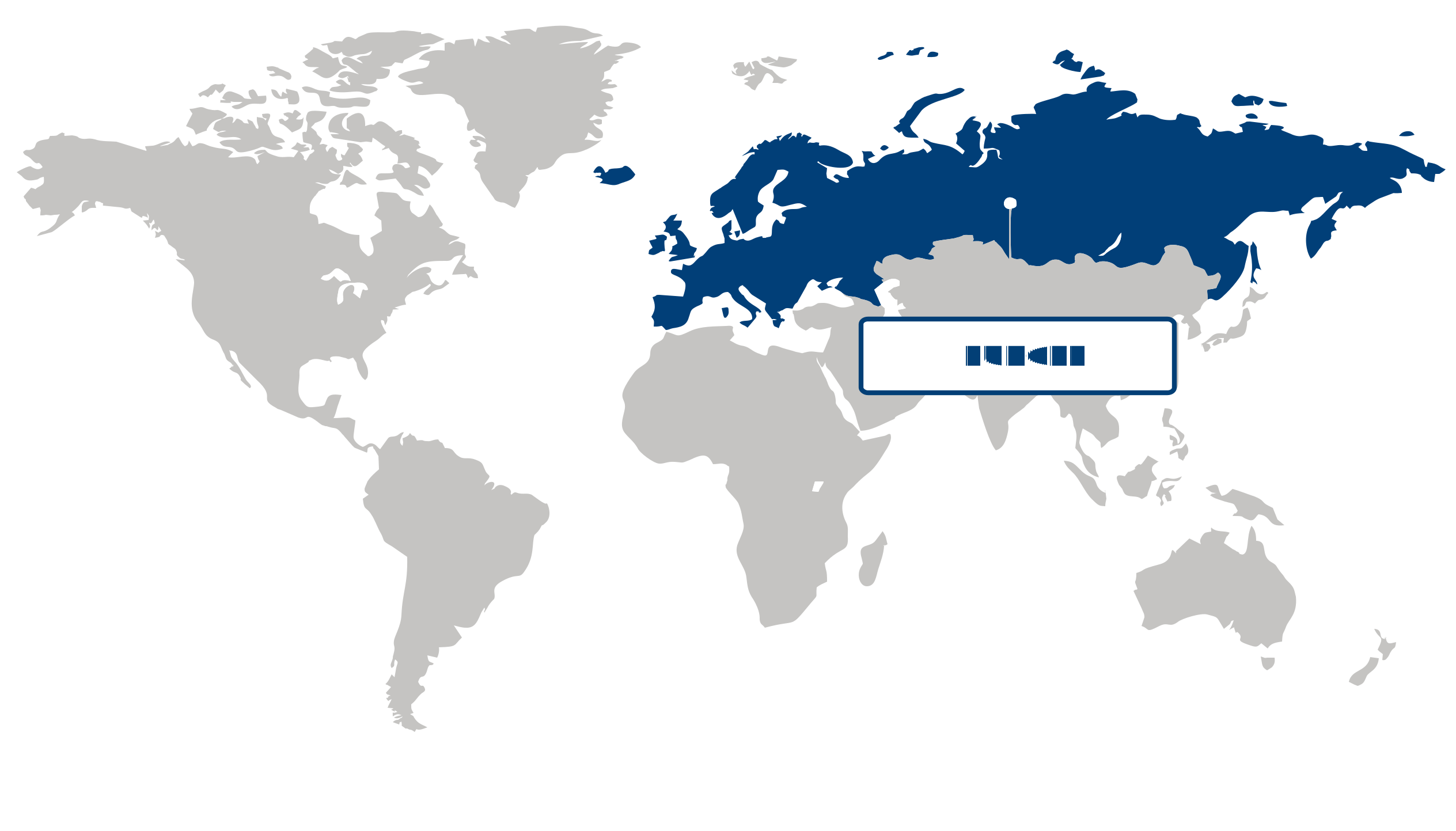
Europe (Largest Region)
The infertility treatment devices and equipment market was led by Europe, which accounted for a 42.19% share in 2026. The region benefits from established reproductive healthcare infrastructure, broad access to fertility services, and strong clinical expertise in assisted reproductive procedures. Increasing awareness of fertility preservation and treatment options is encouraging patients to seek specialized care, while advances in reproductive medicine are supporting the adoption of sophisticated treatment equipment and laboratory technologies. Established healthcare systems and greater availability of fertility clinics also facilitate access to diagnostic and assisted reproductive procedures. In addition, growing attention to delayed parenthood and individualized fertility management is contributing to demand for advanced equipment used throughout the infertility treatment process.
Asia Pacific (Fastest-Growing Region)
Asia Pacific is the fastest-growing regional market, supported by increasing awareness of infertility treatment, improving reproductive healthcare infrastructure, and expanding access to assisted reproductive services. Rising demand for fertility care is encouraging healthcare providers to develop specialized treatment facilities and adopt modern reproductive technologies. Greater awareness of fertility diagnostics, preservation, and assisted conception is also reducing barriers to treatment and broadening the patient base. Investments in healthcare infrastructure and increasing availability of specialized medical professionals are strengthening regional treatment capacity. As reproductive healthcare becomes more accessible and patients increasingly seek advanced treatment options, demand for infertility treatment devices and equipment is gaining momentum across Asia Pacific.
| Parameter | North America | Asia Pacific | Europe | Latin America | MEA |
|---|---|---|---|---|---|
| Innovation Hub i Scale Nascent Developing Advanced | |||||
| Cost-Sensitive Region i Scale Low Medium High | |||||
| Regulatory Environment i Scale Restrictive Neutral Supportive | |||||
| Demand Drivers i Scale Weak Moderate Strong | |||||
| Development Stage i Scale Emerging Developing Developed | |||||
| Adoption Rate i Scale Low Medium High | |||||
| New Entrants / Startups i Scale Sparse Moderate Dense | |||||
| Macro Indicators i Scale Weak Stable Strong |
Key Country Insights
Germany 🇩🇪
Clinical protocol-driven usageIn Germany, infertility treatment devices and equipment are adopted within highly protocol-driven clinical environments emphasizing safety, standardization, and precision. The market is characterized by strong hospital-based fertility services, structured treatment pathways, and consistent investment in laboratory-grade equipment aligned with stringent medical regulatory frameworks and quality assurance requirements.
France 🇫🇷
Public-private fertility care balanceIn France, infertility treatment devices and equipment adoption is influenced by a balanced public-private healthcare system, where access to assisted reproductive technologies is expanding through regulated clinical frameworks. The market reflects steady investment in modern fertility laboratories and standardized treatment infrastructure within both hospital networks and private clinics.
Italy 🇮🇹
Specialist clinic driven demandIn Italy, infertility treatment devices and equipment demand is concentrated in specialist fertility clinics and private healthcare providers. The market reflects gradual modernization of assisted reproduction infrastructure, with increasing adoption of advanced laboratory systems and diagnostic tools to support improving patient access and treatment outcomes.
Japan 🇯🇵
Minimally invasive reproductive techIn Japan, infertility treatment devices and equipment usage is shaped by preference for minimally invasive reproductive technologies and careful clinical practices. The market emphasizes advanced diagnostic precision, embryo handling systems, and controlled laboratory environments, with healthcare providers focusing on improving patient outcomes while maintaining strict procedural safety standards.
South Korea 🇰🇷
High-tech fertility solutionsIn South Korea, infertility treatment devices and equipment demand is driven by advanced reproductive medicine centers and strong adoption of high-tech fertility solutions. The market reflects integration of digital monitoring systems, sophisticated IVF technologies, and continuous innovation in clinical workflows to support personalized and efficient fertility treatment services.
United States 🇺🇸
Advanced fertility clinic adoptionIn the United States, infertility treatment devices and equipment adoption is driven by advanced fertility clinic networks and high utilization of assisted reproductive technologies. The market reflects strong integration of automated laboratory systems, embryo culture technologies, and precision diagnostics, with clinics continuously upgrading infrastructure to improve procedural success and workflow efficiency.
Segment Leadership and Growth Trends
Infertility Treatment Devices and Equipment Market Share (%), by End-use, 2026
Go beyond the chart, access full insights & data tables
Request Free Sample ReportEnd-use Segment Analysis: Fertility Clinics (Largest & Fastest-Growing Segment)
Fertility clinics accounted for the largest share of the infertility treatment devices and equipment market at 79.12% in 2026 and are also the fastest-growing end-use segment, reflecting their central role in providing comprehensive assisted reproductive care. These specialized facilities offer a broad range of infertility procedures and therefore require integrated equipment for diagnosis, treatment, monitoring, and laboratory workflows. Increasing demand for specialized fertility services, greater acceptance of assisted reproductive technologies, and the concentration of advanced reproductive expertise within dedicated clinics continue to support strong equipment utilization. Investments in modern treatment infrastructure and improved clinical capabilities further reinforce the position of fertility clinics as the primary setting for infertility care.
Type Segment Analysis: Sperm Separation Device (Largest Segment) vs Imaging System (Fastest-Growing Segment)
The sperm separation device segment led the infertility treatment devices and equipment market with a 19.43% share in 2026, supported by its essential role in preparing sperm samples for assisted reproductive procedures. These devices enable the selection and processing of sperm with desirable characteristics, helping fertility specialists improve sample quality and support treatment workflows. Their routine relevance across infertility procedures, together with continued emphasis on laboratory efficiency and reproductive outcomes, sustains demand for sperm separation technologies.
Imaging systems are expanding at the fastest pace as fertility care increasingly relies on precise visualization for diagnosis, treatment planning, and procedure guidance. Advanced imaging technologies can support assessment of reproductive structures and improve clinicians' ability to monitor procedures with greater accuracy. The growing use of minimally invasive fertility interventions, increasing focus on personalized treatment approaches, and continued technological improvements in reproductive imaging are contributing to broader adoption of these systems.
| Segment | Sub-Segment | Largest Segment | Fastest Growing |
|---|---|---|---|
| End-use | Fertility Clinics, Hospitals & Other Healthcare Facilities, Clinical Research Institutes | Fertility Clinics | Fertility Clinics |
| Type | Ovum Aspiration Pumps, Sperm Separation Device, Sperm Analyzer Systems, Micromanipulators Systems, Incubators, Cryosystems, Imaging System, Microscopes, Others | Sperm Separation Device | Imaging System |
Competitive Landscape and Market Positioning
Top players in the infertility treatment devices and equipment market:
1. The Cooper Companies Inc. (United States)
2. Cook Medical LLC (United States)
3. Vitrolife AB (Sweden)
4. Hamilton Thorne Ltd. (Canada)
5. Eppendorf SE (Germany)
6. Rocket Medical plc (United Kingdom)
7. Esco Lifesciences Group Ltd. (Singapore)
8. FUJIFILM Irvine Scientific Inc. (United States)
9. Genea Biomedx Pty Ltd. (Australia)
10. Nidacon International AB (Sweden)
The infertility treatment devices and equipment market is advancing through improved precision tools and assisted reproductive technologies. Enhanced laboratory systems and automation are improving treatment success rates. Collaborative development efforts are expanding technological capabilities across fertility solutions. Continuous innovation in device design and functionality is strengthening clinical efficiency, driving the infertility treatment devices and equipment market toward more effective reproductive healthcare solutions.
| Company | Market Share | Company Revenue | Revenue CAGR (%) | Product Portfolio | Geographic Presence | Innovation / R&D Focus | Strategic Developments |
|---|---|---|---|---|---|---|---|
| The Cooper Companies Inc. (United States) | |||||||
| Cook Medical LLC (United States) | |||||||
| Vitrolife AB (Sweden) | |||||||
| Hamilton Thorne Ltd. (Canada) | |||||||
| Eppendorf SE (Germany) | |||||||
| Rocket Medical plc (United Kingdom) | |||||||
| Esco Lifesciences Group Ltd. (Singapore) | |||||||
| FUJIFILM Irvine Scientific Inc. (United States) | |||||||
| Genea Biomedx Pty Ltd. (Australia) | |||||||
| Nidacon International AB (Sweden). |
Industry Development/News
| Company Name | Date | Key Development |
|---|---|---|
| Columbia University Fertility Center | Jun-25 | Columbia University Fertility Center reported the first pregnancy achieved using the STAR AI system, enabling conception in an azoospermic patient after 18 years of infertility. The development highlights clinical validation of AI-enabled sperm identification technology, marking a notable advancement in assisted reproductive technologies and infertility treatment workflows. |
| U.S. Food and Drug Administration (FDA) | May-25 | The U.S. FDA classified anti-mullerian hormone test systems as Class II devices with special controls, clarifying regulatory requirements for ovarian reserve diagnostics. This decision standardizes compliance pathways for manufacturers and supports broader commercialization of infertility-related hormonal testing technologies. |
| Overture Life | Apr-25 | Overture Life raised USD 20.6 million, bringing total funding to USD 57 million, to accelerate deployment of IVF automation technologies. The financing supports scaling of automated laboratory solutions aimed at improving efficiency, consistency, and throughput in assisted reproductive treatment workflows. |
| Conceivable Life Sciences | Jan-25 | Conceivable Life Sciences secured USD 18 million in Series A funding led by ARTIS Ventures to develop and commercialize an AI-powered automated IVF laboratory. The investment supports advancement of end-to-end automation in fertility treatment processes, targeting improved scalability and operational efficiency in IVF clinics. |
Customize Your Report
Explore examples of how this report can be tailored to different research needs, including custom segments, additional topics or chapters, and related reports. Click a section of the wheel or its numbered marker to explore the available options.
Infertility Treatment Devices and Equipment Market — Custom Segments
| Segment | Sub-Segment |
|---|---|
| Procedure Type | Ovarian Stimulation & Monitoring, Oocyte Retrieval, Sperm Preparation, Embryo Culture & Transfer, Cryopreservation |
| Fertility Treatment Pathway | In Vitro Fertilization (IVF), Intracytoplasmic Sperm Injection (ICSI), Intrauterine Insemination (IUI), Fertility Preservation |
| Technology Adoption Level | Conventional Systems, Automated Systems, AI-Enabled Systems, Integrated Laboratory Systems |
Infertility Treatment Devices and Equipment Market — Custom TOC
| Custom Chapter | Custom Details |
|---|---|
| Assisted Reproductive Technology Adoption Strategy |
|
| Fertility Clinic Infrastructure Assessment |
|
| Emerging Treatment Technology Roadmap |
|
Need a different cut of the data?
Request Custom ResearchHow much is the infertility treatment devices and equipment market worth?
How is the infertility treatment devices and equipment industry projected to perform over the next decade?
How is the expansion of IVF clinic networks influencing equipment procurement patterns in the infertility treatment devices and equipment market?
What is driving the increased adoption of imaging systems in fertility treatment workflows?
Why do Fertility Clinics dominate the infertility treatment devices and equipment market?
Why are Imaging Systems the fastest-growing device type in the infertility treatment devices and equipment market?
Why does Europe lead the infertility treatment devices and equipment market?
Why is Asia Pacific the fastest-growing regional market for infertility treatment devices and equipment?
What are the key competitors in the infertility treatment devices and equipment landscape?
Our Clients
"The team took the time to understand our specific business needs and delivered a report that was well aligned with our objectives. Their expertise and understanding of the industry were clearly reflected in the quality and relevance of the insights provided."
Siemens Healthcare
"Our experience in acquiring the research report has been excellent. The depth of analysis, and actionable insights provided have been extremely valuable in supporting our ongoing R&D efforts."
GC Biopharma
"The report offered a comprehensive view of the market trends. The in-depth segmentation and analysis of emerging opportunities gave us a better understanding of the market."
Medtronic
Our Research Team & Methodology
Every Fundamental Business Insights report is built by a dedicated vertical research team, validated through a structured primary-and-secondary methodology, and reviewed for accuracy before it reaches you.
Research Team Overview
Prepared by the Healthcare & Medical Devices Research Team
Delivery
Published
Demand
Available
Support
Trust & Compliance
Research Domains
10 coverage areasResearch Intelligence
| Source | Reference |
|---|---|
| World Health Organization (WHO) | www.who.int |
| U.S. Food & Drug Administration (FDA) | www.fda.gov |
| European Medicines Agency (EMA) | www.ema.europa.eu |
| Centers for Disease Control and Prevention (CDC) | www.cdc.gov |
| National Institutes of Health (NIH) | www.nih.gov |
| National Center for Biotechnology Information (NCBI) | www.ncbi.nlm.nih.gov |
| PubMed | pubmed.ncbi.nlm.nih.gov |
| ClinicalTrials.gov | clinicaltrials.gov |
| International Organization for Standardization (ISO) | www.iso.org |
| ASTM International | www.astm.org |
| Advanced Medical Technology Association (AdvaMed) | www.advamed.org |
| Medical Device Innovation Consortium (MDIC) | mdic.org |
| Biotechnology Innovation Organization (BIO) | www.bio.org |
| International Federation of Pharmaceutical Manufacturers & Associations (IFPMA) | www.ifpma.org |
| U.S. Pharmacopeia (USP) | www.usp.org |
| European Directorate for the Quality of Medicines & HealthCare (EDQM) | www.edqm.eu |
| World Organisation for Animal Health (WOAH) | www.woah.org |
| American Hospital Association (AHA) | www.aha.org |
| OECD Health | www.oecd.org/health |
| World Bank Data | data.worldbank.org |
Research Workflow & Quality Assurance
Data Collection
Verified information gathered through primary and secondary research.
Data Triangulation
Cross-validation using multiple independent data sources.
Forecast Modelling
Market estimates developed using historical trends and analytical models.
Analyst Validation
Findings reviewed by domain experts for accuracy and consistency.
Editorial & Quality Review
Final editorial, quality, and compliance checks before publication.
Final Publication
Released after successful completion of the internal review process.
Report Coverage
📊 Market Assessment
- Market Size & Forecast
- Market Segmentation
- Regional Analysis
- Growth Drivers & Challenges
- Market Dynamics
🏢 Competitive Intelligence
- Competitive Landscape
- Company Profiles
- Competitive Benchmarking
- Mergers & Acquisitions
- Market Share Analysis or Key Company Strategies
🔍 Strategic Analysis
- Value Chain Analysis
- Porter's Five Forces
- PESTLE Analysis
- Pricing Trends
- Supply-Demand Analysis
🚀 Future Outlook
- Technology Landscape
- Regulatory Landscape
- Investment & Funding Landscape
- Emerging Opportunities
- Future Market Outlook
Have a question about this report or need a custom scope?
Request Customization