Inulin Market Size & Growth Forecast 2027–2036, By Segments (Nature, Form, Application, Product), Regional Demand Trends (North America, Asia Pacific, Europe), Key Country Insights (U.S., Japan, South Korea, Germany, France, Italy), and Competitive Landscape
Market Size and Growth Outlook
Inulin Market size was valued at USD 2.1 Billion in 2026 and is anticipated to grow at 6.57% CAGR from 2027 to 2036, surpassing USD 3.97 Billion by 2036. The industry revenue for 2027 is assessed at USD 2.22 Billion.
Get more details on this report
Request Free Sample ReportInulin Market Intelligence Snapshot
Regional Market Dynamics
- Europe leads on strong demand for functional ingredients, established food and beverage industries, and consumer preference for prebiotic, clean-label, and fiber-rich products.
- Asia Pacific is the fastest-growing region, driven by functional food demand, urbanization, changing diets, expanding food processing, and rising healthcare awareness.
Segment Momentum
- The conventional segment held 58.3% of the market in 2026, supported by established manufacturing capabilities, reliable raw material availability, cost-effective production, and consistent quality for large-scale commercial applications.
- Pharmaceuticals are the fastest-growing application as inulin sees expanding use in specialized formulations, digestive health products, and advanced therapeutic applications, supported by growing interest in preventive healthcare.
Market Expansion Drivers
- Rising consumer demand for functional foods driving prebiotic ingredient adoption in health-oriented diets
- Growing preference for natural and clean-label ingredients boosting plant-based dietary fiber integration
- Expansion of functional food and beverage formulations increasing use of inulin as sugar substitute
Leading Market Participants
- Key companies in the inulin market include BENEO GmbH (Germany), Cosucra Groupe Warcoing SA (Belgium), Sensus B.V. (Netherlands), Cargill, Incorporated (United States), Archer Daniels Midland Company (United States), Tate & Lyle plc (United Kingdom), Ingredion Incorporated (United States), Roquette Frères (France), Jarrow Formulas, Inc. (United States)
Global Market Forecast Snapshot
Market Outlook
- 2026 Market Size: USD 2.1 Billion
- 2027 Estimated Market Size: USD 2.22 Billion
- Projected Market Size: USD 3.97 Billion by 2036
- Growth Forecast: 6.57% CAGR (2027-2036)
Regional and Segment Outlook
- Leading Regional Market: Europe
- High-Growth Regional Hub: Asia Pacific
- Core Revenue Segment: Conventional (Nature) | Powder (Form) | Food & Beverages (Application) | Chicory Root Inulin (Product)
- Emerging Opportunity Segment: Organic (Nature) | Powder (Form) | Pharmaceuticals (Application) | Jerusalem Artichoke Inulin (High-performance (HP) Inulin) (Product)
Market Growth Drivers and Industry Trends
Rising consumer demand for functional foods driving prebiotic ingredient adoption in health-oriented diets
Consumers are increasingly seeking foods that support digestive wellness, immune function, and overall health, encouraging manufacturers to incorporate scientifically recognized prebiotic ingredients into everyday products. This shift in dietary preferences will drive the inulin market growth as food producers expand functional offerings across dairy alternatives, cereals, nutrition bars, and dietary supplements. Inulin's ability to improve gut microbiota while contributing to desirable texture and mouthfeel allows formulators to combine nutritional value with product quality, making it an attractive ingredient for health-focused product development across multiple food categories.
Growing preference for natural and clean-label ingredients boosting plant-based dietary fiber integration
Clean-label purchasing behavior continues to reshape ingredient selection, with manufacturers replacing synthetic additives with naturally derived alternatives that align with consumer expectations for transparency and minimally processed foods. The inulin market growth is supported by this transition because inulin is sourced from plants and serves multiple functional roles, including dietary fiber enrichment, texture enhancement, and formulation support. Its compatibility with clean-label claims enables food and beverage companies to simplify ingredient lists while maintaining product performance across a broad range of applications.
Expansion of functional food and beverage formulations increasing use of inulin as sugar substitute
As manufacturers reformulate products to reduce sugar content without compromising taste or texture, ingredient innovation has become a central focus in product development. Within this trend, the inulin market will propel demand by providing a naturally derived ingredient that delivers mild sweetness alongside fiber enrichment and improved mouthfeel. Its versatility allows incorporation into beverages, dairy products, bakery items, confectionery, and nutritional formulations where balanced sensory characteristics remain essential despite lower sugar levels.
| Growth Driver | Impact on CAGR | Regulatory Influence | Geographic Relevance | Adoption Rate | Impact Timeline |
|---|---|---|---|---|---|
| Rising consumer demand for functional foods driving prebiotic ingredient adoption in health-oriented diets | 2.2% | Low | North America, Europe | High | Near Term |
| Growing preference for natural and clean-label ingredients boosting plant-based dietary fiber integration | 2.3% | Low | Europe, Asia Pacific | High | Mid Term |
| Expansion of functional food and beverage formulations increasing use of inulin as sugar substitute | 2.1% | Moderate | North America, Asia Pacific | High | Mid Term |
Explore Growth Opportunities
Request Free Sample ReportRegional Demand Dynamics
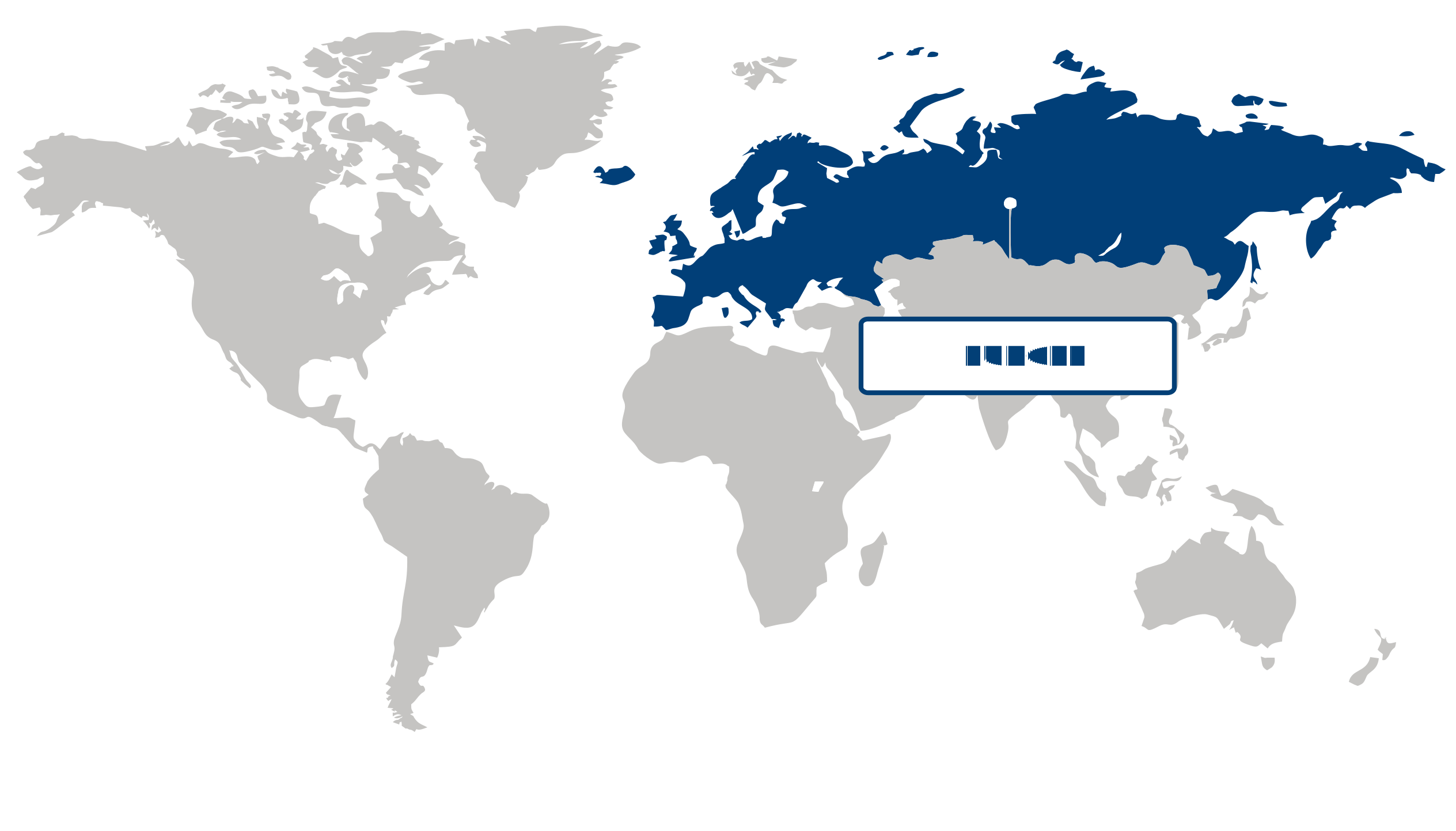
Europe (Largest Region)
Inulin market was led by Europe, which held the largest regional position in 2026, supported by strong consumer preference for functional and health-oriented food ingredients. Demand for prebiotic ingredients is reinforced by growing awareness of digestive health, clean-label formulations, and nutritional products with added functional benefits. The region’s established food and beverage industry, well-developed regulatory environment, and increasing incorporation of fiber-rich ingredients into everyday products provide a strong foundation for inulin consumption. Growing interest in healthier dietary patterns is also encouraging manufacturers to develop products that combine nutritional value with convenience.
Asia Pacific (Fastest-Growing Region)
Asia Pacific is projected to be the fastest-growing region, driven by expanding demand for functional foods and increasing awareness of the health benefits associated with dietary fiber and prebiotic ingredients. Rapid urbanization and changing dietary habits are encouraging consumers to seek convenient foods with enhanced nutritional profiles. The region’s growing food-processing sector is also supporting the incorporation of inulin into dairy products, beverages, bakery products, and nutritional formulations. Rising healthcare awareness and expanding demand for digestive-health solutions are further creating opportunities for manufacturers to strengthen the use of inulin across diverse applications.
| Parameter | North America | Asia Pacific | Europe | Latin America | MEA |
|---|---|---|---|---|---|
| Innovation Hub i Scale Nascent Developing Advanced | |||||
| Cost-Sensitive Region i Scale Low Medium High | |||||
| Regulatory Environment i Scale Restrictive Neutral Supportive | |||||
| Demand Drivers i Scale Weak Moderate Strong | |||||
| Development Stage i Scale Emerging Developing Developed | |||||
| Adoption Rate i Scale Low Medium High | |||||
| New Entrants / Startups i Scale Sparse Moderate Dense | |||||
| Macro Indicators i Scale Weak Stable Strong |
Key Country Insights
United States 🇺🇸
Digestive Health InnovationThe U.S. inulin market benefits from growing demand for prebiotic ingredients in foods, beverages, and dietary supplements. Companies prioritize formulation flexibility, clean-label positioning, and ingredient functionality to support digestive wellness products.
Germany 🇩🇪
Nutritional Ingredient IntegrationGermany incorporates inulin into functional food and nutritional product development with an emphasis on ingredient quality and processing consistency. Manufacturers support applications that improve fiber content while maintaining desirable product characteristics.
Japan 🇯🇵
Functional Nutrition SolutionsJapan emphasizes inulin as a value-added ingredient for health-oriented food and beverage formulations. Product developers focus on balancing nutritional benefits with taste, texture, and consumer acceptance across functional product categories.
South Korea 🇰🇷
Wellness Product FormulationSouth Korea expands inulin applications across nutritional foods and beverages designed for health-conscious consumers. The market encourages innovation in fiber-enriched products while maintaining formulation stability and product quality.
France 🇫🇷
Premium Fiber IngredientsFrance prioritizes inulin for premium food applications that support nutritional enhancement and clean-label product positioning. Suppliers focus on ingredient traceability and consistent functionality for diverse food manufacturing requirements.
Italy 🇮🇹
Dairy Ingredient EnhancementItaly incorporates inulin into dairy, bakery, and specialty food products to improve fiber content and texture. Manufacturers emphasize ingredient versatility and formulation performance while meeting evolving consumer preferences for functional foods.
Segment Leadership and Growth Trends
Inulin Market Share (%), by Nature, 2026
Go beyond the chart, access full insights & data tables
Request Free Sample ReportNature Segment Analysis: Conventional (Largest Segment) vs Organic (Fastest-Growing Segment)
The conventional nature segment accounted for 58.3% of the market share in 2026, making it the leading segment within the inulin market. Its dominance is driven by established manufacturing capabilities, reliable raw material availability, and cost-effective production that supports large-scale commercial applications. Conventional inulin continues to be extensively used across food, beverage, and nutritional products where consistent quality and dependable supply are essential. Its broad accessibility has enabled manufacturers to incorporate functional fiber into a diverse range of consumer products.
The organic nature segment is expected to witness the fastest growth during the forecast period. Rising consumer preference for clean-label products and organically sourced ingredients is encouraging manufacturers to expand their organic product portfolios. Increasing awareness of sustainable agriculture and growing demand for minimally processed nutritional ingredients are further supporting adoption across premium food, beverage, and wellness applications.
Form Segment Analysis: Powder (Largest & Fastest-Growing Segment)
The powder form segment dominated the inulin market, accounting for 67.2% of the market share in 2026, while also emerging as the fastest-growing form. Powdered inulin is widely utilized because it offers excellent stability, long shelf life, easy handling, and compatibility with numerous food, beverage, and dietary supplement formulations. Its ability to improve texture, enhance fiber content, and support product functionality has made it the preferred form for manufacturers. Growing innovation in functional nutrition products is expected to sustain the segment's strong growth trajectory.
Application Segment Analysis: Food & Beverages (Largest Segment) vs Pharmaceuticals (Fastest-Growing Segment)
The food & beverages application segment led the inulin market, accounting for 47.7% of the market share in 2026. The segment benefits from increasing incorporation of inulin into dairy products, bakery items, beverages, and functional foods to improve fiber content and support clean-label product development. Rising consumer interest in digestive wellness and healthier ingredient alternatives continues to encourage wider adoption across food and beverage manufacturing.
The pharmaceuticals application segment is anticipated to register the fastest growth during the forecast period. Expanding use of inulin in specialized formulations, digestive health products, and advanced therapeutic applications is driving demand within the pharmaceutical industry. Growing emphasis on preventive healthcare and scientifically supported functional ingredients is expected to create favorable opportunities for continued expansion of this application segment.
| Segment | Sub-Segment | Largest Segment | Fastest Growing |
|---|---|---|---|
| Nature | Organic, Conventional | Conventional | Organic |
| Form | Powder, Liquid | Powder | Powder |
| Application | Food & Beverages, Dietary Supplements, Pharmaceuticals, Animal Feed | Food & Beverages | Pharmaceuticals |
| Product | Chicory Root Inulin, Jerusalem Artichoke Inulin (High-performance (HP) Inulin) | Chicory Root Inulin | Jerusalem Artichoke Inulin (High-performance (HP) Inulin) |
Unlock insights tailored to your business with our bespoke market research solutions.
Click to get your customized report now.
Competitive Landscape and Market Positioning
Major players in the inulin market:
- BENEO GmbH (Germany)
- Cosucra Groupe Warcoing SA (Belgium)
- Sensus B.V. (Netherlands)
- Cargill Incorporated (United States)
- Archer Daniels Midland Company (United States)
- Tate & Lyle plc (United Kingdom)
- Ingredion Incorporated (United States)
- Roquette Frères (France)
- Jarrow Formulas, Inc. (United States)
Shifts in sourcing strategy and ingredient functionality are reshaping rivalry across the inulin market. Producers are moving beyond competing on supply volume by differentiating through purity profiles, application-specific formulations, and consistent performance across food, beverage, and nutritional products. Demand from manufacturers seeking clean-label formulations has increased the value of technical support and formulation expertise, encouraging suppliers to work more closely with product developers during ingredient selection. At the same time, greater emphasis on resilient agricultural supply chains and traceable raw material procurement is raising barriers for participants that cannot consistently meet quality, sustainability, and regulatory expectations across multiple end-use industries.
| Company | Market Share | Company Revenue | Revenue CAGR (%) | Product Portfolio | Geographic Presence | Innovation / R&D Focus | Strategic Developments |
|---|---|---|---|---|---|---|---|
| BENEO GmbH (Germany) | |||||||
| Cosucra Groupe Warcoing SA (Belgium) | |||||||
| Sensus B.V. (Netherlands) | |||||||
| Cargill Incorporated (United States) | |||||||
| Archer Daniels Midland Company (United States) | |||||||
| Tate & Lyle plc (United Kingdom) | |||||||
| Ingredion Incorporated (United States) | |||||||
| Roquette Frères (France) | |||||||
| Jarrow Formulas Inc. (United States) |
Industry Development/News
| Company Name | Date | Key Development |
|---|---|---|
| Poca | Jul-25 | Poca commercialized a fiber-enriched, zero-calorie coffee sweetener formulated with added dietary fiber. The launch introduces structural innovation to the standard sweetener category, reflecting accelerated technology adoption and the integration of functional gut health ingredients into everyday consumer products. |
| Poca | Jul-25 | Poca commercialized a fiber-enriched, zero-calorie coffee sweetener formulated with added dietary fiber. The launch introduces structural innovation to the standard sweetener category, reflecting accelerated technology adoption and the integration of functional gut health ingredients into everyday consumer products. |
| PepsiCo | Mar-25 | PepsiCo agreed to acquire prebiotic soda brand Poppi for approximately $1.95 billion. The acquisition significantly strengthens PepsiCo's presence in the functional beverage segment, driving the commercial scaling of prebiotic ingredients and expanding the application of gut health solutions within mass-market distribution channels. |
| Health-Ade | Mar-25 | Health-Ade launched SunSip, a prebiotic soda line designed to expand the company's portfolio beyond kombucha. The initiative represents a strategic entry into the functional carbonated beverage category, targeting growing consumer demand for everyday digestive wellness and functional fiber ingredients. |
| PepsiCo | Mar-25 | PepsiCo agreed to acquire prebiotic soda brand Poppi for approximately $1.95 billion. The acquisition significantly strengthens PepsiCo's presence in the functional beverage segment, driving the commercial scaling of prebiotic ingredients and expanding the application of gut health solutions within mass-market distribution channels. |
| Health-Ade | Mar-25 | Health-Ade launched SunSip, a prebiotic soda line designed to expand the company's portfolio beyond kombucha. The initiative represents a strategic entry into the functional carbonated beverage category, targeting growing consumer demand for everyday digestive wellness and functional fiber ingredients. |
| CEFI | Jan-25 | The European Association of Chicory Inulin Producers, representing key producers including Beneo, Cosucra, and Sensus, joined the International Probiotics Association. This strategic alignment aims to advance scientific research and regulatory framework harmonization for prebiotics, fostering stronger ecosystem development and cross-industry collaboration for inulin-type fructans. |
| CEFI | Jan-25 | The European Association of Chicory Inulin Producers, representing key producers including Beneo, Cosucra, and Sensus, joined the International Probiotics Association. This strategic alignment aims to advance scientific research and regulatory framework harmonization for prebiotics, fostering stronger ecosystem development and cross-industry collaboration for inulin-type fructans. |
| Sensus | Jun-22 | Sensus expanded its chicory root fiber production capacity to capture growing global demand for natural prebiotics within plant-based food formulations and dietary supplements. The expansion enhances the company's supply chain capacity and positions it to scale distribution amid rising market interest in functional, plant-derived ingredients. |
| Sensus | Jun-22 | Sensus expanded its chicory root fiber production capacity to capture growing global demand for natural prebiotics within plant-based food formulations and dietary supplements. The expansion enhances the company's supply chain capacity and positions it to scale distribution amid rising market interest in functional, plant-derived ingredients. |
| Beneo | Dec-21 | Beneo invested EUR 30 million (USD 33.9 million) to expand chicory root fiber production by more than 40% across its facilities in Chile and Belgium. This infrastructure expansion directly addresses surging global demand for functional prebiotics, strengthening the company's manufacturing footprint and long-term supply capacity for inulin. |
| Beneo | Dec-21 | Beneo invested EUR 30 million (USD 33.9 million) to expand chicory root fiber production by more than 40% across its facilities in Chile and Belgium. This infrastructure expansion directly addresses surging global demand for functional prebiotics, strengthening the company's manufacturing footprint and long-term supply capacity for inulin. |
Customize Your Report
Explore examples of how this report can be tailored to different research needs, including custom segments, additional topics or chapters, and related reports. Click a section of the wheel or its numbered marker to explore the available options.
Inulin Market — Custom Segments
| Segment | Sub-Segment |
|---|---|
| Sales Channel | Direct Sales, Distributors & Wholesalers, Online Channels |
| Purity Grade | Standard Grade, High-Purity Grade, Pharmaceutical Grade |
| Pricing Tier | Economy, Mid-Range, Premium |
Inulin Market — Custom TOC
| Custom Chapter | Chapter Details |
|---|---|
| Prebiotic Ingredient Adoption |
|
| Gut Health Product Development |
|
| Fiber Fortification Opportunities |
|
Need a different cut of the data?
Request Custom ResearchWhat is the market valuation of inulin?
What is the forecasted size of the inulin industry?
Why is inulin becoming a strategic ingredient in functional food development?
How are clean-label and sugar reduction trends influencing the inulin market?
Why is the conventional segment the largest in the inulin market?
Why are pharmaceuticals the fastest-growing application for inulin?
Why does Europe hold the largest share of the inulin market?
How is Asia Pacific emerging as a high-growth inulin market?
Which companies dominate the inulin landscape?
Our Clients
"The report provided a thorough look at market trends, technological advancements, and the competitive landscape. The depth of insights was really valuable."
ITC Limited
"We would highly recommend Fundamental Business Insights & Consulting to anyone looking for reliable, detailed, and comprehensive market research in the Food industry."
Tyson Foods
"The clarity and presentation of the information were commendable. The report was delivered timely, which made the overall experience smooth and convenient."
Mondelēz International
Our Research Team & Methodology
Every Fundamental Business Insights report is built by a dedicated vertical research team, validated through a structured primary-and-secondary methodology, and reviewed for accuracy before it reaches you.
Research Team Overview
Prepared by the Food & Beverage Research Team
Delivery
Published
Demand
Available
Support
Trust & Compliance
Research Intelligence
| Source | Reference |
|---|---|
| Food and Agriculture Organization (FAO) | www.fao.org |
| World Health Organization (WHO) | www.who.int |
| U.S. Food & Drug Administration (FDA) | www.fda.gov |
| European Food Safety Authority (EFSA) | www.efsa.europa.eu |
| U.S. Department of Agriculture (USDA) | www.usda.gov |
| Codex Alimentarius Commission | www.fao.org/fao-who-codexalimentarius |
| International Organization for Standardization (ISO) | www.iso.org |
| AOAC INTERNATIONAL | www.aoac.org |
| Institute of Food Technologists (IFT) | www.ift.org |
| International Dairy Foods Association (IDFA) | www.idfa.org |
| International Sweeteners Association (ISA) | www.sweeteners.org |
| International Probiotics Association (IPA) | internationalprobiotics.org |
| Good Food Institute (GFI) | gfi.org |
| American Feed Industry Association (AFIA) | www.afia.org |
| International Feed Industry Federation (IFIF) | ifif.org |
| Specialty Food Association (SFA) | www.specialtyfood.com |
| Brewers Association | www.brewersassociation.org |
| International Bottled Water Association (IBWA) | bottledwater.org |
| International Alliance for Dietary/Food Supplement Associations (IADSA) | www.iadsa.org |
| OECD Agriculture & Food | www.oecd.org/agriculture |
Research Workflow & Quality Assurance
Data Collection
Verified information gathered through primary and secondary research.
Data Triangulation
Cross-validation using multiple independent data sources.
Forecast Modelling
Market estimates developed using historical trends and analytical models.
Analyst Validation
Findings reviewed by domain experts for accuracy and consistency.
Editorial & Quality Review
Final editorial, quality, and compliance checks before publication.
Final Publication
Released after successful completion of the internal review process.
Report Coverage
📊 Market Assessment
- Market Size & Forecast
- Market Segmentation
- Regional Analysis
- Growth Drivers & Challenges
- Market Dynamics
🏢 Competitive Intelligence
- Competitive Landscape
- Company Profiles
- Competitive Benchmarking
- Mergers & Acquisitions
- Market Share Analysis or Key Company Strategies
🔍 Strategic Analysis
- Value Chain Analysis
- Porter's Five Forces
- PESTLE Analysis
- Pricing Trends
- Supply-Demand Analysis
🚀 Future Outlook
- Technology Landscape
- Regulatory Landscape
- Investment & Funding Landscape
- Emerging Opportunities
- Future Market Outlook
Have a question about this report or need a custom scope?
Request Customization