Motorbike Riding Gear Market Size & Growth Forecast 2027–2036, By Segments (Distribution Channel, Product), Regional Demand Trends (North America, Asia Pacific, Europe), Key Country Insights (U.S., Japan, South Korea, Germany, France, Italy), and Competitive Landscape
Market Size and Growth Outlook
Motorbike Riding Gear Market size was valued at USD 14.5 billion in 2026 and is anticipated to grow at a 5.23% CAGR from 2027 to 2036, reaching USD 24.14 billion by 2036. The industry revenue for 2027 is assessed at USD 15.14 billion.
Get more details on this report
Request Free Sample ReportMotorbike Riding Gear Market Intelligence Snapshot
Regional Market Dynamics
- Europe leads due to strong motorcycle culture, high rider base, frequent replacement demand for helmets and apparel, and well-established brands and retail distribution networks.
- Asia Pacific grows at 7.57% CAGR driven by expanding two-wheeler usage, rising safety awareness, improved retail and e-commerce access, and increasing adoption of entry-level protective gear.
Segment Momentum
- Protective gear accounted for 72.77% of the market in 2026 because safety remains riders' primary purchasing priority, sustaining consistent demand for helmets, gloves, body armor, and other essential protection products.
- Online sales are expanding rapidly as riders increasingly purchase standardized or replacement gear digitally, benefiting from wider product selection, easier price comparisons, and convenient access to multiple brands and specifications.
Market Expansion Drivers
- Mandatory helmet regulations and rider safety campaigns driving certified protective gear adoption.
- Expanding motorcycle ownership in emerging economies increasing demand for affordable riding apparel.
- Rising demand for stylish multifunctional riding gear supporting lifestyle-oriented motorcycle consumer segments.
Leading Market Participants
- Key players in the motorbike riding gear market include Dainese S.p.A. (Italy), Alpinestars S.p.A. (Italy), Shoei Co., Ltd. (Japan), Arai Helmet, Ltd. (Japan), Schuberth GmbH (Germany), Bell Helmets (United States), FOX Racing (United States), RST Moto (United Kingdom), HJC Helmets (South Korea), REV’IT! Sport International B.V. (Netherlands).
Global Market Forecast Snapshot
Market Outlook
- 2026 Market Size: USD 14.5 billion
- 2027 Estimated Market Size: USD 15.14 billion.
- Projected Market Size: USD 24.14 billion by 2036
- Growth Forecast: 5.23% CAGR (2027-2036)
Regional and Segment Outlook
- Leading Regional Market: Europe
- High-Growth Regional Hub: Asia Pacific
- Core Revenue Segment: Offline (Distribution Channel) | Protective Gear (Product)
- Emerging Opportunity Segment: Online (Distribution Channel) | Clothing (Product)
Market Growth Drivers and Industry Trends
Mandatory helmet regulations and rider safety campaigns driving certified protective gear adoption
Mandatory helmet requirements and broader rider safety initiatives are increasing adoption of certified protective equipment within the motorbike riding gear market, particularly as governments and safety organizations emphasize injury prevention among two-wheeler users. Regulations encourage riders to use helmets that meet established safety requirements, while awareness campaigns are also increasing attention toward protective jackets, gloves, boots, and other riding equipment. Greater recognition of the risks associated with motorcycle accidents is encouraging consumers to assess protective gear based on safety performance, fit, and certification rather than relying only on price or appearance. Retailers and manufacturers are consequently seeing stronger interest in gear designed to provide impact, abrasion, and weather protection during regular riding.
Expanding motorcycle ownership in emerging economies increasing demand for affordable riding apparel
Growing motorcycle ownership across emerging economies is creating a broader customer base for the motorbike riding gear market, particularly as two-wheelers remain an important mode of personal transportation and daily commuting. New riders often require helmets, jackets, gloves, riding pants, and other basic protective apparel as they begin using motorcycles for work, education, and personal mobility. Price sensitivity in these markets is encouraging manufacturers and retailers to develop affordable gear that balances essential protection with comfort and practical functionality. Increased availability through organized retail and online channels is also making riding apparel more accessible to consumers who previously had limited exposure to specialized motorcycle equipment.
Rising demand for stylish multifunctional riding gear supporting lifestyle-oriented motorcycle consumer segments
Motorcycle users are increasingly looking for protective equipment that fits both riding requirements and broader lifestyle preferences, supporting the motorbike riding gear market as manufacturers develop products with greater emphasis on style, versatility, and comfort. Modern riders may prefer jackets, gloves, footwear, and other gear that can transition between commuting, leisure riding, and casual activities without appearing exclusively technical. Multifunctional designs incorporating protective features, weather resistance, ergonomic construction, and contemporary styling are appealing to consumers who view motorcycling as both transportation and a lifestyle activity. This shift is broadening purchasing considerations beyond basic safety equipment toward products that align with personal appearance and everyday usability.
| Growth Driver | Impact on CAGR | Regulatory Influence | Geographic Relevance | Adoption Rate | Impact Timeline |
|---|---|---|---|---|---|
| Mandatory helmet regulations and rider safety campaigns driving certified protective gear adoption | 2.10% | High | Europe, Asia Pacific, North America | High | Near Term |
| Expanding motorcycle ownership in emerging economies increasing demand for affordable riding apparel | 1.80% | Moderate | Asia Pacific, Latin America | High | Mid Term |
| Rising demand for stylish multifunctional riding gear supporting lifestyle-oriented motorcycle consumer segments | 1.50% | Low | Europe, North America, Asia Pacific | Emerging | Mid Term |
Unlock insights tailored to your business with our bespoke market research solutions.
Click to get your customized report now.
Regional Demand Dynamics
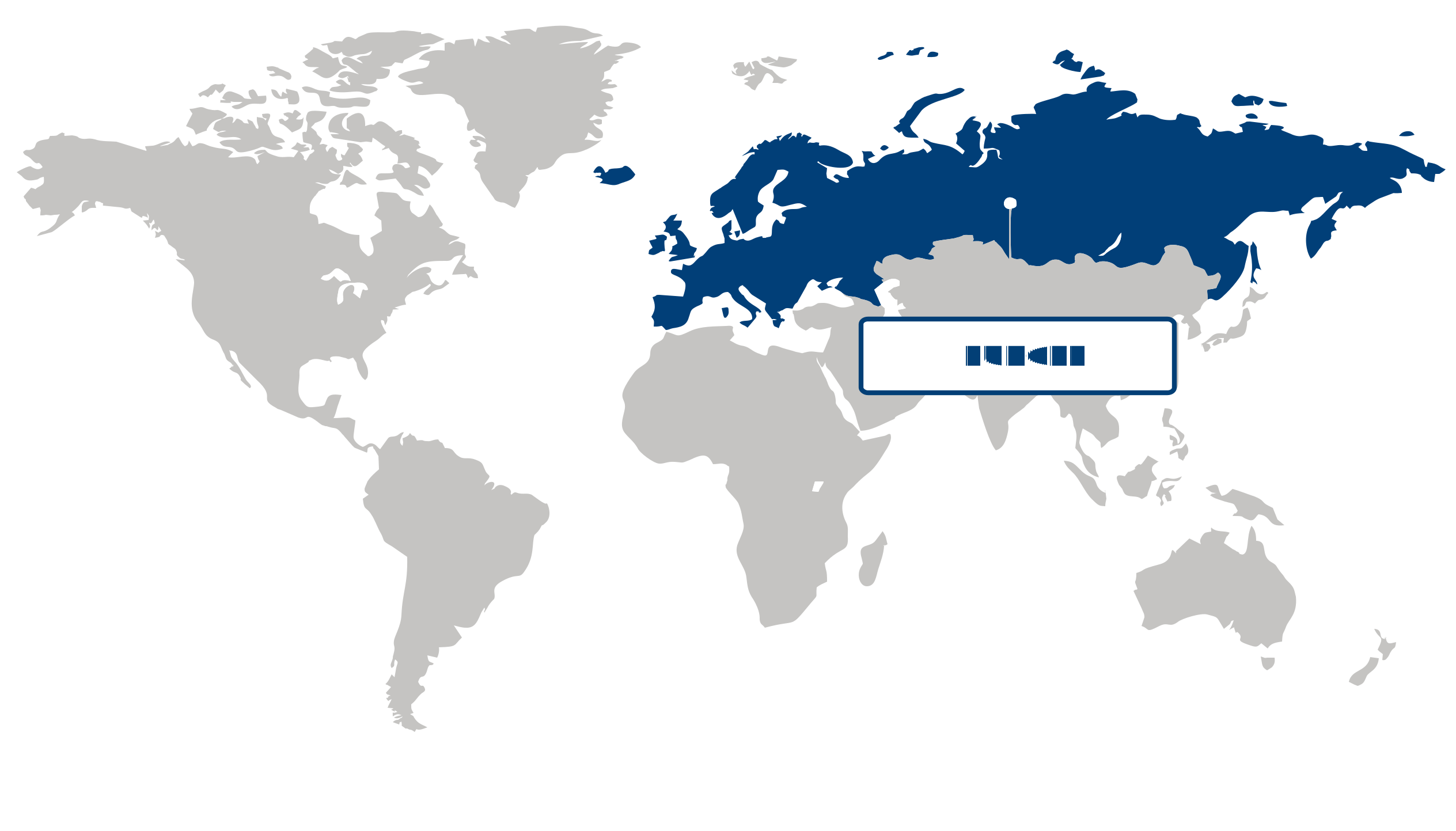
Europe (Largest Region)
Europe maintained the largest share of the motorbike riding gear market in 2026, supported by a mature motorcycle culture, established safety standards, and strong consumer awareness of protective equipment. Riders increasingly prioritize certified helmets, protective apparel, gloves, boots, and other specialized gear that combine safety with comfort and performance. The region’s established motorcycle tourism and recreational riding ecosystem also sustains demand for premium and purpose-specific protective products.
Asia Pacific (Fastest-Growing Region)
Asia Pacific is positioned as the fastest-growing region as motorcycle ownership and usage expand across urban, commuter, recreational, and delivery applications. Rising awareness of road safety is encouraging riders to adopt protective equipment beyond basic requirements, while improving disposable incomes are supporting demand for better-quality riding apparel and accessories. Expanding e-commerce distribution and the increasing popularity of motorcycle-based leisure activities are further broadening access to specialized riding gear.
| Parameter | North America | Asia Pacific | Europe | Latin America | MEA |
|---|---|---|---|---|---|
| Innovation Hub i Scale Nascent Developing Advanced | |||||
| Cost-Sensitive Region i Scale Low Medium High | |||||
| Regulatory Environment i Scale Restrictive Neutral Supportive | |||||
| Demand Drivers i Scale Weak Moderate Strong | |||||
| Development Stage i Scale Emerging Developing Developed | |||||
| Adoption Rate i Scale Low Medium High | |||||
| New Entrants / Startups i Scale Sparse Moderate Dense | |||||
| Macro Indicators i Scale Weak Stable Strong |
Key Country Insights
Germany 🇩🇪
Technical Protection StandardsGermany emphasizes motorbike riding gear that meets demanding safety certifications while delivering comfort and durability for everyday and touring riders. German consumers increasingly value protective equipment incorporating advanced impact protection, breathable fabrics, and ergonomic product design.
France 🇫🇷
Touring Apparel DemandFrance supports steady demand for motorbike riding gear designed for touring, recreational riding, and all-season performance. Suppliers in France increasingly focus on premium protective clothing featuring weather-resistant materials, rider comfort, and compliance with recognized safety standards.
Italy 🇮🇹
Premium Riding ApparelItaly combines strong motorcycle culture with demand for premium riding gear emphasizing design, craftsmanship, and certified protection. Italian manufacturers increasingly differentiate products through technical materials, fashionable styling, and performance features that appeal to both domestic and international riders.
Japan 🇯🇵
Urban Mobility ProtectionJapan focuses on compact, lightweight motorbike riding gear suited to daily commuting and urban mobility without compromising rider protection. Manufacturers in Japan increasingly develop versatile products that balance safety performance with comfort and practical functionality for diverse riding conditions.
South Korea 🇰🇷
Style-Oriented Safety GearSouth Korea experiences growing demand for motorbike riding gear that blends certified protection with contemporary styling and lightweight construction. Brands operating in South Korea increasingly introduce technologically advanced helmets, jackets, and accessories tailored to younger riders and urban commuters.
United States 🇺🇸
Performance Rider EquipmentThe U.S. motorbike riding gear market prioritizes protective apparel that combines rider safety, comfort, and advanced materials for recreational and long-distance riding. Manufacturers in the U.S. increasingly expand product ranges featuring integrated protection, weather adaptability, and premium design.
Segment Leadership and Growth Trends
Motorbike Riding Gear Market Share (%), by Distribution Channel, 2026
Go beyond the chart, access full insights & data tables
Request Free Sample ReportDistribution Channel Segment Analysis: Offline (Largest Segment) vs Online (Fastest-Growing Segment)
The offline distribution channel segment dominated the motorbike riding gear market with a 79.99% share in 2026, supported by consumers' preference for physically assessing the fit, comfort, material quality, and protective features of riding equipment before purchase. Specialized motorcycle stores and retail outlets also provide opportunities for product trials and expert guidance, which is particularly important for safety-oriented products such as helmets, jackets, gloves, and protective accessories. The established presence of dedicated retail networks continues to reinforce the segment's leading position.
The online distribution channel segment is expected to be the fastest-growing segment, driven by expanding e-commerce adoption and the increasing availability of a broad range of motorbike riding gear through digital platforms. Online channels enable consumers to compare products, access wider selections, and purchase specialized equipment conveniently. Improved digital retail experiences and growing consumer confidence in online purchasing are expected to support further segment growth.
Product Segment Analysis: Protective Gear (Largest Segment) vs Clothing (Fastest-Growing Segment)
Holding a 72.77% share in 2026, the protective gear segment led the motorbike riding gear market due to the essential role of safety equipment in reducing injury risks during motorcycle riding. Rising awareness regarding rider safety and increasing emphasis on protective equipment are supporting demand for helmets, body protection, gloves, and other safety-oriented products. The growing participation in recreational and long-distance motorcycling further contributes to the segment's strong market position.
The clothing segment is anticipated to be the fastest-growing segment, supported by rising consumer demand for riding apparel that combines protection, comfort, functionality, and personal style. Manufacturers are increasingly developing specialized garments suitable for varying weather conditions and riding environments. Growing interest in premium motorcycle lifestyles and greater participation in recreational riding are expected to accelerate demand.
| Segment | Sub-Segment | Largest Segment | Fastest Growing |
|---|---|---|---|
| Distribution Channel | Online, Offline | Offline | Online |
| Product | Protective Gear, Clothing, Footwear | Protective Gear | Clothing |
Competitive Landscape and Market Positioning
Top players in the motorbike riding gear market:
1. Dainese S.p.A. (Italy)
2. Alpinestars S.p.A. (Italy)
3. Shoei Co. Ltd. (Japan)
4. Arai Helmet Ltd. (Japan)
5. Schuberth GmbH (Germany)
6. Bell Helmets (United States)
7. FOX Racing (United States)
8. RST Moto (United Kingdom)
9. HJC Helmets (South Korea)
10. REV’IT! Sport International B.V. (Netherlands)
The motorbike riding gear market is growing due to increasing demand for safety and performance-oriented riding equipment. The motorbike riding gear market is witnessing innovation in protective materials and smart gear technologies. Continuous development is enhancing rider safety, comfort, and durability.
| Company | Market Share | Company Revenue | Revenue CAGR (%) | Product Portfolio | Geographic Presence | Innovation / R&D Focus | Strategic Developments |
|---|---|---|---|---|---|---|---|
| Dainese S.p.A. (Italy) | |||||||
| Alpinestars S.p.A. (Italy) | |||||||
| Shoei Co. Ltd. (Japan) | |||||||
| Arai Helmet Ltd. (Japan) | |||||||
| Schuberth GmbH (Germany) | |||||||
| Bell Helmets (United States) | |||||||
| FOX Racing (United States) | |||||||
| RST Moto (United Kingdom) | |||||||
| HJC Helmets (South Korea) | |||||||
| REV’IT! Sport International B.V. (Netherlands). |
Industry Development/News
| Company Name | Date | Key Development |
|---|---|---|
| Alpinestars | Nov-24 | Alpinestars launched the limited edition Martinator S-R10 Racing Helmet and Supertech R Vented Boots in collaboration with MotoGP World Champion Jorge Martin. The products enhance high-performance riding protection through advanced safety engineering and reinforce premium positioning in professional motorsport and consumer riding gear segments. |
| Triumph Motorcycles | Nov-24 | Triumph Motorcycles partnered with Arai to launch a co-branded helmet range including four models covering classic, sport, off-road, and adventure riding segments. The collaboration strengthens premium helmet offerings by integrating performance-focused safety design across multiple riding applications. |
| Alpinestars | Aug-24 | Alpinestars introduced a new off-road goggle range featuring multiple configurations, including youth-focused designs, roll-off systems, and accessory customization options. The expansion enhances its protective eyewear portfolio, supporting diversified product coverage across off-road and recreational riding segments. |
| SHOEI | Jul-24 | SHOEI launched the Neotec 3 helmet integrated with Sena SLR3 Bluetooth communication technology, featuring AIM+ shell construction for enhanced structural safety. The development strengthens its connected helmet offering by integrating communication systems with advanced protective design for touring and urban riding applications. |
Customize Your Report
Explore examples of how this report can be tailored to different research needs, including custom segments, additional topics or chapters, and related reports. Click a section of the wheel or its numbered marker to explore the available options.
Motorbike Riding Gear Market — Custom Segments
| Segment | Sub-Segment |
|---|---|
| Rider Type | Commuters, Touring Riders, Sport & Performance Riders, Off-Road & Adventure Riders, Professional & Competitive Riders |
| Vehicle Type | Standard & Street Motorcycles, Sport Motorcycles, Cruisers & Touring Motorcycles, Off-Road Motorcycles, Scooters & Mopeds |
| Price Tier | Entry-Level, Mid-Range, Premium, Professional |
Motorbike Riding Gear Market — Custom TOC
| Custom Chapter | Custom Details |
|---|---|
| Protective Gear Innovation Landscape |
|
| Motorcycle Lifestyle Segment Opportunities |
|
| Premium Riding Gear Brand Strategy Assessment |
|
Need a different cut of the data?
Request Custom ResearchWhat is the market size of motorbike riding gear?
How will the motorbike riding gear industry grow in terms of size and CAGR by 2036?
How are safety regulations influencing purchasing behavior in the motorbike riding gear market?
What market trends are driving product diversification in the motorbike riding gear market?
Why does protective gear lead the motorbike riding gear market?
Why is the online distribution channel growing fastest in the motorbike riding gear market?
Why does Europe hold the largest share in the motorbike riding gear market?
What is driving Asia Pacific’s rapid growth in motorbike riding gear adoption?
Which organizations are considered leaders in the motorbike riding gear landscape?
Our Clients
"The report provided us with a clear direction, and the level of detail was beyond what we expected. I would definitely recommend their services to others."
Haier Appliances
"The collaboration with Fundamental Business Insights has added significant value to our decision-making process, and we look forward to continuing this partnership for our future market research requirements."
Luxottica Group S.p.A.
"The team at FBI delivered an exceptional research report. The insights on industry innovations were particularly impressive and added a lot of value to the overall report."
Nike
Our Research Team & Methodology
Every Fundamental Business Insights report is built by a dedicated vertical research team, validated through a structured primary-and-secondary methodology, and reviewed for accuracy before it reaches you.
Research Team Overview
Prepared by the Consumer Goods & Services Research Team
Delivery
Published
Demand
Available
Support
Trust & Compliance
Research Domains
10 coverage areasResearch Intelligence
| Source | Reference |
|---|---|
| International Organization for Standardization (ISO) | www.iso.org |
| ASTM International | www.astm.org |
| U.S. Consumer Product Safety Commission (CPSC) | www.cpsc.gov |
| European Commission – Consumer Safety | ec.europa.eu/safety-gate |
| Consumer Technology Association (CTA) | www.cta.tech |
| National Retail Federation (NRF) | nrf.com |
| World Retail Congress | www.worldretailcongress.com |
| World Travel & Tourism Council (WTTC) | wttc.org |
| UN Tourism | www.unwto.org |
| Personal Care Products Council (PCPC) | www.personalcarecouncil.org |
| Cosmetics Europe | cosmeticseurope.eu |
| International Housewares Association (IHA) | www.housewares.org |
| American Apparel & Footwear Association (AAFA) | www.aafaglobal.org |
| World Federation of the Sporting Goods Industry (WFSGI) | wfsgi.org |
| Juvenile Products Manufacturers Association (JPMA) | www.jpma.org |
| Pet Industry Joint Advisory Council (PIJAC) | pijac.org |
| International Council of Toy Industries (ICTI) | www.toy-icti.org |
| International Association of Amusement Parks and Attractions (IAAPA) | iaapa.org |
| Organisation for Economic Co-operation and Development (OECD) | www.oecd.org |
| World Bank Data | data.worldbank.org |
Research Workflow & Quality Assurance
Data Collection
Verified information gathered through primary and secondary research.
Data Triangulation
Cross-validation using multiple independent data sources.
Forecast Modelling
Market estimates developed using historical trends and analytical models.
Analyst Validation
Findings reviewed by domain experts for accuracy and consistency.
Editorial & Quality Review
Final editorial, quality, and compliance checks before publication.
Final Publication
Released after successful completion of the internal review process.
Report Coverage
📊 Market Assessment
- Market Size & Forecast
- Market Segmentation
- Regional Analysis
- Growth Drivers & Challenges
- Market Dynamics
🏢 Competitive Intelligence
- Competitive Landscape
- Company Profiles
- Competitive Benchmarking
- Mergers & Acquisitions
- Market Share Analysis or Key Company Strategies
🔍 Strategic Analysis
- Value Chain Analysis
- Porter's Five Forces
- PESTLE Analysis
- Pricing Trends
- Supply-Demand Analysis
🚀 Future Outlook
- Technology Landscape
- Regulatory Landscape
- Investment & Funding Landscape
- Emerging Opportunities
- Future Market Outlook
Have a question about this report or need a custom scope?
Request Customization