Mountain Bike Shoes Market Size & Growth Forecast 2027–2036, By Segments (Price Range, End Use, Distribution Channel), Regional Demand Trends (North America, Asia Pacific, Europe), Key Country Insights (U.S., Japan, South Korea, Germany, France, Italy), and Competitive Landscape
Jump to Content
Market Size and Growth Outlook
Mountain Bike Shoes Market size was assessed at USD 858.6 million in 2026 and is poised to grow at a 6.94% CAGR between 2027 and 2036, surpassing USD 1.68 billion by 2036. The industry revenue for 2027 is calculated at USD 908.74 million.
Get more details on this report
Request Free Sample ReportMountain Bike Shoes Market Intelligence Snapshot
Regional Market Dynamics
- Europe accounted for 51.94% of the market in 2026, supported by a strong cycling culture, extensive trail infrastructure, specialized retail networks, and sustained demand for performance-oriented footwear.
- Asia Pacific is projected to grow at an 8.36% CAGR, driven by rising cycling participation, expanding retail and digital commerce, and increasing adoption of specialized cycling footwear.
Segment Momentum
- The Mass segment captured 61.01% of the market in 2026 by offering practical performance, durability, and comfort at accessible prices that appeal to the largest group of recreational riders.
- The Female segment is growing fastest as brands introduce more dedicated designs emphasizing fit, comfort, and performance, making mountain bike shoes increasingly relevant and appealing to women riders.
Market Expansion Drivers
- Increasing global participation in mountain biking and outdoor adventure sports.
- Innovations in performance footwear materials enhancing safety, comfort, and durability.
- Rising disposable income enabling higher spending on premium sports equipment.
Leading Market Participants
- Leading companies in the mountain bike shoes market include Shimano Inc. (Japan), adidas AG (Germany), Specialized Bicycle Components, Inc. (United States), Trek Bicycle Corporation (United States), GIRO Sport Design (United States), PEARL iZUMi (United States), Sidi Sport S.r.l. (Italy), Northwave S.r.l. (Italy), Fox Racing, Inc. (United States), Scott Sports SA (Switzerland).
Global Market Forecast Snapshot
Market Outlook
- 2026 Market Size: USD 858.6 million
- 2027 Estimated Market Size: USD 908.74 million.
- Projected Market Size: USD 1.68 billion by 2036
- Growth Forecast: 6.94% CAGR (2027-2036)
Regional and Segment Outlook
- Leading Regional Market: Europe
- High-Growth Regional Hub: Asia Pacific
- Core Revenue Segment: Mass (Price Range) | Male (End Use) | Offline (Distribution Channel)
- Emerging Opportunity Segment: Premium (Price Range) | Female (End Use) | Online (Distribution Channel)
Market Growth Drivers and Industry Trends
Increasing global participation in mountain biking and outdoor adventure sports
Growing participation in mountain biking and outdoor adventure activities is strengthening demand across the mountain bike shoes market as more recreational riders and enthusiasts seek footwear designed specifically for off-road conditions. The expansion of cycling communities, trail-based recreation, adventure tourism, and organized riding activities is encouraging consumers to invest in specialized shoes that provide reliable grip, pedal control, stability, and protection across uneven terrain. Increasing interest in active lifestyles is also broadening the consumer base beyond professional cyclists, supporting demand for footwear suited to trail riding, downhill cycling, and other mountain-oriented activities.
Innovations in performance footwear materials enhancing safety, comfort, and durability
Advancements in footwear materials are improving the functionality of the mountain bike shoes market by enabling manufacturers to address the demanding conditions associated with off-road cycling. Developments in lightweight construction, reinforced materials, impact protection, breathable fabrics, and improved sole compounds can enhance durability while maintaining rider comfort during extended use. Better traction and pedal interfaces also improve control on technical trails, while weather-resistant and protective materials help footwear withstand mud, moisture, abrasion, and repeated mechanical stress, making specialized shoes more attractive to riders seeking performance-oriented equipment.
Rising disposable income enabling higher spending on premium sports equipment
Higher disposable income is supporting the mountain bike shoes market as consumers gain greater capacity to purchase specialized and premium cycling equipment rather than relying on general-purpose footwear. Riders with stronger purchasing power are increasingly able to prioritize features such as advanced fit systems, durable construction, enhanced sole stiffness, improved ventilation, and specialized grip characteristics. Premiumization within outdoor recreation also encourages enthusiasts to upgrade footwear alongside bicycles and other cycling accessories, while the growing emphasis on equipment quality makes performance-focused products more relevant to consumers participating regularly in mountain biking.
| Growth Driver | Impact on CAGR | Regulatory Influence | Geographic Relevance | Adoption Rate | Impact Timeline |
|---|---|---|---|---|---|
| Increasing global participation in mountain biking and outdoor adventure sports | 1.60% | Low | North America, Europe, Asia Pacific | High | Near Term |
| Innovations in performance footwear materials enhancing safety, comfort, and durability | 1.40% | Low | North America, Europe | High | Mid Term |
| Rising disposable income enabling higher spending on premium sports equipment | 1.20% | Low | North America, Europe, Asia Pacific | Medium | Long Term |
Unlock insights tailored to your business with our bespoke market research solutions.
Click to get your customized report now.
Regional Demand Dynamics
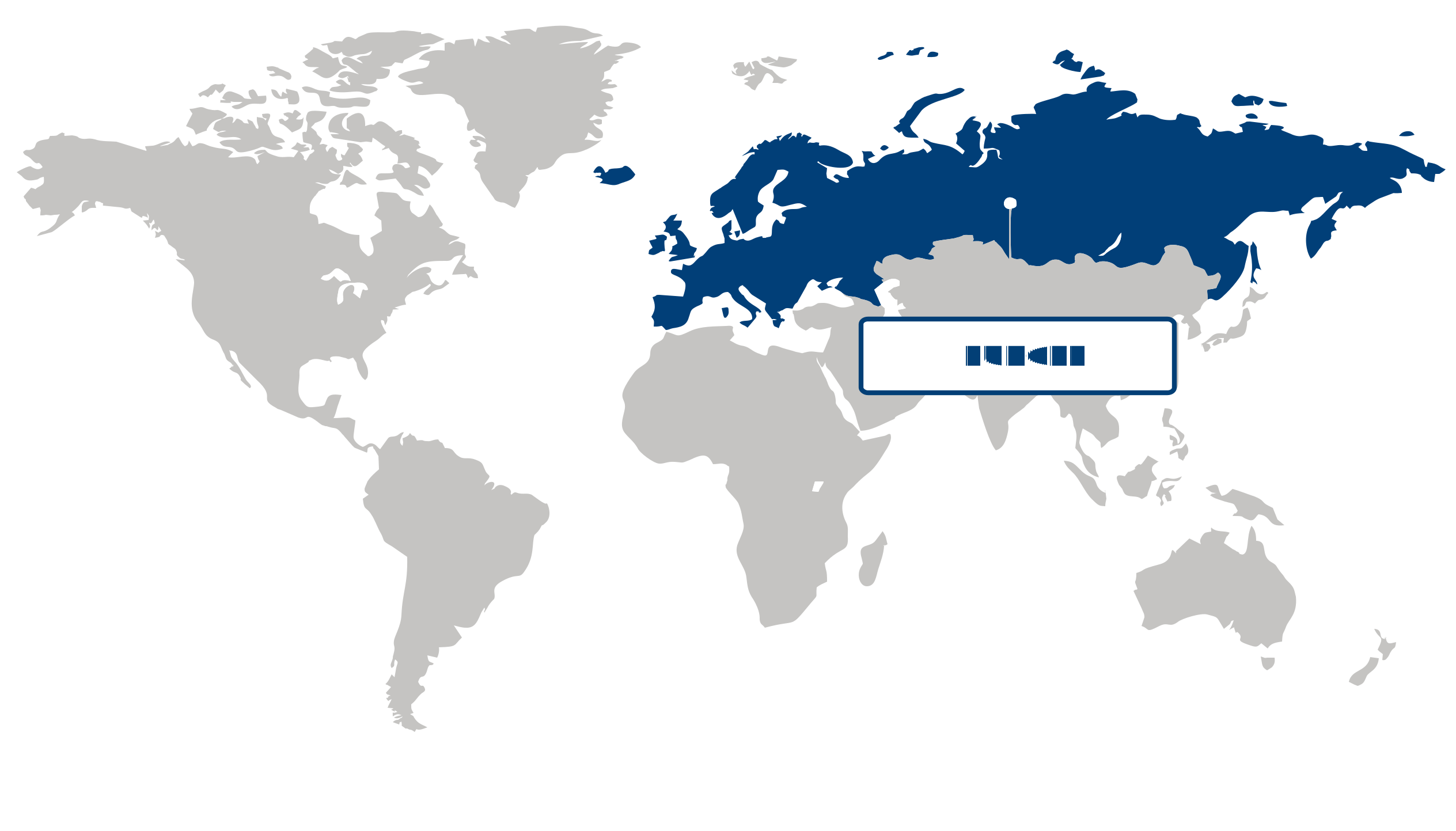
Europe (Largest Region)
In the mountain bike shoes market, Europe held the largest share of 51.94% in 2026, supported by the region's established cycling culture, extensive participation in mountain biking, and strong outdoor recreation ecosystem. Well-developed cycling infrastructure and widespread access to specialized sporting goods channels contribute to consistent demand for performance-oriented footwear. Consumer preference for durable, technically designed equipment, together with growing interest in recreational and competitive cycling, continues to reinforce Europe's leading position.
Asia Pacific (Fastest-Growing Region)
Asia Pacific is the fastest-growing region, benefiting from expanding interest in cycling as a recreational and fitness activity and increasing participation in outdoor sports. Rising disposable incomes and greater consumer awareness of specialized cycling equipment are encouraging riders to move toward purpose-built footwear rather than general athletic shoes. Growing urban cycling communities, development of cycling facilities, and increasing engagement with adventure and endurance sports are also creating favorable conditions for broader adoption of mountain bike shoes.
| Parameter | North America | Asia Pacific | Europe | Latin America | MEA |
|---|---|---|---|---|---|
| Innovation HubiScaleNascentDeveloping Advanced | |||||
| Cost-Sensitive RegioniScaleLowMedium High | |||||
| Regulatory EnvironmentiScaleRestrictiveNeutral Supportive | |||||
| Demand DriversiScaleWeakModerate Strong | |||||
| Development StageiScaleEmergingDeveloping Developed | |||||
| Adoption RateiScaleLowMedium High | |||||
| New Entrants / StartupsiScaleSparseModerate Dense | |||||
| Macro IndicatorsiScaleWeakStable Strong |
Key Country Insights
Germany 🇩🇪
Technical cycling specializationIn Germany, demand for mountain bike shoes is shaped by a highly structured cycling and outdoor sports ecosystem. Riders in Germany emphasize technical performance, durability, and compatibility with professional-grade cycling systems for both recreational and competitive use.
France 🇫🇷
Recreational trail cycling cultureIn France, mountain bike shoes are supported by a strong recreational cycling culture and widespread trail usage. Consumers in France emphasize comfort, grip, and adaptability for long-distance cycling across varied natural landscapes and leisure-focused riding.
Italy 🇮🇹
Cycling heritage footwear designIn Italy, mountain bike shoes are influenced by a deep cycling heritage and strong footwear manufacturing tradition. Demand in Italy focuses on ergonomically designed, performance-oriented shoes that combine technical cycling needs with aesthetic craftsmanship.
Japan 🇯🇵
Compact terrain cycling fitIn Japan, mountain bike shoes are adopted within compact and technically varied terrain cycling environments. Consumers in Japan favor lightweight, precise-fitting footwear that supports maneuverability and efficiency across mixed urban and off-road cycling conditions.
South Korea 🇰🇷
Urban outdoor cycling growthIn South Korea, mountain bike shoes benefit from growing urban outdoor and recreational cycling participation. Consumers in South Korea prioritize stylish yet functional footwear that balances trail performance with urban commuting versatility and comfort.
United States 🇺🇸
Trail performance gear demandIn the U.S., mountain bike shoes are driven by strong recreational and competitive trail biking culture. Consumers in the U.S. prioritize durable, high-traction footwear with advanced sole stiffness and off-road performance features suited for diverse terrain conditions.
Mountain Bike Shoes Market Share (%), by Price Range, 2026
Go beyond the chart, access full insights & data tables
Request Free Sample ReportPrice Range Segment Analysis: Mass (Largest Segment) vs Premium (Fastest-Growing Segment)
Mass-priced mountain bike shoes accounted for the largest share of the mountain bike shoes market, representing 61.01% in 2026. Their strong position reflects broad accessibility among recreational cyclists and riders seeking functional footwear without the higher cost associated with advanced performance features. Growing participation in mountain biking and demand for durable, purpose-built footwear support continued adoption of products positioned within the mass price range. Their balance of affordability, protection, grip, and practical performance makes this segment particularly attractive to a broad consumer base.
Premium mountain bike shoes are expected to register the fastest growth as experienced riders increasingly prioritize specialized performance, comfort, durability, and technical functionality. Advances in footwear construction and demand for equipment that can withstand demanding trail conditions are encouraging consumers to consider higher-value products. Rising interest in competitive and performance-oriented mountain biking is further supporting demand for premium footwear with enhanced fit and specialized features.
End Use Segment Analysis: Male (Largest Segment) vs Female (Fastest-Growing Segment)
Male consumers held the largest share of the mountain bike shoes market in 2026, reflecting the historically strong participation of men in mountain biking and related outdoor cycling activities. Established engagement with trail riding, recreational cycling, and competitive riding continues to sustain demand for specialized footwear among male users. The need for durable shoes offering secure footing, protection, and compatibility with cycling equipment further supports consistent purchasing within this end-use segment.
Female riders represent the fastest-growing end-use segment as participation in mountain biking among women continues to expand and the cycling industry places greater emphasis on products suited to diverse rider needs. Increasing accessibility to recreational cycling, outdoor fitness, and adventure activities is broadening the female customer base. Greater availability of footwear designed around fit, comfort, and performance requirements is also helping encourage adoption among women cyclists.
| Segment | Sub-Segment | Largest Segment | Fastest Growing |
|---|---|---|---|
| Price Range | Mass, Premium | Mass | Premium |
| End Use | Male, Female | Male | Female |
| Distribution Channel | Offline, Online | Offline | Online |
Competitive Landscape and Market Positioning
Major players in the mountain bike shoes market:
1. Shimano Inc. (Japan)
2. adidas AG (Germany)
3. Specialized Bicycle Components Inc. (United States)
4. Trek Bicycle Corporation (United States)
5. GIRO Sport Design (United States)
6. PEARL iZUMi (United States)
7. Sidi Sport S.r.l. (Italy)
8. Northwave S.r.l. (Italy)
9. Fox Racing Inc. (United States)
10. Scott Sports SA (Switzerland)
The mountain bike shoes market is evolving through increasing demand for performance-enhancing and terrain-adaptive footwear solutions. Innovation is focused on improving grip, durability, and rider comfort under extreme conditions. Product differentiation is increasingly driven by material engineering and design functionality enhancements.
| Company | Market Share | Company Revenue | Revenue CAGR (%) | Product Portfolio | Geographic Presence | Innovation / R&D Focus | Strategic Developments |
|---|---|---|---|---|---|---|---|
| Shimano Inc. (Japan) | |||||||
| adidas AG (Germany) | |||||||
| Specialized Bicycle Components Inc. (United States) | |||||||
| Trek Bicycle Corporation (United States) | |||||||
| GIRO Sport Design (United States) | |||||||
| PEARL iZUMi (United States) | |||||||
| Sidi Sport S.r.l. (Italy) | |||||||
| Northwave S.r.l. (Italy) | |||||||
| Fox Racing Inc. (United States) | |||||||
| Scott Sports SA (Switzerland). |
Industry Development/News
| Company Name | Date | Key Development |
|---|---|---|
| Canyon | Jan-25 | Canyon entered the mountain bike footwear segment with the launch of its first specialized shoe, the Tempr CFR Offroad. This strategic expansion signals the company's move beyond bicycle manufacturing into the broader performance cycling accessories market, aimed at capturing higher value from its existing customer base and brand ecosystem. |
| BOA Technology | Jan-25 | BOA Technology expanded its market penetration in off-road cycling footwear through increased integration of its mechanical fit-adjustment systems across diverse industry brands. This widespread adoption strengthens the company’s role in the supply chain as a critical technology provider for performance-focused equipment, enhancing overall product functionality and rider ergonomics. |
| Shimano | Aug-23 | Shimano launched its Gravity Enduro footwear range, integrating proprietary technologies such as the ULTREAD GE outsole and the TORBAL 2.0 midsole. This development represents a material innovation in technical performance, specifically designed to enhance rider grip, stability, and bike control across technically demanding and slippery terrain. |
| Fox Racing | Feb-23 | Fox Racing entered the mountain bike footwear category with the launch of the Union shoe series. This strategic diversification leverages the company’s expertise in motocross to provide specialized technical footwear featuring reinforced toe protection and high-durability outsoles, marking a significant shift into a new performance-oriented equipment segment. |
Customize Your Report
Explore examples of how this report can be tailored to different research needs, including custom segments, additional topics or chapters, and related reports. Click a section of the wheel or its numbered marker to explore the available options.
Mountain Bike Shoes Market — Custom Segments
| Segment | Sub-Segment |
|---|---|
| Pedal Compatibility | Clipless-Compatible Shoes, Flat-Pedal Shoes, Hybrid-Compatible Shoes |
| Riding Discipline | Cross-Country, Trail, Enduro, Downhill/Freeride |
| Product Construction | Traditional Lace-Up, Dial/BOA Closure, Hybrid Closure |
Mountain Bike Shoes Market — Custom TOC
| Custom Chapter | Chapter Details |
|---|---|
| Consumer Performance Needs Assessment |
|
| Off-Road Cycling Participation Trends Analysis |
|
| E-Commerce Channel Evolution Study |
|
Need a different cut of the data?
Request Custom ResearchFrequently Asked Questions
What is the current revenue of the mountain bike shoes market?
What are the growth projections for the mountain bike shoes industry?
How is rising participation in mountain biking influencing purchasing behavior and product requirements?
How are material innovations and rising disposable incomes shaping premiumization in the mountain bike shoes market?
Why does the Mass price range lead the mountain bike shoes market?
Why is the Female segment the fastest-growing end-use category in the mountain bike shoes market?
Why does Europe dominate the mountain bike shoes market?
What is fueling Asia Pacific's growth in the mountain bike shoes market?
Which companies are driving growth in the mountain bike shoes landscape?
Our Clients
"The report provided us with a clear direction, and the level of detail was beyond what we expected. I would definitely recommend their services to others."
Haier Appliances
"The collaboration with Fundamental Business Insights has added significant value to our decision-making process, and we look forward to continuing this partnership for our future market research requirements."
Luxottica Group S.p.A.
"The team at FBI delivered an exceptional research report. The insights on industry innovations were particularly impressive and added a lot of value to the overall report."
Nike
Our Research Team & Methodology
Every Fundamental Business Insights report is built by a dedicated vertical research team, validated through a structured primary-and-secondary methodology, and reviewed for accuracy before it reaches you.
Delivery
Published
Available
Support
- Market Size & Forecast
- Market Segmentation
- Regional Analysis
- Growth Drivers & Challenges
- Market Dynamics
- Competitive Landscape
- Company Profiles
- Competitive Benchmarking
- Mergers & Acquisitions
- Market Share Analysis or Key Company Strategies
- Value Chain Analysis
- Porter's Five Forces
- PESTLE Analysis
- Pricing Trends
- Supply-Demand Analysis
- Technology Landscape
- Regulatory Landscape
- Investment & Funding Landscape
- Emerging Opportunities
- Future Market Outlook