Recycled Thermoplastics Market Size & Growth Forecast 2027–2036, By Segments (Form, Technology, Product, Application), Regional Demand Trends (North America, Asia Pacific, Europe), Key Country Insights (U.S., Japan, South Korea, Germany, France, Italy), and Competitive Landscape
Market Size and Growth Outlook
Recycled Thermoplastics Market size was valued at USD 74.8 billion in 2026 and is anticipated to grow at a 9.12% CAGR from 2027 to 2036, surpassing USD 179.04 billion by 2036. The industry revenue for 2027 is assessed at USD 80.54 billion.
Get more details on this report
Request Free Sample ReportRecycled Thermoplastics Market Intelligence Snapshot
Regional Market Dynamics
- Europe leads the market through its mature recycling infrastructure, established feedstock recovery systems, and regulatory support that encourages consistent recycled resin adoption across manufacturing and packaging.
- Asia Pacific is projected to grow at a 10.96% CAGR as recycling capacity expands and manufacturers increasingly adopt recycled polymers for large-scale, cost-sensitive production applications.
Segment Momentum
- Flakes captured a 52.63% share in 2026 because they serve as a widely traded, cost-efficient intermediate feedstock that supports flexible downstream recycling and reprocessing operations.
- Injection molding is growing fastest as manufacturers increasingly adopt recycled thermoplastics for precise, high-volume component production while maintaining compatibility with established manufacturing processes.
Market Expansion Drivers
- Global regulatory mandates and recycling quotas driving mandatory incorporation of recycled plastics in manufacturing.
- Chemical recycling advancements improving recycled polymer quality for high-performance industrial applications.
- Expanding waste management infrastructure in emerging economies increasing recycled feedstock availability.
Leading Market Participants
- Top players in the recycled thermoplastics market include Veolia Environnement S.A. (France), SUEZ S.A. (France), KW Plastics, Inc. (United States), Plastipak Holdings, Inc. (United States), Envision Plastics Industries, LLC (United States), Clear Path Recycling LLC (United States), Custom Polymers, Inc. (United States), Fresh Pak Corporation (United States), APC Recycling B.V. (Netherlands), B&B Plastics Inc. (United States).
Global Market Forecast Snapshot
Market Outlook
- 2026 Market Size: USD 74.8 billion
- 2027 Estimated Market Size: USD 80.54 billion.
- Projected Market Size: USD 179.04 billion by 2036
- Growth Forecast: 9.12% CAGR (2027-2036)
Regional and Segment Outlook
- Leading Regional Market: Europe
- High-Growth Regional Hub: Asia Pacific
- Core Revenue Segment: Flakes (Form) | Extrusion (Technology) | Polyethylene (Product) | Packaging (Application)
- Emerging Opportunity Segment: Granules (Form) | Injection Molding (Technology) | Polypropylene (Product) | Automotive (Application)
Market Growth Drivers and Industry Trends
Global regulatory mandates and recycling quotas driving mandatory incorporation of recycled plastics in manufacturing
Regulatory mandates and recycling quotas are increasing the requirement for manufacturers to incorporate recycled materials into production processes. The recycled thermoplastics market is consequently benefiting from stronger institutional demand as businesses adjust material sourcing and manufacturing practices to comply with recycling-related requirements. Mandatory use targets can encourage manufacturers to establish recycled polymer procurement channels and integrate recycled feedstocks into product formulations, increasing the role of recycled thermoplastics in industrial production.
Chemical recycling advancements improving recycled polymer quality for high-performance industrial applications
Advances in chemical recycling are improving the ability to process plastic waste into recycled polymers with characteristics suitable for more demanding applications. For the recycled thermoplastics market, better material quality expands the range of manufacturing uses beyond applications where recycled content has traditionally faced performance limitations. Improved processing capabilities can enable manufacturers to consider recycled polymers for applications requiring more consistent material properties, strengthening adoption across industrial production environments.
Expanding waste management infrastructure in emerging economies increasing recycled feedstock availability
The expansion of waste management infrastructure in emerging economies is improving the collection, sorting, processing, and availability of plastic waste for recycling. This development supports the recycled thermoplastics market by creating a more reliable supply of recoverable feedstock for polymer production. Better-organized waste collection and recycling systems can increase the volume of materials entering recycling streams, helping recyclers and manufacturers access greater quantities of suitable recycled inputs for downstream applications.
| Growth Driver | Impact on CAGR | Regulatory Influence | Geographic Relevance | Adoption Rate | Impact Timeline |
|---|---|---|---|---|---|
| Global regulatory mandates and recycling quotas driving mandatory incorporation of recycled plastics in manufacturing | 2.30% | High | Europe, North America, Asia Pacific | High | Near Term |
| Chemical recycling advancements improving recycled polymer quality for high-performance industrial applications | 2.00% | High | Europe, North America | Medium | Mid Term |
| Expanding waste management infrastructure in emerging economies increasing recycled feedstock availability | 1.70% | Moderate | Asia Pacific, Latin America | Emerging | Mid Term |
Unlock insights tailored to your business with our bespoke market research solutions.
Click to get your customized report now.
Regional Demand Dynamics
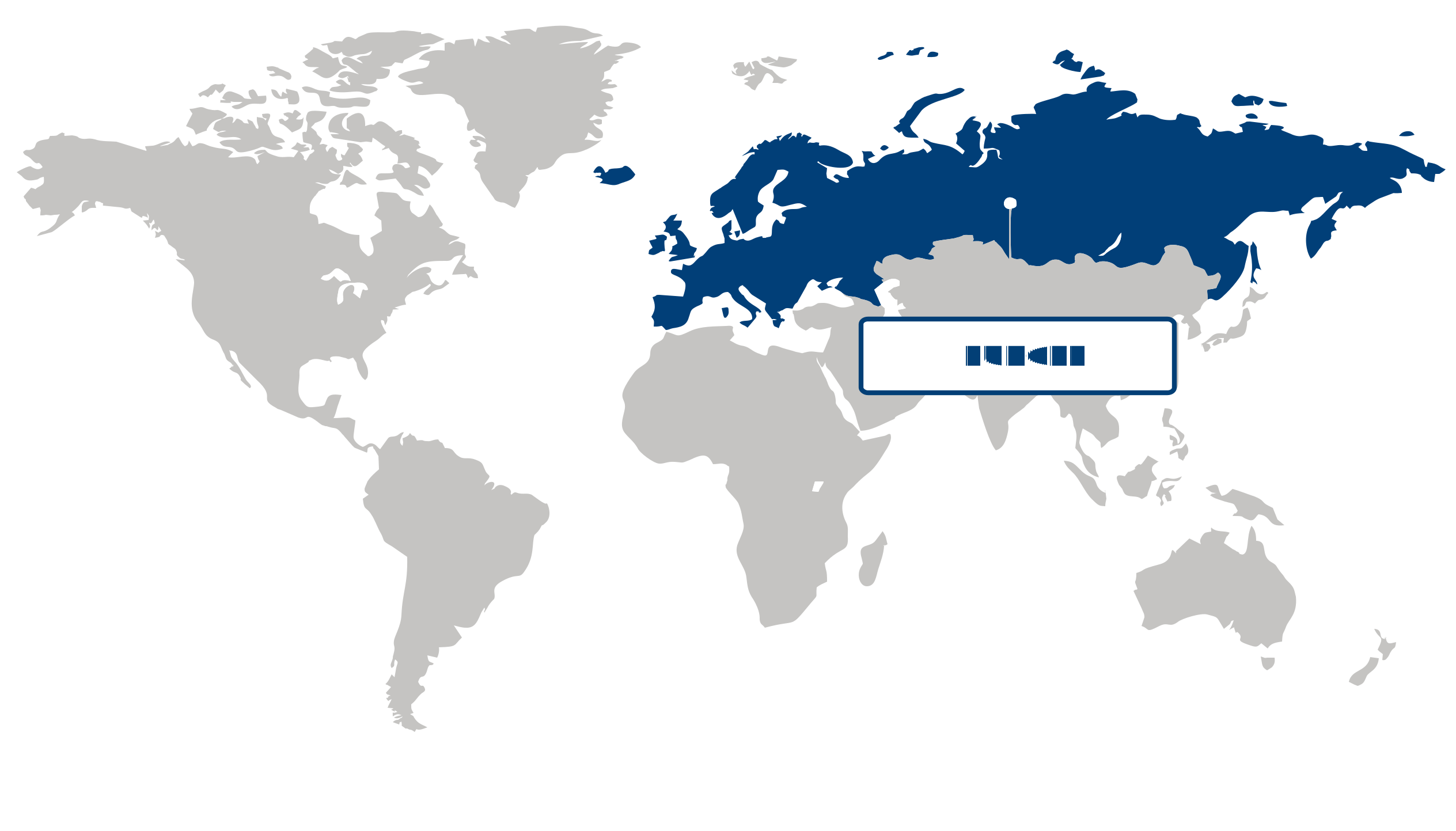
Europe (Largest Region)
Europe represented the largest regional market for recycled thermoplastics in 2026, supported by strong environmental priorities, established recycling infrastructure, and increasing emphasis on circular material use across manufacturing industries. Regulatory pressure to reduce plastic waste and improve resource efficiency is encouraging manufacturers to incorporate recycled polymers into packaging, automotive components, construction products, and consumer goods. Mature waste collection and recycling systems further strengthen the availability and utilization of recycled feedstocks, while sustainability commitments across industries are reinforcing demand for lower-impact material alternatives.
Asia Pacific (Fastest-Growing Region)
Asia Pacific is the fastest-growing region, driven by expanding manufacturing activity, rising plastic consumption, and increasing investment in waste management and recycling infrastructure. Growing environmental awareness, efforts to improve resource recovery, and the adoption of circular-economy practices are encouraging manufacturers to increase the use of recycled thermoplastics across diverse industrial applications.
| Parameter | North America | Asia Pacific | Europe | Latin America | MEA |
|---|---|---|---|---|---|
| Innovation Hub i Scale Nascent Developing Advanced | |||||
| Cost-Sensitive Region i Scale Low Medium High | |||||
| Regulatory Environment i Scale Restrictive Neutral Supportive | |||||
| Demand Drivers i Scale Weak Moderate Strong | |||||
| Development Stage i Scale Emerging Developing Developed | |||||
| Adoption Rate i Scale Low Medium High | |||||
| New Entrants / Startups i Scale Sparse Moderate Dense | |||||
| Macro Indicators i Scale Weak Stable Strong |
Key Country Insights
Germany 🇩🇪
Advanced Recycling IntegrationGermany is expanding recycled thermoplastics use through advanced sorting, processing, and closed-loop manufacturing initiatives. Companies are prioritizing consistent material quality that supports demanding industrial and automotive production requirements.
France 🇫🇷
Eco-Design Material AdoptionFrance is encouraging recycled thermoplastics through circular product design and sustainable manufacturing initiatives. Manufacturers are strengthening partnerships across the recycling value chain to secure reliable secondary material supplies.
Italy 🇮🇹
Industrial Recycling PartnershipsItaly is expanding recycled thermoplastics usage by connecting recyclers with plastics processors and manufacturers. Companies are prioritizing dependable recycled resin quality to support packaging, consumer products, and industrial component production.
Japan 🇯🇵
High-Quality Material RecoveryJapan is emphasizing high-purity recycled thermoplastics for electronics, automotive, and industrial applications. Producers are investing in processing technologies that improve resin consistency and enable broader use in performance-sensitive manufacturing.
South Korea 🇰🇷
Sustainable Polymer ManufacturingSouth Korea is increasing recycled thermoplastics utilization across packaging and industrial manufacturing to support resource efficiency. Businesses are focusing on advanced recycling capabilities that improve material availability and compatibility with existing production lines.
United States 🇺🇸
Circular Materials ExpansionU.S. manufacturers are increasing recycled thermoplastics adoption to meet sustainability objectives while maintaining material performance. Investment is focused on improving recycling technologies, feedstock quality, and incorporation into automotive, packaging, and consumer goods applications.
Segment Leadership and Growth Trends
Recycled Thermoplastics Market Share (%), by Form, 2026
Go beyond the chart, access full insights & data tables
Request Free Sample ReportForm Segment Analysis: Flakes (Largest Segment) vs Granules (Fastest-Growing Segment)
The flakes segment dominated the recycled thermoplastics market in 2026, accounting for a 52.63% share, supported by its importance as an intermediate form in recycling and material recovery processes. Flakes can be produced through sorting, cleaning, shredding, and size reduction of recovered plastic waste, making them suitable for subsequent processing into recycled materials. Their broad applicability across recycling operations and compatibility with downstream conversion processes continue to support strong demand, particularly as manufacturers place greater emphasis on incorporating recycled feedstock into production.
Granules are witnessing the fastest growth as manufacturers increasingly seek recycled thermoplastic feedstock that can be handled efficiently in conventional processing environments. Granulated materials offer advantages in storage, transportation, dosing, and integration into manufacturing workflows, supporting their use across applications requiring consistent material handling. Growing interest in closed-loop recycling and the broader shift toward more efficient utilization of recovered plastics are encouraging recyclers and processors to expand granulation capabilities.
Technology Segment Analysis: Extrusion (Largest Segment) vs Injection Molding (Fastest-Growing Segment)
Extrusion held the largest position in the recycled thermoplastics market in 2026 with a 38.7% share, reflecting its established role in processing recovered thermoplastic materials into continuous forms such as sheets, films, profiles, and other intermediate products. The technology supports high-throughput processing and can accommodate recycled feedstock following appropriate sorting and preparation. Its established industrial use, adaptability to different thermoplastic materials, and suitability for continuous production are key factors sustaining its market leadership.
Injection molding is emerging as the fastest-growing technology as manufacturers increasingly incorporate recycled thermoplastics into molded components and finished products. The process enables the production of complex shapes with consistent dimensions, expanding opportunities for recycled materials across diverse manufacturing applications. Rising emphasis on material circularity, combined with improvements in recycled feedstock quality and processing consistency, is supporting greater adoption of injection molding for products containing recycled thermoplastic content.
| Segment | Sub-Segment | Largest Segment | Fastest Growing |
|---|---|---|---|
| Form | Flakes, Pellets, Granules | Flakes | Granules |
| Technology | Extrusion, Injection Molding, Blow Molding, Others | Extrusion | Injection Molding |
| Product | Polyethylene, Polyethylene Terephthalate, Polypropylene, Polystyrene, Polyvinyl Chloride, Others | Polyethylene | Polypropylene |
| Application | Packaging, Automotive, Consumer Goods, Medical, Building & Construction, Electrical and Electronics, Others | Packaging | Automotive |
Competitive Landscape and Market Positioning
Major players in the recycled thermoplastics market:
1. Veolia Environnement S.A. (France)
2. SUEZ S.A. (France)
3. KW Plastics Inc. (United States)
4. Plastipak Holdings Inc. (United States)
5. Envision Plastics Industries LLC (United States)
6. Clear Path Recycling LLC (United States)
7. Custom Polymers Inc. (United States)
8. Fresh Pak Corporation (United States)
9. APC Recycling B.V. (Netherlands)
10. B&B Plastics Inc. (United States)
The recycled thermoplastics market is gaining momentum as circular material usage becomes increasingly important across industrial manufacturing sectors. Improved processing technologies are enhancing material quality and reusability. Expanding sustainability-driven ecosystems are reinforcing stronger adoption across multiple applications.
| Company | Market Share | Company Revenue | Revenue CAGR (%) | Product Portfolio | Geographic Presence | Innovation / R&D Focus | Strategic Developments |
|---|---|---|---|---|---|---|---|
| Veolia Environnement S.A. (France) | |||||||
| SUEZ S.A. (France) | |||||||
| KW Plastics Inc. (United States) | |||||||
| Plastipak Holdings Inc. (United States) | |||||||
| Envision Plastics Industries LLC (United States) | |||||||
| Clear Path Recycling LLC (United States) | |||||||
| Custom Polymers Inc. (United States) | |||||||
| Fresh Pak Corporation (United States) | |||||||
| APC Recycling B.V. (Netherlands) | |||||||
| B&B Plastics Inc. (United States). |
Industry Development/News
| Company Name | Date | Key Development |
|---|---|---|
| Avient | Oct-24 | Avient introduced recycled-content thermoplastic elastomers and metallic-effect sulfone materials at Fakuma, incorporating globally sourced recycled inputs. The product expansion enhances availability of circular polymer solutions for industrial design applications, supporting broader integration of recycled thermoplastics in performance materials and aesthetic-driven applications across manufacturing sectors. |
| Coca-Cola India | Jun-24 | Coca-Cola India launched the Affordable Small Sparkling Package (ASPP) using fully recycled PET bottles to reduce packaging footprint and enhance affordability. The initiative strengthens circular packaging adoption in India’s beverage sector while supporting increased utilization of recycled thermoplastics in high-volume consumer packaging applications. |
| Coca-Cola India | Oct-23 | Coca-Cola India introduced 100% recycled PET bottles in 250 ml and 750 ml formats in collaboration with local bottling partners. The initiative supports the company’s broader packaging sustainability strategy, targeting increased recycled content usage and improved circularity in beverage packaging systems, with implications for demand growth in recycled thermoplastics. |
| Dow | Jul-22 | Dow and Mura Technology formed a strategic partnership to develop advanced chemical recycling infrastructure across the U.S. and Europe. The initiative targets up to 600 kilotons of annual recycling capacity through multiple large-scale facilities, strengthening industrial-scale conversion of plastic waste into recycled feedstocks and expanding circular economy capabilities within thermoplastics value chains. |
Customize Your Report
Explore examples of how this report can be tailored to different research needs, including custom segments, additional topics or chapters, and related reports. Click a section of the wheel or its numbered marker to explore the available options.
Recycled Thermoplastics Market — Custom Segments
| Segment | Sub-Segment |
|---|---|
| Recycling Source | Post-consumer Waste, Post-industrial Waste, End-of-life Products, Production Scrap |
| Recycled Material Quality Grade | Standard Grade, Food-contact Grade, High-performance Grade, Specialty Grade |
| Collection Channel | Municipal Collection, Commercial & Industrial Collection, Retail Take-back Programs, Deposit-return Systems |
Recycled Thermoplastics Market — Custom TOC
| Custom Chapter | Custom Details |
|---|---|
| Circular Feedstock Availability Assessment |
|
| Mechanical vs Chemical Recycling Competitiveness Study |
|
| High-Growth Application Opportunity Mapping |
|
Need a different cut of the data?
Request Custom ResearchHow large is the recycled thermoplastics market?
What is the expected industry size of recycled thermoplastics by 2036?
How are regulations changing procurement strategies in the recycled thermoplastics market?
How are recycling technology advancements expanding industrial adoption of recycled thermoplastics?
Why are flakes the largest form segment in the recycled thermoplastics market?
Why is injection molding the fastest-growing technology in the recycled thermoplastics market?
Why is Europe the largest market for recycled thermoplastics?
What factors are driving recycled thermoplastics market growth in Asia Pacific?
Who holds a significant market share in the recycled thermoplastics landscape?
Our Clients
"The report helped us understand emerging consumer trends in our product category. It clarified where to focus innovation for the next product launch."
LyondellBasell
"The regional forecast section was incredibly useful. We were able to identify two new potential partners in Europe thanks to the vendor mapping you included."
SABIC
"We appreciated how actionable the recommendations were. It guided us to improve supply chain resilience."
Olin Corporation
Our Research Team & Methodology
Every Fundamental Business Insights report is built by a dedicated vertical research team, validated through a structured primary-and-secondary methodology, and reviewed for accuracy before it reaches you.
Research Team Overview
Prepared by the Chemicals & Materials Research Team
Delivery
Published
Demand
Available
Support
Trust & Compliance
Research Domains
10 coverage areasResearch Intelligence
| Source | Reference |
|---|---|
| American Chemistry Council (ACC) | www.americanchemistry.com |
| European Chemical Industry Council (Cefic) | cefic.org |
| International Council of Chemical Associations (ICCA) | icca-chem.org |
| European Chemicals Agency (ECHA) | echa.europa.eu |
| U.S. Environmental Protection Agency (EPA) | www.epa.gov |
| ASTM International | www.astm.org |
| International Organization for Standardization (ISO) | www.iso.org |
| National Institute of Standards and Technology (NIST) | www.nist.gov |
| Plastics Industry Association (PLASTICS) | www.plasticsindustry.org |
| European Biplastics | www.european-bioplastics.org |
| The Adhesive and Sealant Council (ASC) | www.ascouncil.org |
| National Association of Corrosion Engineers (AMPP) | www.ampp.org |
| Society of Plastics Engineers (SPE) | www.4spe.org |
| International Fertilizer Association (IFA) | www.fertilizer.org |
| CropLife International | croplife.org |
| Packaging Europe | packagingeurope.com |
| Flexible Packaging Association (FPA) | www.flexpack.org |
| Battery Council International (BCI) | batterycouncil.org |
| International Copper Association (ICA) | internationalcopper.org |
| World Steel Association | worldsteel.org |
Research Workflow & Quality Assurance
Data Collection
Verified information gathered through primary and secondary research.
Data Triangulation
Cross-validation using multiple independent data sources.
Forecast Modelling
Market estimates developed using historical trends and analytical models.
Analyst Validation
Findings reviewed by domain experts for accuracy and consistency.
Editorial & Quality Review
Final editorial, quality, and compliance checks before publication.
Final Publication
Released after successful completion of the internal review process.
Report Coverage
📊 Market Assessment
- Market Size & Forecast
- Market Segmentation
- Regional Analysis
- Growth Drivers & Challenges
- Market Dynamics
🏢 Competitive Intelligence
- Competitive Landscape
- Company Profiles
- Competitive Benchmarking
- Mergers & Acquisitions
- Market Share Analysis or Key Company Strategies
🔍 Strategic Analysis
- Value Chain Analysis
- Porter's Five Forces
- PESTLE Analysis
- Pricing Trends
- Supply-Demand Analysis
🚀 Future Outlook
- Technology Landscape
- Regulatory Landscape
- Investment & Funding Landscape
- Emerging Opportunities
- Future Market Outlook
Have a question about this report or need a custom scope?
Request Customization