Roaming Tariff Market Size & Growth Forecast 2027–2036, By Segments (Roaming Type, Service, Distribution Channel, Region), Regional Demand Trends (North America, Asia Pacific, Europe), Key Country Insights (U.S., Japan, South Korea, Germany, France, Italy), and Competitive Landscape
Jump to content
Market Size and Growth Outlook
Roaming Tariff Market size was around USD 88.1 billion in 2026 and is slated to grow at a 5.7% CAGR from 2027 to 2036, exceeding USD 153.36 billion by 2036. The industry revenue for 2027 is calculated at USD 92.33 billion.
Get more details on this report
Request Free Sample ReportRoaming Tariff Market Intelligence Snapshot
Regional Market Dynamics
- Europe led the market in 2026 due to its interconnected telecom ecosystem, dense cross-border travel, mature regulatory frameworks, and established carrier partnerships that support competitive roaming offerings.
- Asia Pacific is projected to grow at a 6.89% CAGR, driven by expanding international travel, rising smartphone penetration, greater mobile data usage, and more flexible roaming plans.
Segment Momentum
- International remained the largest and fastest-growing roaming type in 2026 because cross-border travelers increasingly require uninterrupted voice, messaging, and data connectivity, supported by travel recovery and rising smartphone dependence.
- Data is expanding fastest as travelers increasingly rely on navigation, messaging, digital payments, ride-hailing, work access, and streaming, making continuous mobile internet more essential than traditional calling services.
Market Expansion Drivers
- Rising international tourism increasing demand for cross-border mobile connectivity services.
- Expansion of 5G-enabled smartphones accelerating international data roaming consumption.
- Telecom partnerships and global MVNO agreements expanding roaming service accessibility worldwide.
Leading Market Participants
- Leading players in the roaming tariff market include Vodafone Group plc (United Kingdom), AT&T Inc. (United States), Verizon Communications Inc. (United States), Deutsche Telekom AG (Germany), Telefónica S.A. (Spain), Orange S.A. (France), Bharti Airtel Limited (India), China Mobile Limited (China), América Móvil S.A.B. de C.V. (Mexico), T-Mobile US, Inc. (United States).
Global Market Forecast Snapshot
Market Outlook
- 2026 Market Size: USD 88.1 billion
- 2027 Estimated Market Size: USD 92.33 billion.
- Projected Market Size: USD 153.36 billion by 2036
- Growth Forecast: 5.7% CAGR (2027-2036)
Regional and Segment Outlook
- Leading Regional Market: Europe
- High-Growth Regional Hub: Asia Pacific
- Core Revenue Segment: International (Roaming Type) | Voice (Service) | Retail Roaming (Distribution Channel) | Europe (Region)
- Emerging Opportunity Segment: International (Roaming Type) | Data (Service) | Wholesale Roaming (Distribution Channel) | Asia Pacific (Region)
Market Growth Drivers and Industry Trends
Rising international tourism increasing demand for cross-border mobile connectivity services
The roaming tariff market will benefit from rising international tourism as travelers increasingly require uninterrupted mobile connectivity while crossing national borders. Greater movement between countries creates demand for voice, messaging, and mobile data services without requiring users to change their primary mobile arrangements, supporting greater usage of roaming services during international travel.
Expansion of 5G-enabled smartphones accelerating international data roaming consumption
The growing adoption of 5G-enabled smartphones is enhancing the quality and speed of mobile connectivity, encouraging greater use of data-intensive services while users are abroad. For the roaming tariff market, wider availability of capable devices can support higher international data consumption as travelers use mobile applications, streaming services, navigation, and other connected services across borders.
Telecom partnerships and global MVNO agreements expanding roaming service accessibility worldwide
Telecom partnerships and global MVNO agreements are broadening access to international connectivity by enabling operators to extend roaming coverage across more destinations. This expansion supports the roaming tariff market by improving service availability for customers traveling between regions, while stronger inter-operator arrangements can facilitate more seamless access to mobile networks in international locations.
| Growth Driver | Impact on CAGR | Regulatory Influence | Geographic Relevance | Adoption Rate | Impact Timeline |
|---|---|---|---|---|---|
| Rising international tourism increasing demand for cross-border mobile connectivity services | 1.90% | Moderate | Europe, Asia Pacific | High | Near Term |
| Expansion of 5G-enabled smartphones accelerating international data roaming consumption | 1.80% | Moderate | North America, Europe | High | Mid Term |
| Telecom partnerships and global MVNO agreements expanding roaming service accessibility worldwide | 1.40% | Low | Latin America, Middle East & Africa | Emerging | Long Term |
Unlock insights tailored to your business with our bespoke market research solutions.
Click to get your customized report now.
Regional Demand Dynamics
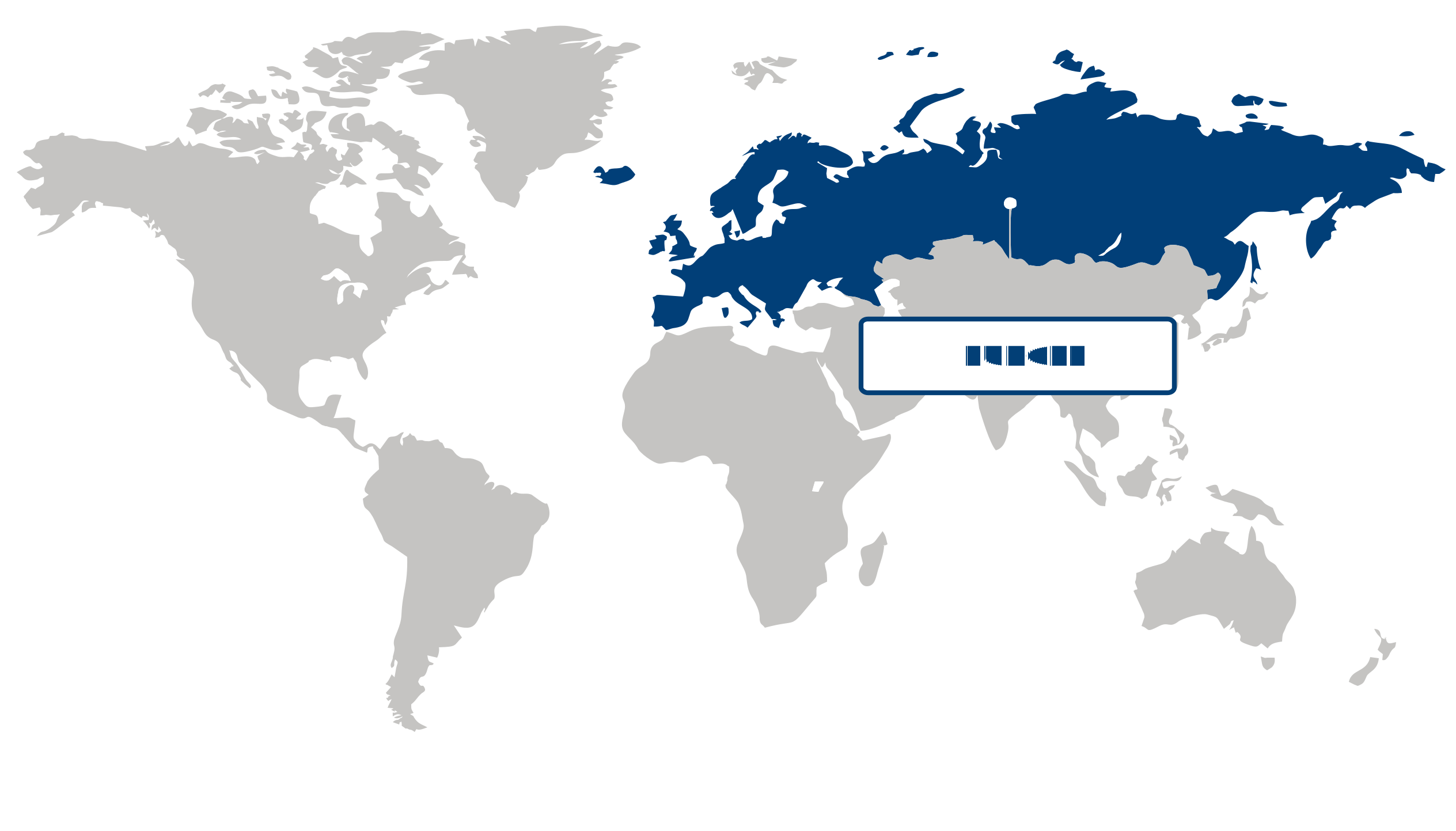
Europe (Largest Region)
The roaming tariff market in Europe maintained the largest regional position in 2026, supported by extensive cross-border travel, high mobile connectivity, and a mature telecommunications ecosystem. Frequent movement between neighboring countries creates sustained demand for transparent and affordable roaming arrangements, while regulatory efforts focused on consumer protection and cross-border communications have encouraged more predictable pricing structures. Strong smartphone adoption and widespread use of mobile data among business and leisure travelers further support roaming activity. In addition, established telecommunications infrastructure and competitive mobile service markets enable operators to develop flexible roaming packages that respond to changing travel patterns and increasing demand for uninterrupted connectivity.
Asia Pacific (Fastest-Growing Region)
Asia Pacific is the fastest-growing regional market, driven by expanding international tourism, rising business travel, and rapid growth in mobile connectivity across emerging economies. Increasing smartphone penetration and broader availability of mobile broadband are encouraging travelers to remain connected while crossing national borders. Telecommunications operators are also expanding roaming partnerships and introducing more flexible data-focused packages to address the growing preference for seamless connectivity. The expansion of digital travel services, increasing cross-border commerce, and greater consumer reliance on mobile applications for navigation, payments, communication, and entertainment are creating additional demand for convenient roaming services across the region.
| Parameter | North America | Asia Pacific | Europe | Latin America | MEA |
|---|---|---|---|---|---|
| Innovation HubiScaleNascentDeveloping Advanced | |||||
| Cost-Sensitive RegioniScaleLowMedium High | |||||
| Regulatory EnvironmentiScaleRestrictiveNeutral Supportive | |||||
| Demand DriversiScaleWeakModerate Strong | |||||
| Development StageiScaleEmergingDeveloping Developed | |||||
| Adoption RateiScaleLowMedium High | |||||
| New Entrants / StartupsiScaleSparseModerate Dense | |||||
| Macro IndicatorsiScaleWeakStable Strong |
Key Country Insights
Germany 🇩🇪
Regional Mobility IntegrationGermany's roaming tariff market benefits from high levels of cross-border movement within Europe and strong demand for seamless mobile connectivity. Service providers are developing flexible tariff structures and value-added offerings to retain subscribers with frequent travel needs.
France 🇫🇷
Consumer-Friendly Roaming OffersFrance continues to emphasize transparent roaming pricing and convenient international mobile services. Operators are refining tariff packages that address varying travel patterns and encourage continued usage of mobile data services outside domestic networks.
Italy 🇮🇹
Tourism-Linked ConnectivityItaly's roaming tariff market is closely connected to significant inbound and outbound travel activity. Mobile operators are enhancing roaming packages and partner network arrangements to provide cost-effective connectivity solutions for consumers and business travelers.
Japan 🇯🇵
Premium Traveler ConnectivityJapan's roaming tariff market emphasizes reliable international connectivity for outbound travelers and corporate users. Operators are prioritizing premium data packages and digital roaming management tools that improve user experience and reduce bill uncertainty.
South Korea 🇰🇷
Data-Centric Roaming PlansSouth Korea's tech-savvy consumer base is driving demand for roaming tariffs that accommodate heavy mobile data usage abroad. Providers are increasingly offering app-based activation and bundled international packages to support seamless connectivity during overseas travel.
United States 🇺🇸
Cross-Border Connectivity ServicesThe U.S. roaming tariff market is shaped by extensive international business and leisure travel demand. Mobile operators are focusing on simplified roaming packages and strategic partnerships that provide predictable pricing and support high data consumption by travelers.
Roaming Tariff Market Share (%), by Roaming Type, 2026
Go beyond the chart, access full insights & data tables
Request Free Sample ReportRoaming Type Segment Analysis: International (Largest & Fastest-Growing Segment)
International roaming represented the largest share of the roaming tariff market in 2026 and is also expected to be the fastest-growing roaming type. Its strong position reflects the continued need for mobile connectivity when subscribers travel across national borders for business, tourism, education, and other purposes. International roaming enables users to maintain access to voice, messaging, and data services without changing their primary mobile subscription. Increasing international mobility and demand for uninterrupted connectivity are supporting sustained expansion of this segment.
Service Segment Analysis: Voice (Largest Segment) vs Data (Fastest-Growing Segment)
Voice services accounted for the largest share of the roaming tariff market in 2026, reflecting the established importance of voice connectivity for travelers who need to maintain communication while outside their home networks. International and business travelers continue to rely on voice services for direct communication, particularly where immediate contact remains essential. Established roaming arrangements and broad network interoperability support the continued relevance of voice-based roaming services.
Data services are expected to be the fastest-growing service segment as travelers increasingly depend on mobile internet access for navigation, communication, entertainment, digital payments, and cloud-based applications. Smartphones have made continuous connectivity increasingly important during international travel, while the growing use of data-intensive applications is increasing demand for roaming data services. This shift toward mobile-first connectivity is strengthening the growth prospects of data roaming.
| Segment | Sub-Segment | Largest Segment | Fastest Growing |
|---|---|---|---|
| Roaming Type | National, International | International | International |
| Service | Voice, SMS, Data | Voice | Data |
| Distribution Channel | Retail Roaming, Wholesale Roaming | Retail Roaming | Wholesale Roaming |
| Region | North America, Europe, Asia Pacific, Latin America, Middle East & Africa (MEA) | Europe | Asia Pacific |
Competitive Landscape and Market Positioning
Key companies in the roaming tariff market:
1. Vodafone Group plc (United Kingdom)
2. AT&T Inc. (United States)
3. Verizon Communications Inc. (United States)
4. Deutsche Telekom AG (Germany)
5. Telefónica S.A. (Spain)
6. Orange S.A. (France)
7. Bharti Airtel Limited (India)
8. China Mobile Limited (China)
9. América Móvil S.A.B. de C.V. (Mexico)
10. T-Mobile US Inc. (United States)
The roaming tariff market is evolving as telecom operators enhance connectivity solutions for global travelers. Innovations in network optimization and pricing models are improving affordability and service quality. Strategic collaborations are enabling more seamless cross-border communication experiences. The roaming tariff market continues to adapt to rising international mobility and data usage demand.
| Company | Market Share | Company Revenue | Revenue CAGR (%) | Product Portfolio | Geographic Presence | Innovation / R&D Focus | Strategic Developments |
|---|---|---|---|---|---|---|---|
| Vodafone Group plc (United Kingdom) | |||||||
| AT&T Inc. (United States) | |||||||
| Verizon Communications Inc. (United States) | |||||||
| Deutsche Telekom AG (Germany) | |||||||
| Telefónica S.A. (Spain) | |||||||
| Orange S.A. (France) | |||||||
| Bharti Airtel Limited (India) | |||||||
| China Mobile Limited (China) | |||||||
| América Móvil S.A.B. de C.V. (Mexico) | |||||||
| T-Mobile US Inc. (United States). |
Industry Development / News
| Company Name | Date | Key Development |
|---|---|---|
| Vodafone | Jul-25 | Vodafone completed its merger with Three UK in July 2025, committing GBP 11 billion toward 5G network upgrades. The consolidation strengthens Vodafone’s scale in the UK telecom market and enhances network capacity and infrastructure investment supporting roaming and cross-network service continuity. |
| Ericsson; Aduna; Bridge Alliance | Mar-25 | Ericsson, Aduna, and Bridge Alliance partnered in March 2025 to develop CAMARA-based network APIs aimed at enabling standardized telecom service exposure. The collaboration supports interoperability and digital infrastructure modernization, improving roaming service integration and cross-operator connectivity frameworks. |
| Advanced Micro Devices, Inc.; VIETTEL | Dec-22 | AMD and VIETTEL entered a collaboration in December 2022 to support 5G network expansion using AMD radio technology integrated into VIETTEL’s infrastructure. The initiative accelerates deployment of advanced mobile network architectures, reinforcing 5G-driven roaming and cross-border connectivity capabilities. |
| T-Mobile USA, Inc.; SpaceX | Aug-22 | T-Mobile USA partnered with SpaceX in August 2022 to utilize Starlink satellite infrastructure for extending mobile network coverage into remote and underserved regions. The collaboration strengthens rural connectivity capabilities and expands the operational scope of roaming and hybrid terrestrial-satellite mobile network services. |
Customize Your Report
Explore examples of how this report can be tailored to different research needs, including custom segments, additional topics or chapters, and related reports. Click a section of the wheel or its numbered marker to explore the available options.
Roaming Tariff Market — Custom Segments
| Segment | Sub-Segment |
|---|---|
| Subscriber Type | Consumer, Enterprise & Business |
| Pricing Model | Pay-As-You-Go, Bundled Roaming Plans, Unlimited & Flat-Rate Plans |
| Operator Type | Mobile Network Operators, Mobile Virtual Network Operators, Roaming Service Providers |
Roaming Tariff Market — Custom TOC
| Custom Chapter | Chapter Details |
|---|---|
| Global Roaming Agreement Benchmarking |
|
| Travel Corridor Revenue Opportunity Assessment |
|
| Cross-Border eSIM Adoption Impact Assessment |
|
Need a different cut of the data?
Request Custom ResearchFrequently Asked Questions
What is the market valuation of roaming tariff?
How is the roaming tariff industry size expected to evolve during the forecast period?
How is the growth in international travel reshaping roaming tariff structures for mobile operators?
Why is mobile data emerging as the dominant growth driver in roaming service consumption?
Why is International the leading roaming type in the roaming tariff market?
Why is Data the fastest-growing service segment in the roaming tariff market?
Why does Europe lead the roaming tariff market?
What is driving rapid growth in the roaming tariff market across Asia Pacific?
Which companies dominate the roaming tariff landscape?
Our Clients
"The team demonstrated a great understanding of our business needs, and the reports were tailored to address our specific concerns and objectives."
Infosys
"The report was up-to-date with the latest industry trends and technological advancements. The detailed competitive landscape analysis was quite helpful."
Zebra Technologies
"The data presented in the report was accurate and well-researched. I also found the market dynamics section particularly useful."
Arlo Technologies
Our Research Team & Methodology
Every Fundamental Business Insights report is built by a dedicated vertical research team, validated through a structured primary-and-secondary methodology, and reviewed for accuracy before it reaches you.
Delivery
Published
Available
Support
- Market Size & Forecast
- Market Segmentation
- Regional Analysis
- Growth Drivers & Challenges
- Market Dynamics
- Competitive Landscape
- Company Profiles
- Competitive Benchmarking
- Mergers & Acquisitions
- Market Share Analysis or Key Company Strategies
- Value Chain Analysis
- Porter's Five Forces
- PESTLE Analysis
- Pricing Trends
- Supply-Demand Analysis
- Technology Landscape
- Regulatory Landscape
- Investment & Funding Landscape
- Emerging Opportunities
- Future Market Outlook