Roasted Coffee Market Size & Growth Forecast 2027–2036, By Segments (Product, Distribution Channel), Regional Demand Trends (North America, Asia Pacific, Europe), Key Country Insights (U.S., Japan, South Korea, Germany, France, Italy), and Competitive Landscape
Market Size and Growth Outlook
Roasted Coffee Market size was more than USD 52.9 billion in 2026 and is set to grow at a 5.42% CAGR between 2027 and 2036, attaining USD 89.68 billion by 2036. The industry revenue for 2027 is estimated at USD 55.31 billion.
Get more details on this report
Request Free Sample ReportRoasted Coffee Market Intelligence Snapshot
Regional Market Dynamics
- Europe led the roasted coffee market in 2026 due to established coffee consumption habits, extensive retail and foodservice networks, and consistent demand across mass-market and premium roast categories.
- Asia Pacific is projected to grow at a 6.67% CAGR, driven by rising urban coffee consumption and expanding retail, café, and at-home distribution channels that encourage regular purchasing.
Segment Momentum
- Arabica accounted for 60.48% of the roasted coffee market in 2026, supported by strong consumer familiarity, established retail and foodservice demand, and well-developed sourcing, roasting, and branding practices that sustain consistent sales volumes.
- B2C is the fastest-growing distribution channel as consumers increasingly purchase roasted coffee through retail and digital platforms, driven by convenience, wider product availability, and rising at-home coffee consumption.
Market Expansion Drivers
- Rising global coffee consumption and expanding café culture driving premium roasted coffee demand.
- Increasing preference for specialty and ethically sourced coffee supporting premiumization trends.
- Growth of e-commerce subscriptions improving consumer access to artisanal roasted coffee products.
Leading Market Participants
- Prominent companies in the roasted coffee market include Nestlé S.A. (Switzerland), JDE Peet’s N.V. (Netherlands), Starbucks Corporation (United States), Luigi Lavazza S.p.A. (Italy), The J.M. Smucker Company (United States), Melitta Group (Germany), Tchibo GmbH (Germany), Massimo Zanetti Beverage Group S.p.A. (Italy), Strauss Coffee B.V. (Netherlands), Farmer Bros. Co. (United States).
Global Market Forecast Snapshot
Market Outlook
- 2026 Market Size: USD 52.9 billion
- 2027 Estimated Market Size: USD 55.31 billion.
- Projected Market Size: USD 89.68 billion by 2036
- Growth Forecast: 5.42% CAGR (2027-2036)
Regional and Segment Outlook
- Leading Regional Market: Europe
- High-Growth Regional Hub: Asia Pacific
- Core Revenue Segment: Arabica (Product) | B2B (Distribution Channel)
- Emerging Opportunity Segment: Robusta (Product) | B2C (Distribution Channel)
Market Growth Drivers and Industry Trends
Rising global coffee consumption and expanding café culture driving premium roasted coffee demand
Rising coffee consumption and the expansion of café culture are strengthening premium product demand in the roasted coffee market. Consumers are increasingly engaging with coffee as part of everyday routines and café-oriented experiences, creating greater exposure to higher-quality roasted products. This consumption shift is encouraging demand for differentiated coffee offerings across both retail and foodservice channels.
Increasing preference for specialty and ethically sourced coffee supporting premiumization trends
The roasted coffee market is benefiting from stronger consumer interest in specialty and ethically sourced products, as purchasing decisions increasingly incorporate quality and sourcing considerations. This preference supports premiumization by encouraging consumers to select differentiated roasted coffee with distinctive characteristics and perceived value, creating opportunities for suppliers to expand higher-value product offerings.
Growth of e-commerce subscriptions improving consumer access to artisanal roasted coffee products
Expansion of e-commerce subscriptions is broadening access to artisanal products within the roasted coffee market by allowing consumers to purchase specialty offerings through convenient recurring delivery models. Subscription-based purchasing can support regular consumption while reducing dependence on physical retail availability, enabling artisanal roasted coffee products to reach consumers seeking convenient access to differentiated selections.
| Growth Driver | Impact on CAGR | Regulatory Influence | Geographic Relevance | Adoption Rate | Impact Timeline |
|---|---|---|---|---|---|
| Rising global coffee consumption and expanding café culture driving premium roasted coffee demand | 2.00% | Low | Europe, North America | High | Near Term |
| Increasing preference for specialty and ethically sourced coffee supporting premiumization trends | 1.80% | Moderate | Europe, Latin America | High | Mid Term |
| Growth of e-commerce subscriptions improving consumer access to artisanal roasted coffee products | 1.30% | Low | North America, Asia Pacific | Medium | Mid Term |
Unlock insights tailored to your business with our bespoke market research solutions.
Click to get your customized report now.
Regional Demand Dynamics
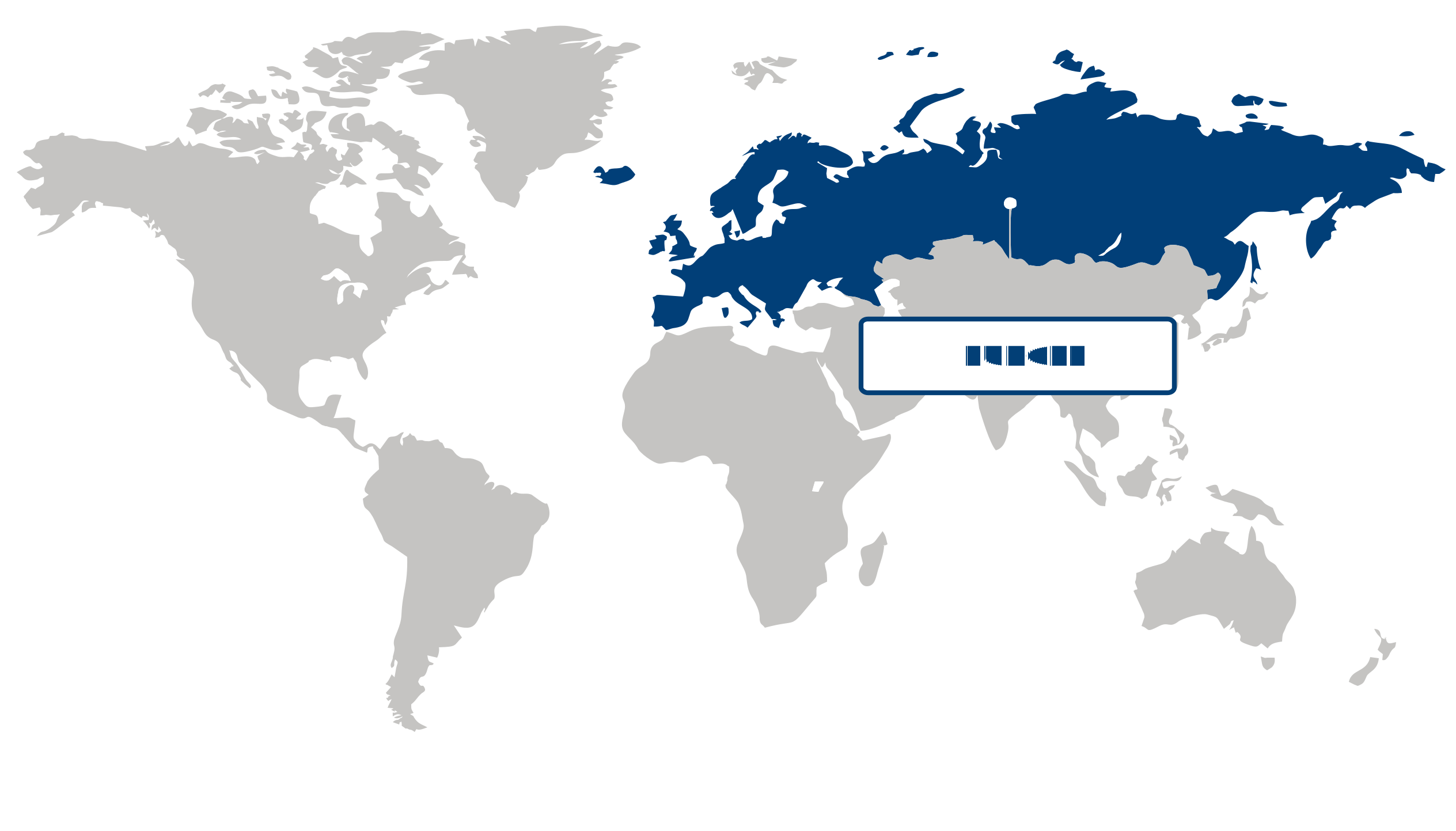
Europe (Largest Region)
Europe held the largest share of the roasted coffee market in 2026, underpinned by a deeply established coffee culture, widespread consumption across both household and out-of-home channels, and strong demand for premium and specialty coffee products. Consumers in the region increasingly value product origin, roasting quality, flavor profiles, and sustainable sourcing, encouraging innovation across the roasted coffee segment. Well-developed retail networks, established café culture, and the expansion of specialty coffee offerings are reinforcing market maturity. The growing popularity of convenient preparation formats alongside continued interest in artisanal roasting is also enabling producers and retailers to address diverse consumer preferences.
Asia Pacific (Fastest-Growing Region)
Asia Pacific is the fastest-growing regional market, supported by changing consumer lifestyles, rising disposable incomes, and the gradual expansion of coffee consumption in traditionally tea-oriented markets. Urban consumers are increasingly experimenting with specialty beverages and premium roasted coffee, while the growth of cafés, modern retail, foodservice outlets, and e-commerce is improving product availability. Younger consumers are also contributing to changing beverage preferences and greater interest in premium experiences, creating opportunities for differentiated roast profiles and higher-value products. Expanding domestic coffee cultures and investments across the broader food and beverage ecosystem are further supporting the region's growth potential.
| Parameter | North America | Asia Pacific | Europe | Latin America | MEA |
|---|---|---|---|---|---|
| Innovation Hub i Scale Nascent Developing Advanced | |||||
| Cost-Sensitive Region i Scale Low Medium High | |||||
| Regulatory Environment i Scale Restrictive Neutral Supportive | |||||
| Demand Drivers i Scale Weak Moderate Strong | |||||
| Development Stage i Scale Emerging Developing Developed | |||||
| Adoption Rate i Scale Low Medium High | |||||
| New Entrants / Startups i Scale Sparse Moderate Dense | |||||
| Macro Indicators i Scale Weak Stable Strong |
Key Country Insights
Germany 🇩🇪
Quality Roasting HeritageGermany maintains strong demand for high-quality roasted coffee supported by established roasting expertise and discerning consumers. German suppliers increasingly focus on certified sourcing, premium product portfolios, and efficient retail partnerships to strengthen market presence.
France 🇫🇷
Artisan Blend FocusFrance values roasted coffee with distinctive flavor profiles and artisanal roasting traditions. French producers and retailers increasingly highlight origin transparency, premium blends, and environmentally responsible packaging to address evolving consumer purchasing preferences.
Italy 🇮🇹
Espresso ExcellenceItaly's roasted coffee market remains closely linked to espresso culture and professional foodservice demand. Italian roasters invest in consistent bean quality, premium roasting techniques, and export-oriented product development while maintaining traditional flavor expectations.
Japan 🇯🇵
Convenience-Driven ConsumptionJapan's roasted coffee market is shaped by demand for consistent quality, single-serve products, and ready-to-drink coffee formats. Roasters in Japan prioritize product refinement, premium flavor profiles, and innovative packaging suited to convenience-oriented consumers.
South Korea 🇰🇷
Specialty Café CultureSouth Korea continues to support roasted coffee demand through an active specialty café ecosystem and premium home brewing trends. Coffee companies in South Korea expand differentiated bean selections, artisanal roasting, and digital retail strategies to attract quality-focused consumers.
United States 🇺🇸
Premium Coffee InnovationThe U.S. roasted coffee market emphasizes premium blends, specialty roasting, and convenient ready-to-brew formats. Consumer demand encourages roasters to expand sustainable sourcing, product differentiation, and direct-to-consumer distribution across retail and online channels.
Segment Leadership and Growth Trends
Roasted Coffee Market Share (%), by Product, 2026
Go beyond the chart, access full insights & data tables
Request Free Sample ReportProduct Segment Analysis: Arabica (Largest Segment) vs Robusta (Fastest-Growing Segment)
Arabica dominated the roasted coffee market with a 60.48% share in 2026, reflecting its strong consumer preference and established position across premium and mainstream roasted coffee offerings. Arabica is valued for its distinctive flavor profile, aroma, and perceived quality, making it widely used in products where taste characteristics are central to purchasing decisions. Continued consumer interest in specialty coffee experiences and differentiated flavor profiles further supports demand for arabica-based roasted coffee.
Robusta is expanding more rapidly as roasters and consumers increasingly recognize its strength, distinctive taste, and suitability for blends and espresso-oriented products. Its ability to contribute body and intensity to roasted coffee formulations supports broader application across diverse beverage preferences. Growing demand for varied coffee profiles and greater use of blends are creating additional opportunities for robusta within the roasted coffee segment.
Distribution Channel Segment Analysis: B2B (Largest Segment) vs B2C (Fastest-Growing Segment)
The B2B distribution channel accounted for a 56.88% share in 2026 in the roasted coffee market, supported by sustained procurement from cafes, restaurants, hospitality establishments, offices, and other commercial users. These buyers require consistent coffee supply to support ongoing beverage operations, making wholesale and institutional purchasing an important route to market. Recurring procurement requirements and the need for dependable product availability reinforce the importance of B2B distribution.
B2C distribution is gaining momentum as consumers increasingly purchase roasted coffee directly for home preparation and seek greater variety in beans, roast profiles, and product formats. The growing emphasis on at-home coffee experiences is encouraging direct consumer purchasing across retail and digital channels. Greater consumer engagement with coffee quality and preparation methods is further supporting the expansion of B2C distribution.
| Segment | Sub-Segment | Largest Segment | Fastest Growing |
|---|---|---|---|
| Product | Arabica, Robusta | Arabica | Robusta |
| Distribution Channel | B2B, B2C | B2B | B2C |
Competitive Landscape and Market Positioning
Prominent players in the roasted coffee market:
1. Nestlé S.A. (Switzerland)
2. JDE Peet’s N.V. (Netherlands)
3. Starbucks Corporation (United States)
4. Luigi Lavazza S.p.A. (Italy)
5. The J.M. Smucker Company (United States)
6. Melitta Group (Germany)
7. Tchibo GmbH (Germany)
8. Massimo Zanetti Beverage Group S.p.A. (Italy)
9. Strauss Coffee B.V. (Netherlands)
10. Farmer Bros. Co. (United States)
Evolving consumer preferences for specialty beverages are driving diversification in roasting profiles and flavor innovation. The roasted coffee market is expanding as premiumization trends influence sourcing and preparation methods. Continuous experimentation with roasting techniques is enhancing aroma consistency and taste differentiation.
| Company | Market Share | Company Revenue | Revenue CAGR (%) | Product Portfolio | Geographic Presence | Innovation / R&D Focus | Strategic Developments |
|---|---|---|---|---|---|---|---|
| Nestlé S.A. (Switzerland) | |||||||
| JDE Peet’s N.V. (Netherlands) | |||||||
| Starbucks Corporation (United States) | |||||||
| Luigi Lavazza S.p.A. (Italy) | |||||||
| The J.M. Smucker Company (United States) | |||||||
| Melitta Group (Germany) | |||||||
| Tchibo GmbH (Germany) | |||||||
| Massimo Zanetti Beverage Group S.p.A. (Italy) | |||||||
| Strauss Coffee B.V. (Netherlands) | |||||||
| Farmer Bros. Co. (United States). |
Industry Development/News
| Company Name | Date | Key Development |
|---|---|---|
| Melitta Group | May-26 | Melitta Group has committed over €100 million to expand its coffee production facility in Bremen, Germany. This capital investment is designed to enhance the company's roasting capacity, supporting its long-term internationalization strategy and reinforcing its competitive positioning within the European roasted coffee market. |
| Highlands Coffee | Apr-25 | Highlands Coffee inaugurated a $19 million roasting facility in Vietnam’s Ba Ria-Vung Tau province. With an annual production capacity reaching 75,000 tons, the plant serves as a strategic hub for exporting roasted coffee to key international markets, including East Asia, Europe, and the United States. |
| Turabo | Dec-24 | Turabo commissioned a new €1 million production facility in Bucharest, designed to produce 100 million Nespresso-compatible capsules and one million kilograms of roasted coffee annually. This investment provides the necessary manufacturing scale to support the company’s planned expansion within the regional Horeca (hotel, restaurant, and café) sector. |
| Roasting Plant Coffee | Jul-24 | Roasting Plant Coffee secured $10 million in funding to accelerate its growth strategy. The capital is earmarked for a significant expansion of its café network across the United States and the United Kingdom over the next five years, focusing on scaling its proprietary fresh-roasting retail model. |
| Farmer Bros | Jun-24 | Farmer Bros completed a strategic consolidation of its roasting operations, centralizing production in Portland, Oregon. This move follows the divestment of its Northlake, Texas, headquarters and roasting facilities to TreeHouse Foods for $100 million, marking a significant restructuring of the company’s manufacturing footprint and supply chain logistics. |
| Luckin Coffee | May-24 | Luckin Coffee commenced operations at a new large-scale roasting facility in China, representing its most significant infrastructure expansion to date. This development strengthens the company’s domestic supply chain capabilities and supports its aggressive growth strategy in response to rising coffee consumption trends within the Chinese market. |
| Nestlé (Nescafé) | May-24 | Nestlé announced a R$1 billion (USD 184 million) investment to expand its Araras factory in Brazil. The project increases production capacity by 50% to support a broader portfolio of roasted, ground, and espresso capsule products, while also expanding its professional machine footprint by 25% across retail and corporate channels. |
| Melitta Group | May-24 | Melitta Group acquired a majority stake in Caturra, a South African coffee roaster and service provider based in Cape Town. This acquisition functions as a strategic entry point for Melitta to expand its operational footprint and distribution capabilities within the African continent, with oversight managed by its European coffee division. |
| JDE Peet’s | Mar-24 | JDE Peet’s secured a long-term global license to manufacture and market Caribou coffee products, excluding retail coffeehouses. The strategic agreement includes the acquisition of Caribou’s roasting operations in Minneapolis and establishes JDE Peet’s as the primary supplier for Caribou’s coffeehouse chain, significantly enhancing its premium coffee portfolio and U.S. market presence. |
| Keurig Dr Pepper | Mar-24 | Keurig Dr Pepper launched a new plastic- and aluminium-free single-serve coffee pod format. Utilizing a plant-based coating to wrap ground roasted coffee, the initiative represents a significant technological innovation in sustainable packaging, addressing consumer demand for reduced waste in the single-serve coffee segment. |
Customize Your Report
Explore examples of how this report can be tailored to different research needs, including custom segments, additional topics or chapters, and related reports. Click a section of the wheel or its numbered marker to explore the available options.
Roasted Coffee Market — Custom Segments
| Segment | Sub-Segment |
|---|---|
| Roast Level | Light Roast, Medium Roast, Medium-Dark Roast, Dark Roast |
| Form | Whole Bean, Ground Coffee, Single-Serve Pods & Capsules, Ready-to-Brew Formats |
| Price Tier | Economy, Mid-Range, Premium, Specialty |
Roasted Coffee Market — Custom TOC
| Custom Chapter | Custom Details |
|---|---|
| Premiumization and Consumer Trend Assessment |
|
| Coffee Origin Strategy Analysis |
|
| Retail Channel Transformation Study |
|
Need a different cut of the data?
Request Custom ResearchWhat is the current revenue of the roasted coffee market?
What are the growth projections for the roasted coffee industry?
How is café culture reshaping premiumization and product assortment strategies in the roasted coffee market?
How are subscription-based e-commerce models influencing access and demand patterns in the roasted coffee market?
Why does Arabica lead the roasted coffee market?
Which distribution channel is expanding fastest in the roasted coffee market?
Why does Europe lead the roasted coffee market?
What is driving roasted coffee market growth in Asia Pacific?
Which companies are driving growth in the roasted coffee landscape?
Our Clients
"The report provided a thorough look at market trends, technological advancements, and the competitive landscape. The depth of insights was really valuable."
ITC Limited
"We would highly recommend Fundamental Business Insights & Consulting to anyone looking for reliable, detailed, and comprehensive market research in the Food industry."
Tyson Foods
"The clarity and presentation of the information were commendable. The report was delivered timely, which made the overall experience smooth and convenient."
Mondelēz International
Our Research Team & Methodology
Every Fundamental Business Insights report is built by a dedicated vertical research team, validated through a structured primary-and-secondary methodology, and reviewed for accuracy before it reaches you.
Research Team Overview
Prepared by the Food & Beverage Research Team
Delivery
Published
Demand
Available
Support
Trust & Compliance
Research Domains
10 coverage areasResearch Intelligence
| Source | Reference |
|---|---|
| Food and Agriculture Organization (FAO) | www.fao.org |
| World Health Organization (WHO) | www.who.int |
| U.S. Food & Drug Administration (FDA) | www.fda.gov |
| European Food Safety Authority (EFSA) | www.efsa.europa.eu |
| U.S. Department of Agriculture (USDA) | www.usda.gov |
| Codex Alimentarius Commission | www.fao.org/fao-who-codexalimentarius |
| International Organization for Standardization (ISO) | www.iso.org |
| AOAC INTERNATIONAL | www.aoac.org |
| Institute of Food Technologists (IFT) | www.ift.org |
| International Dairy Foods Association (IDFA) | www.idfa.org |
| International Sweeteners Association (ISA) | www.sweeteners.org |
| International Probiotics Association (IPA) | internationalprobiotics.org |
| Good Food Institute (GFI) | gfi.org |
| American Feed Industry Association (AFIA) | www.afia.org |
| International Feed Industry Federation (IFIF) | ifif.org |
| Specialty Food Association (SFA) | www.specialtyfood.com |
| Brewers Association | www.brewersassociation.org |
| International Bottled Water Association (IBWA) | bottledwater.org |
| International Alliance for Dietary/Food Supplement Associations (IADSA) | www.iadsa.org |
| OECD Agriculture & Food | www.oecd.org/agriculture |
Research Workflow & Quality Assurance
Data Collection
Verified information gathered through primary and secondary research.
Data Triangulation
Cross-validation using multiple independent data sources.
Forecast Modelling
Market estimates developed using historical trends and analytical models.
Analyst Validation
Findings reviewed by domain experts for accuracy and consistency.
Editorial & Quality Review
Final editorial, quality, and compliance checks before publication.
Final Publication
Released after successful completion of the internal review process.
Report Coverage
📊 Market Assessment
- Market Size & Forecast
- Market Segmentation
- Regional Analysis
- Growth Drivers & Challenges
- Market Dynamics
🏢 Competitive Intelligence
- Competitive Landscape
- Company Profiles
- Competitive Benchmarking
- Mergers & Acquisitions
- Market Share Analysis or Key Company Strategies
🔍 Strategic Analysis
- Value Chain Analysis
- Porter's Five Forces
- PESTLE Analysis
- Pricing Trends
- Supply-Demand Analysis
🚀 Future Outlook
- Technology Landscape
- Regulatory Landscape
- Investment & Funding Landscape
- Emerging Opportunities
- Future Market Outlook
Have a question about this report or need a custom scope?
Request Customization