Coffee Market Size & Growth Forecast 2027–2036, By Segments (Distribution Channel, Product), Regional Demand Trends (North America, Asia Pacific, Europe), Key Country Insights (U.S., Japan, South Korea, Germany, France, Italy), and Competitive Landscape
Market Size and Growth Outlook
Coffee Market size was more than USD 260.74 billion in 2026 and is set to grow at a 5.13% CAGR between 2027 and 2036, crossing USD 430.01 billion by 2036. The industry revenue for 2027 is assessed at USD 272 billion.
Get more details on this report
Request Free Sample ReportCoffee Market Intelligence Snapshot
Regional Market Dynamics
- Europe leads with 36.15% share supported by strong consumption habits, diversified product formats like roasted, ground, capsule, and specialty coffee, and extensive retail and foodservice networks.
- Asia Pacific grows at 6.22% CAGR driven by expanding café chains, rising ready-to-drink availability, modern retail penetration, and increasing daily coffee consumption among younger consumers.
Segment Momentum
- Supermarkets lead the market because they provide strong product visibility, immediate availability, and broad assortment, enabling consumers to compare brands, pack sizes, and promotions during routine grocery shopping.
- Coffee Capsules are the fastest-growing product segment, supported by rising demand for quick, consistent, and low-effort preparation through portion-controlled formats that simplify daily coffee consumption.
Market Expansion Drivers
- Rising specialty coffee consumption and premiumization trend boosting overall coffee market value.
- Expanding café culture and out-of-home consumption driving consistent global coffee demand.
- Growth of sustainable sourcing and traceable coffee supply chains strengthening brand differentiation.
Leading Market Participants
- Top companies in the coffee market include Nestlé S.A. (Switzerland), Starbucks Corporation (United States), JDE Peet's N.V. (Netherlands), Luigi Lavazza S.p.A. (Italy), The J.M. Smucker Company (United States), Tchibo GmbH (Germany), Melitta Group (Germany), UCC Ueshima Coffee Co., Ltd. (Japan), Strauss Coffee B.V. (Netherlands), Massimo Zanetti Beverage Group S.p.A. (Italy).
Global Market Forecast Snapshot
Market Outlook
- 2026 Market Size: USD 260.74 billion
- 2027 Estimated Market Size: USD 272 billion.
- Projected Market Size: USD 430.01 billion by 2036
- Growth Forecast: 5.13% CAGR (2027-2036)
Regional and Segment Outlook
- Leading Regional Market: Europe
- High-Growth Regional Hub: Asia Pacific
- Core Revenue Segment: Supermarkets (Distribution Channel) | Ground Coffee (Product)
- Emerging Opportunity Segment: Online Retail (Distribution Channel) | Coffee Capsules (Product)
Market Growth Drivers and Industry Trends
Rising specialty coffee consumption and premiumization trend boosting overall coffee market value
Increasing consumer interest in higher-quality coffee is encouraging greater experimentation with specialty varieties, distinctive preparation methods, and premium product formats. The coffee market will be driven by this premiumization trend as consumers become more willing to differentiate products based on flavor, origin, processing, and preparation characteristics. Premium offerings can also create opportunities for producers and retailers to capture greater value from consumers seeking more personalized and elevated coffee experiences.
Expanding café culture and out-of-home consumption driving consistent global coffee demand
The expansion of café culture is making coffee an increasingly established part of social, professional, and leisure routines. As out-of-home consumption grows, the coffee market will gain from frequent purchases across cafés, restaurants, workplaces, and other hospitality settings. Cafés also provide consumers with broader choices in preparation styles and specialty beverages, encouraging regular consumption while strengthening coffee's role as both a functional beverage and an experiential product.
Growth of sustainable sourcing and traceable coffee supply chains strengthening brand differentiation
Greater consumer and industry attention to responsible sourcing is increasing the importance of transparency across coffee supply chains. The coffee market will benefit as producers and brands adopt traceability practices that provide greater visibility into sourcing and production processes. Sustainable procurement can help businesses differentiate their offerings by addressing consumer expectations around environmental responsibility, ethical production, and supply-chain transparency, particularly in premium and specialty segments.
| Growth Driver | Impact on CAGR | Regulatory Influence | Geographic Relevance | Adoption Rate | Impact Timeline |
|---|---|---|---|---|---|
| Rising specialty coffee consumption and premiumization trend boosting overall coffee market value | 2.20% | Low | Europe, North America | High | Near Term |
| Expanding café culture and out-of-home consumption driving consistent global coffee demand | 2.00% | Low | Europe, Asia Pacific | High | Near Term |
| Growth of sustainable sourcing and traceable coffee supply chains strengthening brand differentiation | 1.30% | Moderate | North America, Europe | High | Mid Term |
Unlock insights tailored to your business with our bespoke market research solutions.
Click to get your customized report now.
Regional Demand Dynamics
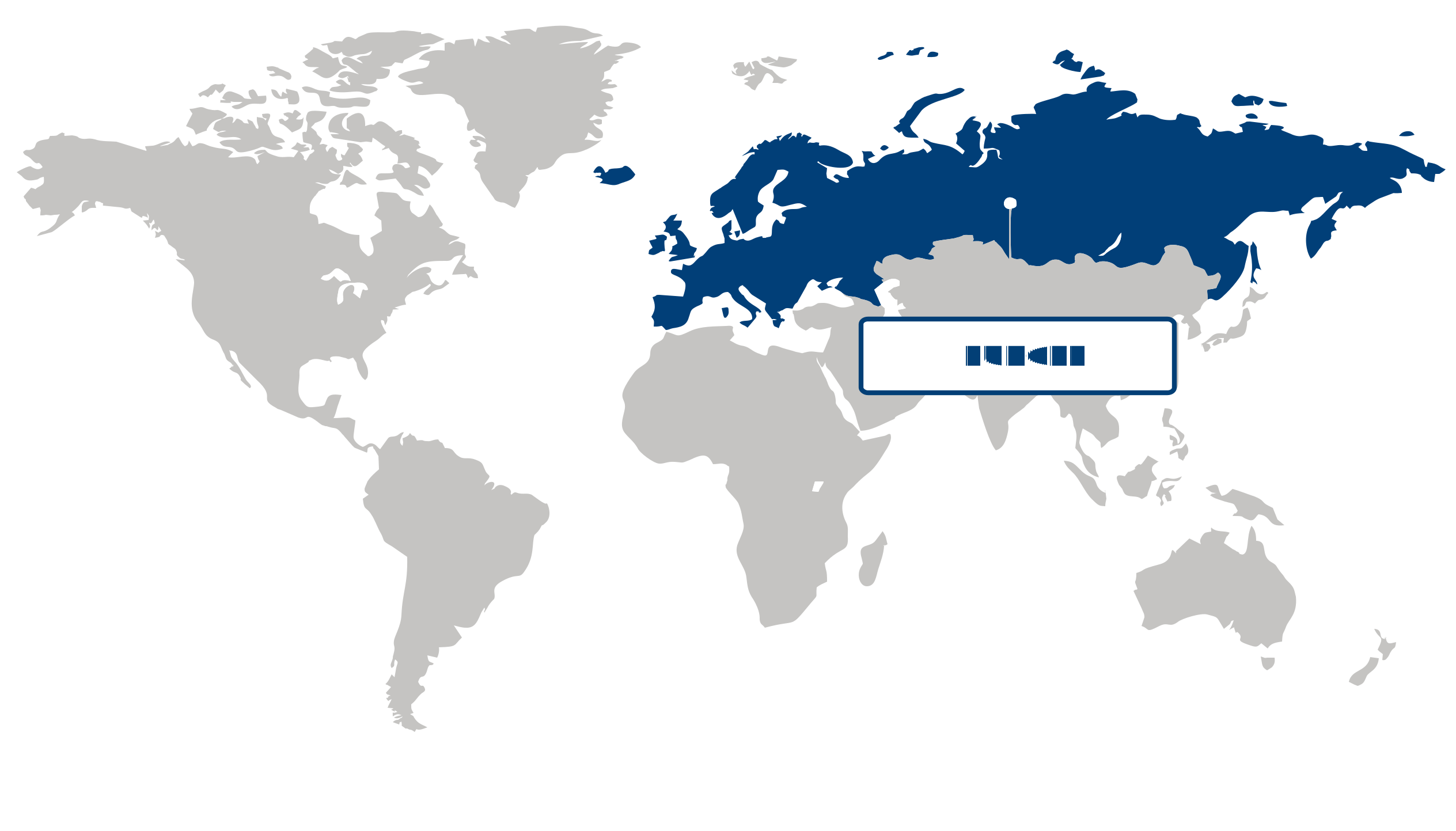
Europe (Largest Region)
In the coffee market, Europe held the largest share in 2026, accounting for 36.15% of the market. The region benefits from deeply established coffee-drinking cultures, widespread café networks, and strong demand across both at-home and out-of-home consumption occasions. Mature specialty coffee segments, premiumization, and continued consumer interest in higher-quality beans and preparation methods support value creation. Well-developed retail and foodservice channels also enable broad product availability and sustained consumption across diverse European markets.
Asia Pacific (Fastest-Growing Region)
Asia Pacific represents the fastest-growing regional market, supported by expanding urbanization, evolving beverage preferences, and increasing adoption of café culture among younger consumers. Rising disposable incomes and greater exposure to specialty and convenience-oriented coffee formats are broadening consumption beyond traditional tea-dominant markets. Expansion of modern retail, foodservice infrastructure, and ready-to-consume beverage offerings is further improving accessibility, while localized flavors and formats help coffee products appeal to diverse consumer preferences.
| Parameter | North America | Asia Pacific | Europe | Latin America | MEA |
|---|---|---|---|---|---|
| Innovation Hub i Scale Nascent Developing Advanced | |||||
| Cost-Sensitive Region i Scale Low Medium High | |||||
| Regulatory Environment i Scale Restrictive Neutral Supportive | |||||
| Demand Drivers i Scale Weak Moderate Strong | |||||
| Development Stage i Scale Emerging Developing Developed | |||||
| Adoption Rate i Scale Low Medium High | |||||
| New Entrants / Startups i Scale Sparse Moderate Dense | |||||
| Macro Indicators i Scale Weak Stable Strong |
Key Country Insights
Germany 🇩🇪
Premium Roasting CultureGermany places strong emphasis on premium roasting quality and certified coffee sourcing. Consumer interest supports investments in sustainable procurement, specialty blends, and value-added coffee experiences across retail and foodservice channels.
France 🇫🇷
Artisan Coffee PreferenceFrance increasingly values artisan roasting, premium coffee quality, and café culture. Businesses introduce distinctive blends and sustainable sourcing strategies while responding to consumer demand for premium coffee experiences.
Italy 🇮🇹
Espresso Tradition EvolutionItaly maintains strong demand for espresso while gradually expanding premium bean selections and specialty coffee formats. Companies modernize product offerings without moving away from established consumer preparation preferences.
Japan 🇯🇵
Convenience Beverage DemandJapan's coffee market benefits from widespread demand for canned, bottled, and ready-to-drink coffee alongside premium café offerings. Companies balance convenience with product quality through continuous flavor and packaging innovation.
South Korea 🇰🇷
Café Experience ExpansionSouth Korea continues to strengthen its coffee market through premium café concepts and differentiated beverage experiences. Domestic and international brands invest in menu innovation and digital ordering to maintain consumer engagement.
United States 🇺🇸
Specialty Consumption TrendsThe U.S. coffee market continues to prioritize specialty beverages, premium beans, and convenient ready-to-drink formats. Businesses expand product portfolios with sustainable sourcing and personalized offerings to address evolving consumer expectations.
Segment Leadership and Growth Trends
Coffee Market Share (%), by Distribution Channel, 2026
Go beyond the chart, access full insights & data tables
Request Free Sample ReportDistribution Channel Segment Analysis: Supermarkets (Largest Segment) vs Online Retail (Fastest-Growing Segment)
Supermarkets dominated the coffee market by distribution channel in 2026, supported by their broad product assortment, established retail infrastructure, and convenience for routine coffee purchases. These outlets allow consumers to compare different coffee formats, brands, roast profiles, and pack sizes in a single shopping trip, while promotional displays and in-store offers can further encourage purchases. The continued presence of supermarkets as a key destination for grocery shopping also supports steady coffee sales, particularly as coffee remains a frequently purchased household beverage. Their ability to combine accessibility with immediate product availability reinforces the strength of the supermarket channel.
Online retail is emerging as the fastest-growing distribution channel, driven by changing purchasing habits and the increasing preference for convenient, digitally enabled shopping experiences. E-commerce platforms provide consumers with access to a wider selection of coffee products than may be available at individual physical stores, including specialty varieties, premium offerings, and niche formats. Subscription models, doorstep delivery, personalized recommendations, and the ability to compare products and reviews are also strengthening the appeal of online purchasing. As consumers increasingly integrate digital commerce into routine grocery and beverage purchases, online retail is gaining importance as a flexible channel for coffee brands and suppliers to reach customers.
Product Segment Analysis: Ground Coffee (Largest Segment) vs Coffee Capsules (Fastest-Growing Segment)
Ground coffee led the coffee market by product type in 2026, reflecting its broad consumer acceptance and compatibility with a wide range of traditional brewing methods. Its established position across households, cafés, workplaces, and foodservice environments is supported by the familiarity of conventional coffee preparation and the availability of products across different roast levels and flavor profiles. Ground coffee also offers consumers flexibility in controlling brewing strength and preparation, making it suitable for diverse consumption preferences. Continued interest in freshly prepared coffee and the popularity of home brewing further underpin the segment's leading position.
Coffee capsules represent the fastest-growing product segment as consumers increasingly prioritize convenience, consistency, and simplified preparation. Capsules reduce the time and effort required to prepare coffee while providing a standardized brewing experience, making them particularly attractive to consumers seeking café-style beverages at home or in workplaces. The expanding interest in premium and specialty coffee has also encouraged the development of capsules featuring differentiated blends, roast profiles, and flavor characteristics. As single-serve brewing becomes more closely associated with convenience and modern coffee consumption, coffee capsules are positioned for strong momentum within the product landscape.
| Segment | Sub-Segment | Largest Segment | Fastest Growing |
|---|---|---|---|
| Distribution Channel | Supermarkets, Convenience Stores, Online Retail, Others | Supermarkets | Online Retail |
| Product | Whole Bean, Ground Coffee, Instant Coffee, Coffee Capsules, Others | Ground Coffee | Coffee Capsules |
Competitive Landscape and Market Positioning
Leading companies in the coffee market:
1. Nestlé S.A. (Switzerland)
2. Starbucks Corporation (United States)
3. JDE Peet's N.V. (Netherlands)
4. Luigi Lavazza S.p.A. (Italy)
5. The J.M. Smucker Company (United States)
6. Tchibo GmbH (Germany)
7. Melitta Group (Germany)
8. UCC Ueshima Coffee Co. Ltd. (Japan)
9. Strauss Coffee B.V. (Netherlands)
10. Massimo Zanetti Beverage Group S.p.A. (Italy)
The coffee market is witnessing strong momentum around sustainable sourcing practices, premium product offerings, and digitally enabled consumer engagement strategies. Companies are expanding ready-to-drink beverages, specialty blends, and functional coffee products to address shifting consumption preferences. Technological advancements in supply chain traceability, roasting efficiency, and personalized retail experiences are also playing a key role in market differentiation.
| Company | Market Share | Company Revenue | Revenue CAGR (%) | Product Portfolio | Geographic Presence | Innovation / R&D Focus | Strategic Developments |
|---|---|---|---|---|---|---|---|
| Nestlé S.A. (Switzerland) | |||||||
| Starbucks Corporation (United States) | |||||||
| JDE Peet's N.V. (Netherlands) | |||||||
| Luigi Lavazza S.p.A. (Italy) | |||||||
| The J.M. Smucker Company (United States) | |||||||
| Tchibo GmbH (Germany) | |||||||
| Melitta Group (Germany) | |||||||
| UCC Ueshima Coffee Co. Ltd. (Japan) | |||||||
| Strauss Coffee B.V. (Netherlands) | |||||||
| Massimo Zanetti Beverage Group S.p.A. (Italy). |
Industry Development/News
| Company Name | Date | Key Development |
|---|---|---|
| Royal Cup | May-26 | Royal Cup finalized the acquisition of Farmer Brothers Coffee Co. This consolidation of two major players significantly expands Royal Cup’s manufacturing, distribution, and customer reach within the professional coffee and tea sectors, strengthening its operational footprint across the competitive U.S. market. |
| Starbucks | Apr-26 | Starbucks entered a joint venture with Boyu Capital to accelerate expansion in China. The partnership leverages local market expertise to support an aggressive growth strategy, with plans to scale its China footprint from approximately 8,000 stores to 20,000, focusing on digital innovation and localized operations to enhance long-term market competitiveness. |
| Nestlé | Apr-26 | Nestlé and Starbucks, through the Global Coffee Alliance, launched "Starbucks Coffee Craft" concentrate. This strategic rollout targets the rapidly expanding global cold coffee market, initially launching in Japan, South Korea, and the UK, to capture premium at-home consumption occasions among younger demographics seeking convenience and personalization. |
| Dutch Bros | Jan-26 | Dutch Bros completed the acquisition of Clutch Coffee, a 20-unit chain in the Carolinas, marking its first formal acquisition. The company plans to rebrand all acquired units to Dutch Bros, executing a strategic regional expansion plan to accelerate its physical store growth and presence in the U.S. market. |
| OFI | May-25 | OFI commissioned a new soluble coffee production facility in Brazil. The plant is equipped to manufacture spray-dried, freeze-dried, and liquid soluble coffee, significantly increasing the company’s global production capacity and enhancing its ability to serve international demand for processed, high-quality coffee products. |
| Massimo Zanetti Beverage USA | Sep-24 | Massimo Zanetti Beverage USA partnered with Ultramar Caffè to install a new high-capacity aluminum espresso capsule packaging line at its Virginia facility. With a projected annual capacity of 100 million units, this initiative directly addresses the increasing U.S. consumer demand for premium, portioned coffee products. |
| Luckin Coffee | May-24 | Luckin Coffee commissioned China’s largest coffee roasting facility. By significantly increasing its domestic roasting capacity, the company is strengthening its supply chain vertical integration to support its rapid store-count expansion and maintain a competitive edge in the high-growth Chinese coffee market. |
| QuattroR | Apr-24 | Investment firm QuattroR acquired a 50% stake in Massimo Zanetti Beverage Group S.p.A. via a major capital increase. This partnership is designed to accelerate the group’s strategic growth and consolidate its leadership in the European coffee industry while bolstering its operational capacity and global market presence. |
| JDE Peet’s | Jan-24 | JDE Peet’s finalized the acquisition of the coffee and tea business of Maratá in Brazil. This acquisition provides JDE Peet’s with expanded national distribution coverage and a stronger competitive position in one of the world's most critical coffee markets, complementing its existing global brand portfolio. |
Customize Your Report
Explore examples of how this report can be tailored to different research needs, including custom segments, additional topics or chapters, and related reports. Click a section of the wheel or its numbered marker to explore the available options.
Coffee Market — Custom Segments
| Segment | Sub-Segment |
|---|---|
| Coffee Variety | Arabica, Robusta, Liberica, Excelsa |
| Roast Level | Light Roast, Medium Roast, Medium-Dark Roast, Dark Roast |
| End User | Household Consumers, Cafés & Coffee Shops, Restaurants & Hospitality, Offices & Institutions |
Coffee Market — Custom TOC
| Custom Chapter | Custom Details |
|---|---|
| Consumer Consumption Patterns and Premiumization Outlook |
|
| Café, Retail, and E-Commerce Channel Strategy Assessment |
|
| Coffee Bean Sourcing and Origin Risk Assessment |
|
Need a different cut of the data?
Request Custom ResearchWhat is the market size of coffee?
How is the coffee industry expected to grow over the next 10 years?
How is premiumization influencing strategic growth in the coffee market?
Why are sustainability and traceability becoming competitive priorities in the coffee market?
Why do Supermarkets remain the leading distribution channel in the coffee market?
Which product segment is growing fastest in the coffee market?
Why does Europe dominate the global coffee market?
What factors are fueling Asia Pacific coffee market growth?
Which organizations are considered leaders in the coffee landscape?
Our Clients
"The report provided a thorough look at market trends, technological advancements, and the competitive landscape. The depth of insights was really valuable."
ITC Limited
"We would highly recommend Fundamental Business Insights & Consulting to anyone looking for reliable, detailed, and comprehensive market research in the Food industry."
Tyson Foods
"The clarity and presentation of the information were commendable. The report was delivered timely, which made the overall experience smooth and convenient."
Mondelēz International
Our Research Team & Methodology
Every Fundamental Business Insights report is built by a dedicated vertical research team, validated through a structured primary-and-secondary methodology, and reviewed for accuracy before it reaches you.
Research Team Overview
Prepared by the Food & Beverage Research Team
Delivery
Published
Demand
Available
Support
Trust & Compliance
Research Domains
10 coverage areasResearch Intelligence
| Source | Reference |
|---|---|
| Food and Agriculture Organization (FAO) | www.fao.org |
| World Health Organization (WHO) | www.who.int |
| U.S. Food & Drug Administration (FDA) | www.fda.gov |
| European Food Safety Authority (EFSA) | www.efsa.europa.eu |
| U.S. Department of Agriculture (USDA) | www.usda.gov |
| Codex Alimentarius Commission | www.fao.org/fao-who-codexalimentarius |
| International Organization for Standardization (ISO) | www.iso.org |
| AOAC INTERNATIONAL | www.aoac.org |
| Institute of Food Technologists (IFT) | www.ift.org |
| International Dairy Foods Association (IDFA) | www.idfa.org |
| International Sweeteners Association (ISA) | www.sweeteners.org |
| International Probiotics Association (IPA) | internationalprobiotics.org |
| Good Food Institute (GFI) | gfi.org |
| American Feed Industry Association (AFIA) | www.afia.org |
| International Feed Industry Federation (IFIF) | ifif.org |
| Specialty Food Association (SFA) | www.specialtyfood.com |
| Brewers Association | www.brewersassociation.org |
| International Bottled Water Association (IBWA) | bottledwater.org |
| International Alliance for Dietary/Food Supplement Associations (IADSA) | www.iadsa.org |
| OECD Agriculture & Food | www.oecd.org/agriculture |
Research Workflow & Quality Assurance
Data Collection
Verified information gathered through primary and secondary research.
Data Triangulation
Cross-validation using multiple independent data sources.
Forecast Modelling
Market estimates developed using historical trends and analytical models.
Analyst Validation
Findings reviewed by domain experts for accuracy and consistency.
Editorial & Quality Review
Final editorial, quality, and compliance checks before publication.
Final Publication
Released after successful completion of the internal review process.
Report Coverage
📊 Market Assessment
- Market Size & Forecast
- Market Segmentation
- Regional Analysis
- Growth Drivers & Challenges
- Market Dynamics
🏢 Competitive Intelligence
- Competitive Landscape
- Company Profiles
- Competitive Benchmarking
- Mergers & Acquisitions
- Market Share Analysis or Key Company Strategies
🔍 Strategic Analysis
- Value Chain Analysis
- Porter's Five Forces
- PESTLE Analysis
- Pricing Trends
- Supply-Demand Analysis
🚀 Future Outlook
- Technology Landscape
- Regulatory Landscape
- Investment & Funding Landscape
- Emerging Opportunities
- Future Market Outlook
Have a question about this report or need a custom scope?
Request Customization