RTA Furniture Market Size & Growth Forecast 2027–2036, By Segments (Material, Application, Distribution Channel, Product), Regional Demand Trends (North America, Asia Pacific, Europe), Key Country Insights (U.S., Japan, South Korea, Germany, France, Italy), and Competitive Landscape
Jump to content
Market Size and Growth Outlook
RTA Furniture Market size was more than USD 19.4 billion in 2026 and is set to grow at a 6.84% CAGR between 2027 and 2036, crossing USD 37.6 billion by 2036. The industry revenue for 2027 is assessed at USD 20.52 billion.
Get more details on this report
Request Free Sample ReportRTA Furniture Market Intelligence Snapshot
Regional Market Dynamics
- Europe led the market in 2026, supported by organized furniture retail, mature e-commerce, and strong consumer preference for flat-pack, self-assembly furniture across diverse price segments.
- Asia Pacific is forecast to grow at an 8.25% CAGR, driven by urbanization, rising online furniture purchases, and increasing demand for affordable, space-efficient furnishings among younger consumers.
Segment Momentum
- Wood accounted for 57.33% of the market in 2026, supported by its broad use across residential furniture, design versatility, familiar appearance, and well-established manufacturing ecosystem.
- Office demand is growing fastest as businesses seek cost-efficient, modular furniture that is easy to ship, assemble, reconfigure, and replace to support evolving workplace layouts.
Market Expansion Drivers
- Growing urban apartment living increasing demand for modular space-saving furniture solutions.
- Expansion of e-commerce distribution improving accessibility and logistics efficiency for flat-pack furniture.
- Rising consumer preference for affordable customizable home furnishings strengthening online RTA furniture sales.
Leading Market Participants
- Top companies in the RTA furniture market include Inter IKEA Systems B.V. (Netherlands), Dorel Industries Inc. (Canada), Tvilum A/S (Denmark), Bush Industries, Inc. (United States), Whalen Furniture Manufacturing, Inc. (United States), Morris Furniture Company, Inc. (United States), Home Reserve, LLC (United States), Simplicity Sofas, Inc. (United States), Fabritec Kitchens Inc. (Canada).
Global Market Forecast Snapshot
Market Outlook
- 2026 Market Size: USD 19.4 billion
- 2027 Estimated Market Size: USD 20.52 billion.
- Projected Market Size: USD 37.6 billion by 2036
- Growth Forecast: 6.84% CAGR (2027-2036)
Regional and Segment Outlook
- Leading Regional Market: Europe
- High-Growth Regional Hub: Asia Pacific
- Core Revenue Segment: Wood (Material) | Home (Application) | Flagship Stores (Distribution Channel) | Storage (Product)
- Emerging Opportunity Segment: Steel (Material) | Office (Application) | Online (Distribution Channel) | Sofa (Product)
Market Growth Drivers and Industry Trends
Growing urban apartment living increasing demand for modular space-saving furniture solutions
The expansion of urban apartment living is increasing the need for furniture that can maximize limited residential space, which will drive the RTA furniture market growth. Smaller apartments and compact urban homes are encouraging consumers to prioritize modular products that can be assembled, rearranged, and adapted to different room configurations. Ready-to-assemble furniture is particularly suited to these environments because flat-pack designs can incorporate functional storage, compact dimensions, and flexible layouts while simplifying transportation into buildings with restricted access. Products such as modular shelving, compact tables, storage units, and multifunctional furniture allow urban households to utilize available floor space more efficiently while maintaining practical and contemporary interiors.
Expansion of e-commerce distribution improving accessibility and logistics efficiency for flat-pack furniture
The rapid development of online furniture retail is making RTA products easier to discover and purchase, strengthening the RTA furniture market. Flat-pack construction provides logistical advantages for e-commerce distribution because products can be packaged in compact forms that simplify handling, warehousing, transportation, and delivery to residential customers. Online channels also allow consumers to compare designs, dimensions, materials, and product configurations without visiting physical stores, expanding the reach of furniture sellers across geographically dispersed markets. Improvements in digital ordering and home-delivery services are further supporting the distribution of ready-to-assemble products, while compact packaging can help streamline inventory management and last-mile delivery operations.
Rising consumer preference for affordable customizable home furnishings strengthening online RTA furniture sales
Consumers increasingly seeking cost-effective furniture with greater flexibility in design and configuration are contributing to growth in the RTA furniture market. Ready-to-assemble products can offer a practical balance between affordability, functionality, and design variety, making them attractive to households furnishing homes without the higher costs associated with fully assembled or highly customized furniture. The availability of multiple finishes, sizes, configurations, and modular components also enables consumers to select products according to their individual space and aesthetic requirements. Online furniture platforms further reinforce this trend by presenting broad assortments of customizable and budget-conscious options, allowing customers to evaluate product features and select furniture suited to specific room layouts.
| Growth Driver | Impact on CAGR | Regulatory Influence | Geographic Relevance | Adoption Rate | Impact Timeline |
|---|---|---|---|---|---|
| Growing urban apartment living increasing demand for modular space-saving furniture solutions | 2.00% | Low | Europe, Asia Pacific | High | Near Term |
| Expansion of e-commerce distribution improving accessibility and logistics efficiency for flat-pack furniture | 1.80% | Low | North America, Europe | High | Near Term |
| Rising consumer preference for affordable customizable home furnishings strengthening online RTA furniture sales | 1.50% | Low | Asia Pacific, Latin America | Medium | Mid Term |
Unlock insights tailored to your business with our bespoke market research solutions.
Click to get your customized report now.
Regional Demand Dynamics
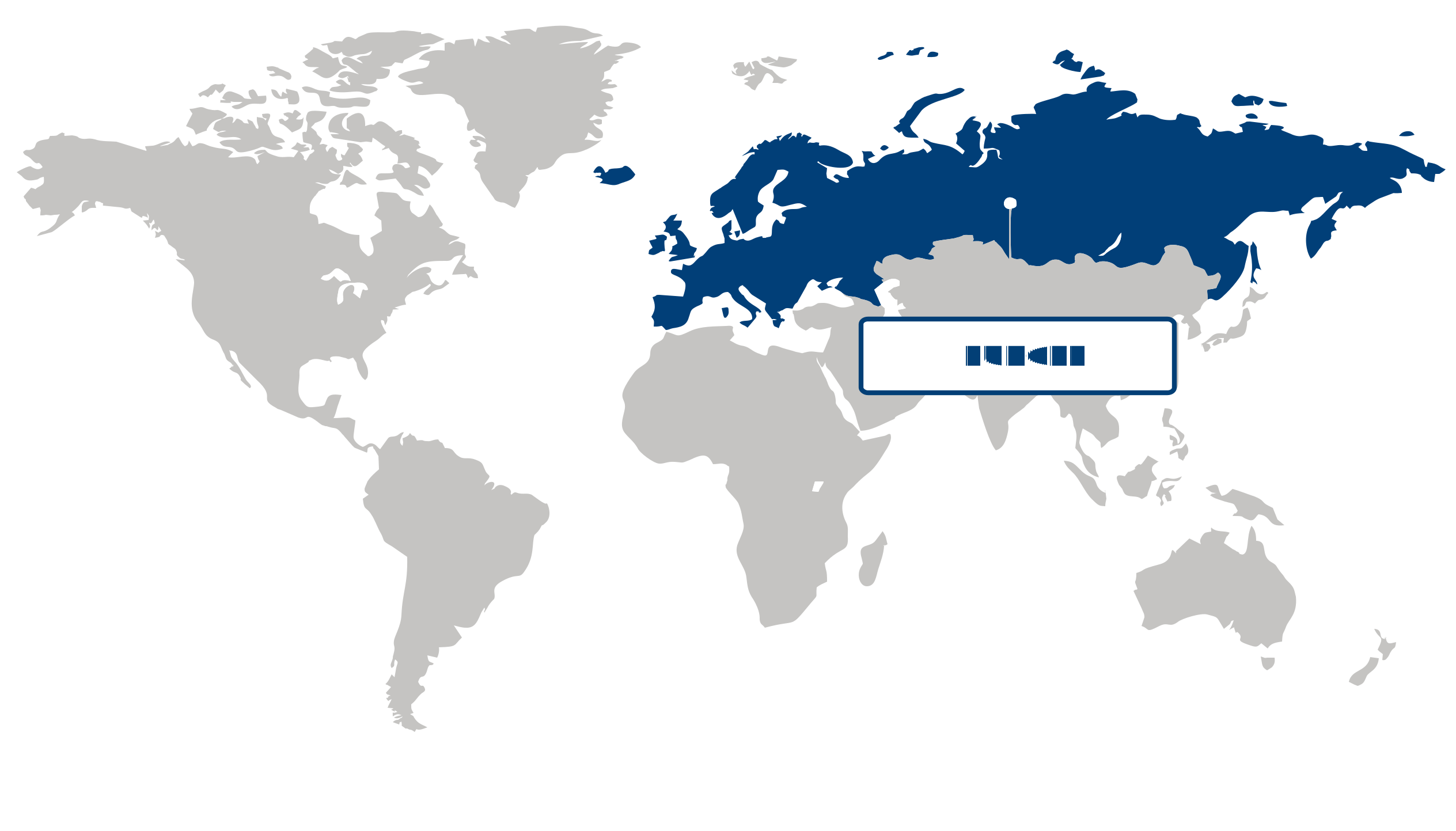
Europe (Largest Region)
Europe accounted for the largest share of the RTA furniture market in 2026, supported by strong demand for space-efficient home furnishings, established furniture manufacturing capabilities, and growing consumer interest in convenient assembly solutions. Ready-to-assemble furniture appeals to households seeking practical products that can be transported, stored, and assembled with relative ease, particularly in urban environments where living spaces are often constrained. The region's developed e-commerce and home-furnishing infrastructure further supports sales by enabling consumers to compare, purchase, and receive furniture conveniently. Growing preference for functional and adaptable interior solutions is also encouraging demand for modular furniture formats. Sustainability considerations and interest in efficient material use are further influencing product development, strengthening the role of RTA furniture within Europe's evolving residential furnishings market.
Asia Pacific (Fastest-Growing Region)
Asia Pacific is the fastest-growing region, driven by rapid urbanization, expanding middle-class populations, and increasing demand for affordable and flexible home furnishings. Smaller urban living spaces are encouraging consumers to prioritize furniture that combines functionality, ease of transportation, and efficient use of available space. The expansion of e-commerce and organized retail is improving access to RTA furniture, while rising household incomes are supporting greater spending on home improvement and interior products. Consumers are also becoming more receptive to contemporary furniture designs and modular solutions that can adapt to changing household needs. Growing residential development and evolving lifestyle preferences are therefore creating favorable conditions for continued expansion of the RTA furniture market across Asia Pacific.
| Parameter | North America | Asia Pacific | Europe | Latin America | MEA |
|---|---|---|---|---|---|
| Innovation HubiScaleNascentDeveloping Advanced | |||||
| Cost-Sensitive RegioniScaleLowMedium High | |||||
| Regulatory EnvironmentiScaleRestrictiveNeutral Supportive | |||||
| Demand DriversiScaleWeakModerate Strong | |||||
| Development StageiScaleEmergingDeveloping Developed | |||||
| Adoption RateiScaleLowMedium High | |||||
| New Entrants / StartupsiScaleSparseModerate Dense | |||||
| Macro IndicatorsiScaleWeakStable Strong |
Key Country Insights
Germany 🇩🇪
Functional Living SolutionsGermany emphasizes RTA furniture that combines durable construction with efficient space utilization for residential and office environments. Producers are expanding modular product ranges that address changing consumer expectations for flexibility and long-term usability.
France 🇫🇷
Contemporary Home AppealFrance prioritizes RTA furniture offering modern aesthetics, practical functionality, and sustainable material options. Suppliers are broadening product portfolios that appeal to consumers seeking adaptable furnishings for evolving residential spaces.
Italy 🇮🇹
Design-Oriented AssemblyItaly combines contemporary furniture design with efficient ready-to-assemble manufacturing to serve value-conscious consumers. Italian manufacturers are refining modular product concepts that preserve visual appeal while simplifying transportation and installation.
Japan 🇯🇵
Compact Space OptimizationJapan focuses on RTA furniture designed for compact urban living and multifunctional interiors. Manufacturers in Japan are introducing lightweight, modular products that maximize storage efficiency while maintaining contemporary design standards.
South Korea 🇰🇷
Modern Urban FurnishingSouth Korea is strengthening demand for stylish RTA furniture suited to apartments and digitally connected consumers. Furniture companies are expanding customizable collections that balance aesthetic appeal, practical assembly, and online purchasing convenience.
United States 🇺🇸
E-Commerce Ready DesignsThe U.S. RTA furniture market benefits from strong online retail activity and demand for affordable home furnishing solutions. Manufacturers are optimizing product designs for efficient shipping, simplified assembly, and flexible living spaces.
RTA Furniture Market Share (%), by Material, 2026
Go beyond the chart, access full insights & data tables
Request Free Sample ReportMaterial Segment Analysis: Wood (Largest Segment) vs Steel (Fastest-Growing Segment)
Wood held the largest share of the RTA furniture market in 2026, accounting for 57.33%, supported by its established use in ready-to-assemble furniture and its combination of durability, visual appeal, and design flexibility. Wood-based materials are well suited to flat-pack construction because they can be precisely cut and processed into standardized components for efficient assembly and transportation. Consumer preference for furniture that combines practicality with a warm, residential aesthetic further strengthens demand for wooden RTA products. The availability of engineered wood options also supports manufacturers in offering lightweight, cost-conscious designs while maintaining structural performance and compatibility with contemporary interior styles.
Steel is the fastest-growing material segment, driven by increasing demand for furniture that emphasizes durability, structural strength, and modern styling. Steel components can provide robust support while enabling streamlined designs that appeal to consumers seeking contemporary furniture solutions. The material is also well suited to modular and space-efficient furniture formats, making it relevant to changing living and working environments. Growing interest in long-lasting furniture and designs that combine metal frames with other materials is further creating opportunities for steel-based RTA products.
Application Segment Analysis: Home (Largest Segment) vs Office (Fastest-Growing Segment)
The home application segment represented the largest portion of the RTA furniture market in 2026, reflecting strong consumer demand for convenient, affordable, and space-efficient furniture solutions. Ready-to-assemble products are particularly attractive for residential users because they can be transported easily and assembled according to individual space requirements. Growing demand for flexible interior layouts, compact living solutions, and furniture that can adapt to changing household needs is supporting residential adoption. The broad range of RTA tables, storage units, beds, seating, and other household furnishings also enables consumers to coordinate practical functionality with evolving interior preferences.
Office applications are expanding at the fastest pace, supported by changing workplace configurations and increasing demand for flexible furniture that can be deployed efficiently. RTA furniture offers advantages in transportation, installation, and reconfiguration, making it suitable for offices that need adaptable workspaces. The growing adoption of hybrid and collaborative workplace models is encouraging organizations to consider modular furniture that can be rearranged as space requirements change. Demand for functional, contemporary, and easily deployable office furnishings is therefore strengthening the role of RTA products in commercial environments.
| Segment | Sub-Segment | Largest Segment | Fastest Growing |
|---|---|---|---|
| Material | Wood, Glass, Steel, Others | Wood | Steel |
| Application | Home, Office | Home | Office |
| Distribution Channel | Specialty Stores, Home Centers, Flagship Stores, Online, Others | Flagship Stores | Online |
| Product | Table, Chair, Beds, Sofa, Storage, Others | Storage | Sofa |
Competitive Landscape and Market Positioning
Leading companies in the RTA furniture market:
1. Inter IKEA Systems B.V. (Netherlands)
2. Dorel Industries Inc. (Canada)
3. Tvilum A/S (Denmark)
4. Bush Industries Inc. (United States)
5. Whalen Furniture Manufacturing Inc. (United States)
6. Morris Furniture Company Inc. (United States)
7. Home Reserve LLC (United States)
8. Simplicity Sofas Inc. (United States)
9. Fabritec Kitchens Inc. (Canada)
The RTA furniture market is driven by rising demand for space-efficient and cost-effective furnishing solutions. Product innovation is focusing on modularity, ease of assembly, and aesthetic versatility. Differentiation is increasingly achieved through sustainable materials and digitally enhanced retail experiences.
| Company | Market Share | Company Revenue | Revenue CAGR (%) | Product Portfolio | Geographic Presence | Innovation / R&D Focus | Strategic Developments |
|---|---|---|---|---|---|---|---|
| Inter IKEA Systems B.V. (Netherlands) | |||||||
| Dorel Industries Inc. (Canada) | |||||||
| Tvilum A/S (Denmark) | |||||||
| Bush Industries Inc. (United States) | |||||||
| Whalen Furniture Manufacturing Inc. (United States) | |||||||
| Morris Furniture Company Inc. (United States) | |||||||
| Home Reserve LLC (United States) | |||||||
| Simplicity Sofas Inc. (United States) | |||||||
| Fabritec Kitchens Inc. (Canada). |
Industry Development / News
| Company Name | Date | Key Development |
|---|---|---|
| Dorel Industries | Feb-25 | Dorel Industries finalized a sale-leaseback agreement for its manufacturing plant and warehouse facility in Indiana. Executed under a broader corporate restructuring program, the transaction highlights strategic efforts to optimize operational footprints and improve capital efficiency amid ongoing financial and structural market challenges. |
| Dieffenbacher | Oct-24 | Dieffenbacher completed the acquisition of Pagnoni, an Italian manufacturer specializing in wood composite presses. Transitioning to operate as Pagnoni Dieffenbacher S.r.l., this acquisition enhances the company's technical capabilities and equipment portfolio supporting downstream manufacturing across the global wood-based panel and furniture supply chains. |
| Walmart.com | Jun-23 | Walmart.com expanded its product portfolio through a commercial partnership with the Pioneer Woman brand to launch a dedicated ready-to-assemble furniture line. Composed of wood and veneer constructions, the product launch targets kitchen, dining room, and bedroom categories, enhancing retail distribution accessibility for the mass market segment. |
Customize Your Report
Explore examples of how this report can be tailored to different research needs, including custom segments, additional topics or chapters, and related reports. Click a section of the wheel or its numbered marker to explore the available options.
RTA Furniture Market — Custom Segments
| Segment | Sub-Segment |
|---|---|
| Price Range | Economy, Mid-Range, Premium |
| Room Type | Living Room, Bedroom, Dining Room, Home Office, Outdoor |
| Buyer Type | Individual Consumers, Commercial Buyers, Institutional Buyers |
RTA Furniture Market — Custom TOC
| Custom Chapter | Chapter Details |
|---|---|
| Consumer Buying Behavior Assessment |
|
| E-Commerce Growth Strategy |
|
| Sustainable Furniture Demand Assessment |
|
Need a different cut of the data?
Request Custom ResearchFrequently Asked Questions
What is the current size of the RTA furniture market?
How much is the RTA furniture industry expected to grow by 2036?
How is urban apartment living influencing demand in the RTA furniture market?
How is e-commerce strengthening growth in the RTA furniture market?
Why does wood remain the leading material in the RTA furniture market?
Why is the office application the fastest-growing segment in the RTA furniture market?
Why does Europe hold the largest share of the RTA furniture market?
What factors are accelerating RTA furniture market growth in Asia Pacific?
Who are the leading players in the RTA furniture landscape?
Our Clients
"The report provided us with a clear direction, and the level of detail was beyond what we expected. I would definitely recommend their services to others."
Haier Appliances
"The collaboration with Fundamental Business Insights has added significant value to our decision-making process, and we look forward to continuing this partnership for our future market research requirements."
Luxottica Group S.p.A.
"The team at FBI delivered an exceptional research report. The insights on industry innovations were particularly impressive and added a lot of value to the overall report."
Nike
Our Research Team & Methodology
Every Fundamental Business Insights report is built by a dedicated vertical research team, validated through a structured primary-and-secondary methodology, and reviewed for accuracy before it reaches you.
Delivery
Published
Available
Support
- Market Size & Forecast
- Market Segmentation
- Regional Analysis
- Growth Drivers & Challenges
- Market Dynamics
- Competitive Landscape
- Company Profiles
- Competitive Benchmarking
- Mergers & Acquisitions
- Market Share Analysis or Key Company Strategies
- Value Chain Analysis
- Porter's Five Forces
- PESTLE Analysis
- Pricing Trends
- Supply-Demand Analysis
- Technology Landscape
- Regulatory Landscape
- Investment & Funding Landscape
- Emerging Opportunities
- Future Market Outlook