Safety Eyewear Market Size & Growth Forecast 2027–2036, By Segments (Product, Distribution Channel, Application), Regional Demand Trends (North America, Asia Pacific, Europe), Key Country Insights (U.S., Japan, South Korea, Germany, France, Italy), and Competitive Landscape
Market Size and Growth Outlook
Safety Eyewear Market size was more than USD 4.6 billion in 2026 and is set to grow at a 3.14% CAGR between 2027 and 2036, reaching USD 6.27 billion by 2036. The industry revenue for 2027 is estimated at USD 4.72 billion.
Get more details on this report
Request Free Sample ReportSafety Eyewear Market Intelligence Snapshot
Regional Market Dynamics
- Europe holds the largest share due to strong workplace safety compliance, routine procurement in industrial sectors, and steady replacement demand across manufacturing and construction industries.
- Asia Pacific is growing at 4.56% CAGR, supported by expanding industrial activity, rising infrastructure projects, and increasing formalization of workplace safety practices.
Segment Momentum
- Non-Prescription safety eyewear captured a 65.06% share in 2026 because employers favor standardized protection that simplifies procurement, compliance, and replacement across manufacturing, construction, and other industrial workplaces.
- Direct-to-Consumer (D2C) is growing fastest as workers increasingly prefer convenient purchasing, greater control over fit and style, and easier access to replacement or prescription eyewear outside enterprise procurement systems.
Market Expansion Drivers
- Stringent occupational safety regulations increasing industrial adoption of protective eyewear solutions.
- Technological innovations in anti-fog and impact-resistant eyewear improving worker comfort and compliance.
- Rising industrial automation investments increasing eye protection requirements across manufacturing environments.
Leading Market Participants
- Major companies in the safety eyewear market include 3M Company (United States), Honeywell International Inc. (United States), Kimberly-Clark Corporation (United States), UVEX Winter Holding GmbH & Co. KG (Germany), Bollé Safety (France), Pyramex Safety Products LLC (United States), MCR Safety (United States), Radians, Inc. (United States), Gateway Safety, Inc. (United States), HexArmor LLC (United States).
Global Market Forecast Snapshot
Market Outlook
- 2026 Market Size: USD 4.6 billion
- 2027 Estimated Market Size: USD 4.72 billion.
- Projected Market Size: USD 6.27 billion by 2036
- Growth Forecast: 3.14% CAGR (2027-2036)
Regional and Segment Outlook
- Leading Regional Market: Europe
- High-Growth Regional Hub: Asia Pacific
- Core Revenue Segment: Non-Prescription (Product) | Business to Business (B2B) (Distribution Channel) | Industrial Manufacturing (Application)
- Emerging Opportunity Segment: Prescription (Product) | Direct to Consumers (D2C) (Distribution Channel) | Construction (Application)
Market Growth Drivers and Industry Trends
Stringent occupational safety regulations increasing industrial adoption of protective eyewear solutions
Workplace safety requirements are compelling employers to provide appropriate protection against hazards that can cause eye injuries, including flying particles, chemical exposure, and mechanical impacts. The safety eyewear market is being supported by stronger emphasis on compliance with occupational protection standards across manufacturing, construction, laboratories, and other industrial settings. Employers are increasingly incorporating certified protective eyewear into workplace safety programs and risk-control procedures, creating recurring demand for products suited to different operational environments. Regulatory enforcement and greater organizational focus on employee safety are also encouraging replacement of inadequate or outdated protective eyewear with products designed to meet applicable protection requirements.
Technological innovations in anti-fog and impact-resistant eyewear improving worker comfort and compliance
Advances in lens coatings, frame materials, ventilation systems, and impact-resistant designs are addressing common limitations associated with conventional protective eyewear. These improvements will drive the safety eyewear market by making protective products more comfortable and practical for extended workplace use. Anti-fog technologies can improve visibility in humid or temperature-variable environments, while enhanced impact resistance provides greater protection during tasks involving particles, tools, or machinery. Better fit, lightweight construction, and improved optical clarity can also reduce discomfort and distractions, making workers more likely to consistently wear required eye protection during their activities.
Rising industrial automation investments increasing eye protection requirements across manufacturing environments
The expansion of automated machinery, robotics, and advanced production systems is changing workplace environments and introducing different combinations of mechanical and operational hazards. As industrial facilities adopt more automated equipment, the safety eyewear market will gain from continued requirements for eye protection around machining operations, material handling, maintenance activities, and equipment servicing. Even where production processes are automated, workers remain involved in monitoring, troubleshooting, inspection, and maintenance tasks that can expose them to flying debris, sparks, or other eye hazards. Increasing integration of sophisticated machinery is therefore reinforcing the need for protective eyewear suited to modern manufacturing workplaces.
| Growth Driver | Impact on CAGR | Regulatory Influence | Geographic Relevance | Adoption Rate | Impact Timeline |
|---|---|---|---|---|---|
| Stringent occupational safety regulations increasing industrial adoption of protective eyewear solutions | 2.00% | High | Europe, North America, Asia Pacific | High | Near Term |
| Technological innovations in anti-fog and impact-resistant eyewear improving worker comfort and compliance | 1.60% | Moderate | Europe, North America | High | Mid Term |
| Rising industrial automation investments increasing eye protection requirements across manufacturing environments | 1.30% | Moderate | Asia Pacific, Europe | Medium | Mid Term |
Unlock insights tailored to your business with our bespoke market research solutions.
Click to get your customized report now.
Regional Demand Dynamics
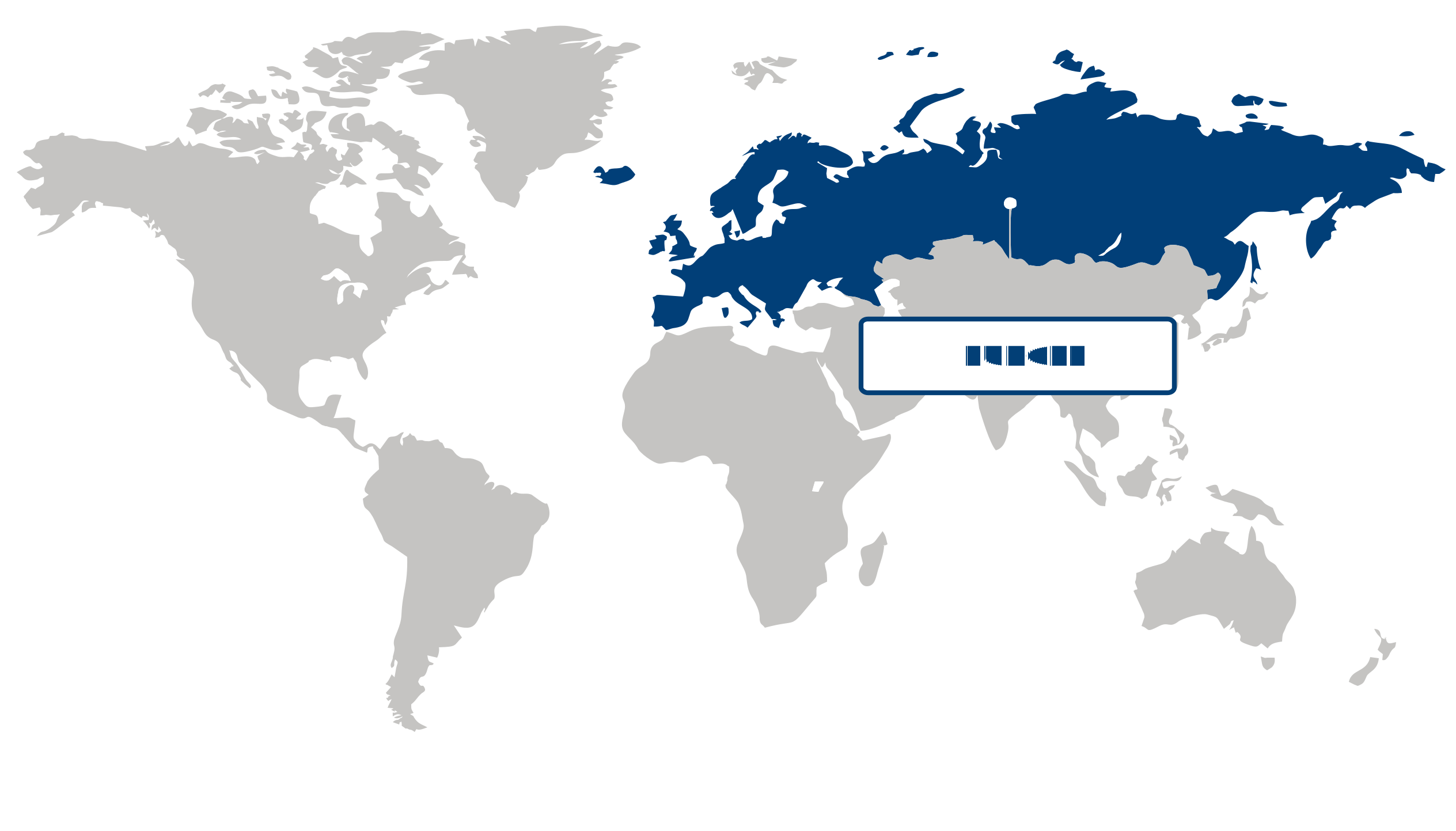
Europe (Largest Region)
The safety eyewear market was led by Europe, which maintained the largest share in 2026. Strong occupational safety standards, established industrial and construction sectors, and heightened awareness of workplace eye protection underpin the region's market position. Regulatory emphasis on worker protection encourages employers to adopt compliant protective equipment across manufacturing, construction, healthcare, laboratory, and other high-risk environments. In parallel, demand for comfortable, durable, and technologically advanced eyewear is encouraging product upgrades, while mature procurement and distribution systems support consistent access to protective solutions.
Asia Pacific (Fastest-Growing Region)
Asia Pacific is experiencing the fastest regional growth, supported by expanding manufacturing, construction, infrastructure development, and industrial activity. As workplaces become more focused on employee safety and regulatory compliance, the adoption of protective eyewear is gaining importance across industries exposed to dust, chemicals, particles, and other occupational hazards. Increasing awareness of workplace health and safety, together with improving industrial standards and expanding organized distribution networks, is creating favorable conditions for broader adoption. Rising investments in industrial facilities and infrastructure are further strengthening the demand environment for safety eyewear.
| Parameter | North America | Asia Pacific | Europe | Latin America | MEA |
|---|---|---|---|---|---|
| Innovation Hub i Scale Nascent Developing Advanced | |||||
| Cost-Sensitive Region i Scale Low Medium High | |||||
| Regulatory Environment i Scale Restrictive Neutral Supportive | |||||
| Demand Drivers i Scale Weak Moderate Strong | |||||
| Development Stage i Scale Emerging Developing Developed | |||||
| Adoption Rate i Scale Low Medium High | |||||
| New Entrants / Startups i Scale Sparse Moderate Dense | |||||
| Macro Indicators i Scale Weak Stable Strong |
Key Country Insights
Germany 🇩🇪
Industrial Compliance FocusGermany emphasizes high-performance safety eyewear designed for industrial precision, workplace protection, and optical clarity. German manufacturers continue integrating advanced materials and ergonomic features that improve worker acceptance across demanding production environments.
France 🇫🇷
Occupational Safety SolutionsFrance continues strengthening workplace safety practices through wider adoption of protective eyewear across industrial and healthcare sectors. The French market favors products that combine certified protection with user comfort and modern aesthetic design.
Italy 🇮🇹
Manufacturing Workforce SupportItaly maintains consistent demand for safety eyewear across manufacturing, construction, and engineering industries where reliable eye protection remains essential. Italian buyers increasingly seek durable products that improve comfort without compromising workplace safety requirements.
Japan 🇯🇵
Precision Protective DesignJapan prioritizes lightweight safety eyewear offering superior visibility and comfort for electronics, manufacturing, and laboratory applications. Japanese buyers increasingly value compact designs that support prolonged use while maintaining reliable protective performance.
South Korea 🇰🇷
Smart Manufacturing SafetySouth Korea supports demand for safety eyewear aligned with advanced manufacturing and technology-intensive workplaces. Companies in South Korea increasingly adopt protective eyewear featuring enhanced comfort, anti-fog coatings, and compatibility with modern industrial operations.
United States 🇺🇸
Workplace Protection StandardsThe U.S. safety eyewear market is shaped by industrial safety requirements and increasing adoption across manufacturing, healthcare, and construction environments. Organizations in the U.S. continue to prioritize comfortable protective eyewear that combines compliance with extended daily wear.
Segment Leadership and Growth Trends
Safety Eyewear Market Share (%), by Product, 2026
Go beyond the chart, access full insights & data tables
Request Free Sample ReportProduct Segment Analysis: Non-Prescription (Largest Segment) vs Prescription (Fastest-Growing Segment)
In the safety eyewear market, the non-prescription segment accounted for the largest share of 65.06% in 2026, driven by its broad applicability across industrial, construction, manufacturing, laboratory, and other work environments where eye protection is required. Non-prescription safety eyewear offers a practical solution for protecting workers against dust, debris, chemical splashes, and other occupational hazards without requiring customized corrective lenses. Its widespread availability, ease of replacement, and suitability for general workplace use continue to support the segment's leading position in 2026.
The prescription segment is the fastest-growing product segment, supported by increasing recognition of the need to combine vision correction with effective workplace eye protection. Workers requiring corrective lenses are increasingly seeking safety eyewear designed to provide both clear vision and compliance with occupational protection requirements. Growing attention to employee safety, comfort, and productivity is encouraging the adoption of customized protective eyewear, while advances in lens technology and product design are further supporting segment growth.
Distribution Channel Segment Analysis: Business to Business (B2B) (Largest Segment) vs Direct to Consumers (D2C) (Fastest-Growing Segment)
The business-to-business (B2B) segment dominated the safety eyewear market with a 74.8% share in 2026, reflecting the large-scale procurement requirements of employers operating in safety-sensitive industries. Organizations commonly purchase protective eyewear in bulk to equip employees, meet workplace safety standards, and maintain consistent access to essential personal protective equipment. Long-term supply relationships, centralized procurement practices, and the need for products meeting specific workplace requirements continue to reinforce the segment's dominant position in 2026.
The direct-to-consumers (D2C) segment is the fastest-growing distribution channel, driven by increasing consumer access to specialized safety eyewear through digital and brand-operated sales channels. D2C models provide buyers with greater convenience, broader product visibility, and easier access to customized or premium protective eyewear. Rising awareness of personal safety among individual users and the growing adoption of online purchasing are supporting the expansion of direct-to-consumer channels, particularly as product manufacturers seek closer engagement with end users.
| Segment | Sub-Segment | Largest Segment | Fastest Growing |
|---|---|---|---|
| Product | Prescription, Non-Prescription | Non-Prescription | Prescription |
| Distribution Channel | Business to Business (B2B), Direct to Consumers (D2C), Others | Business to Business (B2B) | Direct to Consumers (D2C) |
| Application | Oil & Gas, Construction, Industrial Manufacturing, Military, Public Sectors, Others | Industrial Manufacturing | Construction |
Competitive Landscape and Market Positioning
Top players in the safety eyewear market:
1. 3M Company (United States)
2. Honeywell International Inc. (United States)
3. Kimberly-Clark Corporation (United States)
4. UVEX Winter Holding GmbH & Co. KG (Germany)
5. Bollé Safety (France)
6. Pyramex Safety Products LLC (United States)
7. MCR Safety (United States)
8. Radians Inc. (United States)
9. Gateway Safety Inc. (United States)
10. HexArmor LLC (United States)
Innovation in workplace protection and user comfort is driving competition in the safety eyewear market. Manufacturers are introducing anti-fog coatings, impact-resistant lenses, and ergonomic frame designs that improve visibility and long-duration wearability. Smart protective eyewear integrated with augmented display capabilities and enhanced customization features is also emerging as a key differentiation trend.
| Company | Market Share | Company Revenue | Revenue CAGR (%) | Product Portfolio | Geographic Presence | Innovation / R&D Focus | Strategic Developments |
|---|---|---|---|---|---|---|---|
| 3M Company (United States) | |||||||
| Honeywell International Inc. (United States) | |||||||
| Kimberly-Clark Corporation (United States) | |||||||
| UVEX Winter Holding GmbH & Co. KG (Germany) | |||||||
| Bollé Safety (France) | |||||||
| Pyramex Safety Products LLC (United States) | |||||||
| MCR Safety (United States) | |||||||
| Radians Inc. (United States) | |||||||
| Gateway Safety Inc. (United States) | |||||||
| HexArmor LLC (United States). |
Industry Development/News
| Company Name | Date | Key Development |
|---|---|---|
| Zeiss | Nov-25 | Zeiss entered a strategic collaboration with Ugly Fish to develop and expand safety-focused eyewear product lines. By combining Ugly Fish’s market-specific presence with Zeiss’s established optical technology capabilities, the partnership aims to enhance competitive positioning within the protective eyewear segment through the delivery of high-performance safety solutions. |
| Innovative Eyewear, Inc. | Apr-24 | Innovative Eyewear, Inc. filed two U.S. patent applications for its Lucyd Armor smart safety glasses, covering both functional utility and ornamental design. This development signals the company's intent to formalize intellectual property protections ahead of the product's market entry, bridging the gap between connected wearable technology and industrial-grade safety protection requirements. |
| Popticals | Apr-24 | Popticals launched the POPZULU Ops Edition, a line of ballistic and safety eyewear designed for tactical and industrial applications. The product utilizes proprietary micro-rail technology and impact-resistant lenses from Carl Zeiss Vision, representing a strategic focus on integrating high-durability materials and collapsible frame engineering to address specific functional requirements within demanding industrial and defense-related environments. |
| Protective Industrial Products | Mar-24 | Protective Industrial Products (PIP) acquired Australia-based Scope Optics Pty Ltd. to expand its global portfolio of protective eye gear. This acquisition integrates Scope Optics’ advanced lens technologies and premium eyewear designs into PIP's existing PPE offerings, furthering the company’s strategic objective of strengthening its comprehensive head-to-toe safety equipment solutions through targeted consolidation. |
Customize Your Report
Explore examples of how this report can be tailored to different research needs, including custom segments, additional topics or chapters, and related reports. Click a section of the wheel or its numbered marker to explore the available options.
Safety Eyewear Market — Custom Segments
| Segment | Sub-Segment |
|---|---|
| Price Tier | Economy, Mid-Range, Premium |
| Protection Level | Basic Impact Protection, High-Impact Protection, Specialized Protection |
| Eyewear Design | Spectacle-Style, Goggle-Style, Over-the-Glass, Wraparound |
Safety Eyewear Market — Custom TOC
| Custom Chapter | Custom Details |
|---|---|
| Workplace PPE Compliance and Procurement Trends |
|
| Industry-Specific End-User Adoption Assessment |
|
| Smart Safety Eyewear Adoption Outlook |
|
Need a different cut of the data?
Request Custom ResearchWhat is the market size of safety eyewear?
How is the safety eyewear industry expected to grow over the next 10 years?
How are regulatory-driven procurement practices influencing long-term demand patterns in the safety eyewear market?
Why are product performance improvements becoming critical to compliance and usage consistency in the safety eyewear market?
Why are non-prescription products the largest segment in the safety eyewear market?
What is driving the rapid growth of the direct-to-consumer channel in the safety eyewear market?
Why does Europe lead the safety eyewear market?
What is fueling growth in Asia Pacific safety eyewear adoption?
Which organizations are considered leaders in the safety eyewear landscape?
Our Clients
"The report provided us with a clear direction, and the level of detail was beyond what we expected. I would definitely recommend their services to others."
Haier Appliances
"The collaboration with Fundamental Business Insights has added significant value to our decision-making process, and we look forward to continuing this partnership for our future market research requirements."
Luxottica Group S.p.A.
"The team at FBI delivered an exceptional research report. The insights on industry innovations were particularly impressive and added a lot of value to the overall report."
Nike
Our Research Team & Methodology
Every Fundamental Business Insights report is built by a dedicated vertical research team, validated through a structured primary-and-secondary methodology, and reviewed for accuracy before it reaches you.
Research Team Overview
Prepared by the Consumer Goods & Services Research Team
Delivery
Published
Demand
Available
Support
Trust & Compliance
Research Domains
10 coverage areasResearch Intelligence
| Source | Reference |
|---|---|
| International Organization for Standardization (ISO) | www.iso.org |
| ASTM International | www.astm.org |
| U.S. Consumer Product Safety Commission (CPSC) | www.cpsc.gov |
| European Commission – Consumer Safety | ec.europa.eu/safety-gate |
| Consumer Technology Association (CTA) | www.cta.tech |
| National Retail Federation (NRF) | nrf.com |
| World Retail Congress | www.worldretailcongress.com |
| World Travel & Tourism Council (WTTC) | wttc.org |
| UN Tourism | www.unwto.org |
| Personal Care Products Council (PCPC) | www.personalcarecouncil.org |
| Cosmetics Europe | cosmeticseurope.eu |
| International Housewares Association (IHA) | www.housewares.org |
| American Apparel & Footwear Association (AAFA) | www.aafaglobal.org |
| World Federation of the Sporting Goods Industry (WFSGI) | wfsgi.org |
| Juvenile Products Manufacturers Association (JPMA) | www.jpma.org |
| Pet Industry Joint Advisory Council (PIJAC) | pijac.org |
| International Council of Toy Industries (ICTI) | www.toy-icti.org |
| International Association of Amusement Parks and Attractions (IAAPA) | iaapa.org |
| Organisation for Economic Co-operation and Development (OECD) | www.oecd.org |
| World Bank Data | data.worldbank.org |
Research Workflow & Quality Assurance
Data Collection
Verified information gathered through primary and secondary research.
Data Triangulation
Cross-validation using multiple independent data sources.
Forecast Modelling
Market estimates developed using historical trends and analytical models.
Analyst Validation
Findings reviewed by domain experts for accuracy and consistency.
Editorial & Quality Review
Final editorial, quality, and compliance checks before publication.
Final Publication
Released after successful completion of the internal review process.
Report Coverage
📊 Market Assessment
- Market Size & Forecast
- Market Segmentation
- Regional Analysis
- Growth Drivers & Challenges
- Market Dynamics
🏢 Competitive Intelligence
- Competitive Landscape
- Company Profiles
- Competitive Benchmarking
- Mergers & Acquisitions
- Market Share Analysis or Key Company Strategies
🔍 Strategic Analysis
- Value Chain Analysis
- Porter's Five Forces
- PESTLE Analysis
- Pricing Trends
- Supply-Demand Analysis
🚀 Future Outlook
- Technology Landscape
- Regulatory Landscape
- Investment & Funding Landscape
- Emerging Opportunities
- Future Market Outlook
Have a question about this report or need a custom scope?
Request Customization