



Trade Credit Insurance Market Size & Growth Forecast 2026–2035, By Segments (Enterprise Size, Coverage, Application, End-use), Regional Demand Trends (North America, Asia Pacific, Europe), Key Country Insights (U.S., Japan, South Korea, Germany, France, Italy), and Competitive Landscape
Market Size and Growth Outlook
Base Year Value (2025)
USD 12.68 Billion
CAGR (2026-2035)
11.1%
Forecast Year Value (2035)
USD 36.33 Billion

Historical Data Period
2022-2025

Largest Region
Europe

Forecast Period
2026-2035
Trade Credit Insurance Market Intelligence Snapshot:
-
Regional Market Dynamics:
- Europe held a 33.60% market share in 2025, supported by mature credit management practices, widespread receivables protection, and strong demand from exporters, manufacturers, wholesalers, and financial institutions.
- Asia Pacific is expected to grow at a 12.43% CAGR, driven by expanding trade volumes, greater SME participation in supply chains, and increasing demand for receivables risk protection and working capital support.
-
Segment Momentum:
- Large Enterprises account for 63% share due to high receivables exposure, extensive customer portfolios, and structured integration of credit insurance into enterprise risk and payment management systems.
- Single Buyer Coverage is growing fastest as firms seek targeted protection for key counterparties, offering focused risk transfer for high-value exposures without insuring the entire receivables portfolio.
-
Market Expansion Drivers:
- Expanding global trade flows increasing demand for protection against cross-border payment defaults.
- AI-driven insurtech platforms and analytics improving underwriting accuracy and credit risk assessment.
- Rising geopolitical fragmentation increasing corporate exposure to international trade credit risks.
-
Leading Market Participants:
Leading companies in the trade credit insurance market include Allianz Trade (France), Atradius N.V. (Netherlands), Coface SA (France), American International Group, Inc. (United States), Zurich Insurance Group AG (Switzerland), Chubb Limited (Switzerland), QBE Insurance Group Limited (Australia), Great American Insurance Company (United States), Aon plc (Ireland), Credendo Group (Belgium).
Global Market Forecast Snapshot:
-
Market Outlook:
- 2025 Market Size: USD 12.68 Billion
- Projected Market Size: USD 36.33 Billion by 2035
- Growth Forecasts: 11.1% CAGR (2026-2035)
-
Regional and Segment Outlook:
- Leading Regional Market: Europe
- High-Growth Regional Hub: Asia Pacific
- Core Revenue Segment: Large Enterprises (Enterprise Size) | Whole Turnover Coverage (Coverage) | Domestic (Application) | Food & Beverage (End-use)
- Emerging Opportunity Segment: Small & Medium Enterprises (Enterprise Size) | Single Buyer Coverage (Coverage) | Domestic (Application) | Automotive (End-use)
Market Growth Drivers and Industry Trends
Expanding global trade flows increasing demand for protection against cross-border payment defaultsAs exporters and suppliers extend more open-account terms to win and retain overseas buyers, unpaid invoices become a larger balance-sheet risk rather than a routine commercial issue. This is driving demand for the trade credit insurance market because cross-border transactions expose firms to longer payment cycles, weaker visibility into buyer solvency, and more complex legal recovery processes when defaults occur. In practice, companies use trade credit insurance to protect receivables while continuing to offer competitive payment terms, which supports trade volume, eases lender confidence in insured receivables, and reinforces market demand among businesses scaling international sales.
AI-driven insurtech platforms and analytics improving underwriting accuracy and credit risk assessment
AI-led underwriting tools are reshaping how insurers evaluate buyer quality, sector stress, and claims probability, making the trade credit insurance market more responsive to changing credit conditions. By drawing on real-time payment behavior, financial data, and portfolio-level exposure patterns, these platforms help insurers refine coverage decisions and pricing with greater precision than traditional manual assessment models. That improvement influences market adoption in practical ways: policyholders receive faster quote turnaround and more tailored credit limits, while insurers can write business more selectively, manage loss ratios more effectively, and serve mid-sized enterprises that were previously harder to assess efficiently.
Rising geopolitical fragmentation increasing corporate exposure to international trade credit risks
Trade relationships are becoming more vulnerable to sanctions, export controls, tariff disputes, currency restrictions, and sudden policy interventions, all of which can disrupt a buyer’s ability or willingness to pay. This is driving market development for the trade credit insurance market because corporate finance teams are treating receivables risk as part of broader country and counterparty exposure management rather than as an isolated credit function. In practice, insurers are seeing greater interest from firms reassessing customer concentration, supplier-country exposure, and payment reliability in politically sensitive corridors, with coverage used to preserve sales continuity while limiting the financial shock of non-payment tied to geopolitical disruption.
| Growth Driver Assessment Framework | |||||
| Growth Driver | Impact On CAGR | Regulatory Influence | Geographic Relevance | Adoption Rate | Impact Timeline |
|---|---|---|---|---|---|
| Expanding global trade flows increasing demand for protection against cross-border payment defaults | 2.00% | Moderate | Europe, Asia Pacific, North America | High | Near Term |
| AI-driven insurtech platforms and analytics improving underwriting accuracy and credit risk assessment | 1.60% | High | Europe, North America | High | Mid Term |
| Rising geopolitical fragmentation increasing corporate exposure to international trade credit risks | 1.40% | Moderate | Europe, Asia Pacific | Medium | Mid Term |
Unlock insights tailored to your business with our bespoke market research solutions - Click to get your customized report now!
Regional Demand Dynamics
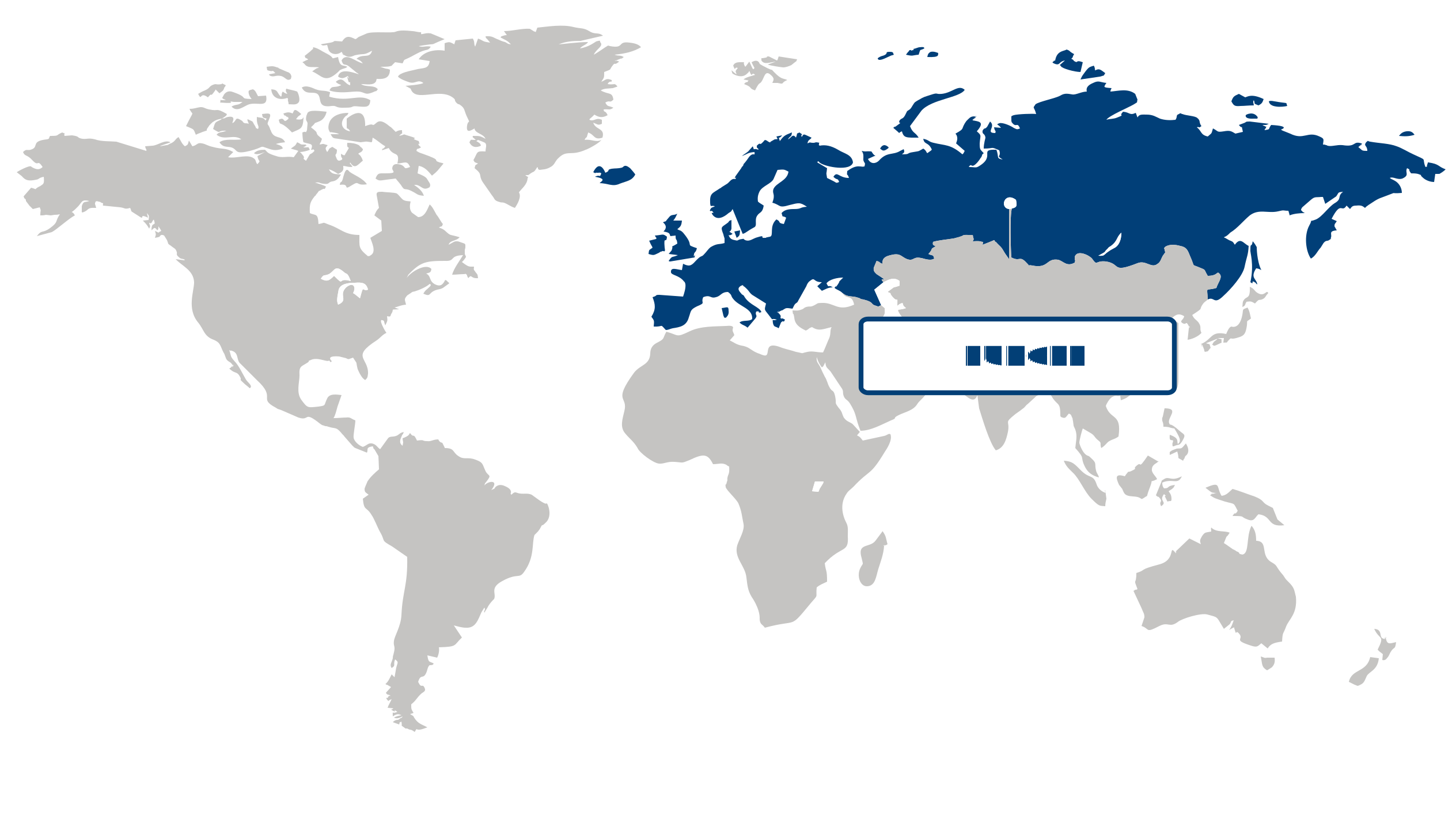
Largest Region
Europe
33.60% Market Share in 2025
Europe held the leading regional position in 2025, accounting for a 33.60% share of the trade credit insurance market. This leadership is underpinned by the region’s mature credit management practices, broad use of receivables protection across domestic and cross-border trade, and the strong presence of established insurers serving a large base of exporters, manufacturers, wholesalers, and financial institutions. In practice, companies across Europe rely on trade credit insurance to manage buyer default risk, support open-account trading, and secure financing against insured receivables, which keeps policy demand closely tied to day-to-day commercial activity.
Asia Pacific is projected to expand at a 12.43% CAGR over the forecast period in the trade credit insurance market, backed by the region’s fast-rising trade volumes, expanding SME participation in regional and international supply chains, and increasing awareness of receivables risk as businesses extend credit to new buyers. Growth is being propelled by the practical need to protect cash flow in markets with diverse credit environments, while insurers gain traction by offering coverage that helps firms trade more confidently and improve access to working capital as cross-border commercial activity becomes more complex.
Key Country Insights
The U.S. trade credit insurance market supports businesses managing payment risk across domestic and international trade. Companies in the U.S. increasingly seek flexible coverage solutions that strengthen receivables protection while enabling confident customer expansion and working capital management.
Japan emphasizes trade credit insurance as a tool for maintaining stable commercial relationships and reducing receivable risks. Japanese companies continue aligning insurance solutions with complex supply chains and long-term business partnerships across international markets.
South Korea supports trade credit insurance adoption as exporters diversify markets and customer portfolios. Businesses in South Korea increasingly use insurance solutions to strengthen financial stability while managing payment exposure across global trading partners.
Germany relies on trade credit insurance to strengthen commercial resilience across manufacturing and export-oriented industries. Businesses in Germany increasingly integrate credit risk assessment and insurance coverage into broader strategies for managing customer payment uncertainty.
France continues integrating trade credit insurance into corporate risk management strategies for industrial and commercial sectors. Companies in France increasingly prioritize policy flexibility and credit intelligence that support informed customer decisions and resilient cash flow management.
Italy places strong emphasis on trade credit insurance for small and medium-sized enterprises managing customer payment risks. Italian businesses increasingly adopt tailored insurance solutions that improve receivables security while supporting sustainable commercial relationships across domestic and export markets.
Segment Leadership and Growth Trends
Large Enterprises held a 63% share of the trade credit insurance market in 2025, reflecting their broader receivables exposure, larger customer portfolios, and greater need for structured protection against non-payment risk across domestic and cross-border transactions. Their leadership is underpinned by the routine integration of trade credit insurance into enterprise credit management practices, especially where high invoice volumes and extended payment terms make risk transfer operationally valuable rather than optional.
Small & Medium Enterprises are emerging as the fastest-growing segment in the trade credit insurance market as these businesses face increasing pressure to protect cash flow while expanding customer relationships on credit terms. Growth is gaining pace because trade credit insurance gives SMEs a practical way to support sales expansion and manage buyer default risk without carrying the same internal credit assessment capacity as larger firms, making the product more compelling relative to operating uninsured.
Coverage Segment Analysis: Whole Turnover Coverage (Largest Segment) vs Single Buyer Coverage (Fastest-Growing Segment)
Within the trade credit insurance market, Whole Turnover Coverage accounted for the largest share in 2025 because it aligns well with businesses that need portfolio-wide protection across a broad base of receivables. Its strongest position is aided by the operational convenience of covering ongoing trade activity under one structure, which helps companies manage credit risk consistently rather than selecting exposure case by case.
Single Buyer Coverage is the fastest-growing coverage segment in the trade credit insurance market as companies look for targeted protection tied to specific high-value trading relationships. Its momentum is being encouraged by the practical need to insure concentrated buyer exposure without extending coverage across the full receivables book, making it an increasingly relevant option where risk is more focused and insurance needs are tied to individual counterparties.
| Report Segmentation | |||
| Segment | Sub-Segment | Largest Segment | Fastest Growing Segment |
|---|---|---|---|
| Enterprise Size | Large Enterprises, Small & Medium Enterprises | Large Enterprises | Small & Medium Enterprises |
| Coverage | Whole Turnover Coverage, Single Buyer Coverage | Whole Turnover Coverage | Single Buyer Coverage |
| Application | Domestic, International | Domestic | Domestic |
| End-use | Food & Beverage, IT & Telecom, Healthcare, Energy, Automotive, Others | Food & Beverage | Automotive |
 Read our Research Approach
Competitive Landscape and Market Positioning
Major players in the trade credit insurance market:1. Allianz Trade (France)
2. Atradius N.V. (Netherlands)
3. Coface SA (France)
4. American International Group Inc. (United States)
5. Zurich Insurance Group AG (Switzerland)
6. Chubb Limited (Switzerland)
7. QBE Insurance Group Limited (Australia)
8. Great American Insurance Company (United States)
9. Aon plc (Ireland)
10. Credendo Group (Belgium)
The trade credit insurance market is evolving through enhanced risk assessment models that improve financial protection for businesses engaged in credit-based trade. Continuous digital transformation is streamlining underwriting and claims processing workflows. Expanding service models are also improving flexibility and responsiveness to evolving credit risks.
Industry Development/News
| Company Name | Date | Key Development |
|---|---|---|
| Goldman Sachs Alternatives | Oct-24 | Goldman Sachs Alternatives acquired FGI Worldwide, a provider of working capital finance and trade credit insurance. This acquisition integrates FGI’s multi-country receivables finance and credit insurance capabilities into the Goldman Sachs alternatives platform, facilitating the expansion of its risk management, financing, and insurtech-enabled credit solutions across international markets. |
| Intact | Oct-24 | Intact increased its ownership in Cartan Trade to 80%, establishing it as the dedicated underwriting platform for its European trade credit insurance business. By acquiring these shares from Scor, Intact consolidates its control, aiming to strengthen its underwriting capacity and broaden its trade credit insurance operations across the European commercial market. |
| Atradius | Oct-24 | Atradius established a presence in the Dubai International Financial Centre (DIFC) to expand its footprint in the Middle East. The move is designed to enhance access to regional clients, providing localized support for underwriting and credit risk solutions to meet the growing demand for structured trade protection in high-growth emerging markets. |
| Maalexi | Aug-24 | Maalexi secured a US$3 million debt facility from Citi to expand its agricultural trade risk management platform. The funding supports the company's efforts to finance additional cargo purchases and enhances its AI-driven capabilities for credit and performance risk assessment, specifically targeting cross-border agricultural trade for small and medium-sized enterprises. |
| The Clear Group | Jul-24 | The Clear Group acquired a trade credit insurance business, adding approximately £6.6 million in gross written premium to its portfolio. This strategic acquisition strengthens the firm's competitive position in the UK specialty insurance market and expands its operational footprint in credit risk coverage services for commercial clients. |
| M1xchange | Aug-25 | M1xchange partnered with Tata AIG to integrate trade credit insurance directly onto its TReDS platform, marking a first for the Indian market. This integration improves risk protection for financiers and enhances liquidity, facilitating greater access to secure working capital for MSMEs within the broader digital trade credit ecosystem. |
| TradeCreditTech | May-23 | TradeCreditTech partnered with TreasurUp to digitize trade credit insurance and credit risk management for SMEs. Through this collaboration, banks can integrate TreasurUp’s trade credit platform directly into their online commercial banking portals, providing automated access to credit protection tools and enhancing the digital delivery of risk management services. |
| Coface | Jan-23 | Coface acquired Rel8ed, a North American data analytics boutique. This acquisition integrates Rel8ed’s advanced analytics capabilities and proprietary data sets into Coface’s existing offerings, enhancing its trade credit insurance operations through improved data-driven credit risk assessment and market intelligence capabilities. |
Why Choose Us
Specialized Expertise: Our team comprises industry experts with a deep understanding of your market segment. We bring specialized knowledge and experience that ensures our research and consulting services are tailored to your unique needs.
Customized Solutions: We understand that every client is different. That's why we offer customized research and consulting solutions designed specifically to address your challenges and capitalize on opportunities within your industry.
Proven Results: With a track record of successful projects and satisfied clients, we have demonstrated our ability to deliver tangible results. Our case studies and testimonials speak to our effectiveness in helping clients achieve their goals.
Cutting-Edge Methodologies: We leverage the latest methodologies and technologies to gather insights and drive informed decision-making. Our innovative approach ensures that you stay ahead of the curve and gain a competitive edge in your market.
Client-Centric Approach: Your satisfaction is our top priority. We prioritize open communication, responsiveness, and transparency to ensure that we not only meet but exceed your expectations at every stage of the engagement.
Continuous Innovation: We are committed to continuous improvement and staying at the forefront of our industry. Through ongoing learning, professional development, and investment in new technologies, we ensure that our services are always evolving to meet your evolving needs.
Value for Money: Our competitive pricing and flexible engagement models ensure that you get maximum value for your investment. We are committed to delivering high-quality results that help you achieve a strong return on your investment.
Select Licence Type

