Welded Plate & Block Heat Exchangers Market Size & Growth Forecast 2027–2036, By Segments (End-use), Regional Demand Trends (North America, Asia Pacific, Europe), Key Country Insights (U.S., Japan, South Korea, Germany, France, Italy), and Competitive Landscape
Jump to content
Market Size and Growth Outlook
Welded Plate & Block Heat Exchangers Market size was over USD 706.1 million in 2026 and is likely to grow at a 6.75% CAGR between 2027 and 2036, crossing USD 1.36 billion by 2036. The industry revenue for 2027 is estimated at USD 746.21 million.
Get more details on this report
Request Free Sample ReportWelded Plate & Block Heat Exchangers Market Intelligence Snapshot
Regional Market Dynamics
- Europe leads due to established industrial base, strong replacement demand, and widespread use of compact corrosion-resistant heat exchangers supporting efficiency and reliability in process industries.
- Asia Pacific is growing at 8.14% CAGR driven by industrial capacity additions, greenfield projects, and adoption of advanced heat exchanger designs improving energy efficiency and process flexibility.
Segment Momentum
- HVAC & Refrigerators lead with 30.24% share due to consistent demand for compact, efficient heat transfer systems in commercial cooling, refrigeration, and building temperature-control infrastructure.
- Chemical segment is fastest-growing as processing industries require durable heat exchangers for continuous operations, prioritizing thermal efficiency, reliability, and equipment performance under demanding operating conditions.
Market Expansion Drivers
- Rising industrial demand for energy-efficient heat transfer systems reducing operational costs.
- Advancements in welded gasketless designs improving reliability and reducing maintenance requirements.
- Tightening emissions regulations driving replacement of inefficient thermal management equipment globally.
Leading Market Participants
- Top companies in the welded plate & block heat exchangers market include Alfa Laval AB (Sweden), Kelvion Holding GmbH (Germany), Tranter Inc. (United States), API Heat Transfer Inc. (United States), HFM Heat Exchangers (Germany), SHINEHEAT Corp. (South Korea), Nexson Group (France), SWEP International AB (Sweden), GEA Group AG (Germany), Hisaka Works, Ltd. (Japan).
Global Market Forecast Snapshot
Market Outlook
- 2026 Market Size: USD 706.1 million
- 2027 Estimated Market Size: USD 746.21 million.
- Projected Market Size: USD 1.36 billion by 2036
- Growth Forecast: 6.75% CAGR (2027-2036)
Regional and Segment Outlook
- Leading Regional Market: Europe
- High-Growth Regional Hub: Asia Pacific
- Core Revenue Segment: HVAC & Refrigerators (End-use)
- Emerging Opportunity Segment: Chemical (End-use)
Market Growth Drivers and Industry Trends
Rising industrial demand for energy-efficient heat transfer systems reducing operational costs
The pursuit of lower operating expenses and improved energy utilization is supporting the welded plate & block heat exchangers market as industrial facilities seek more efficient thermal management solutions. Welded heat exchangers provide effective heat transfer within compact configurations, making them suitable for applications where efficient energy recovery and process heating or cooling are important. Their ability to support close temperature approaches and efficient thermal exchange can help industrial operators optimize process performance while reducing energy losses. Demand is particularly relevant across energy-intensive processing environments where thermal efficiency directly influences operating requirements and the effectiveness of production systems.
Advancements in welded gasketless designs improving reliability and reducing maintenance requirements
Technological improvements in welded and gasketless heat exchanger configurations are creating favorable conditions for the welded plate & block heat exchangers market by addressing reliability and maintenance challenges associated with conventional designs. Eliminating conventional gasketed joints can reduce potential leakage points and improve suitability for demanding operating environments involving elevated temperatures, pressures, or aggressive process conditions. Advances in manufacturing and joining technologies are also enabling more robust equipment configurations that require fewer interventions during operation. These characteristics are attractive to industrial users seeking dependable heat transfer equipment with reduced maintenance complexity and longer operational continuity.
Tightening emissions regulations driving replacement of inefficient thermal management equipment globally
Stricter environmental requirements are encouraging industrial operators to reassess inefficient thermal systems, thereby increasing opportunities in the welded plate & block heat exchangers market. Heat transfer performance has a direct relationship with energy consumption and the associated emissions generated by industrial processes, making thermal efficiency an important consideration as facilities work to meet environmental requirements. Replacing outdated or inefficient heat exchange equipment with more effective systems can improve process energy utilization while supporting efforts to reduce the environmental burden of industrial operations. The need to modernize thermal management infrastructure is particularly relevant in facilities where existing equipment limits energy recovery or operates with comparatively high resource consumption.
| Growth Driver | Impact on CAGR | Regulatory Influence | Geographic Relevance | Adoption Rate | Impact Timeline |
|---|---|---|---|---|---|
| Rising industrial demand for energy-efficient heat transfer systems reducing operational costs | 2.20% | Moderate | North America, Europe, Asia Pacific | High | Near Term |
| Advancements in welded gasketless designs improving reliability and reducing maintenance requirements | 1.90% | Low | Europe, North America, Asia Pacific | High | Mid Term |
| Tightening emissions regulations driving replacement of inefficient thermal management equipment globally | 1.50% | High | Europe, North America | Medium | Long Term |
Unlock insights tailored to your business with our bespoke market research solutions.
Click to get your customized report now.
Regional Demand Dynamics
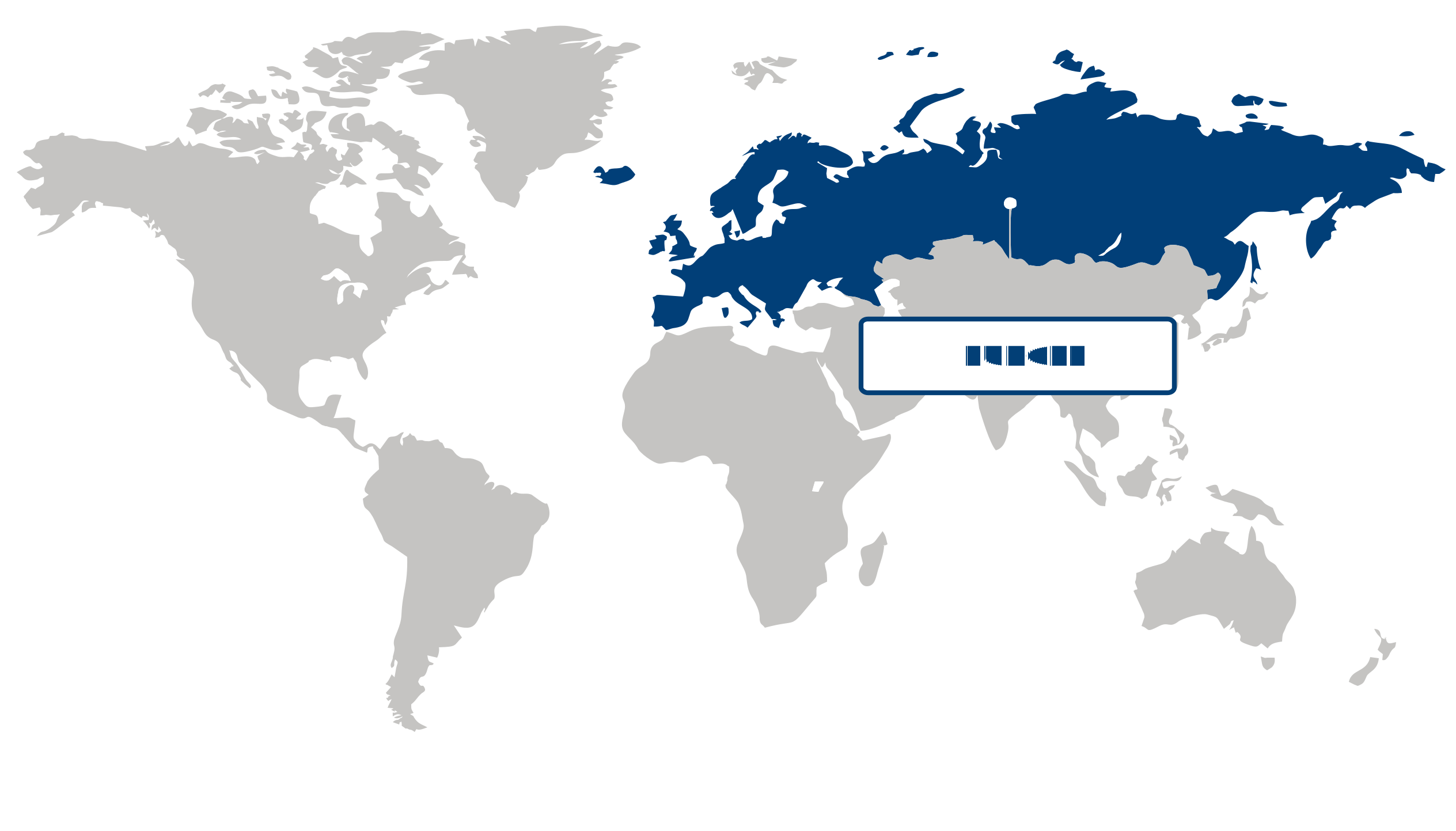
Europe (Largest Region)
Europe accounted for the largest share of the welded plate & block heat exchangers market in 2026, supported by its mature industrial base and strong focus on energy efficiency across process-intensive sectors. Demand is reinforced by applications in chemical processing, power generation, food processing, and other industries where efficient thermal management is essential. The region’s emphasis on reducing energy consumption and industrial emissions is encouraging the adoption of compact, high-efficiency heat exchange technologies. Ongoing industrial modernization and investments in efficient process equipment are further supporting regional market strength.
Asia Pacific (Fastest-Growing Region)
The Asia Pacific welded plate & block heat exchangers market is expanding rapidly as industrialization, manufacturing capacity, and energy infrastructure continue to develop. Growing demand from chemical, petrochemical, power, and process industries is increasing the need for reliable thermal management equipment. Investments in new production facilities and modernization of existing industrial systems are also creating opportunities for advanced heat exchanger technologies, while rising attention to energy conservation is encouraging more efficient process designs.
| Parameter | North America | Asia Pacific | Europe | Latin America | MEA |
|---|---|---|---|---|---|
| Innovation HubiScaleNascentDeveloping Advanced | |||||
| Cost-Sensitive RegioniScaleLowMedium High | |||||
| Regulatory EnvironmentiScaleRestrictiveNeutral Supportive | |||||
| Demand DriversiScaleWeakModerate Strong | |||||
| Development StageiScaleEmergingDeveloping Developed | |||||
| Adoption RateiScaleLowMedium High | |||||
| New Entrants/StartupsiScaleLowMedium High | |||||
| Macro IndicatorsiScaleWeakStable Strong |
Key Country Insights
Germany 🇩🇪
Precision Thermal EngineeringGermany emphasizes high-performance welded plate & block heat exchangers for industrial facilities requiring reliable heat transfer and operational efficiency. Manufacturers focus on engineering precision, long equipment life, and integration with advanced process automation systems.
France 🇫🇷
Energy Transition ApplicationsFrance incorporates welded plate & block heat exchangers into industrial projects that emphasize efficient heat management and lower energy consumption. Demand is supported by modernization initiatives across chemical production, district energy, and sustainable industrial infrastructure.
Italy 🇮🇹
Customized Industrial SolutionsItaly applies welded plate & block heat exchangers across diverse manufacturing industries requiring tailored thermal management solutions. Italian suppliers emphasize flexible equipment configurations, efficient maintenance, and compatibility with specialized industrial processing requirements.
Japan 🇯🇵
Space-Efficient Heat RecoveryJapan adopts welded plate & block heat exchangers for applications where compact equipment and energy recovery are critical. Domestic users prioritize durable designs that optimize thermal performance in space-constrained industrial and manufacturing environments.
South Korea 🇰🇷
Petrochemical Process IntegrationSouth Korea supports the welded plate & block heat exchangers market through investments in petrochemical, refining, and industrial processing facilities. Market participants focus on equipment capable of handling aggressive media while improving operational reliability and energy utilization.
United States 🇺🇸
Industrial Process EfficiencyThe U.S. welded plate & block heat exchangers market is driven by demand from chemical processing, energy, and industrial manufacturing. Companies prioritize compact, corrosion-resistant systems that improve thermal efficiency while supporting plant modernization and demanding process conditions.
Welded Plate & Block Heat Exchangers Market Share (%), by End-use, 2026
Go beyond the chart, access full insights & data tables
Request Free Sample ReportEnd-use Segment Analysis: HVAC & Refrigerators (Largest Segment) vs Chemical (Fastest-Growing Segment)
HVAC & refrigerators accounted for the largest share of the welded plate & block heat exchangers market in 2026, driven by the need for efficient thermal management across heating, cooling, refrigeration, and industrial climate-control applications. Welded plate and block configurations offer compact designs, effective heat transfer, and durability under demanding operating conditions, making them suitable for systems where space efficiency and reliable thermal performance are important. Increasing demand for energy-efficient cooling and heating equipment is further supporting adoption as end users seek technologies that can improve system efficiency while maintaining dependable operation.
The chemical segment is experiencing the fastest growth as chemical processing facilities increasingly require robust heat-exchange solutions capable of handling demanding temperatures, pressures, and process environments. Welded plate and block heat exchangers provide high thermal efficiency and compact configurations while supporting applications involving process heating, cooling, condensation, and heat recovery. The expansion of chemical processing activities and greater emphasis on energy optimization are encouraging manufacturers and plant operators to adopt efficient thermal management technologies. Growing efforts to improve process productivity and recover usable heat are further strengthening demand for these heat exchangers within chemical operations.
| Segment | Sub-Segment | Largest Segment | Fastest Growing |
|---|---|---|---|
| End-use | Chemical, Food & Beverages, HVAC & Refrigerators, Oil & Gas, Power Generation, Others | HVAC & Refrigerators | Chemical |
Competitive Landscape and Market Positioning
Leading companies in the welded plate & block heat exchangers market:
1. Alfa Laval AB (Sweden)
2. Kelvion Holding GmbH (Germany)
3. Tranter Inc. (United States)
4. API Heat Transfer Inc. (United States)
5. HFM Heat Exchangers (Germany)
6. SHINEHEAT Corp. (South Korea)
7. Nexson Group (France)
8. SWEP International AB (Sweden)
9. GEA Group AG (Germany)
10. Hisaka Works Ltd. (Japan)
In the welded plate & block heat exchangers market, manufacturers are emphasizing compact system designs, thermal efficiency improvements, and corrosion-resistant materials to address demanding industrial applications. Process industries are increasingly seeking energy-efficient heat transfer solutions that minimize maintenance requirements and operational costs. Continuous engineering advancements are contributing to stronger product differentiation within the sector.
| Company | Market Share | Company Revenue | Revenue CAGR (%) | Product Portfolio | Geographic Presence | Innovation / R&D Focus | Strategic Developments |
|---|---|---|---|---|---|---|---|
| Alfa Laval AB (Sweden) | |||||||
| Kelvion Holding GmbH (Germany) | |||||||
| Tranter Inc. (United States) | |||||||
| API Heat Transfer Inc. (United States) | |||||||
| HFM Heat Exchangers (Germany) | |||||||
| SHINEHEAT Corp. (South Korea) | |||||||
| Nexson Group (France) | |||||||
| SWEP International AB (Sweden) | |||||||
| GEA Group AG (Germany) | |||||||
| Hisaka Works Ltd. (Japan). |
Industry Development / News
| Company Name | Date | Key Development |
|---|---|---|
| Nexson | Apr-24 | Nexson completed the acquisition of Thermowave GmbH, a German manufacturer of plate heat exchangers, to diversify its product portfolio. By integrating Thermowave’s gasketed and semi-welded heat exchanger technologies, Nexson enhances its competitive position in sectors including refrigeration, chemical processing, and renewable energy, allowing the company to offer a more comprehensive range of thermal transfer solutions globally. |
| Alfa Laval | May-23 | Alfa Laval expanded its brazed plate heat exchanger production capacity across manufacturing sites in Italy, China, Sweden, and the U.S. This investment is strategically aligned with the global energy transition, aimed at meeting the accelerating demand for energy-efficient heating and cooling infrastructure, including residential and commercial heat pump systems, and supporting broader decarbonization initiatives. |
Customize Your Report
Explore examples of how this report can be tailored to different research needs, including custom segments, additional topics or chapters, and related reports. Click a section of the wheel or its numbered marker to explore the available options.
Welded Plate & Block Heat Exchangers Market — Custom Segments
| Segment | Sub-Segment |
|---|---|
| Construction Material | Stainless Steel, Carbon Steel, Nickel Alloys, Titanium, Other Alloys |
| Heat Transfer Medium | Liquid-to-Liquid, Gas-to-Liquid, Gas-to-Gas, Steam-to-Liquid, Two-Phase Applications |
| Flow Configuration | Counter-Flow, Cross-Flow, Parallel-Flow |
Welded Plate & Block Heat Exchangers Market — Custom TOC
| Custom Chapter | Chapter Details |
|---|---|
| Process Industry Replacement Opportunity Assessment |
|
| Industrial Decarbonization Demand Outlook |
|
| End-User Equipment Selection Criteria Analysis |
|
Need a different cut of the data?
Request Custom ResearchFrequently Asked Questions
How much revenue does the welded plate & block heat exchangers market generate?
How is the welded plate & block heat exchangers industry size expected to evolve during the forecast period?
How is the focus on energy efficiency influencing adoption of welded plate & block heat exchangers?
How are gasketless designs and tightening emissions regulations driving replacement demand in this market?
Why does the HVAC & Refrigerators segment dominate the welded plate & block heat exchangers market?
Why is the Chemical segment the fastest-growing end-use in the welded plate & block heat exchangers market?
Why does Europe hold the largest share in the heat exchangers market?
What is driving Asia Pacific’s growth in this heat exchangers market?
What are the prominent companies operating in the welded plate & block heat exchangers landscape?
Our Clients
"The team at Fundamental Business Insights & Consulting demonstrated a commitment to excellence, not only in the quality of the report but also in their client-centric approach."
FANUC
"The level of detail in the market segmentation provided were particularly noteworthy. The detailed country-level insights were also very helpful."
B&R Industrial Automation GmbH
"The consultant took the time to understand our specific business objectives, ensuring that the reports were tailored to address our unique challenges and opportunities."
KUKA SE & Co. KGaA
Our Research Team & Methodology
Every Fundamental Business Insights report is built by a dedicated vertical research team, validated through a structured primary-and-secondary methodology, and reviewed for accuracy before it reaches you.
Delivery
Published
Available
Support
- Market Size & Forecast
- Market Segmentation
- Regional Analysis
- Growth Drivers & Challenges
- Market Dynamics
- Competitive Landscape
- Company Profiles
- Competitive Benchmarking
- Mergers & Acquisitions
- Market Share Analysis or Key Company Strategies
- Value Chain Analysis
- Porter's Five Forces
- PESTLE Analysis
- Pricing Trends
- Supply-Demand Analysis
- Technology Landscape
- Regulatory Landscape
- Investment & Funding Landscape
- Emerging Opportunities
- Future Market Outlook