Whiskey Tourism Market Size & Growth Forecast 2027–2036, By Segments (Experience Type, Whiskey Type), Regional Demand Trends (North America, Asia Pacific, Europe), Key Country Insights (U.S., Japan, South Korea, Germany, France, Italy), and Competitive Landscape
Jump to Content
Market Size and Growth Outlook
Whiskey Tourism Market size was worth USD 24.3 billion in 2026 and is poised to grow at a 9.12% CAGR between 2027 and 2036, exceeding USD 58.16 billion by 2036. The industry revenue for 2027 is assessed at USD 26.17 billion.
Get more details on this report
Request Free Sample ReportWhiskey Tourism Market Intelligence Snapshot
Regional Market Dynamics
- Europe captured 43.46% of the market in 2026 through its established distilleries, mature tourism infrastructure, heritage attractions, and strong domestic and international visitor flows.
- North America is expected to grow at an 11.3% CAGR as distilleries expand experiential offerings and invest in tourism-ready facilities that encourage longer visits and higher visitor spending.
Segment Momentum
- Distillery Tours/Tasting Experiences held a 60.14% share in 2026 by combining production heritage, guided learning, and tasting into a consistently available visitor experience supported by established destination infrastructure.
- Craft Whiskey is growing fastest as travelers increasingly seek localized, distinctive tasting experiences, with smaller-batch production stories and regional character adding appeal to tourism activities.
Market Expansion Drivers
- Growing experiential tourism demand driving distillery tours and tasting experiences.
- Rising online interest and social media visibility boosting whiskey travel engagement.
- Expansion of premium craft whiskey trails enhancing regional tourism-driven economic ecosystems.
Leading Market Participants
- Key companies in the whiskey tourism market include Diageo plc (United Kingdom), Pernod Ricard SA (France), Brown-Forman Corporation (United States), Suntory Global Spirits Inc. (United States), William Grant & Sons Ltd (United Kingdom), Bacardi Limited (Bermuda), Edrington Group Limited (United Kingdom), Chivas Brothers Ltd (United Kingdom), Heaven Hill Brands (United States), LVMH Moët Hennessy Louis Vuitton SE (France).
Global Market Forecast Snapshot
Market Outlook
- 2026 Market Size: USD 24.3 billion
- 2027 Estimated Market Size: USD 26.17 billion.
- Projected Market Size: USD 58.16 billion by 2036
- Growth Forecast: 9.12% CAGR (2027-2036)
Regional and Segment Outlook
- Leading Regional Market: Europe
- High-Growth Regional Hub: North America
- Core Revenue Segment: Distillery Tours/Tasting Experiences (Experience Type) | Single Malt Whiskey (Whiskey Type)
- Emerging Opportunity Segment: Whiskey Festival (Experience Type) | Craft Whiskey (Whiskey Type)
Market Growth Drivers and Industry Trends
Growing experiential tourism demand driving distillery tours and tasting experiences
The growing preference for immersive travel experiences is driving the whiskey tourism market growth as travelers increasingly seek activities that provide cultural, educational, and sensory engagement rather than conventional sightseeing. Distillery visits allow tourists to explore production processes, learn about regional traditions, participate in guided tastings, and understand the heritage associated with whiskey-making. These experiences can be incorporated into broader travel itineraries and appeal to visitors interested in culinary and beverage-focused tourism. Distilleries are consequently developing more engaging visitor experiences that combine production tours with curated tastings, hospitality offerings, and educational activities.
Rising online interest and social media visibility boosting whiskey travel engagement
Greater digital engagement around whiskey culture will propel the whiskey tourism market as online platforms make distilleries, destinations, tasting experiences, and regional whiskey traditions more visible to potential travelers. Social media content featuring tours, tasting rooms, production facilities, and destination experiences can stimulate curiosity and encourage travelers to include distillery visits in their itineraries. Online communities also facilitate the exchange of recommendations and experiences, strengthening consumer awareness of whiskey-focused travel destinations. The availability of digital content and user-generated experiences is helping transform whiskey tourism from a niche activity into a more discoverable component of experiential and food-and-beverage travel.
Expansion of premium craft whiskey trails enhancing regional tourism-driven economic ecosystems
The development of premium craft whiskey trails is strengthening the whiskey tourism market by connecting multiple distilleries and related attractions into coordinated regional travel experiences. Such trails encourage visitors to explore different production locations while supporting complementary businesses including accommodation providers, restaurants, transportation services, retailers, and local cultural attractions. Craft whiskey destinations can also highlight regional production heritage and differentiate themselves through distinctive products, landscapes, and visitor experiences. As tourism authorities and local businesses seek to develop integrated destination offerings, whiskey trails provide a framework for extending visitor stays and distributing tourism activity across wider regional economies.
| Growth Driver | Impact on CAGR | Regulatory Influence | Geographic Relevance | Adoption Rate | Impact Timeline |
|---|---|---|---|---|---|
| Growing experiential tourism demand driving distillery tours and tasting experiences | 2.30% | Low | Europe, North America | High | Near Term |
| Rising online interest and social media visibility boosting whiskey travel engagement | 2.00% | Low | Europe, North America, Asia Pacific | High | Near Term |
| Expansion of premium craft whiskey trails enhancing regional tourism-driven economic ecosystems | 1.70% | Low | Europe, North America | High | Mid Term |
Explore Growth Opportunities
Request Free Sample ReportRegional Demand Dynamics
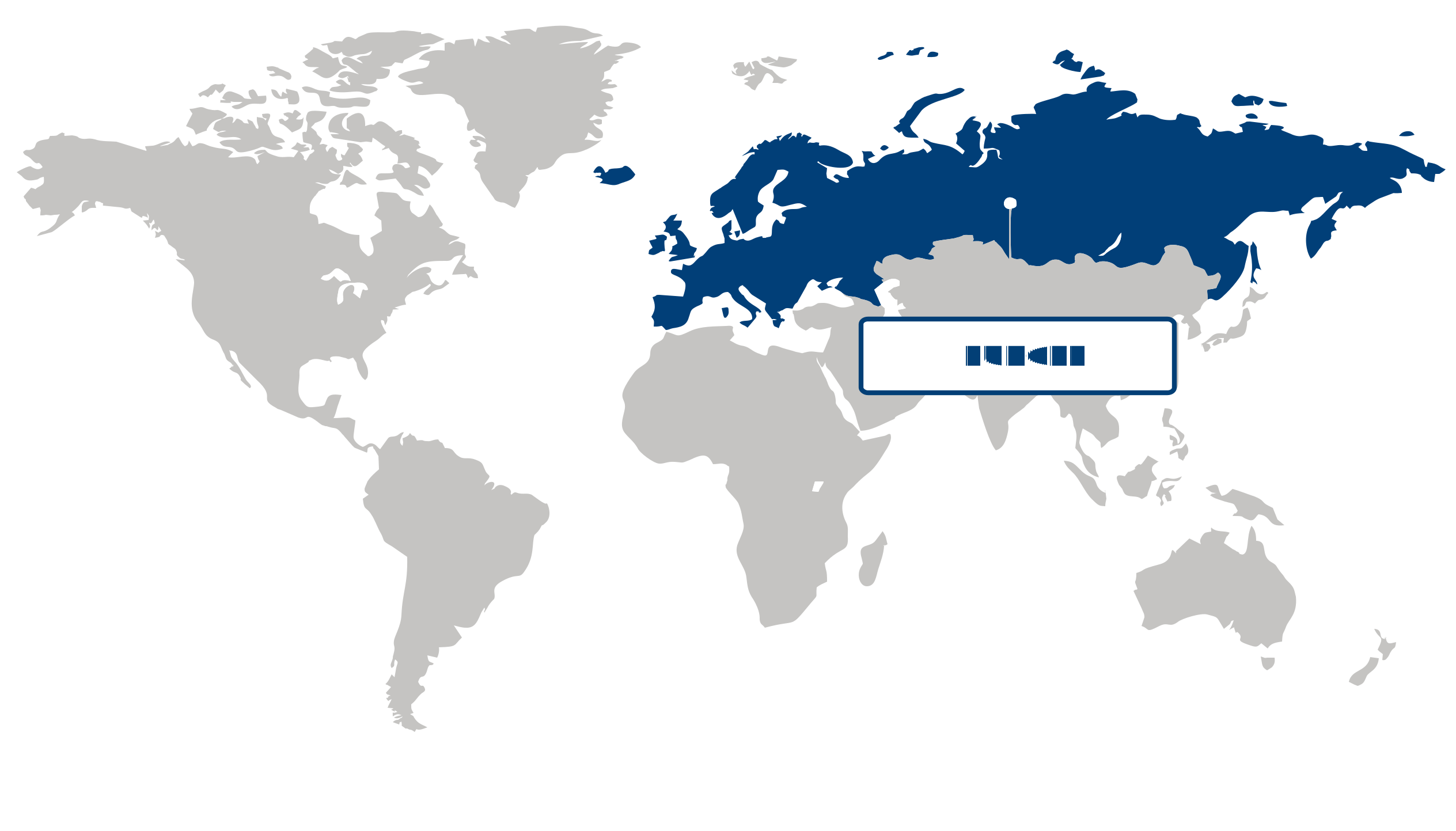
Europe (Largest Region)
Europe led the whiskey tourism market with a 43.46% share in 2026, benefiting from its deep heritage of whiskey production, established distillery tourism infrastructure, and strong cultural association with traditional spirits. Historic distilleries, tasting experiences, guided tours, and destination-based beverage tourism contribute to a well-developed visitor ecosystem across the region. Whiskey tourism is also supported by growing consumer interest in provenance, craftsmanship, production techniques, and authentic local experiences. Improvements in hospitality infrastructure and the integration of distillery visits with broader food, cultural, and leisure itineraries further enhance the appeal of whiskey-focused travel. The region’s established reputation for premium whiskey experiences provides a strong foundation for continued tourism demand.
North America (Fastest-Growing Region)
North America represents the fastest-growing regional market, driven by expanding interest in distillery experiences, craft whiskey production, and experiential travel. Consumers are increasingly seeking immersive visits that combine tastings with education about production methods, local heritage, and product authenticity. The growing visibility of regional distilleries and the development of tourism routes around whiskey-producing areas are helping broaden the visitor base. Strong domestic travel activity and the integration of whiskey experiences into culinary and cultural tourism are also supporting market expansion. As distilleries continue to enhance visitor facilities and diversify experiences beyond traditional tastings, North America is gaining momentum as an attractive destination for whiskey-focused tourism.
| Parameter | North America | Asia Pacific | Europe | Latin America | MEA |
|---|---|---|---|---|---|
| Innovation HubiScaleNascentDeveloping Advanced | |||||
| Cost-Sensitive RegioniScaleLowMedium High | |||||
| Regulatory EnvironmentiScaleRestrictiveNeutral Supportive | |||||
| Demand DriversiScaleWeakModerate Strong | |||||
| Development StageiScaleEmergingDeveloping Developed | |||||
| Adoption RateiScaleLowMedium High | |||||
| New Entrants / StartupsiScaleSparseModerate Dense | |||||
| Macro IndicatorsiScaleWeakStable Strong |
Key Country Insights
Germany 🇩🇪
Premium Spirits ExplorationGermany's whiskey tourism market is driven by consumers seeking curated tasting experiences and niche distillery visits. The country increasingly combines whiskey-related travel with broader culinary and cultural tourism, creating opportunities for experiential offerings and premium visitor packages.
France 🇫🇷
Culinary Pairing ExperiencesFrance integrates whiskey tourism with its established food and beverage culture by promoting tasting experiences and gastronomic partnerships. The country's tourism offerings increasingly highlight premium whiskey appreciation alongside regional culinary experiences and boutique travel programs.
Italy 🇮🇹
Lifestyle Tourism ExtensionIn Italy, whiskey tourism is developing through experiential travel formats that combine premium spirits with cultural and lifestyle activities. Distillery events, tasting workshops, and specialized tourism packages are attracting consumers interested in artisanal beverages and destination-based experiences.
Japan 🇯🇵
Craft Heritage ShowcaseJapan leverages the international appeal of its whiskey traditions by developing destination experiences around distillery craftsmanship and local heritage. Whiskey tourism in Japan increasingly emphasizes exclusive tours, limited-edition releases, and premium hospitality experiences for domestic and international visitors.
South Korea 🇰🇷
Experiential Beverage TravelSouth Korea is cultivating whiskey tourism through growing consumer interest in premium spirits and experiential travel. The market is seeing greater integration of distillery visits, tasting events, and themed hospitality experiences that appeal to younger consumers seeking distinctive leisure activities.
United States 🇺🇸
Distillery Experience DestinationThe U.S. whiskey tourism market is expanding through immersive distillery experiences, heritage storytelling, and premium tasting programs. States with established whiskey production are investing in visitor infrastructure and event-driven tourism that connects consumers directly with craft and premium brands.
Whiskey Tourism Market Share (%), by Experience Type, 2026
Go beyond the chart, access full insights & data tables
Request Free Sample ReportExperience Type Segment Analysis: Distillery Tours/Tasting Experiences (Largest Segment) vs Whiskey Festival (Fastest-Growing Segment)
Distillery tours and tasting experiences led the whiskey tourism market with a 60.14% share in 2026, reflecting their central role in connecting visitors with whiskey production, heritage, and product discovery. These experiences provide travelers with direct exposure to distillation processes, aging practices, and tasting traditions, creating an immersive format that appeals to both enthusiasts and leisure tourists. The combination of educational value, authentic destination experiences, and opportunities for guided product sampling continues to support strong demand for distillery-based tourism.
Whiskey festivals are gaining momentum as tourism preferences increasingly shift toward social, event-driven experiences that bring together producers, enthusiasts, and travelers. These events offer broader opportunities for tasting, cultural engagement, entertainment, and discovery across different whiskey styles, creating a more dynamic visitor experience than individual destination tours. Growing interest in experiential travel and community-oriented food and beverage events is strengthening the appeal of whiskey festivals and supporting their faster market expansion.
Whiskey Type Segment Analysis: Single Malt Whiskey (Largest Segment) vs Craft Whiskey (Fastest-Growing Segment)
In the whiskey tourism market, single malt whiskey accounted for a 40.28% share in 2026, supported by its strong association with authenticity, heritage, craftsmanship, and established whiskey-producing destinations. Travelers often seek single malt experiences to understand regional production traditions, maturation methods, and distinctive flavor characteristics. Its premium positioning and strong connection with destination-based distillery visits make single malt whiskey an important driver of tasting experiences and whiskey-focused travel.
Craft whiskey is emerging as a faster-growing tourism category as travelers increasingly seek distinctive, locally produced beverages and more personalized experiences. Smaller-scale production emphasizes experimentation, regional identity, innovative maturation approaches, and direct engagement with producers, which can enhance the experiential value of a visit. Rising consumer interest in artisanal products and authentic local experiences is encouraging destinations to incorporate craft whiskey into tours, tastings, and event-based tourism offerings.
| Segment | Sub-Segment | Largest Segment | Fastest Growing |
|---|---|---|---|
| Experience Type | Distillery Tours/Tasting Experiences, Whiskey Festival, Others | Distillery Tours/Tasting Experiences | Whiskey Festival |
| Whiskey Type | Single Malt Whiskey, Blended Whiskey, Bourbon, Craft Whiskey, Others | Single Malt Whiskey | Craft Whiskey |
Unlock insights tailored to your business with our bespoke market research solutions.
Click to get your customized report now.
Competitive Landscape and Market Positioning
Key companies in the whiskey tourism market:
1. Diageo plc (United Kingdom)
2. Pernod Ricard SA (France)
3. Brown-Forman Corporation (United States)
4. Suntory Global Spirits Inc. (United States)
5. William Grant & Sons Ltd (United Kingdom)
6. Bacardi Limited (Bermuda)
7. Edrington Group Limited (United Kingdom)
8. Chivas Brothers Ltd (United Kingdom)
9. Heaven Hill Brands (United States)
10. LVMH Moët Hennessy Louis Vuitton SE (France)
The whiskey tourism market is expanding as experiential travel becomes a stronger driver of consumer engagement. Experiences are increasingly designed around immersive storytelling and localized cultural authenticity. Ecosystem development across hospitality and artisanal networks is further enriching visitor engagement pathways.
| Company | Market Share | Company Revenue | Revenue CAGR (%) | Product Portfolio | Geographic Presence | Innovation / R&D Focus | Strategic Developments |
|---|---|---|---|---|---|---|---|
| Diageo plc (United Kingdom) | |||||||
| Pernod Ricard SA (France) | |||||||
| Brown-Forman Corporation (United States) | |||||||
| Suntory Global Spirits Inc. (United States) | |||||||
| William Grant & Sons Ltd (United Kingdom) | |||||||
| Bacardi Limited (Bermuda) | |||||||
| Edrington Group Limited (United Kingdom) | |||||||
| Chivas Brothers Ltd (United Kingdom) | |||||||
| Heaven Hill Brands (United States) | |||||||
| LVMH Moët Hennessy Louis Vuitton SE (France). |
Industry Development/News
| Company Name | Date | Key Development |
|---|---|---|
| Irish Whiskey Association | Oct-25 | The Irish Whiskey Association introduced the "Irish Whiskey Way," a collaborative tourism trail linking distilleries and regional cultural attractions across Ireland. The initiative facilitates a unified visitor experience and strengthens the industry’s collective tourism infrastructure by effectively integrating whiskey production sites into a broader network of national hospitality and leisure offerings. |
| Hinch Distillery | Oct-25 | Hinch Distillery implemented a dedicated shuttle service connecting Belfast city centre to its distillery site. By streamlining visitor logistics and improving accessibility, the initiative enhances the scalability of the company’s guided tour and immersive tasting programs, supporting increased throughput and engagement within the regional whiskey tourism landscape. |
| Pig’s Lane | Sep-25 | Pig’s Lane opened a specialized whiskey parlour in Killarney, marking a strategic expansion of whiskey-centric hospitality venues in the region. By creating an underground, purpose-built space dedicated to whiskey appreciation and tasting, the firm is enhancing regional tourism infrastructure and providing a specialized, high-engagement venue for whiskey enthusiasts visiting the area. |
| Irish Whiskey Experiences | Sep-25 | Irish Whiskey Experiences successfully facilitated its first international seven-day distillery tour, offering structured, behind-the-scenes access to Northern Ireland’s key production facilities. This expansion of organized, multi-day programming highlights the growing commercial demand for curated, high-touch whiskey tourism and indicates a shift toward more specialized, long-duration travel packages within the sector. |
| Bacardi | Jul-24 | Bacardi launched an enhanced visitor experience at its Dewar’s Aberfeldy Distillery in the Perthshire Highlands. Utilizing the facility’s historic 1898 warehouse buildings, the tour provides an educational deep dive into the double-aging and maturation processes. This expansion strengthens the distillery’s competitive positioning by offering a high-value, immersive operational experience to the whiskey tourism segment. |
| Diageo | Mar-24 | Diageo reopened the Port Ellen Distillery on Islay following a major renovation as part of its USD 185 million investment in Scotch whisky tourism. The facility features carbon-neutral technology and advanced distillation infrastructure, reviving a historic site closed since 1983 and re-establishing its position as a prominent destination for premium whiskey-focused tourism and heritage experiences. |
Customize Your Report
Explore examples of how this report can be tailored to different research needs, including custom segments, additional topics or chapters, and related reports. Click a section of the wheel or its numbered marker to explore the available options.
Whiskey Tourism Market — Custom Segments
| Segment | Sub-Segment |
|---|---|
| Visitor Origin | Domestic Visitors, Regional International Visitors, Long-Haul International Visitors |
| Visitor Motivation | Whiskey Education & Appreciation, Heritage & Cultural Tourism, Premium Tasting & Experiential Travel, Social & Leisure Tourism, Events & Festivals |
| Booking Channel | Direct Booking, Online Travel Agencies & Tour Platforms, Travel Agencies & Tour Operators, Hotel & Destination Packages |
Whiskey Tourism Market — Custom TOC
| Custom Chapter | Chapter Details |
|---|---|
| Destination Development Opportunity Assessment |
|
| Premium Visitor Experience Strategies |
|
| Distillery Tourism Revenue Models |
|
Need a different cut of the data?
Request Custom ResearchFrequently Asked Questions
What is the current size of the whiskey tourism market?
How much is the whiskey tourism industry expected to grow by 2036?
How is experiential travel changing commercial opportunities in the whiskey tourism market?
How are digital platforms influencing demand for whiskey tourism experiences?
Why do distillery tours and tasting experiences lead the whiskey tourism market?
Why is craft whiskey the fastest-growing whiskey type in the whiskey tourism market?
Why does Europe dominate the whiskey tourism market?
What is accelerating whiskey tourism growth in North America?
Who are the leading players in the whiskey tourism landscape?
Our Clients
"The report provided us with a clear direction, and the level of detail was beyond what we expected. I would definitely recommend their services to others."
Haier Appliances
"The collaboration with Fundamental Business Insights has added significant value to our decision-making process, and we look forward to continuing this partnership for our future market research requirements."
Luxottica Group S.p.A.
"The team at FBI delivered an exceptional research report. The insights on industry innovations were particularly impressive and added a lot of value to the overall report."
Nike
Our Research Team & Methodology
Every Fundamental Business Insights report is built by a dedicated vertical research team, validated through a structured primary-and-secondary methodology, and reviewed for accuracy before it reaches you.
This report was prepared by the Consumer Goods & Services Research Team at Fundamental Business Insights, a dedicated research group specializing in global consumer markets, retail industries, and service-oriented businesses. The team closely tracks evolving consumer preferences, purchasing behavior, product innovation, brand strategies, retail and e-commerce developments, pricing trends, distribution channels, sustainability initiatives, demographic shifts, and changing lifestyle patterns to deliver timely and reliable market intelligence. The research is developed using a structured methodology that combines primary discussions with manufacturers, brand owners, retailers, distributors, service providers, industry experts, and other key stakeholders, along with company annual reports, government consumer statistics, regulatory publications, industry associations, retail market data, trade publications, and other authoritative secondary sources. Market estimates are validated through multiple research techniques, including top-down and bottom-up analysis, before undergoing an internal quality review to ensure accuracy, consistency, and methodological integrity prior to publication.
Delivery
Published
Available
Support
- Market Size & Forecast
- Market Segmentation
- Regional Analysis
- Growth Drivers & Challenges
- Market Dynamics
- Competitive Landscape
- Company Profiles
- Competitive Benchmarking
- Mergers & Acquisitions
- Market Share Analysis or Key Company Strategies
- Value Chain Analysis
- Porter's Five Forces
- PESTLE Analysis
- Pricing Trends
- Supply-Demand Analysis
- Technology Landscape
- Regulatory Landscape
- Investment & Funding Landscape
- Emerging Opportunities
- Future Market Outlook